May 19, 2026
payouts for golf tournaments, golf tournament prize money, golf tournament payouts calculator, golf tournament formats, golf event management
Learn how payouts for golf tournaments work. This guide covers prize pool calculation, structures, ties, skins, and admin best practices for 2026.

The scoring is done. Dinner is about to start. A few players are already asking what the skins paid, who got bumped into the money after the tie, and whether net and gross are being paid separately. This is the moment where a well-run event either looks polished or starts to wobble.
Most frustration around payouts for golf tournaments has nothing to do with the golf itself. It comes from unclear rules, messy spreadsheets, and payout decisions made too late. Club events, charity outings, leagues, and pro-ams all have different pressures, but the same standard applies. If the money or prizes aren't handled cleanly, players remember that longer than the course setup.
A fair payout system doesn't have to be complicated. It does have to be deliberate, documented, and easy to execute when the round ends.
Why a Clear Payout Strategy is Non-Negotiable
The last putt dropping is not the finish line for the tournament director. It's the handoff from competition to administration, and that's where a lot of events lose trust.
Players don't just want to know what they won. They want to know why the payout came out that way. If two teams tie and nobody can explain the split, or if the committee changes the prize structure after scores are posted, the event instantly feels less professional.
Trust is built before payouts are issued
Good payout administration starts before the first tee shot. The field should know three things in advance:
What funds the purse. Entry fees, sponsor money, added cash, shop credit, or a mix.
Who is eligible. Amateur-only, pro-only, pro-am, team divisions, flights, side games.
How ties are handled. Split evenly, scorecard playoff for trophies only, or another posted rule.
When those rules are visible early, disputes usually shrink to simple clarifications instead of emotional arguments.
Practical rule: If a player has to ask how the money is being divided after the round, the payout policy was published too late.
Manual payout work creates avoidable pressure
The old pattern is familiar. Someone exports scores, checks a spreadsheet, rechecks the sheet after a tie, then updates a side pot that was tracked separately on paper. That process works right up until one variable changes.
The risk isn't only arithmetic. It's credibility. Once players see staff debating the math in the scoring area, they assume the rest of the administration may be just as loose.
There's also a business side to this. Organizers in other event-driven industries already understand that revenue and payout structures need to be clear and defensible. If you're interested in how sponsorship economics are framed in another creator-led market, this breakdown of creator income from sponsorships is useful because it shows how much clarity matters when money flows through multiple stakeholders.
What works and what doesn't
A few patterns consistently hold up in real events:
What works: Written payout terms, one source of truth for entries and side games, and a posted method for tie handling.
What doesn't: Verbal promises at check-in, separate side-game sheets floating around the shop, and manual last-minute edits.
What works: Finalizing the model before registration closes.
What doesn't: Deciding how many places to pay after seeing who finished high.
A payout strategy is part of the player experience, not back-office cleanup. Events that treat it that way run smoother, look stronger, and get fewer challenges at the prize table.
How to Calculate Your Total Prize Purse
Most payout problems start with a bad opening number. If the purse isn't clearly defined, every later calculation is shaky.
The clean way to think about it is this. Gross intake is not the same as prize money. Entry fees may include golf, food, tee gifts, charitable contributions, or admin costs. If those pieces aren't separated, the field will assume more money is in the purse than exists.
Start with a purse formula you can defend
Use a simple internal formula:
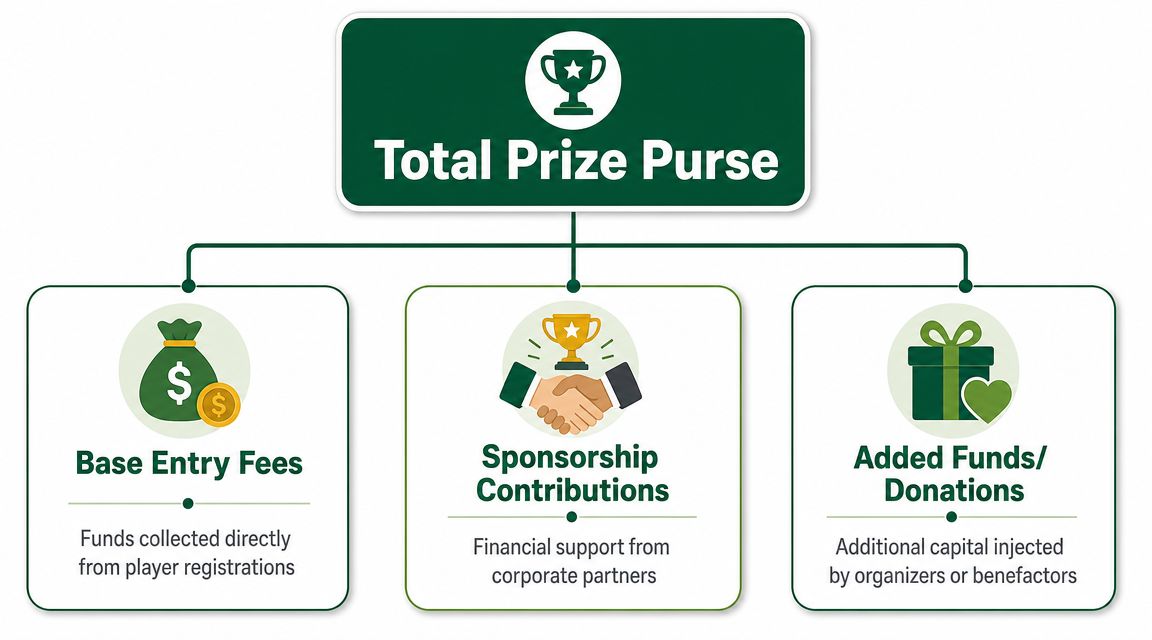
Total Prize Purse = eligible player fee contribution - non-purse deductions + sponsorship contributions + added funds
That formula matters because sanctioned tournament systems don't treat payouts as a simple finish-position exercise. They calculate from player fees, player-pack deductions, added cash or value, payout field percentage, and optional rounding rules, which is why a thorough payout process needs an audit trail from the start, as shown in the PDGA tournament management payout guidance.
This applies directly to golf events. Even when your event isn't formally sanctioned under another sport's rulebook, the operational logic is the same. If money is being collected and redistributed, every deduction and addition should be explainable.
Break the purse into buckets
The cleanest setup is to separate every incoming dollar into one of three buckets:
Player-funded purse money. The part of each entry fee that goes to prizes.
Sponsor-funded purse money. Cash or prize value designated for winners, flights, or contests.
Added money. Extra funds from the club, association, host, or donor.
Keep those buckets distinct from event costs such as meals, cart fees, tee gifts, printed materials, or charitable allocations. If your registration fee bundles everything together, publish the split in writing before the event.
A transparent purse doesn't need to be complicated. It needs to be traceable.
Where organizers get into trouble
The common mistakes are operational, not strategic.
Purse setup issue | What it causes |
|---|---|
Mixing prize money and hospitality costs | Inflated player expectations |
Counting sponsor value without defining whether it's cash or merchandise | Confusion at payout time |
Running side games outside the main ledger | Missing or duplicated payouts |
Changing deductions after registration opens | Arguments over fairness |
One more point matters for local events. Directors often think they need to mimic a tour model exactly. They don't. Local and amateur events can build their own payout structure, but they still need the same discipline around inputs, deductions, and documentation.
When the purse number is clean, the rest of the payout workflow becomes straightforward. When it isn't, every leaderboard scenario turns into a finance meeting.
Common Payout Models Explained
Once the purse is set, the primary choice is distribution. Most club and outing formats fall into a few workable models, and each one sends a different signal to the field.
A competitive invitational usually wants a sharper top end. A member event may want broader participation in the payout. A charity scramble may care more about energy and prize variety than strict competitive weighting.
Percentage-based payouts
This is the closest cousin to the pro model. In men's professional golf, the winner's share is usually about 18% of the tournament purse, and amateurs aren't eligible for prize money, so if an amateur finishes in a money-paying position, that payout is redistributed to the next eligible professional, as outlined in this explanation of pro golf payout rules.
That structure is useful as a reference point, not a mandate. Club events have more flexibility, and most should use it.
A percentage model works well when you want the payout table to scale automatically with the purse. If more players enter or more sponsor money is added, the distribution adjusts without rewriting fixed amounts.
Pros
Scales cleanly with changing purse totals
Easy to publish in advance
Works well for larger fields and multiple divisions
Cons
Requires more setup discipline
Can feel too top-heavy if the event is social
Needs clear rounding rules
Fixed-place payouts
This model posts exact prizes by finishing place. Players know what first, second, and third are worth before the round starts.
It works best for smaller events, league finals, and outings where the field wants simplicity. The downside is rigidity. If the field size changes late, the posted chart may no longer feel proportional.
Gross and net are not interchangeable
A lot of payout confusion comes from mixing gross and net expectations. If you're paying both, define whether each has its own purse, whether players can win in both categories, and how handicap adjustments affect ties.
Some organizers separate gross and net completely. Others use gross for the main competition and reserve net for flights or shop-credit prizes. Either approach can work if it's posted in advance.
For formats that involve pooled wagering or participant-driven pools, a separate framework may make more sense than standard placement payouts. This overview of pari-mutuel golf formats is useful if your event includes that kind of side action.
A simple sample payout table
Below is a sample payout for 50-player event (paying top 10). This is an illustrative structure only, so the prize money column is shown qualitatively rather than with invented dollar figures.
Place | Payout % | Prize Money |
|---|---|---|
1 | Highest share | Top prize based on your posted purse |
2 | Lower than 1st | Second-place prize |
3 | Lower than 2nd | Third-place prize |
4 | Lower than 3rd | Fourth-place prize |
5 | Lower than 4th | Fifth-place prize |
6 | Lower than 5th | Sixth-place prize |
7 | Lower than 6th | Seventh-place prize |
8 | Lower than 7th | Eighth-place prize |
9 | Lower than 8th | Ninth-place prize |
10 | Lower than 9th | Tenth-place prize |
The right model isn't the one that looks most like television golf. It's the one your field understands, accepts, and can verify when the scores are final.
Managing Payouts for Ties Skins and Side Games
This is where payout administration gets real. Most events don't break down over first place. They break down when three players tie for a spot, a skin carries over, or one side game was tracked on a different sheet than the main competition.
The tie rule itself is straightforward. The challenge is applying it consistently across the whole event.
The tie-splitting method that holds up
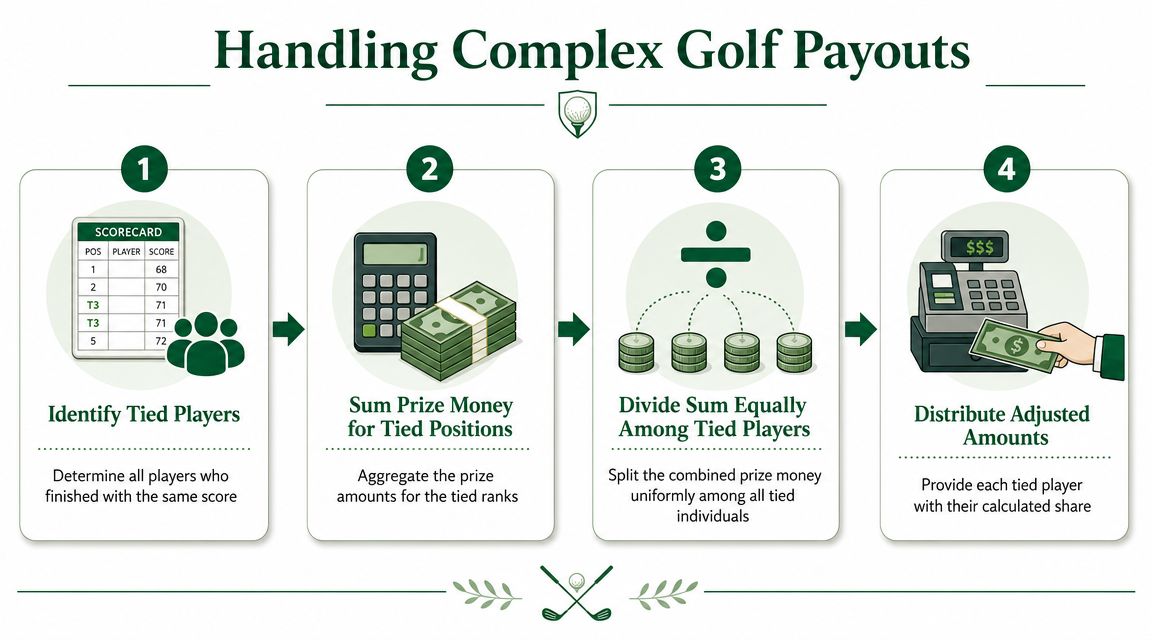
The common rule is to add the prize money for all tied positions and divide equally among the tied players. A three-way tie for second combines second-, third-, and fourth-place money, then splits that total three ways, as explained in this walkthrough of golf tie payout calculations.
That rule sounds simple because it is. The failure point is usually not the formula. It's forgetting which positions are consumed by the tie or applying one tie method to the main event and another to a side pot.
Use this sequence every time:
Identify the tied finish positions
Confirm exactly which places are involved.Add the value of those places
Use the posted payout chart, not a revised estimate.Divide evenly by the number of tied players
Apply your posted rounding rule if needed.Advance the next payout position correctly
If three players tie for second, the next player is not third. That player follows the last tied position.
If you don't document tie handling before the round, players will assume whatever rule benefits them most.
Side games need separate ledgers
Skins, closest-to-the-pin, hole prizes, team flights, and optional cash games should never be mixed casually into the main purse sheet. They may be announced together at the end, but they should be administered separately.
That matters most with skins. A skin only pays if there is a valid standalone winner for that hole under the event's stated rules. If your outing uses gross skins, net birdies shouldn't suddenly count because nobody won a gross skin on a hole. If carryovers are allowed, say that before tee-off.
For organizers using multiple side formats, this primer on skins game rules in golf is a helpful reference point when you're standardizing house rules.
What usually works best in live events
A practical structure looks like this:
Main competition stays on one payout chart.
Skins pool runs as an independent ledger.
Contest prizes such as closest-to-the-pin are logged hole by hole.
Flights or team divisions use separate charts tied to eligibility rules.
That separation prevents one result from accidentally changing another. It also makes post-round announcements cleaner. Staff can verify each bucket on its own rather than trying to reconcile one giant worksheet while players wait at the bar.
Keeping Your Payouts Compliant and Transparent
The fairest payout system in the world can still create trouble if nobody documented it. Governance is what turns payout math into something defensible.
Local events don't operate under one universal prize table. Amateur and club competitions often use their own distribution charts that change with field size, which is exactly why directors need to create and communicate their event-specific structure clearly, as shown in the PGA New England prize distribution chart.
Publish the rules before the round
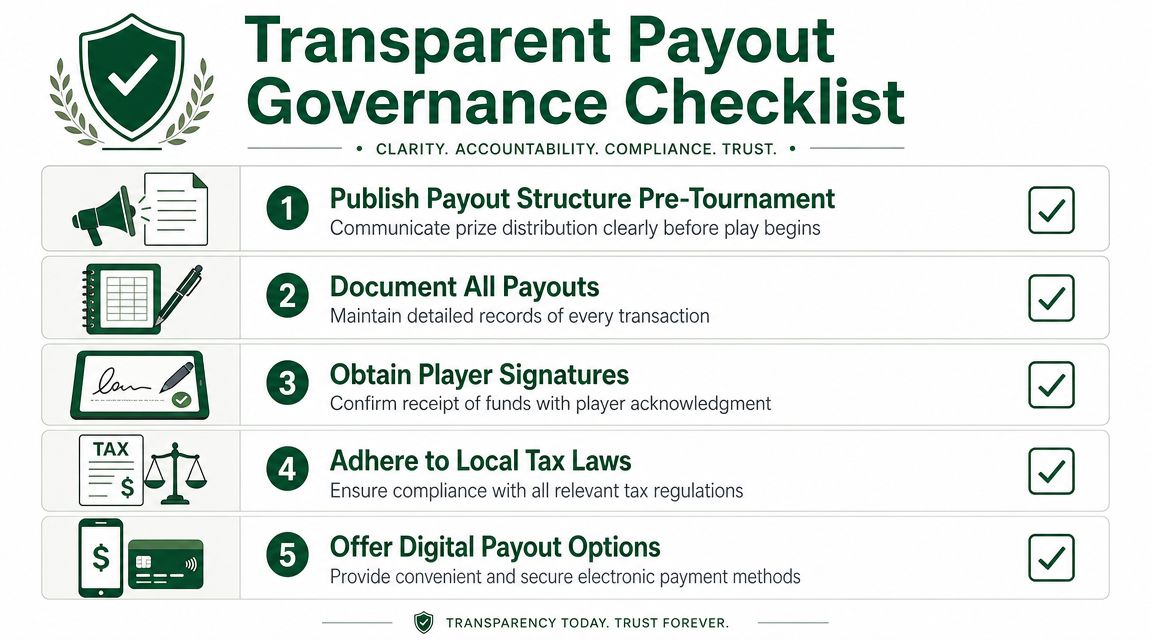
Every event should have a short conditions sheet or registration page that states:
Eligibility rules for pros, amateurs, teams, flights, and side games
Purse contribution rules so players know what part of entry fees funds prizes
Tie procedures for the main competition and side games
Payout method such as cash, shop credit, digital transfer, or merchandise
Timing for when payouts are finalized and distributed
This doesn't need to read like a legal memo. It needs to answer the questions players always ask after the round.
Protect the event with good records
The strongest defense against disputes is a complete record. Keep the original payout chart, final scores, tie adjustments, side-game results, and a ledger of what was paid to whom.
That record matters for more than player relations. Amateur status rules and tax treatment can affect how prizes should be awarded in some events. The exact requirements depend on your location, event type, and prize format, so organizers should confirm details with the relevant governing body and tax professional rather than guessing.
Clear records don't just help when someone challenges a payout. They help when staff turnover happens and next year's director has to understand what you did.
Transparency is not extra administration. It is the administration.
How to Execute Payouts Instantly and Accurately
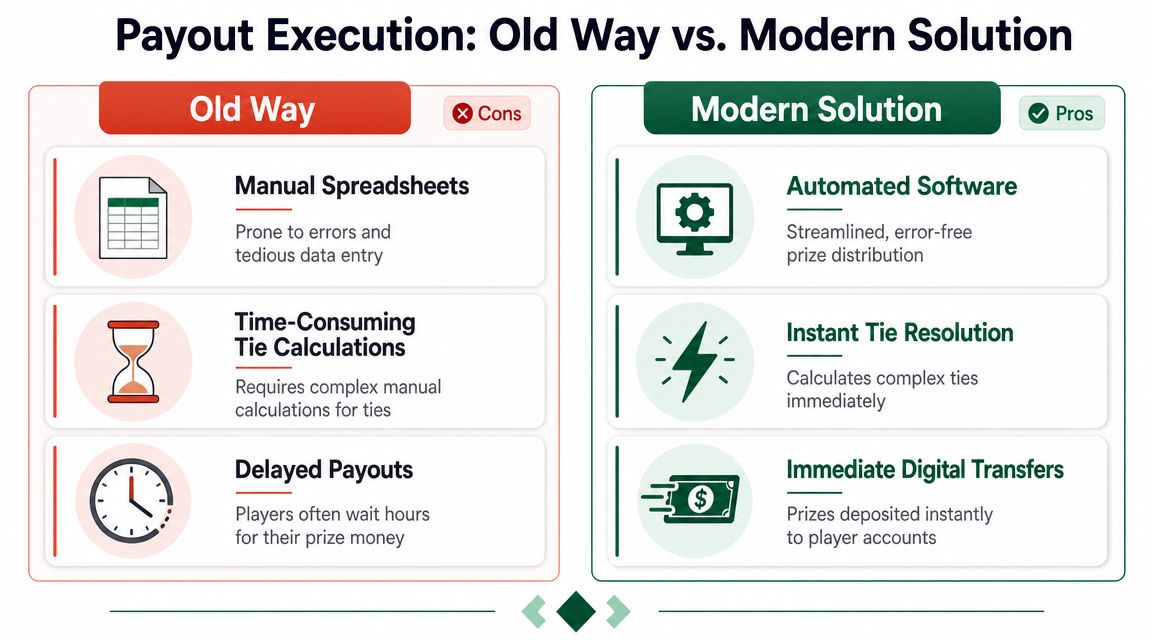
The hardest part of payout work used to be timing. Players finish within a short window, ties stack up near the top, side games have to be checked, and everyone expects results immediately. That's why so many events still end with one staff member buried in a spreadsheet while the room waits.
Manual methods fail in predictable ways. One formula references the wrong row. A tie consumes the wrong positions. A skins pool gets updated on a separate tab. None of those mistakes are dramatic, but each one chips away at confidence.
Why automated payout tools change the job
At the top end of golf, the first-place prize at The Players Championship is $4.5 million from a $25M purse, which illustrates how non-linear prize distribution can become and why accurate calculations matter at every level, as noted in this review of golf event prize money rankings.
Your event won't operate at that scale, but the operational lesson is the same. Once payouts depend on purse size, tied positions, flights, and separate side games, software becomes less of a convenience and more of a control system.
A good payout tool should do four things well:
Pull from final scores automatically so staff aren't re-entering results
Apply posted rules consistently for ties, flights, and separate prize buckets
Create a clean ledger for review after the event
Support fast disbursement once winners are confirmed
What to replace spreadsheets with
Spreadsheet templates are fine for a very small event with one purse and no side action. They break down once the format gets layered.
Tournament platforms with payout logic built in are better suited for modern operations. For example, golf tournament manager software can centralize scoring, side games, and payout calculations in one workflow instead of scattering them across separate tools. Live Tourney is one example of a web-based system that includes a payouts calculator alongside scoring and event management, which is the setup many courses and organizers need.
Payment speed matters too. If your winners include international guests or you're comparing different transfer rails, this guide to UK payment systems is a useful operational read because payout execution isn't only about calculation. It's also about how quickly and cleanly the funds move once results are official.
Fast payouts feel professional. Accurate payouts build trust. You need both.
The best-run events don't treat payouts as a final administrative burden. They treat them as the closing ceremony. When the software handles the calculations, staff can focus on announcing winners, thanking sponsors, and ending the day well.
If you want a simpler way to handle payouts for golf tournaments, Live Tourney gives organizers one web-based place to manage scoring, side games, and payout calculations without relying on disconnected spreadsheets.