May 15, 2026
scotch game golf, golf formats, golf tournament scoring, golf side games, live tourney
Master the Scotch game golf format. Our guide explains the rules, scoring, variations, and player strategy, plus a runbook for tournament organizers.
You can spot a Scotch game from a fairway away. One player is adding numbers on a scorecard, one is certain his birdie is worth something extra, another is asking whether closest-to-the-pin counts on that hole, and the fourth just wants to hit before the group behind gets impatient.
That confusion is exactly why scotch game golf has such a split reputation. Players love it because every hole feels alive. Organizers hesitate because a format that sounds simple in the grill room can become a scoring mess by the turn if the setup isn't tight.
For a club pro, league operator, or outing director, that gap matters. Scotch isn't hard to run, but it does punish vague rules, sloppy score capture, and last-minute administration. When it's organized well, it creates the kind of round players talk about afterward. When it's organized poorly, it creates debates.
What Is the Scotch Game in Golf
Scotch game golf is a team-based points format most often played by four golfers split into two two-person teams. Each player plays their own ball, and points are awarded for specific outcomes on each hole. The exact point categories can vary by club or group, which is part of the appeal and part of the confusion.
What keeps Scotch relevant is that it isn't just one rigid betting game. It's a framework. A group can make it simple for a casual member game or more detailed for a serious money match, as long as everyone agrees on the scoring categories before the first tee.
Why the format has lasted
Scotch comes out of golf's older social culture, not tournament committee design. Golf history in Scotland notes that golf was formally banned in Scotland in 1457 by King James II because it distracted men from archery practice, then later moved through major milestones such as the first official rules in Edinburgh in 1744 and the Old Course at St Andrews expanding to 18 holes in 1764. In that broader setting, Scotch developed as a flexible side game suited to foursomes where each hole could produce several scoring outcomes.
Scotch works because a hole doesn't die after one player finds trouble. There are still team points, low-ball points, and side categories in play.
That is the practical reason clubs still use it. In a standard net or gross game, one bad shot can take a player out of the hole. In Scotch, that same player might still help the team, or his partner can salvage points elsewhere. It keeps everyone involved longer.
What organizers should understand first
The biggest mistake is treating Scotch like a novelty format. It isn't. It's a repeatable, highly social competition structure that can fit member games, leagues, shotgun events, and informal weekend matches.
It also scales well because the wager or prize layer can change without changing the underlying game. Some groups play for pride. Others tie points to money or shop credit. The format allows both, which is why it has stayed so embedded in club culture.
The Core Rules of Scotch Foursomes
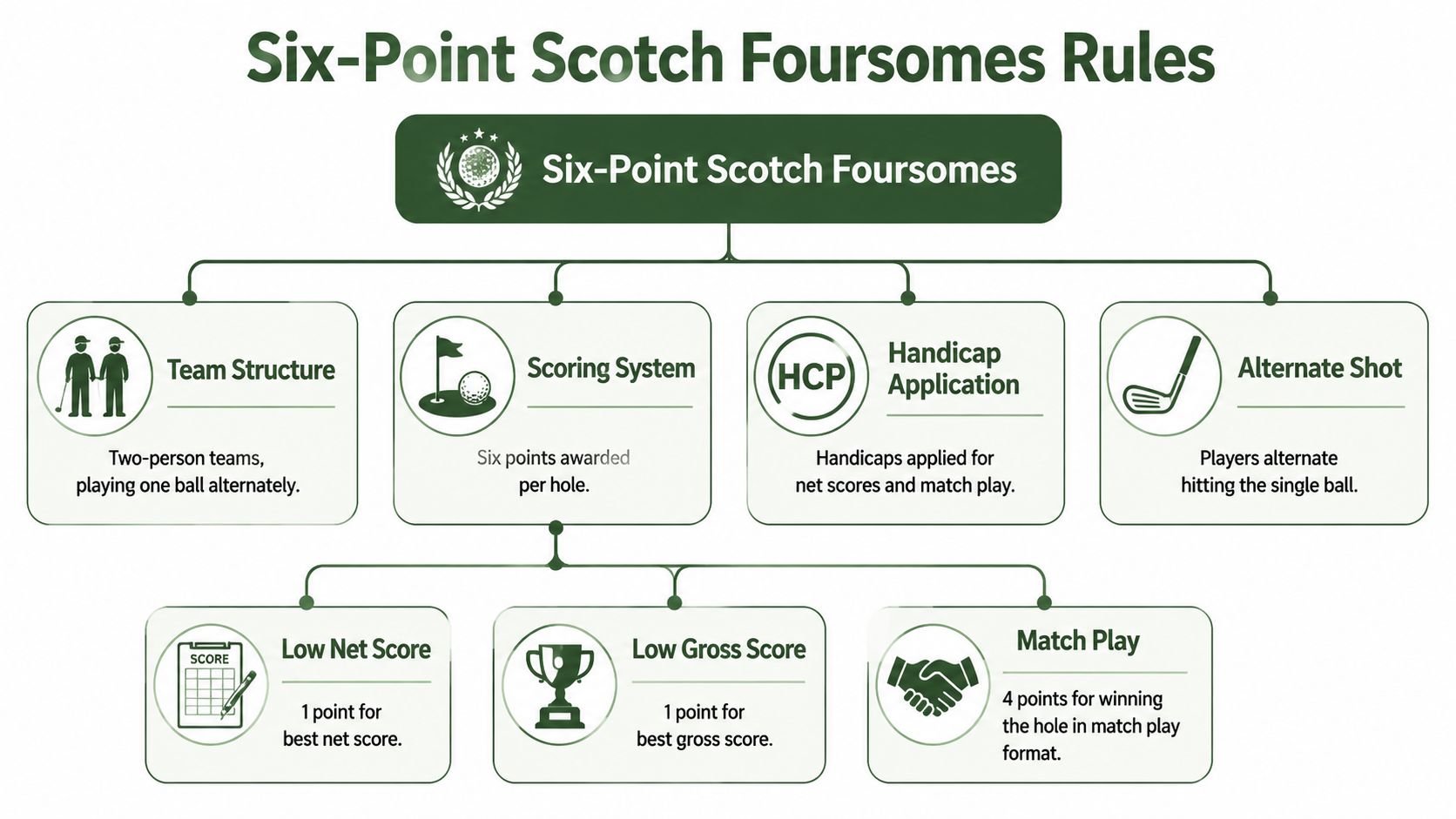
The version most organizers need to know is Six-Point Scotch. It gives structure without becoming too complicated for players to follow on the course.
Start with the basic distinction. This is not alternate-shot foursomes. In Scotch, each player plays his or her own ball from tee to hole. The teams are still two-person teams, but the scoring happens across several categories inside the same hole.
Standard team setup
A common Scotch game uses:
Two teams of two: Four players total, paired into partners.
Individual balls in play: Each golfer completes the hole with their own ball.
Hole-by-hole scoring: Points are assigned after every hole, not just at the end of the round.
If your players are used to straight match play, it helps to brief them in those terms first. You're still creating a hole-by-hole contest, but you're layering multiple point opportunities on top of it. If you need a refresher on match play fundamentals before adapting them to Scotch, this guide to golf match play rules is a useful primer.
The common six-point model
One widely used version of Scotch awards points across these categories:
Common scoring categories
Low ball
Low team total
Birdie
Closest to the pin in regulation
Putts in some local versions
That structure comes from a common club version described in Chicago Golf Guy's overview of the Scotch game, which also notes that the exact setup varies by group or club.
The cleaner operational model for organized events is the version many pros prefer because it reduces ambiguity:
2 points for team total
2 points for low ball
1 point for proximity
1 point for birdie
That point mix is the one described in The Fried Egg's explanation of Six-Point Scotch.
Where groups get tripped up
Most disputes don't come from the golf. They come from undefined terms.
A scorecard that says "closest to the pin" without stating whether it applies only on holes reached in regulation invites trouble. A card that says "birdie point" without explaining whether both teams can earn it on the same hole creates more trouble. If putts are included, players need to know whether all putts count, whether gimmies exist, and how concessions are handled.
Practical rule: If a point category can be interpreted two ways, write the exact interpretation on the scorecard before anyone tees off.
For organized Scotch, the rules document should answer three things with no room for debate:
Which point categories are live on each hole
How ties are handled
Whether handicaps are applied before point allocation
If those three items are clear, the game usually runs fine.
Scoring Explained with Clear Examples
The easiest way to make Scotch click is to score a single hole on paper.
Let's use a par 4 with two teams. Team Maplewood has Player A and Player B. Team Oakwood has Player C and Player D. We'll use the common six-point structure of 2 points for team total, 2 for low ball, 1 for proximity, and 1 for birdie.
Example one with a clear winner
Scores on the hole:
Player A: 4
Player B: 5
Player C: 4
Player D: 6
Now assign the points.
Low team total:
Maplewood posts 4 + 5 = 9. Oakwood posts 4 + 6 = 10. Maplewood wins the lower combined total, so Maplewood gets 2 points.
Low ball:
A and C both make 4, which is the best individual score on the hole. Since the low ball is tied between teams, those 2 points are split, with each team getting 1 point.
Birdie:
Nobody made 3, so no birdie point is awarded.
Proximity:
If Oakwood hit the closest tee shot to the hole on the applicable regulation approach or par 3 setup your event uses, Oakwood gets 1 point.
That leaves the hole like this:
Team | Team Total Points | Low Ball Points | Birdie | Proximity | Total |
|---|---|---|---|---|---|
Maplewood | 2 | 1 | 0 | 0 | 3 |
Oakwood | 0 | 1 | 0 | 1 | 2 |
Example two with a birdie swing
Now change only one score.
Player A: 3
Player B: 5
Player C: 4
Player D: 6
Maplewood still wins team total with 8 against 10, so that's 2 points. Player A now has the outright low ball with 3, so Maplewood takes the full 2 points there. Because A made birdie, Maplewood also earns the 1 birdie point. If Oakwood still wins proximity, Oakwood gets 1 point.
Final result:
Maplewood: 5 points
Oakwood: 1 point
That's why the format creates momentum swings so quickly. One aggressive score can affect several categories on the same hole.
If you want players to understand basic golf scoring language before they tackle a points game like this, this plain-English guide to scoring in golf helps.
What scorekeepers should record
The cleanest scorekeeping method is to capture the following on every hole:
Each player's hole score
Which team won the combined total
Whether low ball was won outright or tied
Whether a birdie was made
Who won proximity, if active
Record the raw facts first. Let the points calculation happen afterward. That's how you prevent arithmetic errors from turning into rules arguments.
Paper scorecards can do this, but once you have multiple groups in the field, manual point math becomes the weak link.
Common Scotch Game Variations and Side Bets
Scotch survives because it bends without breaking. The core idea stays the same, but groups adjust the point categories to match the type of round they're running.
Some clubs want a cleaner game with fewer moving parts. Others want more volatility and more chances for teams to climb back into the match. Neither approach is wrong. The mistake is mixing versions inside the same event.
The variations most groups actually use
A few formats show up repeatedly in member games and informal matches:
Scoring Category | 6-Point Scotch | 5-Point Scotch | 6-Point High-Low |
|---|---|---|---|
Low ball | Yes | Yes | Yes |
Low team total | Yes | Yes | No |
Birdie | Yes | Yes | Yes |
Closest to the pin | Yes | No | Yes |
High ball or alternate category | No | No | Yes |
5-Point Scotch usually strips out one category, most often proximity. That makes administration easier and removes the need for someone to verify every nearest-to-the-pin result during play.
6-Point High-Low changes the feel of the match. Instead of rewarding only the best score and team aggregate, it creates another angle for point allocation, often making team balance and partner strategy even more important.
For a broader menu of event formats that pair well with leagues and member games, this tournament golf games guide is worth reviewing when you're building a season schedule.
Presses and why they create work
The side-bet concept that gives Scotch its edge is the press. A trailing team starts a new wager or mini-match for the remaining holes. It keeps a lopsided front side from turning into a dead back side.
In a private game, that can be part of the fun. In a formal event, presses add real administrative load.
Here are the practical trade-offs:
Good for engagement: A team that falls behind still has something live to play for.
Bad for manual scoring: Extra bets stacked on top of point scoring are hard to track cleanly.
Fine in small groups: If one foursome understands the rules, they can self-manage.
Risky in larger fields: Once several groups interpret presses differently, payout disputes follow.
What to standardize before the round
If your event allows variations or side action, lock these down in writing:
Press timing: Can teams press automatically, only at set points, or only by agreement?
Scoring version: Everyone must play the same Scotch structure in the same competition.
Stake handling: If points convert to money, define that conversion before play starts.
One documented example of Scotch wagering describes mixed point values within the same broader game, including $1 per point for one matchup and $0.05 per point for another, which shows how flexible the format can be in practice when groups set their own terms in advance within the same game context, as described in the earlier linked Chicago Golf Guy piece.
That flexibility is part of the charm. It's also why organized events need tighter controls than casual weekend money games.
Strategy for Winning Your Scotch Match
Scotch rewards a different kind of team than a scramble. You don't need two players chasing hero shots all day. You need a pairing that can produce coverage across several scoring categories.
The best teams usually have contrast. One player keeps the hole alive. The other creates upside.
Build the right partnership
A reliable pairing often looks like this:
One steady player: Finds fairways, avoids doubles, posts usable scores.
One aggressive player: Has birdie potential and can steal low-ball points.
Compatible tempo: Partners who communicate cleanly make better decisions under pressure.
Two volatile players can make Scotch exciting, but not always profitable. If both are playing from recovery positions, your team total disappears quickly. If both are ultra-conservative, you may stay respectable but lose too many birdie and low-ball opportunities.
Play the hole in layers
Scotch strategy works best when teams think in sequence, not just shot-by-shot.
If your partner is safely in position, that gives you room to attack. If your partner is already in trouble, your job changes. Suddenly center-green and two putts might be the smart play because preserving team total matters more than chasing a pin.
A good Scotch team doesn't make the same decision twice. It reacts to what the partner has already done on that hole.
That sounds obvious, but many teams still play independently, as if the game is a pair of singles matches added together. That's where points leak away.
Use pressure well
Scotch has a psychological rhythm. A team that wins a few categories in a row can force the other side into low-percentage choices.
What works:
Clear partner communication: Decide who is protecting and who is attacking.
Quick score verification on each green: Don't carry uncertainty to the next tee.
Selective aggression: Push hardest when one shot can affect several categories.
What doesn't work:
Late-hole confusion: Teams who sort out points after the next tee usually misremember details.
Unbalanced pairings: Two players with the same strengths often leave point categories uncovered.
Automatic presses from emotion: If your group allows presses, they should be tactical, not impulsive.
Players often think Scotch is all about making birdies. It isn't. Birdies matter, but so does preventing the other team from stacking points in the lower-volatility categories.
The Tournament Organizer's Runbook for Scotch
The trouble starts at registration, not on the first tee. A Scotch event can look simple on the tee sheet, then turn into a scoring dispute by the sixth hole if pairings, handicap application, and score capture are not set up correctly. Organizers who treat it like a standard team game usually create extra work for the golf shop and confusion for the field.
A clean Scotch operation starts with one decision. Decide whether you are running a strict, published format with fixed point categories, or a looser member-game version that allows side agreements. For a tournament, fixed rules win every time. Write the categories, tie treatment, handicap method, and any presses on one event sheet before pairings go out.

Before pairings are published
Pairings decide whether your event feels competitive or lopsided. In member events, I prefer to balance the field before I worry about anything else, because uneven teams create far more complaints than the format itself.
Use a short setup checklist:
Sort players by ability first: A, B, C, and D buckets still work well for building fairer teams.
Set handicap treatment in advance: Publish where strokes apply, whether they affect every category or only team total, and how fractional allowances are handled.
Cut categories you cannot verify: If your staff cannot track proximity or presses cleanly, leave them out.
State pace expectations: Scotch slows down when groups debate points on every green. Tell them when and how to confirm scores.
For the wider event plan, ABC Hire's event planning template is a useful prompt for staffing, timing, signage, print materials, and backup plans. Those details matter more in Scotch than they do in a basic stableford or scramble.
What should be on the scorecard
A standard scorecard is not enough. Scotch needs a card or digital view that matches the game exactly, because players are tracking both gross scores and category results at the same time.
Include:
Player names and team assignments
Stroke allocation by hole, if handicaps apply
A line for each player's raw hole score
A separate field for each point category
A rules note covering ties, concessions, and unfinished holes
If the card only shows a team total, groups start settling categories from memory. That is where bad math and post-round arguments show up.
How to handle scoring during play
The organizer's job is to remove judgment calls from routine scoring. The cleanest process is to collect every player's hole score, then let the scoring system apply the event rules the same way for every group.
That means your workflow should do four things well:
Record all four raw scores
Apply handicap rules consistently
Assign category points without manual recalculation
Show standings early enough for groups to catch errors before cards are final
Paper can handle this in a casual game. In a full field event, paper usually shifts the workload to the golf shop after the round. Live Tourney helps staff run real-time scoring, leaderboard updates, and event setup for formats like Scotch where one hole can produce several scoring outcomes.
One practical trade-off. Live scoring improves accuracy and speeds up payouts, but only if players know what they are entering. Give groups a two-minute briefing before they go out, and assign one staff member to scoring support during the opening stretch.
The post-round process that saves staff time
Do not let groups walk away from scoring with unresolved holes. Once players head to the bar, details get fuzzy and every exception takes longer to settle.
Use a closeout routine that is the same for every group:
Confirm hole-by-hole points before submission
Check any disputed hole against the written event sheet
Finalize results before calculating payouts
Assign one staff member to handle exceptions only
Well-run Scotch events are not hard to sell. They are hard to administer if the format lives on scraps of paper and verbal rulings. Get the setup right, mirror the format on the scorecard, and use software to keep scoring consistent. That is how Scotch stays fun for players and manageable for the staff.
Why Scotch Is the Perfect Format for Your Next Event
Most clubs already have enough scrambles, enough predictable net events, and enough formats where half the field mentally checks out after a few holes. Scotch game golf solves that problem because it gives players more ways to contribute.
A player who isn't making birdies can still help on team total. A team that loses one category can still salvage the hole somewhere else. That layered scoring creates better engagement and stronger partner interaction than many standard formats.
Why it works so well in organized play
For events, Scotch offers a rare mix of social energy and competitive structure:
It suits mixed-skill groups: Good players chase upside, steadier players protect team position.
It keeps holes active: More than one point opportunity means fewer dead stretches.
It feels different from the usual calendar formats: Members notice when an event has texture.
The format does demand discipline from the organizer. Rules must be written clearly. Handicap handling has to be consistent. Scoring can't be an afterthought.
The case for using it more often
That extra work is exactly why Scotch stands out when it's run well. Players remember formats that feel lively and professionally managed. They also remember when the golf shop has the results ready, the leaderboard makes sense, and no one is arguing over what counted on the back nine.
If you're looking for a format that feels traditional, competitive, and fresh at the same time, Scotch deserves a regular place on the schedule.
If you're running a Scotch event and want a cleaner way to handle setup, scoring, and live results, Live Tourney gives organizers a web-based option for managing pairings, score entry, and leaderboards without relying on manual point calculations.