May 16, 2026
sun country jr golf, junior golf new mexico, junior golf tournaments, youth golf programs, el paso junior golf
Your complete guide to the Sun Country Jr Golf program for 2026. Learn about age groups, schedules, registration, fees, and what to expect on tour.

If you're a parent in New Mexico or West Texas, this usually starts the same way. Your child likes golf, maybe plays in clinics or weekend rounds, and now you're wondering what actual competition should look like. You want something organized, age-appropriate, and serious enough to help them improve without throwing them into the deep end.
That's where sun country jr golf makes sense for a lot of families. It gives young players a local pathway into tournament golf, and it gives parents a structure they can learn quickly. If you're also a coach, club professional, or volunteer helping run events, the same program offers a useful model for what junior competition should feel like when it's managed well.
Your Guide to the Sun Country Jr Golf Tour
Most new families don't need hype. They need clarity.
They want to know whether their child is old enough, good enough, and ready for the pace of tournament golf. They also want to know what a typical event day feels like, what rules are different from casual play, and whether the tour will help a player grow instead of just exposing weaknesses.
Sun country jr golf is a practical answer because it gives juniors a defined competitive environment close to home. That matters. A child usually develops faster when the first tournament experience is structured, familiar, and not overloaded with travel stress or confusion about expectations.
A good way to approach the tour is to think in three stages:
Fit
Check the age division and make sure the player can handle basic golf etiquette, scorekeeping awareness, and pace of play.Schedule
Look at the event types and choose an entry point that matches the player's current comfort level, not the parent's long-term goals.Preparation
Teach tournament habits before the first tee time. Arrive early, warm up with a plan, know the rules, and keep the day simple.
Practical rule: The best first event is rarely the hardest one available. It's the one that lets a junior finish the round wanting to play again.
For organizers, the same principle applies. The strongest junior tours don't just post events. They remove uncertainty for families. Clear divisions, simple policies, and predictable communication do more for player retention than flashy branding ever will.
Understanding the Sun Country Junior Golf Program
Sun Country isn't just a batch of summer dates on a calendar. It functions as a developmental pipeline for junior players in the Southwest.
According to the Sun Country Junior Golf overview, the program runs about 40 events annually, spans local satellite events, major championships, and national qualifiers, and is open to boys and girls ages 7 to 18. That matters because it shows families they're entering a real system, not a one-off camp model or a short seasonal series with limited progression.

Why the structure matters
A junior program works best when it gives players room to grow through repeated competition. That's what this format supports.
A younger or newer player can begin in a lower-pressure local setting. A more advanced junior can aim for majors or qualifier-style events. Families don't have to jump immediately from practice rounds to elite travel golf. They can move step by step.
That progression also helps with skills that don't show up on a launch monitor. Juniors learn how to warm up on time, manage nerves, recover after a bad hole, and post a score when the round feels difficult. Those habits often decide whether a player sticks with competitive golf.
What experienced parents notice quickly
The strongest junior tours usually do three things well:
They create repetition so players can compete often enough to normalize tournament nerves.
They separate stages of competition so beginners and experienced juniors aren't all forced into the same environment.
They make improvement visible through recurring events and familiar procedures.
A junior golfer doesn't need every event to be a breakthrough. They need a place to learn what tournament golf feels like, then come back and do it better next time.
For organizers, this kind of multi-tier structure is also easier to defend and explain. Parents can see the pathway. Coaches can place players more appropriately. Staff can set expectations by event type instead of improvising every week.
Age Divisions and Key Rules for Players
A common tournament-morning problem looks like this: a family arrives on time, but the player is still unsure which tee they are playing, whether they pick up at a limit, and what happens after one rough hole. That confusion is avoidable. If parents and staff get the age division and a few key rules clear before check-in, the day runs much better for everyone.
Sun Country uses age-and-gender divisions for boys and girls, serving players in New Mexico and El Paso County, Texas. For families, division placement shapes the competitive fit. For organizers, it affects tee setup, grouping, pace targets, and how many rules questions come back to the scoring table.
Sun Country Jr Golf Age Divisions (2026)
Girls' Divisions | Boys' Divisions |
|---|---|
7-9 | 7-9 |
10-12 | 10-12 |
13-15 | 13-15 |
16-18 | 16-18 |
That structure gives younger players a more realistic introduction to tournament golf and gives older players a setting that better matches their distance, stamina, and scoring expectations.
Parents usually focus on fairness first. That makes sense. The better question is fit. A player who competes in the right division is more likely to learn proper tournament habits, keep pace with the group, and stay engaged after a bad stretch. Organizers see the same benefit from the other side. Groups tend to move more consistently when players in the same pairing have similar course demands and decision-making speed.
What division placement changes on the course
Division placement is not just a label on a registration page. It affects the full round.
Tee assignments are set to match age and development.
Pace of play improves when players face similar hole lengths and expectations.
Scoring context is more useful because families are comparing players in a similar stage.
Player confidence holds up better when the course setup matches current ability.
Some families ask about playing up. There are cases where that makes sense, usually for a player who has already shown they can handle the longer setup and the mental side of tougher competition. In many cases, though, playing up too early creates slow rounds, frustration, and a scorecard that teaches very little.
If a junior is new to tournament golf, start with the division that fits their age and let results guide the next decision.
The Double Par rule in non-major events
Sun Country uses a Double Par stroke limit in non-major events. For players ages 7 to 12, once they reach double par without holing out, they pick up and move to the next hole. Players ages 13 to 18 follow that same rule in non-major events.
This rule helps more than parents sometimes expect.
A young player can make one big number and still have a useful day, instead of spending the next six holes trying to recover emotionally. Pace of play also stays under control, which matters in junior golf more than people realize. One group stuck on a single hole can back up the entire side.
For families, the key is simple. Explain the pickup rule before the round so it feels normal, not like a penalty invented on the spot.
For tournament staff, consistency matters just as much. Starters, rules volunteers, and scorers should all use the same wording at check-in and on the first tee. That prevents the common problem where one group records a pickup correctly and another group argues over whether the player should have finished the hole.
Practical prep for players and parents
A short pre-tournament routine solves a lot of avoidable stress.
Confirm the division before leaving home, not in the parking lot.
Explain pickup situations in plain language so the player knows what double par means.
Practice score awareness during casual rounds. Juniors should recognize when they are close to the limit.
Prepare for the next-shot mindset after a bad hole. Recovery starts on the next tee, not after the round.
Organizers can support that process with a cleaner player meeting, a one-page rules summary, and clear scorecard instructions. Those small details save time later. They also improve the player experience, especially for first-time families.
If your family wants a broader view of how junior tours often sort players by development and event level, this breakdown of the junior PGA tournament schedule gives helpful context.
The Tournament Season Schedule and Major Events
Families usually ask the same scheduling question first. Should we start with smaller local events, or should we go straight into majors and qualifiers?
The right answer depends on the player, but the calendar itself gives good clues. In a healthy junior tour, not every tournament serves the same purpose. Some dates are best for learning how tournament golf works. Others are clearly designed for players who want to test themselves in a more demanding setting.

How to think about event tiers
A practical way to sort the schedule is by function, not by title alone.
Local events are often the best entry point for younger players or first-timers. They let families learn tournament routines without stacking too much pressure onto one day.
Majors usually ask more of the player. Better preparation, stronger emotional control, and steadier scoring matter more.
Qualifiers carry a different energy. Players know the result can connect to larger opportunities, so the atmosphere tends to feel sharper.
That progression is familiar across junior golf. If you want a broader sense of how advanced junior calendars are often built, this overview of the junior PGA tournament schedule is a useful comparison point.
A concrete example from the schedule
One clear example is the Sun Country Junior Tour Majors, Qualifiers and Outside Tournaments listing, which includes an event at NMSU Golf Course in Las Cruces, New Mexico, scheduled for June 7 to 8, and notes that it is open to members with an active Sun Country Residency.
That matters for two reasons.
First, it shows a formal, date-specific qualifier pathway rather than an informal open-play model. Second, it tells families that membership status and eligibility details aren't side issues. They're part of how access to certain events is managed.
The same listing also places Sun Country within a broader competitive ecosystem by referencing championship timing such as the 2025 U.S. Junior Amateur at Trinity Forest Golf Club in Dallas, Texas, scheduled for July 21 to 26. For families, the takeaway isn't that every player should chase national events right away. It's that local junior golf in this region is aligned with a serious competitive framework.
What works when planning a season
Parents usually do better when they build a season with restraint.
A smart approach looks like this:
Start with readiness, not ambition
If a player hasn't handled tournament pace or self-management yet, begin with a simpler competitive setting.Mix challenge with comfort
A season full of intimidating events wears players down. A season with no challenge at all doesn't teach enough.Read the eligibility notes early
Residency, membership status, and event type can affect entry.Plan travel lightly at first
The best junior schedules leave room to learn from each event instead of rushing to the next one.
For organizers, tiering also improves event quality. When every tournament is marketed as equally important, parents get confused and players end up in the wrong fields. Clear labels and clean descriptions save a lot of avoidable phone calls.
How to Register for the Sun Country Jr Golf Tour
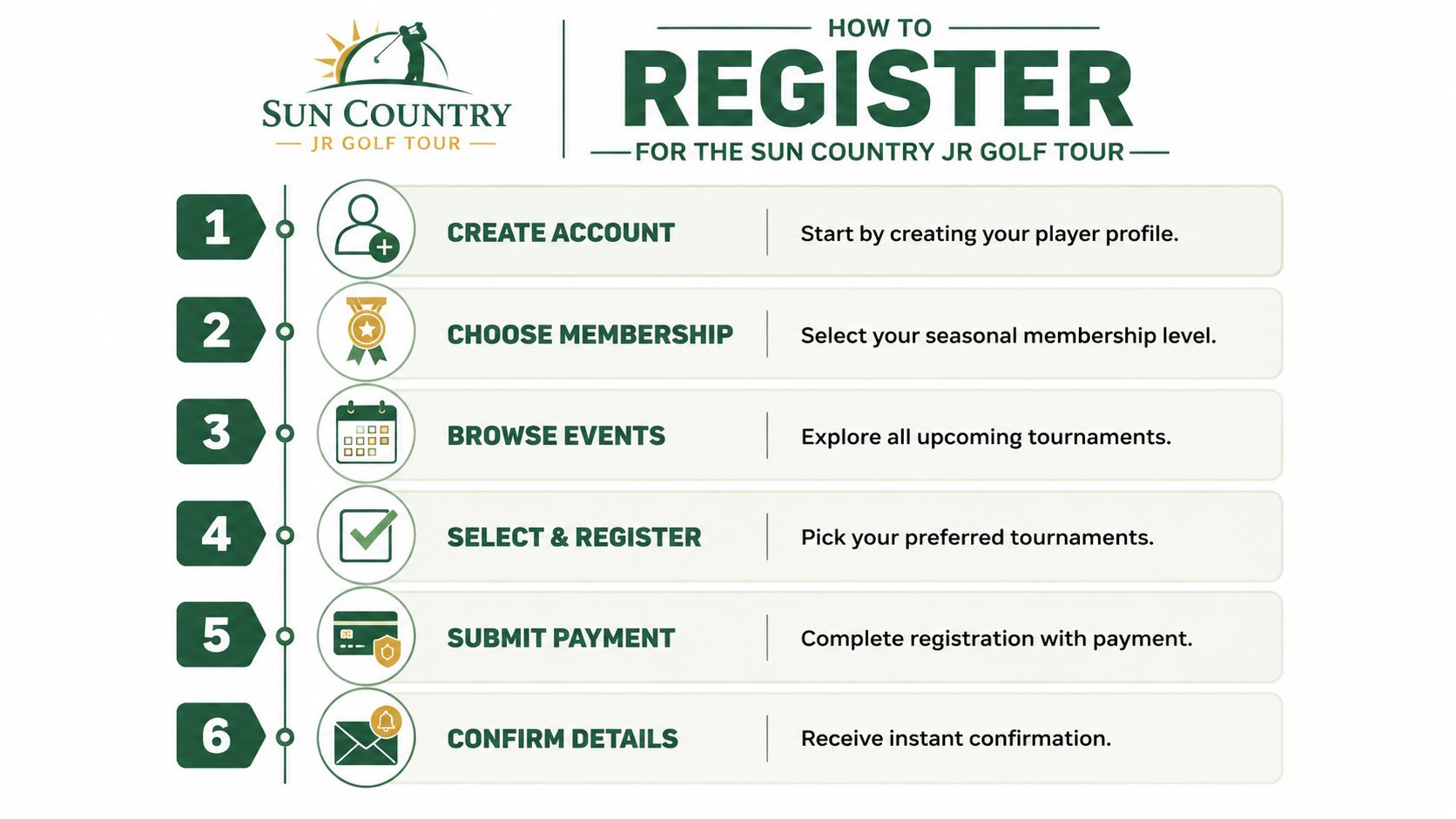
Registration feels complicated mostly when families try to do it all at once. It gets simpler when you handle it in order and check eligibility before you click into events.
A clean way to handle signup
Use this sequence.
Create the player account
Start with the junior's basic profile information. Keep names, birth details, and contact information consistent with whatever records you'll use for tournament play.Confirm eligibility
Before choosing events, verify that the player fits the tour's participation requirements and any event-specific notes.Select membership status
Some tournaments are tied to membership standing, so this step affects what you can enter.Browse the calendar carefully
Don't register by event title alone. Read whether it's a local event, major, or qualifier-style competition.Complete payment and save confirmation
Keep the receipt and registration email in one place. Parents who stay organized here avoid most event-week confusion.Check follow-up details
Tee times, player notices, and updates often matter more than the initial signup screen.
Two mistakes families should avoid
The first is rushing into a difficult event because a date fits the family calendar. The second is ignoring player records and handicap-related details until the night before.
If you need help locating player handicap information as part of your prep, this guide to GHIN lookup by name and state can help families organize that side of the process.
Register early enough that you still have time to ask questions. Last-minute junior tournament registration almost always creates avoidable stress for the parent and the player.
What organizers can do to reduce registration friction
Families don't need more forms. They need fewer surprises.
The strongest registration systems do these things well:
Use plain language so parents know whether an event is beginner-friendly or more advanced.
Separate membership from event entry clearly enough that no one confuses the two.
Send immediate confirmation with the next action spelled out.
Avoid manual back-and-forth unless there's an actual exception to resolve.
When junior event registration is clunky, staff spend the week answering the same questions repeatedly. When it's clean, parents arrive calmer and players are more prepared.
Tips for Running Efficient Junior Golf Events
Junior tournaments are harder to run than many adults expect. You're not just moving groups around a golf course. You're managing different age groups, different levels of tournament experience, parent expectations, volunteer communication, and rule variations that have to be enforced consistently.
That's why efficiency matters. Not for the sake of speed alone, but because a well-run event feels calmer to everyone on site.
Where events usually break down
The common failure points are predictable:
Manual registration lists create check-in bottlenecks and spelling errors.
Paper score handling leads to delays, missed signatures, and awkward corrections.
Loose starter instructions produce inconsistent rule explanations from one tee to the next.
Last-minute text chains leave parents unsure about timing, weather notes, or pairings.
What works is standardization. Give every starter the same short script. Publish one clear player notice. Build pairings so divisions make sense operationally, not just numerically.
The operator mindset that helps most
Think like a traffic manager, not just a tournament host.
You want clean flow from arrival to warm-up, from first tee to scoring, and from scoring to results. Junior golfers play better when adults remove friction around them. Parents also judge event quality by how easy the day feels, not just by how quickly awards are handed out.
For larger gatherings tied to presentations, meals, or sponsor functions, some organizers borrow ideas from other event categories. Even a resource about how to organize corporate event seating can be useful when you're assigning banquet tables, volunteer stations, or family check-in zones in a more orderly way.
Good junior event operations are usually quiet. Families know where to go, staff know what to say, and the round starts on time without drama.
The best tools remove repetitive work
Organizers should lean on digital systems where possible. Online registration, real-time scoring, centralized communication, and automated leaderboard logic all reduce manual cleanup.
That shift is especially valuable in junior golf because age divisions and event rules add complexity quickly. If you're comparing formats and workflows for smaller regional competitions, this guide on local golf tournaments offers helpful ideas for structuring play and administration more cleanly.
What doesn't work is layering modern expectations onto old methods. Families expect immediate confirmations, clear updates, and visible results. If staff are still rebuilding the tournament by hand every time a player scratches or a scorecard is unclear, the event will feel disorganized even if the golf itself is strong.
Sun Country Jr Golf FAQs
What should a new player bring to a first event
Keep it simple. A junior needs clubs that fit reasonably well, golf balls, tees, a glove, water, snacks that won't melt, and weather-appropriate gear. New families often overpack accessories and underprepare for hydration, comfort, and pace.
For a first tournament, the best setup is the one the player already knows how to use.
Are caddies and spectator carts allowed
Families should check the current event policies before each tournament. Junior golf rules on caddies, push carts, spectator carts, and where parents can walk can vary by event type and site conditions.
The practical advice is straightforward. Don't assume the policy will match a prior event. Read the notice, and if anything is unclear, ask before tournament day.
How should parents think about Player of the Year points
Treat points as a byproduct, not the purpose. They matter more once a player is competing regularly and understands how to handle tournament golf.
Early on, the better questions are these: Is the player learning how to post scores accurately? Are they finishing rounds with composure? Do they want to come back and compete again? If those answers are strong, the rest usually has a chance to follow.
If you run junior tournaments, leagues, or competitive golf events and want a cleaner way to handle registration, live scoring, pairings, and communication, Live Tourney is worth a look. It gives organizers a modern, app-free way to run professional events without the usual software drag, which is especially useful when families expect fast updates and a smooth tournament-day experience.