
Jul 15, 2026
los lagos golf course scorecard, golf scorecard, tournament scorecard, live tourney, golf course management
Get the complete 2026 Los Lagos Golf Course scorecard. Download, view hole-by-hole stats, and learn how to create custom scorecards for your next tournament.

You're usually looking for a Los Lagos golf course scorecard for one of two reasons. You've either got a tee time and want the card before you arrive, or you're building pairings, handicaps, and printed materials for an event and need the right course data in the right format.
That distinction matters here, because there are two different Los Lagos courses that people regularly mix up. One is the tournament-ready club in Fort Mohave, Arizona. The other is the public 9-hole facility in San Jose, California. If you're searching with event setup in mind, using the wrong Los Lagos card will throw off tee assignments, handicap math, and every printed sheet that follows.
Your Guide to the Los Lagos Scorecard
This guide focuses on Los Lagos Golf Club in Fort Mohave, Arizona, which is the one most tournament staff and traveling players mean when they ask for the Los Lagos golf course scorecard. It's the stronger fit for competitive setup and formal event administration.
The confusion is understandable. Los Lagos Golf Course in San Jose, CA, at 2995 Tuers Road, operates as a 9-hole public facility with a documented course length of 3,240 yards and a course rating of 68.5, which sits below the standard 18-hole benchmark of 72.0 and makes it a more moderate test for recreational and league play, according to the San Jose Los Lagos scorecard listing.
If you need the Fort Mohave card, use this article as your working reference. If you're a player, the goal is simple: understand what the scorecard is telling you before the first tee. If you're a head pro or tournament director, the scorecard is more than yardages and pars. It's the baseline document for fair competition.
Practical rule: Confirm the city and state before you print anything. “Los Lagos” alone isn't enough for a serious event.
A clean scorecard does three jobs well:
Guides play: It gives players the hole information they need quickly.
Supports competition: It provides the course data that handicap and event setup depend on.
Prevents errors: It stops staff from building pairings and rules sheets around the wrong layout.
Printable Los Lagos Golf Course Scorecard
If your immediate need is a printable Los Lagos golf course scorecard, start with a clean visual you can save to your phone or print for the golf shop counter.
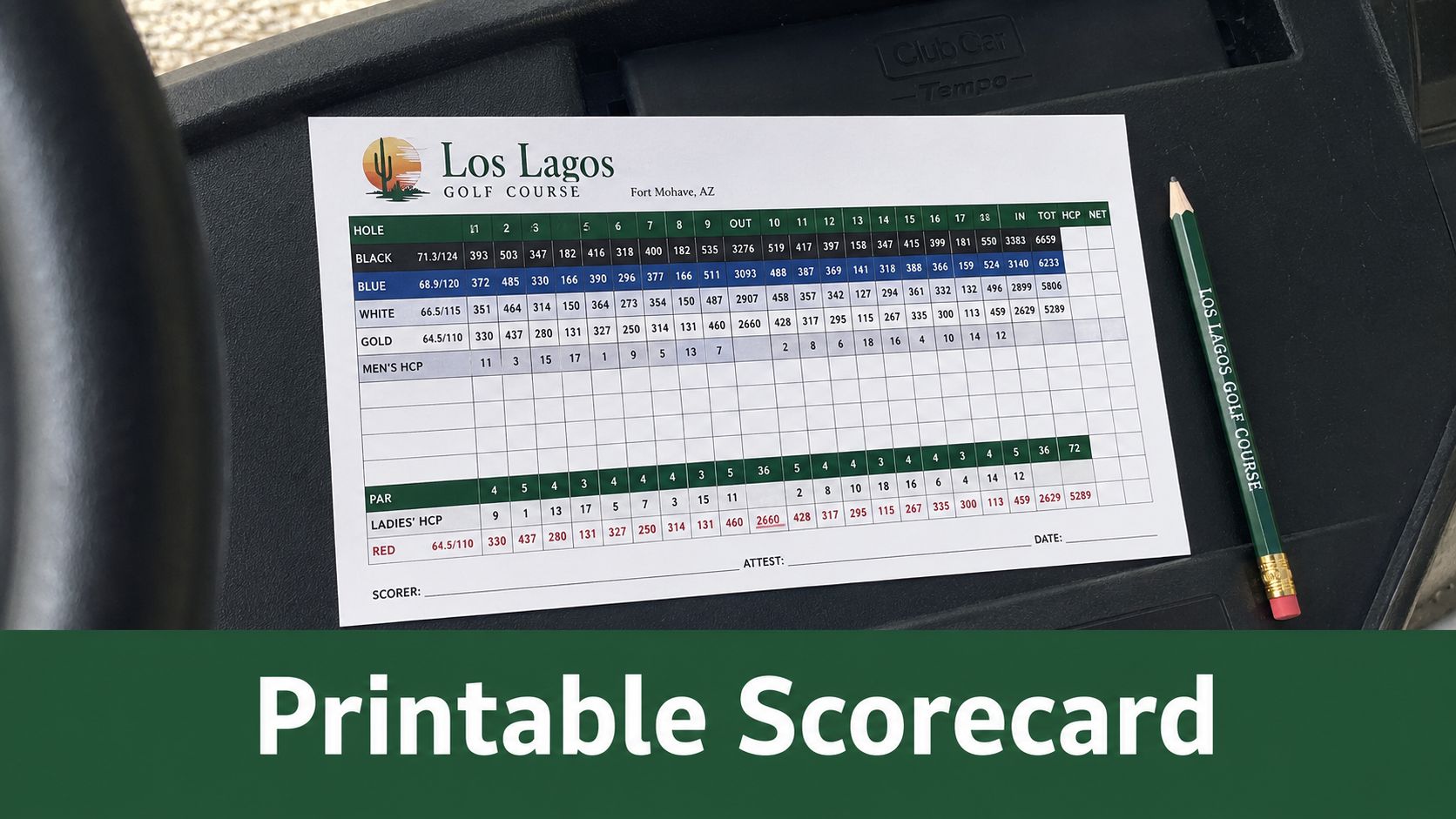
For players, that's enough to check hole flow, mark basic strategy notes, and avoid walking to the first tee blind. For tournament staff, though, a standard card is only the starting point. It shows the course. It doesn't show your field, your tees, your pairings, or your competition details.
Use the printed card for three practical tasks:
Pre-round prep: Mark conservative targets and likely trouble holes.
Cart staging: Keep a copy with starter materials and local rules sheets.
Event reference: Verify that the course setup on player materials matches the intended tees and hole information.
A scorecard that's readable at a glance is useful. A scorecard that's accurate for the day's competition is what keeps an event under control.
Hole by Hole Yardage Par and Handicap
For competitive planning, the card has to become structured data. Players can work from a photo. Professionals need something they can scan, compare, and build around.
Here's the visual overview.
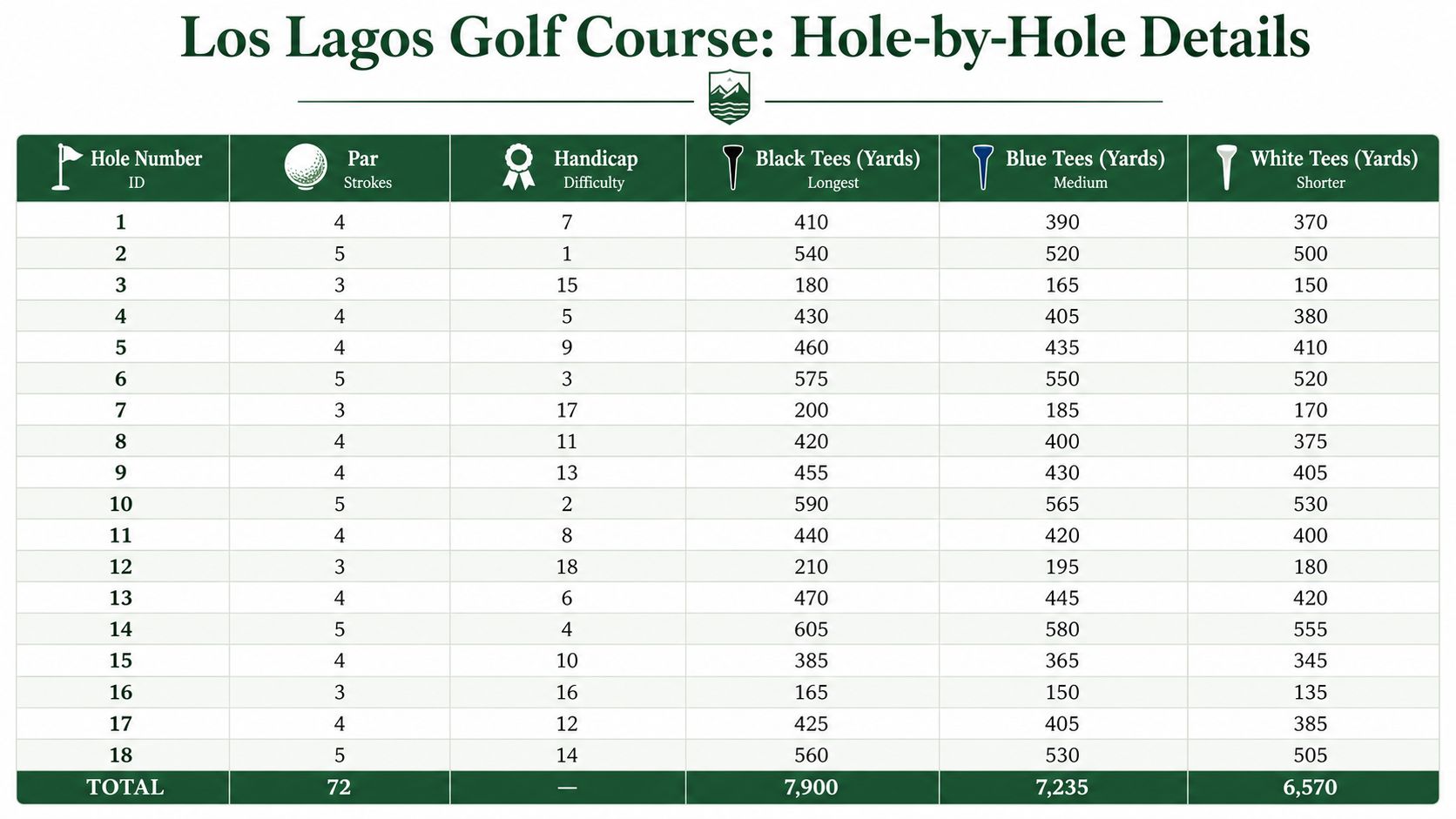
What matters most on the card
At Los Lagos Golf Club in Fort Mohave, the core identifiers are the ones that shape how the course plays in competition. The Blue course is listed at 6,921 feet, with a course rating of 72.0 and a slope rating of 126, based on the Fort Mohave Los Lagos scorecard listing.
Those numbers matter because they tell you this isn't a casual pitch-and-putt card dressed up for tournament day. This is a layout with enough length and difficulty to demand real decisions from stronger players while still exposing weak course management for higher handicaps.
How to read a hole table like a pro
A good hole-by-hole sheet should let you answer four questions fast:
Scorecard Element | Why it matters in play |
|---|---|
Par | Sets scoring expectation and helps players choose where aggression makes sense |
Handicap index | Identifies where strokes fall in net competitions |
Tee yardage | Changes club selection, landing zones, and carry decisions |
Tee set used for the event | Prevents scoring and handicap mistakes before they happen |
What doesn't work is treating the scorecard as decoration. I see that mistake often in outings. Staff print a card because they need one, but no one checks whether the day's assigned tees match the card in players' hands. That's how gross and net events go sideways.
If the tee assignment on the event setup doesn't match the card the player is holding, you don't have a small admin issue. You have a scoring problem.
What to watch before event day
Before a competitive round, review these details against the official setup:
Tee consistency: Every group should be playing from the tees assigned in the competition terms.
Stroke allocation: Confirm the hole handicap order lines up with the format you're running.
Printed legibility: Yardages, pars, and handicap rows need to be readable without squinting in a cart.
For a player, the Los Lagos golf course scorecard helps shape club choices. For a tournament director, it's the backbone of the entire round.
Understanding Course Rating and Slope
Most players glance at rating and slope and move on. Pros and tournament staff can't afford to do that.
Course rating tells you how difficult the course is expected to play for a scratch golfer. Slope rating tells you how much harder it tends to play for a bogey golfer relative to a scratch player. If you want a cleaner explanation of how those terms work in practice, this short guide on what a course rating means lays out the concept well.
Why these numbers affect real competition
On event day, rating and slope are not abstract. They influence how handicaps translate to the course and whether players get the right number of strokes for the setup in front of them.
That's why tournament staff should treat the scorecard as operating data, not just player information. If the course identifiers are off, every net result built on top of them becomes questionable.
What players should take from it
For the player, the practical takeaway is simple:
Higher difficulty changes expectations: A course can punish poor misses more than the yardage alone suggests.
Handicap travel matters: Your index doesn't play the same way everywhere.
Tees matter as much as talent: A round from the wrong tee can distort both pace and scoring.
The best scorecards don't just show numbers. They tell you what kind of day you're walking into.
Pro Tips for Playing Los Lagos
A good round at Los Lagos usually comes down to restraint. Players who try to overpower every hole tend to create the big number themselves. Players who treat the card as a planning tool usually keep the round intact.
Off the tee
Start with the simple discipline first. Pick the shot that keeps the next one easy.
On a course with enough difficulty to expose bad positioning, the smartest play isn't always the longest club. A fairway wood or controlled hybrid that holds the short grass can be more valuable than driver if driver brings one side of the hole fully into play.
On-course note: The scorecard gives you yardage. It doesn't show how quickly trouble can tighten your angle into the green.
Three habits help here:
Favor the side with room: If a hole gives you one safe half and one expensive half, use the safe half.
Choose your miss before you swing: Don't stand on the tee and “see what happens.”
Respect the opening holes: Early doubles usually come from swinging too hard before you've found your tempo.
Into the greens
Most tournament players lose shots at Los Lagos by short-siding themselves. Even a well-struck approach can become a poor result if it misses on the wrong side and leaves no simple recovery.
Use the card to manage front-to-back yardage, then add one more layer of discipline. Aim for the part of the green that leaves a putt or routine chip, not the pin that creates a heroic recovery if you miss by a little.
A few practical rules hold up well:
Middle of the green is never a bad decision when the pin sits near a trouble side.
Take your medicine after a poor tee shot. Advancing to a scoring wedge yardage is often better than forcing a low-percentage hero shot.
Protect momentum on the hardest stroke holes. Pars and clean bogeys matter more there than chasing birdie.
Where rounds get away
The danger stretch in any round isn't always the longest sequence of holes. It's the stretch where a player stops committing to targets and starts reacting emotionally.
That's when you'll see the same pattern. A missed fairway leads to an overaggressive recovery. The recovery leads to a missed green in the wrong place. Then the card shows a number that was avoidable from the first swing.
The best competitive rounds at Los Lagos don't feel dramatic. They feel organized.
Local Rules and On Course Information
Before the first group goes off, get the practical items settled. Unaddressed practicalities typically result in avoidable penalties and starter questions.
Quick pre-round checklist
Confirm out-of-bounds markers: Don't assume perimeter boundaries from memory. Use what's marked on site that day.
Review penalty area treatment: Water and lateral trouble need to be clear before competition starts.
Check teeing ground assignments: Make sure players know exactly which markers are in use for their division.
Verify cart and path instructions: Event pace suffers when groups improvise cart procedure.
Carry a local rules sheet: A printed rules addendum saves repeated rulings on the course.
What doesn't work is relying on clubhouse conversation. By the time a player says, “I thought that was free relief,” the damage is already done.
If you're running the event, put local rules in writing and keep them physically attached to starter materials, scorecards, or cart packets. If you're playing, ask before the round starts, not after a ruling becomes expensive.
Creating Custom Scorecards for Your Event
The standard Los Lagos golf course scorecard is useful. For a real event, it's incomplete.
A tournament card has to do more than show the course. It needs to reflect the field playing that day, the tees assigned, and the competition format in force. That's where a stock card stops being enough.

Why generic cards break down
A pro shop scorecard won't carry the event details serious staff need. It won't identify player names, pairings, event-specific handicaps, or branding. It also won't help much when late roster changes hit the sheet.
That's why automated tournament workflows are a better fit. Modern platforms can start from a fixed template, then let staff import rosters, assign tee selections, and map event data so names and tee times fill automatically, as outlined in this guide to golf course score cards.
What a custom scorecard should solve
A strong event card should reduce work, not create more of it.
Roster changes: Late scratches and pairing edits shouldn't force full manual rebuilds.
Tee accuracy: Different divisions must print with the right setup.
Professional presentation: Event branding, names, and tee times should appear cleanly on the finished piece.
For a deeper look at what belongs on a properly built event card, this breakdown of the best golf scorecard setup is worth reviewing.
How Live Tourney Automates Scorecard Creation
When staff automate scorecard production correctly, the difference shows up before the shotgun even starts. Fewer check-ins stall at the table. Fewer players ask where they're supposed to play from. Fewer carts leave the staging area with the wrong materials.
This is what that workflow looks like in practice.

The non-negotiable fields
A compliant scorecard built through a customizable report builder must include the event name and date, each player's full name, that player's course handicap, the exact tee box being played, and for each hole the correct par, yardage, and stroke index, according to this overview of the best golf scorecard requirements.
That list is the difference between a scorecard that looks polished and one that can actually support tournament scoring.
A tournament card should answer every basic scoring question before the player has to ask it.
What an efficient workflow looks like
In a well-run operation, staff don't rebuild cards one by one. They work from a repeatable template and update only the event variables.
That usually means:
Load the field once. Import rosters rather than keying in names repeatedly.
Assign tees and competitive setup. Lock down the playing basis before printing.
Map event data into the template. Let names and times populate automatically.
Review exceptions only. Focus on scratches, late additions, and changed pairings.
Approve for print. Check data, layout, and usability before the stack goes out.
What to check before printing
Even good software won't save a careless final review. Staff still need to confirm the details that matter on paper.
Names and dates: Spelling errors make an event look sloppy fast.
Tee boxes and handicap lines: Scoring disputes usually originate here.
Score entry area: If players can't mark cleanly, your recap work gets harder later.
Physical quantity: Always print a buffer for additions and damaged cards.
The biggest gain isn't just speed. It's consistency. Every group gets the same level of clarity.
Go Beyond Paper with App-Free Live Scoring
A printed card is still useful. It just doesn't have to carry the whole event by itself.
Modern tournament operations work better when the paper card and digital scoring flow support each other. Players keep the card for reference and backup, then enter scores live as the round moves.
Live Tourney supports real-time, app-free live scoring through a web browser on a smartphone, so players can enter hole-by-hole scores and the leaderboard updates instantly without any download, as described in this overview of app-free golf score tracking and supported by the Live Tourney platform review.
Why this format works on event day
The strongest part of browser-based scoring is adoption. Players don't have to find an app, install it, or troubleshoot it in the parking lot. They scan a QR code or open a link and start entering scores.
That gives staff three practical advantages:
Faster visibility: Leaders and flights update during play.
Cleaner communication: Players and spectators can follow results on their own devices.
Less post-round bottleneck: Staff spend less time chasing cards to build a leaderboard after the fact.
Paper still has a place. But for a modern event, the best experience starts with an accurate scorecard and ends with live results that everyone can see.
If you run tournaments, leagues, or outings and want cleaner scorecards, easier setup, and live scoring that works in a browser, take a look at Live Tourney. It's built for golf operators who want a professional event without the usual admin drag.





