Jun 29, 2026
bali hai scorecard, bali hai golf club, las vegas golf, golf tournament setup, golf scorecard
Get the official Bali Hai scorecard for 2026. This guide has hole-by-hole yardages, pars, playing tips, and tournament setup advice. Download a printable card.

You're probably in one of two spots right now. Either you've booked a round at Bali Hai and you want a scorecard that helps you play the course, or you're the person responsible for running an outing there and you need more than yardage and par.
That's the right instinct. Bali Hai isn't a place where you show up cold, glance at the card on the first tee, and expect your usual game to hold. The setting can distract you, the visuals can push you into bad targets, and the wrong tee setup can turn a good event into a long day.
I've always treated the Bali Hai scorecard as two documents in one. For a player, it's a decision map. For an organizer, it's the foundation of tee assignments, handicap handling, and pace. If you use it that way, the course becomes much more manageable.
Your Essential Guide to Playing Bali Hai Golf Club
A round at Bali Hai usually starts with a false sense of comfort. The property looks generous from the opening tee, the setting feels more resort than grind, and the visuals invite aggressive swings. Then the course starts asking better questions than many players expect.
I've played Bali Hai enough times to know the scorecard earns attention before the first ball is in the air. For an individual player, it helps set realistic targets off the tee and into greens that can look friendlier than they play. For a tournament director, it does even more. It shapes tee assignments, handicap accuracy, pace expectations, and the difference between a polished event and a five-hour slog.
Bali Hai Golf Club sits at 5160 Las Vegas Boulevard South and operates as a public 18-hole facility. GolfLink's Bali Hai Golf Club listing places the course at 6,994 yards from the longest tees, par 71, with a course slope of 130 and a course rating of 73. Published numbers for Bali Hai can vary by source and by tee configuration, which is normal for high-profile resort courses with multiple setups. The practical takeaway is simple. Confirm the card and tee markers in use on the day you play or host.
That distinction is important for two groups.
Players need the card to answer real strategy questions. Is driver creating a clear advantage, or just bringing more fairway trouble into play? Which par 5s are actual scoring holes, and which ones only look that way from the tee? A good number on the scorecard keeps ego out of the decision.
Organizers need the same card for different reasons. Bali Hai attracts groups that expect sharp operations. Tee boxes have to fit the field, handicaps have to match the setup, and live scoring has to keep the day moving instead of adding confusion. That is why I treat the Bali Hai scorecard as part player guide, part event setup sheet.
Practical rule: At Bali Hai, strong rounds and well-run tournaments usually start with one choice made correctly. Pick the right tees first.
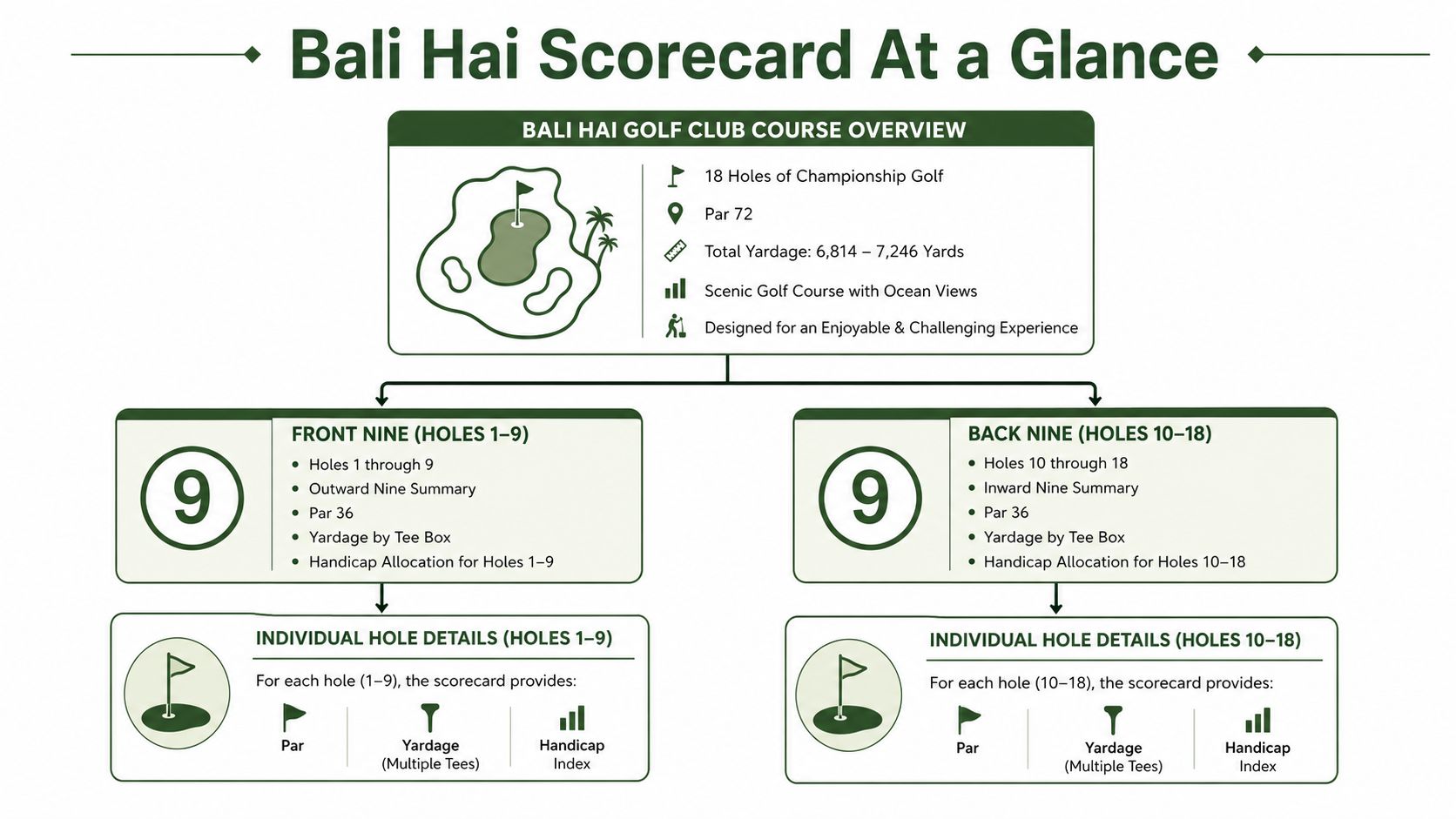
Bali Hai Scorecard At a Glance
The quickest way to read the Bali Hai scorecard is to start with the tee sets, then work backward into strategy and handicapping. Bali Hai uses a multi-surface configuration with four distinct tee levels, Black, Gold, Silver, and Bronze, ranging from 5,535 to 7,002 yards, and the Black tees carry a men's course rating of 74.1 with a slope of 137 according to Golfshake's Bali Hai Golf Club course page.
Core scorecard data
Tee set | Total yardage | Par | Course rating | Slope |
|---|---|---|---|---|
Black | 7,002 yards | 71 | 74.1 | 137 |
Gold | 5,130 yards | 71 | 70.8 | 130 |
Silver | 4,940 yards | 71 | 69.1 | 124 |
Bronze | 4,520 yards | 71 | 67.3 | 115 |
Alternate published measurements you should know
Source | Total yardage | Slope | Notes |
|---|---|---|---|
GolfLink | 6,994 yards | 130 | Public-course listing with broader facility details |
Golf Digest | 7,004 yards | 137 | Premium-course listing and event contact details |
Golfshake | 7,002 yards | 137 | Tee-by-tee configuration reference |
Those differences aren't a problem. They're common in golf, especially when different publications and rating systems update at different times. What matters is using one standard for your round or event and staying consistent.
How to read rating and slope
A course rating tells a stronger player what the course should play like under that tee setup. A slope rating points to how much more difficult the course gets as the player's skill level drops. At Bali Hai, that distinction matters a lot.
If you're a low-handicap player, the black card tells you the course has enough length and enough built-in pressure to expose poor strategy even on solid ball-striking days. If you're a mid- or higher-handicap player, the slope tells you the penalty for missing in the wrong place rises fast.
That's why a Bali Hai scorecard should never be read as just yardage.
For individual play: pick the tee set that lets you hit approach clubs you normally handle well.
For competitive rounds: match the tee set to the kind of test you want. Don't let ego choose.
For events: keep one published scorecard standard on every player handout, pairing sheet, and scoring platform so there's no confusion.
The smartest players at Bali Hai don't ask, “How far is it?” They ask, “What shot does this yardage force me to hit next?”
Download Your Printable Bali Hai Scorecard
A printable Bali Hai scorecard is worth having before you arrive. I'd rather mark targets, conservative lines, and no-go misses on paper or on a phone screenshot the night before than figure it out hole by hole with a group waiting behind me.
For players, that prep sharpens club selection. For organizers, it cleans up communication because every participant sees the same card before the event starts. That reduces first-tee questions and avoids the usual confusion around tees, handicaps, and format notes.
Here's the practical move:
Save a digital copy: keep it on your phone for quick reference during warm-up.
Print one for notes: mark layup clubs, likely wind calls, and safe green sections.
Send it to your field early: if you're running an outing, include it with your player email alongside digital golf scorecards that show how modern scorecard workflows can look.
A scorecard is more useful when it becomes a planning sheet. At Bali Hai, that small step usually saves shots.
Hole by Hole Playing Strategy The Front Nine
The front nine asks for discipline more than flair. The visuals are part of the challenge. Bali Hai's thousands of palm trees and white sand bunkers shape how players aim, and on comparable courses dense tree lines have been shown to increase out-of-bounds risk by 15 to 20 percent, which is why fairway position matters so much more than hero carries on this property, as noted in Top 100 Golf Courses reviews of Bali Hai.

If you like detailed routing notes, a hole-by-hole course strategy guide is a useful companion format. At Bali Hai, though, the main idea stays the same. Hit to space first, then attack.
Holes 1 through 3
The opening hole is where players often give away a shot by trying to announce themselves with driver. Don't. On a course framed by palms and bright bunkering, the aggressive line often looks wider than it is. Start with the club that leaves a full approach from the fairway.
Hole 2 usually rewards commitment more than power. Pick a side of the fairway and stick to it. Indecision is a bigger mistake here than a conservative target.
On 3, pay attention to green entry angle. A lot of players only think about front yardage, but the key question is whether your tee ball gives you a clean line into the middle of the putting surface. If not, you're playing defense immediately.
On-course note: The palm-lined visuals can make a safe landing area feel narrow. Trust the actual target, not the theatrical framing.
Holes 4 through 6
This middle stretch on the front is where the Bali Hai scorecard starts to matter in a practical way. If a hole's listed yardage leaves you between clubs from your chosen tee set, the mistake is trying to force a perfect shot instead of changing your first-shot plan.
A few principles work well here:
Choose the easier second shot: if laying back gives you a number you like, that's the better play.
Respect the white sand visually, but don't fear it blindly: some bunkers are true penalties, others are areas you can still play from.
Miss away from palm clusters: once the ball gets under or behind tree canopies, recovery options shrink fast.
Hole 5 is often a good example of course management over ego. If your normal driver shape brings the tree line or edge trouble into play, throttle back. Bali Hai punishes the one miss you knew was possible.
Hole 6 is where I like a middle-green mindset unless the pin is clearly accessible from the fairway. Resort courses with polished presentation tempt players into flag hunting. That's rarely the right percentage play here.
Holes 7 through 9
The closing part of the front nine can shift momentum in either direction. If you've been steady, stay that way. Players often chase one more birdie before the turn and walk to 10 after a loose bogey or worse.
Use this checklist on 7 through 9:
Start with your stock shot shape, not the one you wish you had that day.
Aim for the fattest fairway section, especially if the palm framing narrows your eye line.
Play uphill putts when possible, even if that means a less aggressive approach.
Accept par as a strong score when the hole asks for two precise swings.
By the ninth green, you should know whether your tee choice was correct. If approach shots have felt strained all morning, the card was telling you something before you teed off.
Hole by Hole Playing Strategy The Back Nine
The back nine is where rounds at Bali Hai get sorted out. The course features nine par-four holes, and for over 60 percent of amateur golfers, par-fours are the most volatile holes for scoring, making them the biggest source of both birdie chances and double-bogey mistakes, according to Two Guys Who Golf's Bali Hai review.
That's the lens I use on the inward side. Don't ask whether a hole is attackable in theory. Ask whether the next two shots can be played from control.
Holes 10 through 12
Hole 10 is a reset hole if you use it correctly. After the turn, many players swing harder without realizing it. That usually leads to a poor start on the back. Commit to rhythm first. A fairway ball on 10 is worth more than a few extra yards.
Hole 11 often rewards patience. If you can leave your preferred wedge or short-iron number, do that instead of squeezing every yard from the tee. On par-fours, distance only helps when it improves the approach window.
Hole 12 is one of those holes where bogey avoidance matters as much as birdie hunting. If the pin location tempts you into a forced carry or a shot over trouble, take the safer line and trust your putter.
Holes 13 through 15
This stretch is where many amateur rounds tilt. The scorecard may show manageable yardage, but par-fours become dangerous when the first shot lands on the wrong side of the fairway or leaves a partial distance you don't practice often.
What works here is simple:
Situation | Better choice at Bali Hai |
|---|---|
Tight visual tee shot | Hit the club that keeps the ball short of the main trouble |
Uncertain approach distance | Favor the fat side of the green |
Borderline pin | Ignore it and play center section |
Risky recovery angle | Take the easy miss and rely on the next shot |
This isn't passive golf. It's efficient golf. The players who score on Bali Hai's par-fours usually don't pull off more spectacular shots. They make fewer expensive decisions.
If you're writing numbers on the card after every hole, the back nine should feel like a management test, not a driving contest.
Holes 16 through 18
The final stretch punishes impatience. If you're protecting a good round, don't start steering the ball. If you're trying to recover from a rough middle section, don't chase everything at once.
I like a three-part approach coming home:
On 16, play for a full, committed approach. Half-swings and uncomfortable yardages cause more trouble than a slightly longer second shot.
On 17, treat position as the first objective. A clean look into the green beats a longer recovery from a poor angle.
On 18, know your tournament situation before you choose aggression. In casual play, finishing with a solid par is usually a win. In competition, the card and the leaderboard may justify a different risk.
The big takeaway from the back nine is that Bali Hai doesn't require nonstop aggression. It rewards players who understand which par-fours can be pressed and which ones should be negotiated.
Tournament Playbook Tee Selection and Handicapping
Most tournament problems at Bali Hai start before check-in. They start when the host picks tees based on habit instead of field strength. That's a mistake on any course, but it's a costly one on a premium venue where players expect the round to feel polished from the opening announcement forward.
Tee choice should match the event
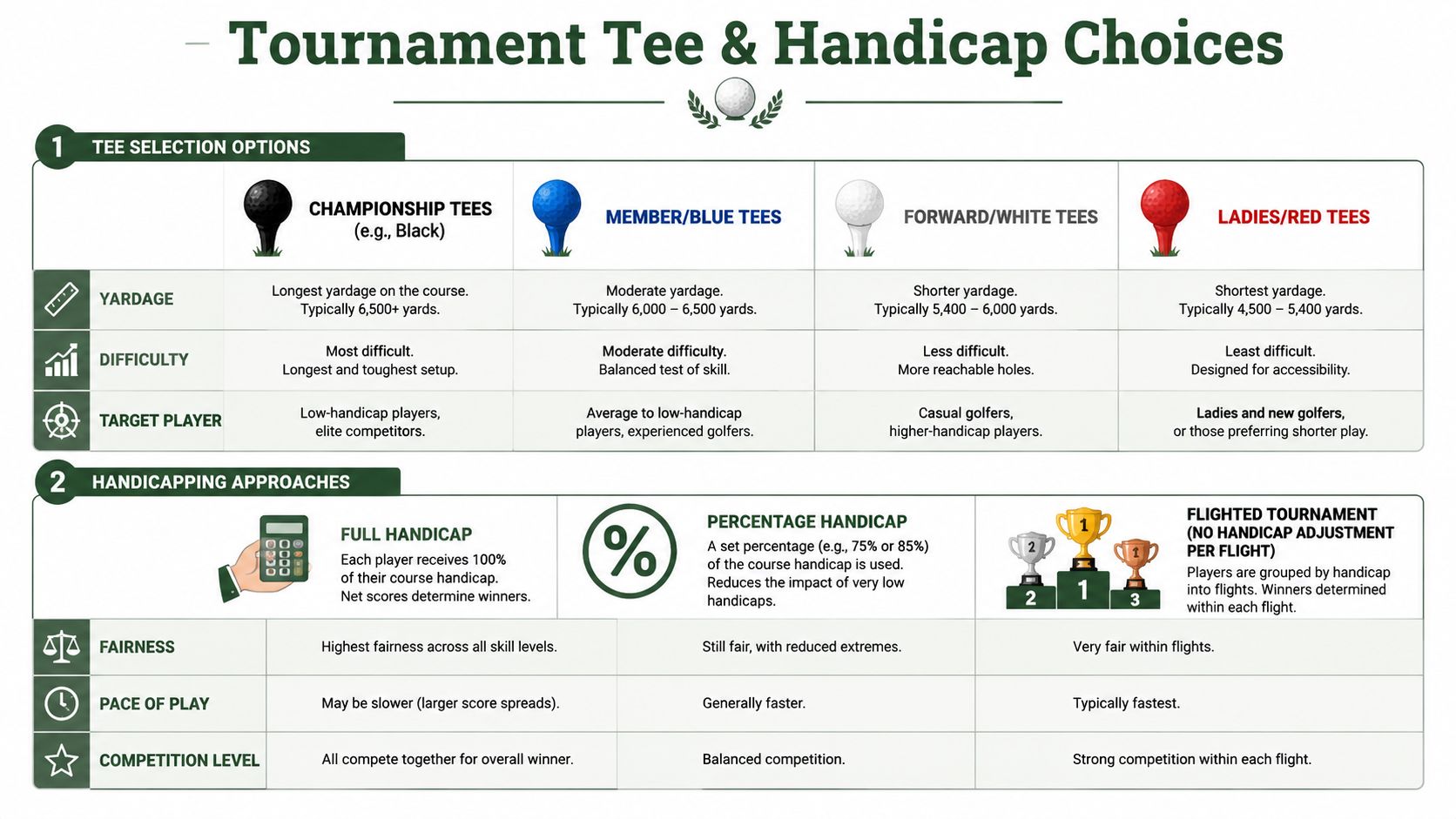
The cleanest way to assign tees is to start with event purpose.
Corporate outing: keep the field moving and keep approach shots playable. Most mixed-skill corporate groups score better and enjoy the day more from a middle setup than from the longest card.
Charity scramble: use a tee that invites aggressive play without forcing repeated long carries or slow searches. Scramble players like opportunity, not punishment.
Competitive low-handicap event: move the better field back only if they can handle the approach demands and if your prize structure justifies a stronger test.
If you need help converting index to playing handicap, a USGA course handicap calculator explainer is a practical reference point.
Three tee-selection examples that work
Here's the model I'd use in real operations.
Event type | Best approach | Why it works |
|---|---|---|
Executive corporate outing | Gold or mixed Gold and Silver | Better pace, less frustration, stronger player experience |
Charity scramble | Gold for most of the field, Silver for shorter hitters if needed | Creates scoring chances without making the course feel soft |
Competitive invitational | Black for elite players, Gold for the rest in separate flights | Preserves challenge while staying fair |
The key is that tee assignment should be about comparable approach difficulty, not old labels like “men's tees” and “ladies' tees.” Bali Hai's multiple tee options make smarter setup possible. Use them.
Handicapping without creating confusion
Most event hosts overcomplicate this part. The better move is to match handicap treatment to format, then explain it clearly on every player sheet.
A few practical rules:
For individual net events: use one published course setup and apply handicaps consistently across the field.
For scrambles: reduce handicap influence so the event still rewards execution and team fit.
For flighted competition: separate strong players cleanly rather than trying to force one handicap model to fit everyone.
Director's rule: Fairness at Bali Hai starts with giving players the right club into greens. Tee setup controls that more than almost anything else.
Tournament Playbook Formats and Live Scoring
Bali Hai can host polished events, but not every format fits the property equally well. The course looks friendly from the cart path. It can feel much tougher once a mixed-skill field starts missing into framed landing areas, bunkers, and tree trouble. That's why format selection matters so much.
The safest choice for broad corporate and charity fields is a four-person scramble. It softens the punishment of one bad drive, keeps groups engaged, and helps pace because players aren't all grinding out individual recoveries. A two-person best ball works well for stronger member-guest style groups that still want some individual accountability.

Formats that fit Bali Hai best
Four-person scramble: best for charity and sponsor-heavy fields. It reduces the impact of difficult tee shots and keeps the atmosphere upbeat.
Two-person best ball: ideal when you want real golf scores without overloading weaker players.
Shamble: a strong middle ground if your field wants more individual shot-making after the drive.
What usually doesn't work as well is a straight individual stroke-play event for a wide corporate field. Bali Hai's visual intimidation and premium expectations can slow those rounds down fast if too many players are in survival mode.
Live scoring changes the day
For organizers running multiple events, Live Tourney offers a flat-rate subscription of $2,700 per year for unlimited use, which creates predictable costs compared with platforms that charge per event or hold features behind premium gates, according to Golf Course Technology Reviews on Live Tourney.
That matters because event operations don't break down on dramatic issues. They break down on small ones. Paper cards go missing. Staff re-enter totals. Teams crowd a scoring table. Winners wait while someone checks arithmetic.
Live scoring fixes that operational pileup when it's set up correctly.
What smooth execution looks like
A clean Bali Hai tournament setup usually includes:
One scoring method for everyone so there's no confusion after the round.
Visible leaderboards that keep players engaged while groups finish.
Clear hole assignments and tee sheets before carts leave the staging area.
Fast scoring verification instead of a long post-round bottleneck.
If you're running outings regularly, the best systems are the ones your staff can operate without turning tournament morning into an IT project. At a venue like Bali Hai, players notice that polish immediately.
Frequently Asked Questions About Bali Hai
How expensive is it to play Bali Hai
Expect destination-resort pricing. Rates change sharply by season, day of week, and demand, so Bali Hai often feels more like a premium Vegas experience than a standard public round. For players, that means booking with flexibility helps. For event organizers, it means locking in your date and player count early if budget control matters.
Is Bali Hai a public course
Yes. Bali Hai is open to public play, and that is part of its appeal. An individual golfer can book a tee time, but the course also fits organized groups well because the operation is built to handle visitor traffic, corporate outings, and charity fields without the private-club friction some groups run into.
Is it suitable for corporate and charity events
Yes, especially if your group wants a venue that feels like a trip, not just a round.
From a tournament director's standpoint, Bali Hai works best for events that value presentation, hospitality, and a memorable setting. It is not the course I would choose for a beginner-heavy field that wants a fast, low-stress scramble with minimal forced carries. It is a better fit for client entertainment, sponsor-facing charity events, and corporate groups that want the venue to do part of the selling for them.
What's the biggest mistake first-time players make
Choosing tees that are too long.
I see this all the time at Bali Hai. Players get caught up in the setting, glance at the card, and pick a tee based on ego instead of carry distance and approach-yardage comfort. That decision usually leads to long second shots, short-sided misses, and a scorecard that gets ugly by the turn. If you want a better day, choose the set that leaves full shots into par 4s, not hybrids and fairway woods all afternoon.
For tournaments, the same rule applies. A well-run event at Bali Hai starts with realistic tee assignments.
How should I book or prepare
Book early and confirm the tee setup before you arrive. Bali Hai can play very differently depending on where markers are set and how much wind shows up that day.
Players should review the scorecard in advance and identify the holes where position matters more than length. Organizers should send pairings, format rules, and pace expectations before the event, not in the cart staging area. That one step saves time, reduces confusion, and usually leads to a better first hour for the entire field.
If you run outings, leagues, or charity events and want a simpler way to manage pairings, score entry, and live leaderboards, take a look at Live Tourney. It's a practical fit for tournament directors who want clean execution without adding more work for staff or players.