Aug 10, 2026
junior golf league, golf league management, youth golf programs, how to run a golf league, junior golf
Launch and manage a successful junior golf league with our step-by-step guide. Covers formats, registration, scoring, and promotion for a thriving program.

You know the scene. Parents are asking where to check in, a volunteer is hunting for scorecards, one group is still on the first tee, and somebody's trying to figure out whether the match is tied because the math on the card doesn't match what the kids just said. A junior golf league can feel messy fast when it's run with paper, text messages, and a lot of hope. It doesn't have to.
The opportunity is bigger than most clubs think. The National Golf Foundation reported nearly 4 million U.S. juniors ages 6 to 17 played golf on a course in 2025, the highest level since 2004. That was a 58% increase since 2019, and girls now make up 35% of youth players, up from 15% in 2000 (NGF participation report). That kind of growth doesn't reward clunky operations. It rewards leagues that feel organized, friendly, and easy to repeat.
The Modern Junior Golf League Opportunity
A junior league gets a lot easier to run when parents know where to go, kids know what happens next, and staff can see the whole day in one place. That is a prime opportunity now, because families expect the same clarity from a league that they get from other youth sports and school activities.
The strongest leagues treat organization as part of the product. Clean online registration, simple age group setup, live tee sheets, and fast updates reduce questions before they reach the pro shop. The result is less time spent chasing answers and more time spent coaching, greeting families, and keeping play moving.
A modern setup also changes who says yes. Parents who are new to golf usually want reassurance that the program will be easy to follow, while returning families want a repeatable routine that does not create extra work every week. If the league runs through a web-based system, those needs are easier to meet without adding more volunteer labor.
That is why the growth in junior golf matters operationally, not just as a headline. More families entering the game means more expectations around communication, mobile access, and quick problem solving. Clubs that can deliver that experience have an advantage, because they look organized from the first sign-up form to the last score posted.
A good league also builds trust before the first tee time. Clear confirmations, visible schedules, and accurate player information help parents feel confident that their child is in the right place with the right group. That trust matters for retention, and it is easier to earn when the program feels thoughtfully run.
For clubs that want to reduce manual work, there is a clear path. Use a structure that fits the age group, keep the parent experience simple, and choose tools that let your staff spend less time managing logistics. If you want a practical starting point, a golf league program guide can help you compare the moving parts before you commit to a setup.
Uniforms matter here too. If you want teams to look organized from day one, it helps to find custom team uniforms that fit your league identity and remove one more decision from the weekly grind.
The best junior leagues do not feel complicated to families. They feel organized, welcoming, and worth coming back to, and that starts with systems that make the entire program easier to run.
Designing Your League Structure and Format
The format decision shapes everything else. If the league is meant to introduce kids to golf, the structure should lower stress, speed up play, and make teamwork feel natural. If the goal is to prepare advanced juniors for tournament golf, the structure should teach them how to compete under firmer rules. Trying to do both with one setup usually creates a program that satisfies nobody.

Choosing the right format
The most useful starting point is age grouping. The PGA Jr. League uses 9u, 13u, and 17u divisions, and its two-person scramble format keeps younger players involved without forcing them to carry every shot alone (PGA Jr. League format). That structure works because kids can play with a partner, keep moving, and stay engaged even when one player has a rough hole.
A more traditional model looks very different. The Central Gauteng Golf Union junior league uses 18-hole four-ball match play, divides the league into 3 divisions, and has teams of 8 players playing home and away with no extensions permitted (CGGU junior league conditions). That kind of structure fits clubs with stronger players and a higher tolerance for formal competition.
Format | Best For | Key Features | Management Complexity |
|---|---|---|---|
Individual Stroke Play | Experienced juniors who need full scoring reps | Every shot counts, simple to explain, harder emotionally | Moderate |
Team Scramble Format | Beginners, mixed abilities, family-friendly leagues | Shared responsibility, faster pace, less pressure | Lower |
Skills Challenge Series | Introductory programs or off-course development nights | Targets putting, chipping, and basic ball control | Lower to moderate |
For many clubs, a hybrid works best. Pair a friendly team format with structured scoring so kids stay interested, then layer in tougher competition later for players who want it. If you need a practical model for how leagues are packaged and paced, the guide on golf league programs is useful background.
If uniforms are part of your identity plan, keep them simple and recognizable. A resource like find custom team uniforms can help when you want the league to look unified without making the admin side harder than it needs to be.
The main trade-off is clear. Scramble formats create confidence and social energy, while match-play formats build sharper competition habits. Pick the one that matches your players' maturity, not the one that sounds most impressive in a brochure.
Streamlining Registration and Scheduling
Registration is where leagues usually lose time. If parents have to print forms, mail checks, or email sizes back and forth, the staff inherits the mess. A clean online system removes that friction and keeps the league from starting with a pile of follow-up work.

Build registration around decisions, not spreadsheets
The best registration flow asks only what the league needs. Age group, contact information, shirt size if you're doing uniforms, emergency contact details, and payment in one pass. Anything else can usually wait.
That matters because the administrative workload is rarely the registration form itself, it's the cleanup after people submit incomplete information. A web-based system keeps rosters in one place, reduces duplicate entry, and makes changes easier when a child moves into a different age division or a family needs to switch sessions. Live Tourney is one option in that space, since it supports league management, registration portals, and season-long scheduling in one workflow (league management software overview).
Scheduling should be just as disciplined. Set the season calendar before opening registration, then publish practice nights, match nights, and rain dates together so no one is guessing later. Parents want certainty, and staff need a plan that doesn't collapse when weather changes.
A simple template looks like this:
Week 1, orientation and rules night
Week 2, practice and pairings
Weeks 3 to 6, league matches
Week 7, makeup or rain date
Week 8, closing day and recognition
That structure keeps the season legible. It also gives families enough notice to plan around school, work, and other sports, which makes attendance more reliable.
Practical rule: if you can't explain the season in one sentence, parents will miss details before they ever miss a tee time.
When registration and scheduling are tied to one system, the staff stops babysitting spreadsheets. That leaves more time for coaching, communication, and the part people remember, whether the day felt easy.
Executing Flawless Gameday Operations
A smooth league day starts before anyone arrives. Tee times go out early, pairings are confirmed, and parents know exactly where to park, where to check in, and who to ask if a child arrives late. The best events feel calm because the information is already in everyone's hands.

What a clean league day looks like
A parent walks to the starter with a phone already showing the round details. A volunteer checks the child in, confirms the pairing, and sends the group to the tee without a pile of paper changing hands. On the course, the kids know their format and the score updates as they go, so nobody has to reconstruct the result afterward.
That kind of flow matters even more in formats that use points instead of total strokes. In many junior leagues, including PGA Jr. League, scoring uses a match-play point system where each three-hole flag is worth 1 point and software can track it in real time (Carolina PGA explanation). It keeps the focus on short segments rather than making younger players obsess over a single bad hole.
The parent experience changes too. Instead of waiting for a hand-calculated result at the end, families can follow the action as it happens. That reduces confusion, cuts down on score disputes, and makes the day feel more professional.
A few day-of habits matter every time:
Send pairings early: Give families enough time to plan arrival and warm-up.
Check in fast: Use one person or one station for names, reminders, and emergency notes.
Show the scoring method plainly: Kids should know what counts before the first hole.
Close the loop after play: Post results, communicate any makeups, and explain the next date before people leave.
If the league uses a live leaderboard, keep it simple and visible. Parents don't need noise. They need clarity.
Fostering Player Development and Safety
A junior league can look successful and still miss the point if kids don't feel safe, supported, and eager to return. Winning matters less than whether the environment teaches good habits and keeps families comfortable enough to come back next week. That's why the long-term value lives in coaching culture, not just the score.
The GolfSixes League is a strong reminder of that. Monitoring found a 35% increase in junior membership, with 59% of parents volunteering and 88% of families describing the format as fun (Golf Foundation reporting). That tells you something practical, parents stay involved when the league is social, manageable, and easy to support.
What safety and development should look like
Start with the basics that can't be skipped:
Clear weather policy: Make the cancellation and lightning plan visible before the season starts.
Adult supervision: Never assume someone else is watching a group.
Volunteer screening: Anyone working near kids should be vetted according to your club's standards.
Emergency readiness: Staff should know where the first-aid kit is and who handles a problem.
Encouragement-first coaching: Correct mistakes without embarrassing the player.
The right tone matters as much as the checklist. Kids learn faster when they're relaxed enough to ask questions and make mistakes. Parents trust a league more when coaches speak in plain language, keep the pace moving, and avoid turning every hole into a lecture.
A league also needs age-appropriate expectations. Younger kids need shorter instructions, clear boundaries, and a lot of reinforcement around sportsmanship. Older juniors can handle more feedback, but they still need the experience to feel positive if you want them to stay in the game.
For a useful local example of how junior programming can support development without losing the fun, the overview at Sun Country Jr Golf is worth a look.
A junior league should feel like a place where kids can get better without feeling judged every time they miss a shot.
That's the standard to protect. If safety, supervision, and coaching quality are consistent, parents relax and kids keep showing up.
Promoting Your League and Measuring Success
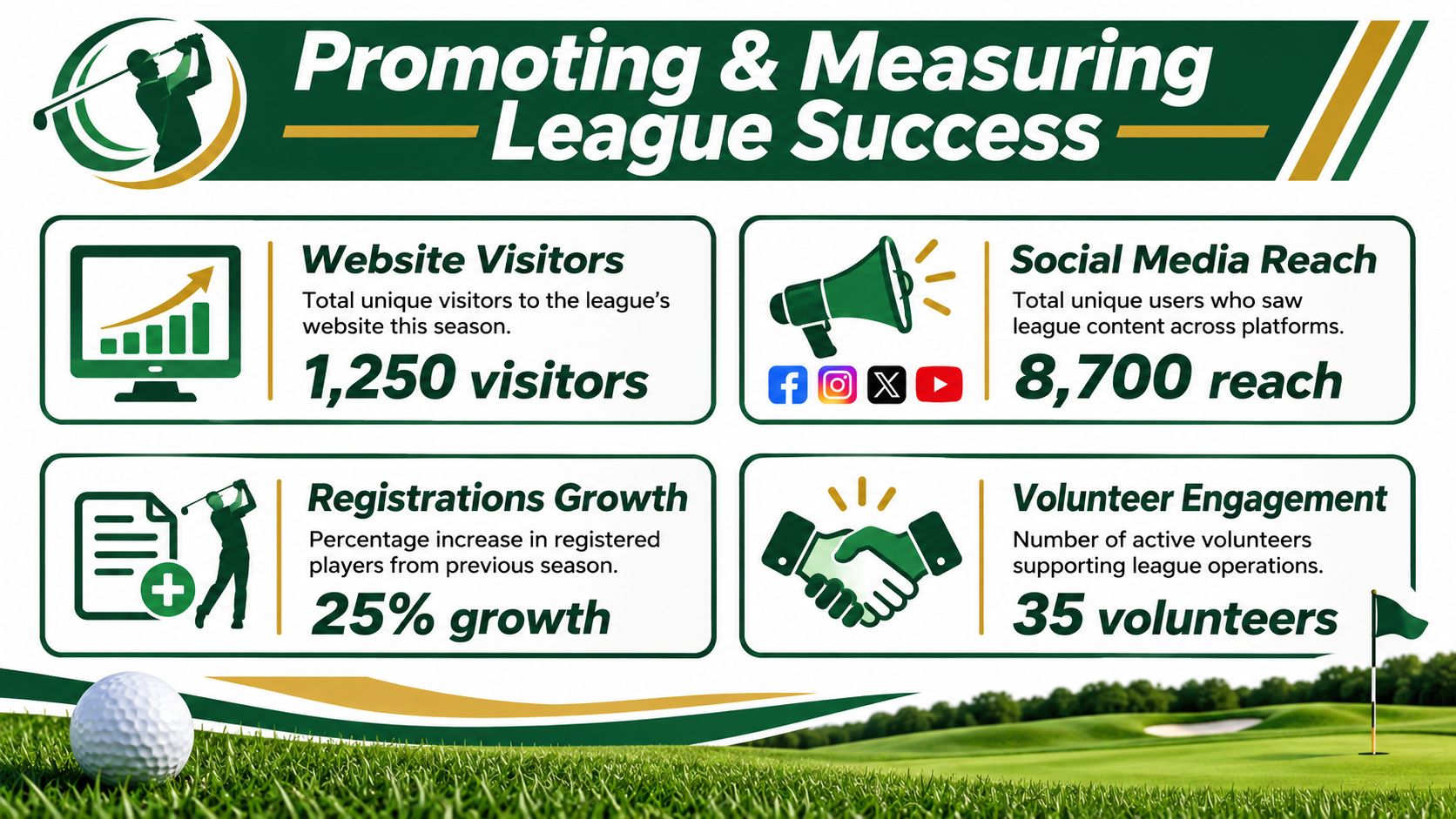
Local promotion works best when it feels familiar, not loud. Post the league on your club's website, share it through social media, and ask nearby schools or youth groups to pass it along. An open house or a short clinic night can also remove the intimidation factor for families who've never stepped onto a course.
Measure more than money
A league earns trust when it can prove value in ways the clubhouse understands. Revenue matters, but it's not the only signal. Retention, parent feedback, volunteer participation, and new junior signups tell a fuller story about whether the program is working.
If you want a practical playbook for club visibility, the ideas in strategies to boost your club translate well to junior programming because the league is part of the club's larger community footprint. Use the same logic for your own program. Show people where to sign up, what the league looks like, and why it feels easy to join.
Three KPIs are enough to start:
Retention rate: How many players return next season or next session.
Parent satisfaction: What families say about communication, safety, and fun.
Volunteer participation: How many parents or members help with fixtures.
New junior memberships: Whether the league is bringing fresh families into the club.
Those numbers tell management whether the league is building momentum or just filling a calendar slot. They also guide what to fix. If signups are strong but retention is weak, the issue might be the format. If parents love the experience but volunteer help is thin, the issue might be communication.
Strong promotion gets kids in the door. Strong measurement keeps the league honest.
Live Tourney gives golf staff a practical way to manage registrations, schedules, and live scoring in one web-based system, which fits junior leagues that need less paperwork and more clarity. If you're ready to run a cleaner season with easier check-ins and live results families can follow, visit Live Tourney and see how it can support your league from signup to final standings.