Aug 11, 2026
golf tournament schedule, tournament planning, tee sheet, live scoring, event templates
Learn how to build a golf tournament schedule that works. Templates, tee sheets, pairings, contingencies, and live scoring tips for organizers.

You can tell a golf tournament schedule is in trouble before the first group even tees off. The carts are stacked wrong, two players checked in but never got paired, the shotgun is already sliding late, and the leaderboard on the screen hasn't moved since breakfast. That's not a calendar problem. That's a scheduling problem, and it usually starts because someone treated the golf tournament schedule like a poster instead of the operating system for the day.
A good tournament schedule is a constraint system. It has to fit field size, format, daylight, staffing, communication, and scoring into one clean rhythm. The best ones feel boring in the right way, because every handoff has already been thought through, from registration to final prizes. If you build it that way, the event runs with less shouting, fewer reroutes, and a lot less of the “we'll figure it out at the starter table” nonsense.
When the Schedule Breaks on the First Tee
The fastest way to spot a weak golf tournament schedule is to stand at the starter table and watch people improvise. One cart is promised to a group that already walked to the practice green. A sponsor foursome is looking for a printed sheet that was never finalized. Somebody says the shotgun can wait “just five more minutes,” which in tournament language means the whole morning is about to wobble.
That's what happens when the schedule is built from the outside in, with dates first and operations later. It looks organized on a spreadsheet, but the field doesn't experience a spreadsheet, it experiences tee times, pairings, check-in lines, announcements, and the first ten minutes after the horn blows. If those pieces don't line up, the whole event starts feeling amateur, even if the golf is strong.
The schedule is the job, not the decoration
A tournament schedule has to answer practical questions before the day begins. Who is in the field, how are they starting, where do they report, when do pairings lock, and what happens if a group is late or a volunteer doesn't show? Those are operational decisions, not cosmetic ones.
That mindset matters because golf scheduling has always been tied to bigger competitive and commercial rhythms. The men's majors now sit in a fixed annual sequence, with the Masters in April, the PGA Championship in May, the U.S. Open in June, and The Open Championship in July, a structure that's been in place since 2019 and creates a predictable peak-demand cycle for broadcasts, sponsorships, travel, and course operations (men's major golf championships). The same idea applies at club level, just on a smaller scale. The schedule has to create order before anyone reaches the first tee.
Practical rule: If the starter, scorer, and pro shop don't all know the same answer, the schedule isn't finished yet.
Build the event like a chain of decisions, not a date on a flyer. Once that clicks, the rest becomes manageable, from pairings to live scoring to the final awards handoff.
Build the Golf Tournament Schedule Backwards From the First Tee
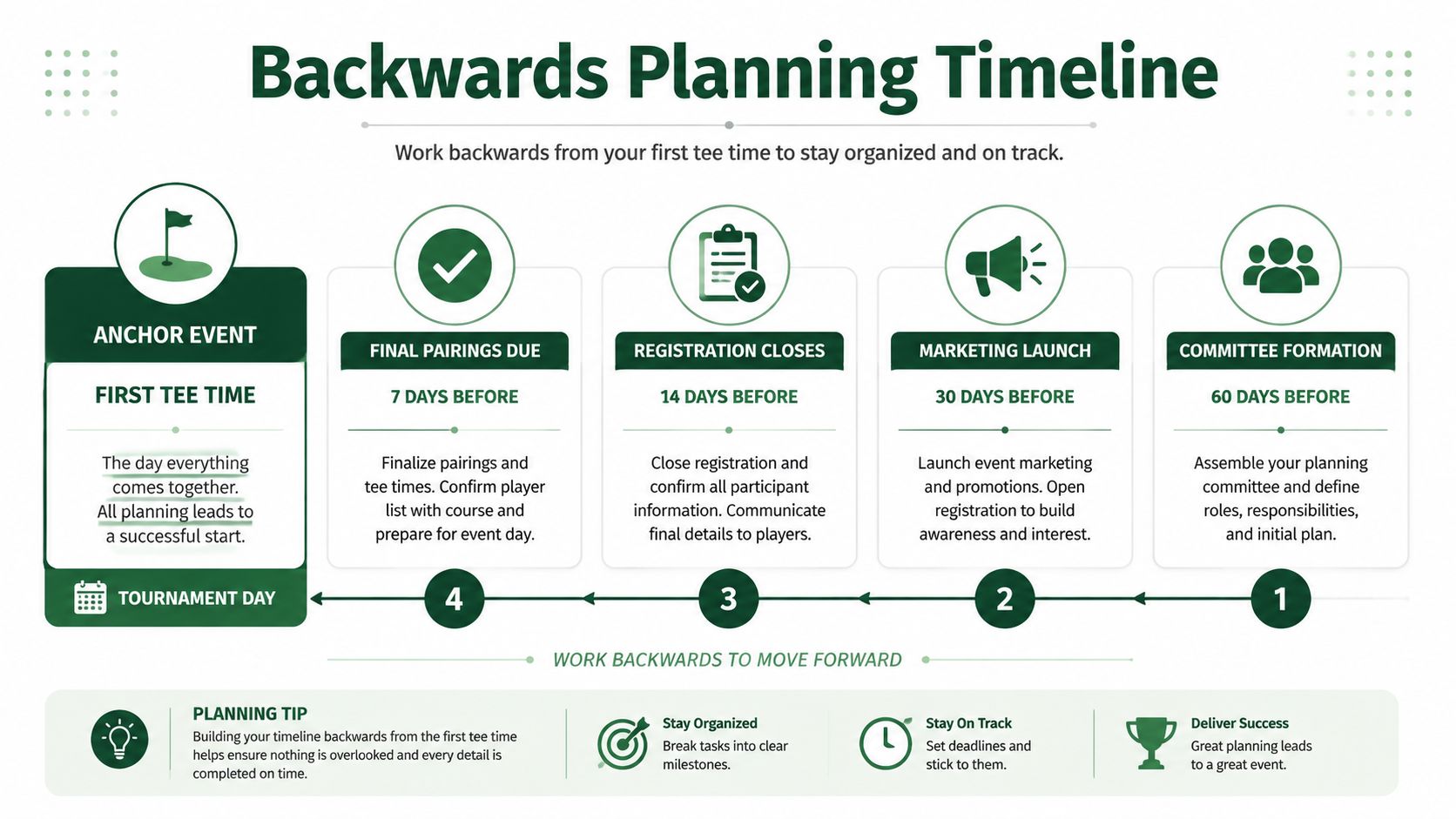
The cleanest way to build a golf tournament schedule is to start at the first tee time and work backward. Too many committees begin with “What date works?” and end with a mess of missed printing deadlines, delayed pairings, and sponsor materials that arrive after players already checked in. Start with the actual first group, then trace every requirement back from that moment.
Anchor every milestone to tournament day
If the event starts at 8:00 a.m., registration can't still be open at 7:55. Pairings can't be fluid the night before if the cart staff needs a final sheet before sunrise. Sponsor signage, rules sheets, scorecards, and live scoring access all need to be locked before the first player ever steps on property.
A useful planning rhythm looks like this:
Eight weeks out: Confirm sponsors, event theme, and marketing launch.
Four weeks out: Close the format decision, open or finalize registration, and confirm the field cap.
Two weeks out: Draft pairings and build the tee sheet.
One week out: Print player materials, rules sheets, and signage.
Final 48 hours: Rehearse the day-of sequence, confirm staff, and check communications.
That backwards approach works because each step depends on the one after it. You can't finalize pairings before you know the field structure. You can't print correct materials before you know the pairings. You can't communicate cleanly to players if the event details are still drifting.
Choose the date like an operator
The right date is more than a blank square on the calendar. Daylight, local competition, course closure days, and seasonal pace all matter. In golf, timing is often strategic, not administrative. The PGA Tour's own schedule history shows that tournament placement shifts when the sport wants to manage television windows, commercial inventory, and global reach, including the 2014 wraparound schedule with 45 events over 43 weeks and the 2019 changes that moved the PGA Championship to May, returned THE PLAYERS Championship to March, and reduced the FedExCup Playoffs to three events ending in August (PGA Tour schedule).
That doesn't mean your member-guest needs TV strategy. It does mean the date has to fit the course, the staff, and the players' ability to show up ready. If your setup depends on morning calm, don't schedule a time that collides with another club function, a major local outing, or a daylight crunch.
Build the event backward, then lock the front end last. That's how you stop the schedule from drifting while everyone else is still debating details.
For a useful planning comparison, the structure of a conference agenda can help because it forces the organizer to think in dependencies instead of loose topics. The logic in how to write a conference agenda translates well to golf, especially when you need a sequence that keeps people moving without dead time.
Pick the Right Tee-Time or Shotgun Format for Your Field
Format choice changes everything downstream. A standard tee-time start gives you more control and cleaner pacing. A modified shotgun gives a medium field more energy and a better finish window. A full shotgun makes sense when you need everyone to start and finish together, usually for a single awards moment and a more social event feel.
Match the format to the field, not the other way around
Small fields usually run best on staggered tee times because there's no reason to force everyone into a shotgun just to look official. Mid-size outings often gain more from a modified shotgun, especially when you want a shared start but don't have enough players to justify a full-field launch. Large fields can handle a full shotgun if the course layout, staffing, and awards timing can absorb it.
Field Size | Recommended Format | Start Interval | Group Size | Notes |
|---|---|---|---|---|
Under 60 players | Tee times | 8 to 10 minutes | 2 to 4 | Cleanest pacing, easiest to recover from delays |
80 to 120 players | Modified shotgun | Course-specific | 4 | Good for outings that want a shared finish without full-field congestion |
Around 144 players | Full shotgun | Simultaneous | 4 | Best when everyone needs to finish together for one awards ceremony |
A tee-time model is usually the least chaotic when you care most about pace and volunteer simplicity. A shotgun model works better when the experience matters more than pure flow, or when the organizer wants a unified social start. The wrong call is choosing a shotgun just because it sounds more “event-like.” If the course can't support the check-in volume, cart staging, or restroom traffic, the schedule will feel jammed before anyone reaches the first fairway.
Keep the pace logic simple
For tee times, 8- to 10-minute intervals are a sensible working range in many club settings, because they give the starter room to recover from a late player without collapsing the whole line. For shotguns, the question is whether the course can load players efficiently without creating bottlenecks at staging, practice greens, or bathrooms.
If you're building a format decision for a committee, keep the justification short. Say the field size, the start type, and the finish requirement. That's usually enough to end the argument.
The operational detail behind shotgun starts is worth understanding if you're weighing that format against tee times, and the internal reference on what is a shotgun start in golf is a useful quick read when the committee wants a simple explanation. For broader scheduling context, PGA Tour's Signature Event layer shows how even elite events now use eligibility rules tied to performance and standing rather than open registration, including the AT&T Pebble Beach Pro-Am scheduled for Feb. 9–15 with field access for the Top 10 thru 2025 FedExCup Fall and a field size of 80 (Signature Events). That's a reminder that format and entry logic belong together.
Pairing Logic and Tee-Sheet Logistics That Hold Up
Pairings are where the schedule becomes real. Once names move from registration into groups, every choice affects pace, personality, cart allocation, and the starter's ability to keep the field moving. If the tee sheet is sloppy, the rest of the day has to absorb the mistakes.
Choose the pairing method before you start sorting names
Three pairing methods show up again and again. Handicap-based pairings help balance competition and protect pace. Random draw keeps things fair when the event is social or when the organizer wants fresh combinations. Self-selected groups work when the outing is more about relationships than strict competition.
Pick one logic and use it all the way through. If half the field is self-selected and the rest is random, somebody will feel the process was arbitrary, and the starter will spend the day cleaning up decisions that should have been settled earlier. The pairing method has to match the event, the field, and the amount of control the organizer wants to keep.
Build the tee sheet like an operations document
A usable tee sheet needs more than names. It should carry time, group, players, cart number, tee assignment, and a notes column for anything unusual. That notes column is where you catch real-world issues, like allergies, walk-only requests, sponsor flags, or a player who needs to be near the pro shop for a presentation.
Repeat requests need rules. Late adds need a cutoff. The “my buddy just showed up” situation needs a default answer before it lands at the desk. If the organizer has already defined how to absorb one extra player, one withdrawn player, or one cart issue, the starter does not have to improvise under pressure.
For tee-sheet workflow, the practical habits are the same ones that make golf pairing software useful in the first place, because the software only helps if the logic behind it is sound. The same principle shows up in other scheduling-heavy fields too, including best practices for guard scheduling, where coverage, overlap, and handoff discipline matter more than the calendar view itself.
Operator's note: A tee sheet should answer the question “what happens next?” without a phone call.
If the event needs multiple versions of the same sheet, keep the starter, cart staff, and pro shop copies aligned before printing. One stale version is enough to cause confusion at the check-in desk and slow the first wave of players. This is the kind of work that looks small until it goes wrong.
The Day-Of Clock and Communication Cadence
Tournament morning has its own rhythm, and good operators treat it like a clock, not a mood. The day works best when every communication has a purpose and every station knows who is responsible for the next handoff. If staff are guessing, the schedule already lost a little ground.
Set the morning sequence before anyone arrives
A practical flow starts before sunrise. Staff arrive, signs go out, registration opens, carts are staged, and the starter gets the final tee sheet. Players should not be discovering information by wandering from one table to another. The process needs to funnel them forward.
A clean communication cadence helps:
Night before: Send a reminder with arrival time, tee sheet expectations, and any weather note.
Morning of: Send the tee sheet or check-in details to players and key staff.
Once the first group is on the course: Confirm that check-in is closed, the starter is moving, and scoring is live.
The roles matter just as much as the timing. The starter controls pace at the first tee. The ranger absorbs friction on the course. The scoring table keeps the results moving toward the clubhouse and any awards handoff. If one of those roles is missing, someone else has to cover it immediately.
Redundancy keeps the day from stalling
A single volunteer can't be the only person who knows where the scorecards go. One staffer shouldn't be the only one with the live scoring login. The best event teams build in a backup for every critical task, especially registration, scoring, and player communication.
For events that need a more formal service ladder, the way wedding coordination tiers are structured is a useful analogy. Different levels of support, different handoff expectations, fewer surprises when the schedule gets busy. Golf events need the same clarity, especially when check-in volume rises all at once.
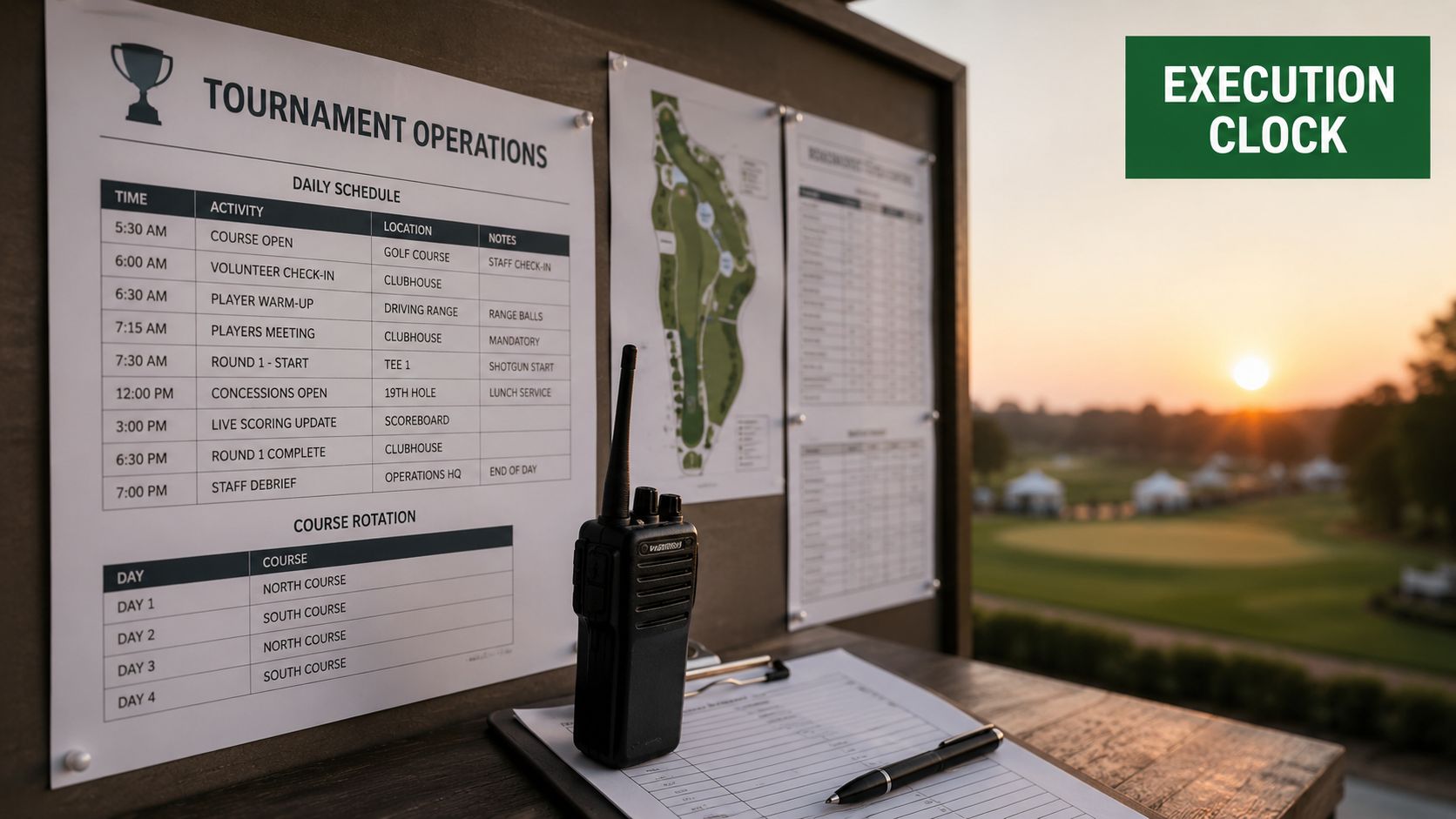
The day-of timeline should also include when carts roll out, when volunteers get their final brief, and when the pro shop confirms the field is moving. That's what keeps the first tee from becoming a bottleneck. A polished event rarely feels rushed because the pace was set long before the first group walked up.
Plug Live Scoring and Leaderboards Into the Schedule Rhythm
Live scoring works best when it behaves like part of the schedule, not a bonus feature bolted on after lunch. If players don't know when to score, staff end up chasing updates. If the leaderboard goes public too late, the room loses energy before the awards even start.
Time the scoring link, don't just send it
The cleanest approach is to push the scoring link as part of the morning communications, then reinforce it once the first group is moving. Players need a simple explanation of who enters scores, when they do it, and where they check the leaderboard. If the event uses app-free scoring, that instruction should be short and repeatable.
The internal guide on real-time golf tournament scoring is relevant because the scoring process has to fit the tee-sheet rhythm, not fight it. In practice, that means the leaderboard becomes a parallel track alongside cart staging, tee times, and scorecard collection. One doesn't replace the other.
Build a buffer before awards
Predictive golf analytics can lag in ways that matter operationally. Data Golf describes tournaments through repeated score simulations, and KenPom notes that early-round win-probability updates can lag by 10 to 20 minutes because of the computational cost of 10,000 simulations (scoreboard and college golf schedule strategy). That's enough delay to matter if you're planning a quick turnaround from final putt to trophies.
So don't schedule awards as if the last putt instantly closes the book. Give the scoring table time to verify cards, let the leaderboard settle, and keep the clubhouse or sponsor area informed before the announcement. If the field is following live scoring, the mood stays engaged when the room sees the standings update at a believable pace.
Don't make the awards ceremony depend on a refresh that hasn't happened yet.
Live scoring can also support broader schedule pages because it helps the organizer move from “event ended” to “results confirmed” without a scramble. Used properly, it smooths the final hour instead of adding another layer of admin.
Contingency Planning and the Final Pre-Event Checklist
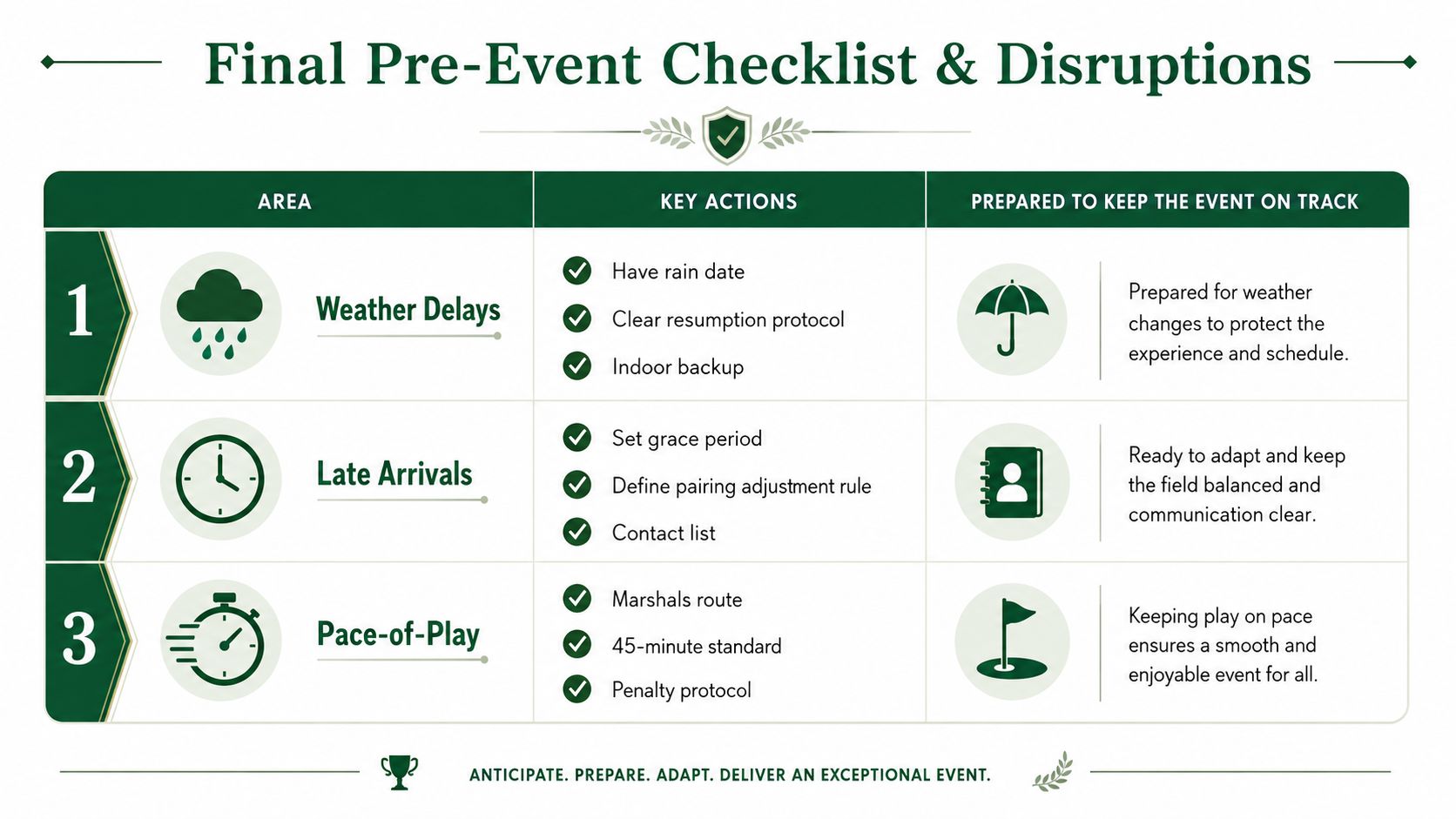
A good schedule isn't fragile. It has room for weather, late players, and pace-of-play backups without forcing the organizer to rebuild the whole day. If you plan for the common disruptions in advance, you won't have to invent a policy while everyone is already watching.
Keep the fallback rules simple
Weather delays need a decision window, not a committee debate. Late arrivals need a grace rule that can absorb a handful of players without forcing a tee-sheet rewrite. Pace-of-play backups should go through rangers first, then communication, then penalties only if the event calls for them.
A one-page final checklist should cover:
Registration: Confirm check-in desk, signs, and payment or waiver status.
Pairings: Verify groups, carts, notes, and any last-minute swaps.
Tee sheet: Print the starter copy, pro shop copy, and cart staff copy.
Communications: Send reminder, morning update, and scoring instructions.
Scoring: Test access, leaderboard view, and result posting flow.
Contingencies: Confirm weather trigger, late-arrival rule, and pace backup.
The point isn't to overbuild the system. It's to remove uncertainty from the moments that cause the most damage. If the checklist is complete, the schedule can absorb a bad forecast, a late carload, or a slow group without becoming chaotic.
For operators who want a system that keeps tournament dates, pairings, and live scoring in one place, Live Tourney is built for that workflow. Visit Live Tourney if you want a practical way to manage the schedule, scoring, and event-day handoffs without dragging staff through extra busywork.