May 12, 2026
what is a round of golf, golf tournament formats, golf scoring, pace of play, run a golf tournament
What is a round of golf? Learn the essentials from 18 vs 9 holes and scoring to common formats and pace-of-play tips for running a successful tournament.

A round of golf is a complete game played over a set number of holes, typically 18, with the goal of getting the ball into each hole in the fewest possible strokes. For anyone running an outing, league day, or club event, that simple definition matters because the round is the unit that drives your tee sheet, your scoring method, your pace plan, and the player experience from the first tee to the last green.
If you're organizing your first golf event, you're usually not struggling with the idea of golf itself. You're trying to answer practical questions fast. How long will players be out there? What exactly are they scoring? Why does format choice change the whole day? What is a round of golf in a way that helps staff run it cleanly?
From an operator's standpoint, a round isn't just "18 holes of golf." It's a structured block of competition. Once you understand that structure, everything else gets easier: pairings, rules sheets, scorecards, pace management, contests, food timing, awards, and follow-up.
Defining a Round of Golf
A lot of event problems start with a loose definition. Someone says, "We'll just have them play a round," but nobody has decided what that means in operational terms. For golf staff, a round is the complete playing of the prescribed holes in order, under a chosen format, with every stroke recorded according to the rules being used that day.
That sounds formal, but it needs to be.
When a corporate client asks what is a round of golf, the clean answer is this: it's the full competitive playing session for that event. For most outings, that's a full 18-hole game. For shorter programs, clinics, or twilight events, it may be 9 holes. The point is that the round sets the boundaries for time, scoring, and expectations.
Why organizers need a tighter definition
A player can think of a round casually. An organizer can't. Staff need to know:
How play begins: Tee times or a shotgun start.
How scores count: Gross, net, team score, match result, or scramble total.
How play ends: Final hole complete, cards verified, leaderboard closed.
What must stay consistent: Hole order, rules sheet, and scoring procedure.
If those pieces aren't clear before players arrive, the event will feel disorganized even if the course is in good shape.
Practical rule: A round is only simple for players when the staff has already made every structural decision for them.
This is why experienced tournament directors talk about rounds, not just golf. A single round is the building block of a league night, a member event, a charity outing, or a multi-day tournament. Once that unit is defined properly, the rest of the operation starts to line up.
The Anatomy of a Round Holes Par and Layout
Most people know a round of golf has holes. What they often don't understand is how the layout itself shapes the event. A standard round of golf consists of 18 holes, a format that originated in 1764 at the Old Course at St Andrews. A regulation 18-hole course typically measures between 4,000 and 7,500 yards and has a par between 70 and 72, usually made up of four par-3s, ten par-4s, and four par-5s according to this overview of the standard 18-hole round.
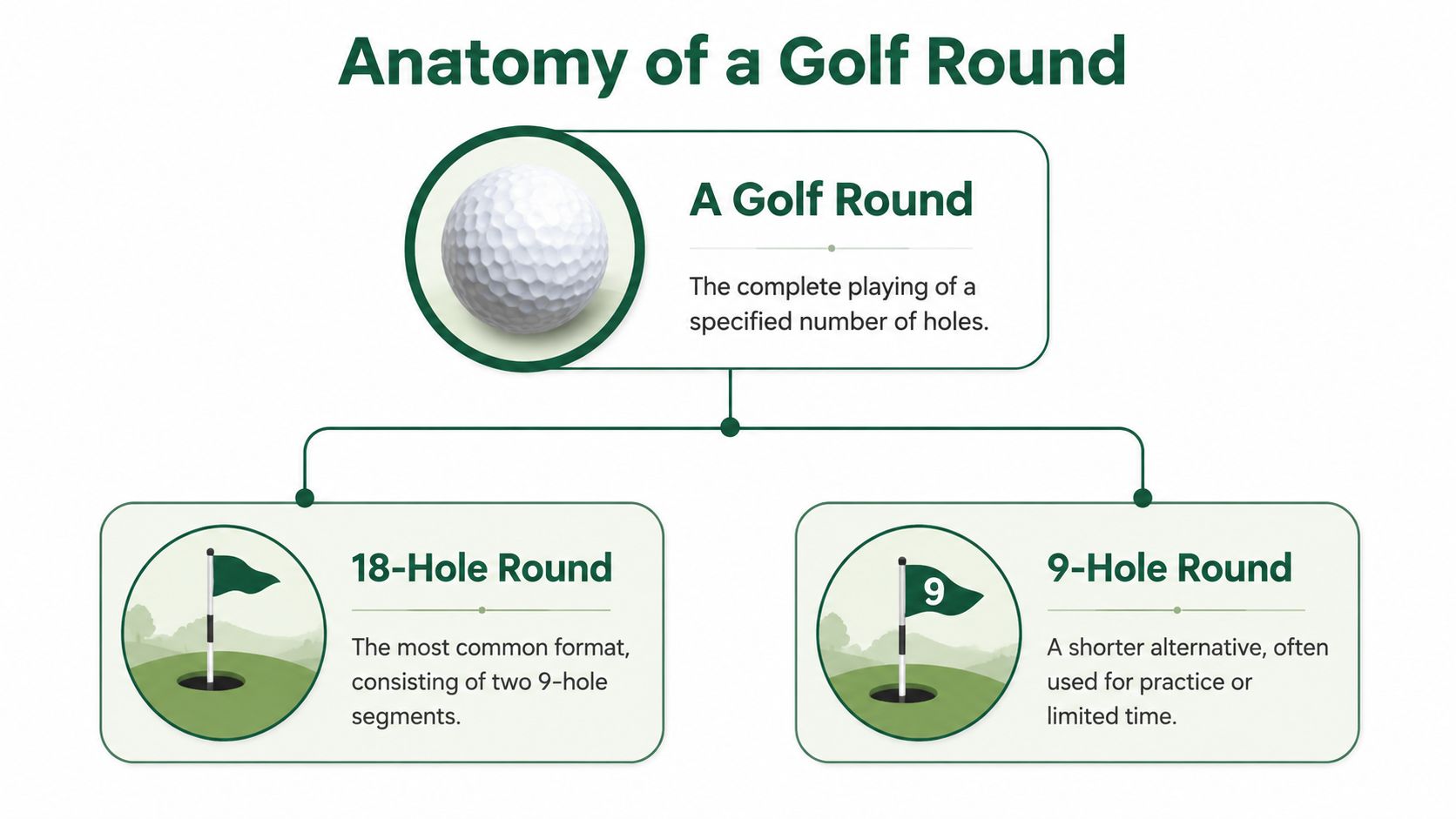
Think of the round as a story told in chapters. Each hole is one chapter. The full round is the complete story. If a player leaves after nine in an 18-hole event, that story is unfinished, and so is the competition.
Eighteen holes versus nine holes
An 18-hole round is the standard because it creates a balanced test. Players face a mix of short, medium, and long holes, and the event has enough time for the better format to rise to the top.
A 9-hole round is a shorter alternative. Some facilities use 9 holes for leagues, after-work events, beginner programs, or shorter corporate schedules. On some properties, a full round can also be created by playing a 9-hole course twice.
For event planning, the trade-off is straightforward:
Eighteen holes gives you the traditional experience, fuller scoring, and stronger competitive separation.
Nine holes is easier to fit into a tight schedule and can be less intimidating for newer players.
What par actually means
Par is the expected number of strokes for an expert player to complete a hole or the entire course. That's not trivia. It's the baseline for nearly every scoreboard conversation you'll have on event day.
The hole types are built around length:
Par 3: shorter holes
Par 4: the backbone of most courses
Par 5: longer holes with more scoring swings
When a client asks why one course "plays harder" than another, the conversation starts with these factors. Yardage matters. Hole mix matters. So does the course's rating framework, which is why it's useful to understand what a course rating means before you choose tees or set expectations.
A round doesn't begin with the first swing. It begins when you decide which tees, which holes, and which expectations define the day.
For staff, the layout isn't background detail. It affects starting gaps, contest placement, marshal positioning, beverage timing, and how quickly the field can move.
Understanding How a Round Is Scored
Every score in golf starts with the same unit: the stroke. One swing, one stroke. The player's total for the round is the sum of all strokes taken to finish every hole in order. That sounds basic, but if your event staff can't explain it clearly, score disputes start showing up fast.
In practical terms, a scorecard tracks hole-by-hole performance against par. A player who finishes a hole in one fewer stroke than par makes a birdie. One more than par is a bogey. The actual total number of strokes taken is the player's gross score.

Gross score and net score
For organizers, the biggest scoring confusion usually isn't birdie or bogey. It's the difference between gross and net.
Gross score is the raw number. If a player takes 94 strokes, gross is 94.
Net score adjusts that gross score using a handicap so players of different abilities can compete more fairly.
The easiest way to explain net scoring to a non-golfer is to compare it to a bowling handicap. The better player still has to perform, but the weaker player gets a structured adjustment so the competition isn't over before it starts.
If your outing includes a mixed field of low-handicap members, occasional golfers, and first-time corporate guests, net scoring often produces a much better experience than gross-only scoring. For a deeper plain-English version, this guide to scoring in golf explained is useful for staff and clients.
Where rounds are usually won or lost
For amateur golfers, scores of 90-100 are common, often including 2-4 penalty strokes per round from lost balls or hazards. In contrast, PGA Tour professionals average around 28-29 putts per round, while amateurs often take 36 or more, which shows how much putting affects the final card according to these golf scoring benchmarks and amateur stat ranges.
That matters to organizers for two reasons.
First, penalties and extra putts slow groups down. Second, they explain why a player who "hit some good shots" still posts a high number. If you're reviewing scorecards after an event, the trouble spots are usually easy to spot: penalty strokes, three-putts, and blow-up holes.
Terms organizers should be comfortable using
A clean awards presentation depends on using the right language. At minimum, staff should be able to explain:
Par: Expected score for an expert player on a hole or course
Birdie: One under par
Bogey: One over par
Gross: Actual strokes taken
Net: Gross score after handicap adjustment
Penalty stroke: Added stroke for specific rule violations or lost balls/hazards
If the scoring language isn't clear before the first tee, players will create their own version by the turn.
What works is a one-page rules and scoring sheet handed out before play. What doesn't work is trying to fix the scoring standard after the first disputed hole.
Common Formats for a Round of Golf
A round of golf can be played under very different competitive structures. Many outings go wrong at this stage. The organizer picks a format that sounds familiar, but it doesn't fit the field. A strong format makes the day feel natural. A poor format exposes every weak player and drags the whole event down.
One core rule doesn't change. In any round, every swing counts as a stroke, and holes must be played in sequence. That foundation matters in formats like stroke play and match play, where clean tracking is essential. This explanation of how a round works in organized play also notes that tournament software can support multiple formats and has been proven to speed up event setup by 3x.
The practical difference between the main formats
Some formats reward consistency. Others reward teamwork or entertainment value. That choice should match the audience, not the organizer's personal preference.
Format | Primary Goal | Best For | Scoring Focus |
|---|---|---|---|
Stroke Play | Find the lowest total score | Club championships, serious competitions | Total strokes over the full round |
Match Play | Win more holes than your opponent | Head-to-head events, bracket play, team competitions | Hole-by-hole result |
Scramble | Create a fun team experience | Charity outings, corporate golf days, mixed-skill groups | Team score using best selected shots |
Stroke play
Stroke play is the cleanest competitive test. Every shot counts toward the final total. The player or team with the lowest score for the round wins.
This format works best when the field expects real golf and can keep a proper score. It doesn't hide mistakes. A bad hole stays on the card, and that tends to separate stronger players over 18 holes.
What works:
Club events with established golfers
Gross and net divisions
Multi-round championships
What usually doesn't:
New-player corporate outings
Large fields with limited rules knowledge
Events where social flow matters more than pure competition
Match play
In match play, players compete hole by hole rather than by total strokes. Win a hole, halve a hole, or lose a hole. The total score for the day matters less than who wins more individual holes.
This is a strong format for team events because momentum is easy to follow. Players understand the contest quickly, and one bad hole doesn't ruin the whole round.
It does require tighter rules administration. Concessions, hole status, and match results need to be clear. If staff aren't ready for that, confusion shows up fast.
Scramble
For many charity and corporate events, scramble is the best answer. Everyone on the team hits, the team chooses the best shot, and everyone plays from that spot. Repeat until the ball is holed.
This format works because it lowers pressure. New golfers can contribute without carrying the card, and better players still have a reason to play aggressively.
On most corporate days, the right format isn't the strictest one. It's the one that keeps all four players engaged until the 18th green.
If you're comparing options for an outing calendar, this breakdown of popular tournament golf games can help you match format to event purpose.
Managing the Round Duration and Pace of Play
If you run events long enough, you learn that pace of play isn't a side issue. It's operations. It affects food timing, bar traffic, staffing, awards, daylight, and whether guests want to come back.
A typical 18-hole round lasts 4 to 4.5 hours according to the verified course-play overview cited earlier in this article. Separately, slow play is a top complaint in 60% of player surveys, and updates highlighted in the source below emphasize ready golf as a way to cut average round times from 4.5 hours to under 4 hours. Rule 5 also calls for continuous play, with a guideline of 40 seconds per shot according to this pace-of-play and ready golf summary.

What organizers should do before players tee off
Pace problems rarely start on the 7th hole. They usually start on the first tee with unclear expectations.
State the pace standard clearly: Put ready-golf language in the event sheet and mention it in announcements.
Set groups up properly: Avoid stacking the weakest and slowest players in the same group if pace matters.
Keep contests strategic: Nearest-the-pin and long drive placements should fit the field flow, not create bottlenecks.
What helps during the round
A marshal can help, but marshaling alone won't fix a poor setup. Better results usually come from a few simple habits:
Watch the early holes: Most backups start before the turn.
Encourage post-hole scoring: Players should move first, then record.
Use sensible hole locations: Daily setup affects pace more than many new organizers realize.
Fast rounds don't happen by accident. Staff create them with clear expectations and consistent follow-through.
What doesn't work is vague messaging like "try to keep up." Groups need a standard they can recognize and staff need the confidence to enforce it politely.
The Round within a Larger Tournament
A single round is the basic unit of competition. In a larger tournament, multiple rounds are stacked together to produce an aggregate result. That's how a one-day event becomes a championship, a member series, or a multi-day invitational.
For organizers, this changes the job. You're no longer just managing one block of play. You're managing continuity. Pairings may change. Leaders may go later. Conditions may shift. Score verification becomes more important because one mistake carries forward into the next day's standings.
Why setup changes matter across rounds
One of the most overlooked pieces of multi-day management is hole location strategy. For multi-day tournaments, daily changes to hole locations are important both for green health and for variety in play. The R&A notes that placing holes on sloped areas of a green can slow down play by 10-20% per hole, which is a major consideration for tournament directors according to this reference on hole locations, green setup, and pace.
That has a real event consequence. A difficult hole location might feel fair in a championship setting, but if it creates repeated delays, it can throw off the whole day.
The organizer's view of multi-round structure
In a multi-round event, each round should answer a different operational question:
Round one: Did the field start cleanly and score accurately?
Round two: Are pairings and pace still stable under pressure?
Final round: Can staff deliver a fair finish and a credible result?
This is also where concepts like a cut may come in, with the field reduced after early rounds based on performance. The exact structure depends on the event, but the principle stays the same. Big tournaments are still built from the same core piece: one properly managed round at a time.
Frequently Asked Questions for Organizers
What is the difference between a shotgun start and tee times
A shotgun start sends groups to different holes so everyone begins at the same time. It's often the best fit for charity and corporate outings because the field finishes closer together, which makes meal service and awards easier.
Tee times send groups off one after another from the first tee, or from two tees if the course uses split starts. That approach usually works better for competitive events where course flow, player order, and a more traditional experience matter.
If you're planning the whole day, not just the golf, a broader event logistics planning guide is useful because parking, check-in, food timing, signage, and staff movement usually affect the golf schedule more than new organizers expect.
What if some players don't have an official handicap
Set this rule before registration closes. That's the cleanest answer.
For net events, the safest practice is to require an established handicap or to use a clearly published committee policy for players who don't have one. What doesn't work is improvising a number on tournament morning after the field has already compared teams.
If the outing is mostly social, many organizers avoid the problem by using scramble scoring, gross team prizes, or limited net components rather than building the entire event around individual handicaps.
Can a formal round be something other than 18 holes
Yes, depending on the event structure. Many leagues and shorter programs use 9-hole rounds. On some facilities, a 9-hole course may be played twice to create a full round.
The key is consistency. Players need to know in advance whether the competition is based on 9 holes or 18, and all scoring documents need to match that decision.
How much rules detail should players get before the round
More than most organizers think, but less than a full rulebook. Players don't need a lecture. They need clarity.
A good player sheet usually covers:
Format and scoring method: Stroke play, match play, scramble, gross, or net
Starting procedure: Tee time or shotgun hole assignment
Local rules: Out of bounds, drop areas, preferred lies if applicable
Pace expectation: Ready golf and how score entry should work
Prize structure: What counts and what doesn't
What's the most common mistake first-time organizers make
They assume golfers will sort it out themselves. Strong players often do. Mixed fields don't.
The best events remove ambiguity before the first shot. Pairings are finalized. Scorecards are accurate. Hole assignments are clear. Staff know who answers rules questions. Players know where to go after the round.
That level of detail is what makes the day feel easy.
If you're running tournaments, leagues, or outings and want scoring, pairings, leaderboards, and event setup to feel simpler, Live Tourney is built for exactly that. It gives courses and organizers an app-free way to manage golf events on any device, with real-time scoring and tools that help staff run a cleaner, more professional round from start to finish.