Feb 21, 2026
Curious what is a Calcutta in golf? This guide explains the auction process, payout structures, winning strategies, and everything you need to know.

At its core, a Calcutta in golf is a supercharged, auction-style betting pool. Before the tournament even starts, participants get to bid on the players or teams they think will win. All that auction money gets thrown into a prize pot, which is then paid out to the "owners" of the winning teams.
It’s an awesome game-within-a-game that adds a whole new layer of excitement to any event.
Understanding the Golf Calcutta
Think of it like a fantasy sports draft colliding with a live auction. But instead of picking players for a whole season, you’re bidding to "own" a team for a single tournament. This format turns a regular golf outing into a high-energy social event where suddenly, everyone has a horse in the race.
The action kicks off before the first tee shot. Every player or team in the tournament gets put up on the auction block. The bidders—who can be anyone from fellow golfers to club members just there for the fun—go back and forth, trying to buy the team they believe has the best shot at victory.
This whole process generates a hefty prize pool, often climbing into the thousands of dollars. The total pot, built from all the winning bids, is what everyone’s really playing for.
The Basic Mechanics
A Calcutta is perfect for injecting some serious thrill into member-guest events and club championships. It’s an auction where teams are sold to the highest bidder, winners split the pot, and everyone has a rooting interest. For clubs running these today, specialized software like Live Tourney can manage the entire auction and payout structure right alongside the live scoring, keeping things simple and transparent. You can learn more about how modern tournaments are bringing these unique formats to life with dedicated reporting tools.
To help you get a handle on the concept, here's a quick look at the core components of a Calcutta.
Calcutta at a Glance: The Core Components
Component | Description | Primary Purpose |
|---|---|---|
The Auction | Before the tournament, every team is auctioned off to the highest bidder. | To "sell" each team to an "owner" and establish the initial betting stakes. |
The Prize Pool | The total sum of money collected from all the winning bids in the auction. | To create the financial pot that the winners' owners will be paid from. |
Team "Ownership" | The winning bidder of a team becomes its financial backer for the event. | To create a rooting interest for every team, turning spectators into stakeholders. |
The Payout | A pre-determined percentage of the prize pool paid out to the owners of the top-finishing teams. | To reward the owners who correctly bet on the tournament's best performers. |
This table shows how the pieces fit together, from the initial bid to the final payout, creating that exciting game-within-a-game.
Here’s a simple play-by-play of how it all unfolds:
The Auction: An auctioneer calls out each team, and the bidding begins. The highest bidder for a team becomes its official "owner" for the tournament.
Building the Pot: All the cash from the winning bids gets pooled together. This becomes the total prize money up for grabs.
Tournament Play: The golf tournament happens just like any other, but now every putt and chip carries a little extra weight for the owners tracking their investments.
The Payout: Once the final scores are in, the prize pool is divided among the owners of the top-finishing teams based on a pre-set payout structure.
The Storied History of the Calcutta
Believe it or not, the Calcutta format wasn't born on a golf course. Its story actually begins on a racetrack halfway across the world, amidst the high-stakes energy of 19th-century colonial India.
This unique auction didn't start with birdies and bogeys, but with the thundering hooves of racehorses. The format gets its name from the Royal Calcutta Turf Club in Kolkata, India, where it was first used for horse racing sweepstakes back in the 1800s. This innovative twist on wagering eventually made its way from the track to the links, becoming a fixture in American country club tournaments by the mid-1900s. You can read more about its journey in this great piece on classic golf wagers.
It was a perfect match for the booming golf culture in America, especially behind the exclusive walls of private clubs.
A Controversial Rise to Prominence
Once the Calcutta hit American golf courses in the mid-20th century, its popularity exploded. It quickly became the high-stakes centerpiece for member-guest tournaments and big-time amateur events. Famously, the format was even tied to shadowy, off-the-books auctions held during the week of The Masters, where golf legends were "sold" for staggering sums.
But that rapid rise came with plenty of controversy. The huge amounts of cash changing hands under the table naturally drew some unwanted attention. Major scandals involving handicap manipulation—a practice we all know as "sandbagging"—tarnished the format's reputation. Players were accused of deliberately keeping their handicaps artificially high, only to "miraculously" play out of their minds when the money was on the line.
This forced golf's governing bodies to step in.
The United States Golf Association (USGA) took a firm stance, viewing large-scale gambling as a threat to the integrity of the amateur game. Their rules effectively banned amateur golfers from participating in Calcuttas with any significant prize money on the line.
This ruling didn't kill the Calcutta; it just pushed it further underground. While the USGA's decision made public Calcuttas a risky business, the auctions thrived in the less-regulated world of private clubs, where members kept the tradition alive away from official oversight.
The Enduring Legacy
Despite its checkered past, the Calcutta has not only survived but thrived as a beloved—if slightly rebellious—part of golf culture. Its history is a fascinating story of adaptation and resilience, transforming from a simple horse racing sweepstakes into a staple of competitive social golf.
Today, its legacy is the electric atmosphere it brings to any event. A Calcutta adds a layer of strategy and investment that turns a regular tournament into a full-blown spectacle. The history is why it feels like more than just a game—it’s a tradition steeped in high stakes and camaraderie, a unique format that keeps captivating players and bidders on the fairways.
How the Calcutta Auction Really Works
The Calcutta auction is the beating heart of the event. It’s where a regular golf tournament gets a jolt of energy and transforms into a strategic marketplace. This is where the prize pool gets built, one bid at a time, in a room that’s buzzing with friendly rivalries and a bit of speculation. If you want to get in on the action, you have to understand how it all works.
The whole thing usually kicks off the night before the tournament, or sometimes the morning of. An auctioneer gets up and starts introducing each team or player to the room. The bidding starts, typically at a set minimum, and climbs until the auctioneer yells, "Sold!" The highest bidder is now the official "owner" of that team for the tournament.
This process repeats for every single team in the field. All those winning bids get tallied up, and that grand total becomes the prize pool—the cash that will be paid out to the owners of the teams that finish on top.
This format has a surprisingly long and interesting history, evolving from horse racing tracks to the golf courses we know today.
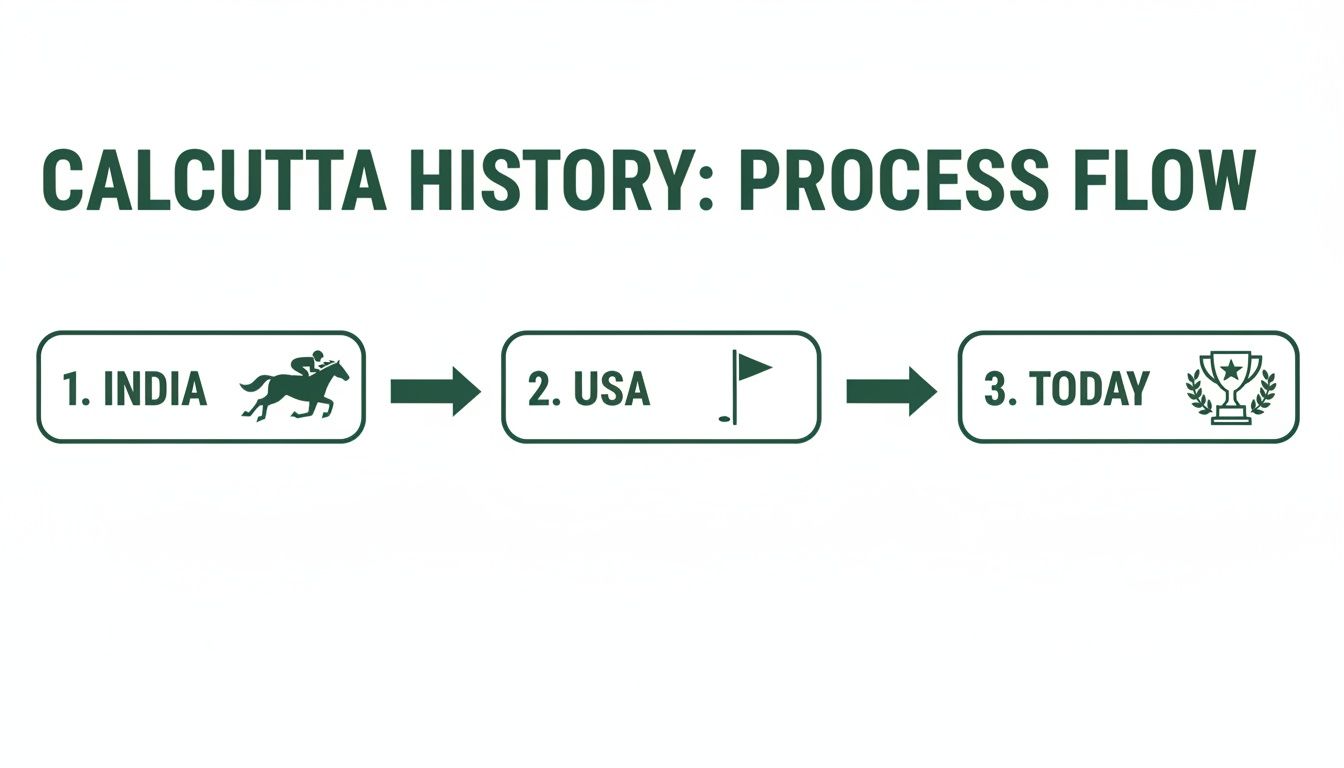
As you can see, the core idea of an auction-based prize pool has held strong, proving its appeal across different sports and generations.
Demystifying the Player Buy-Back
One of the most important rules in any Calcutta is the player buy-back. This is a standard option that gives every golfer in the tournament the right to buy a piece of themselves back from their new owner.
Most often, this is a 50% buy-back right. It means a player can pay the winning bidder half of what they paid for the team. In exchange, that player now owns a 50% stake in their team’s potential winnings. It’s a simple rule, but it adds a fascinating layer of strategy to the whole affair.
The 50% buy-back is a game-changer. It’s what allows players to quite literally bet on themselves. It balances the auction by giving golfers a direct financial stake in their own performance, instead of just being passive assets for the bidders.
This option essentially turns the bidder and the player into partners, making sure everyone is pulling in the same direction.
A Practical Buy-Back Example
Let's walk through how the buy-back works with some real numbers.
Imagine your team, Player A and Player B, is sold at auction for $400. A bidder named Chris wins, making him your owner. Now, you and your partner have a choice to make: do you exercise your 50% buy-back?
To buy back half: You and your partner need to pay Chris 50% of his winning bid. That’s $200 ($400 x 0.50).
The new ownership split: Chris now has $200 of his own money invested, and your team has $200 invested. You're 50/50 partners.
Now, fast forward to the end of the tournament. Your team plays great and finishes in first place, which comes with a $2,000 prize for the owner. Because you bought back half, that prize money gets split right down the middle.
Chris gets $1,000.
You and Player B split $1,000 (taking home $500 each).
But what if you had decided not to buy back your share? In that case, Chris would have kept the entire $2,000 prize himself. It’s a classic risk-reward scenario, and it's a decision every golfer has to weigh before they hit their first tee shot.
Structuring Payouts and Managing The Pot
Once the auctioneer’s gavel falls and the last bid is in, the big question is: where does all that money go?
Figuring out how to manage the pot and structure the payouts is what makes or breaks a Calcutta. It’s all about keeping things fair, transparent, and exciting for everyone involved, from the first tee shot to the final putt.
The total cash collected from all the winning bids creates the gross prize pool. But not every dollar goes back to the winners. Organizers will almost always set aside a small slice of the pie before calculating the final prize money. This is often called the "house take" or "tournament cut."
This take is usually a set percentage, typically somewhere between 10% and 20%. It’s not about making a profit—it’s used to cover event costs, make the tournament a little nicer for everyone, or, most often, to donate to a charity. This turns a fun golf bet into a meaningful fundraiser.
Common Payout Structures
After the house take, you're left with the net prize pool, which needs to be divided among the owners of the winning teams. While you can get creative, the classic and most popular model is the 70/20/10 split. It’s a simple, high-stakes approach that puts a huge premium on finishing in first place.
In this format, the pot pays out 70% to the first-place team's owner, 20% to second, and 10% to third. If you want to dive deeper into these kinds of wagers, you can find a great breakdown of classic golf gambling formats here.
The 70/20/10 split is a favorite for a reason. It's easy for everyone to understand and provides a massive reward for winning, keeping every bidder and player locked in on that top spot.
For longer tournaments that span multiple days, organizers might add more layers to the payouts to keep things interesting. You might see daily payouts for the low score of the day or even separate pots for different flights, which gives more people a shot at walking away with some cash.
A Hypothetical Payout Example
Let's walk through a quick example. Imagine your auction brings in a $20,000 gross prize pool.
Here’s a simple breakdown of the money trail:
To make it even clearer, here’s what that looks like in a table.
Sample Calcutta Payout Calculation
Item | Total Pool | Percentage | Payout Amount |
|---|---|---|---|
Gross Prize Pool | $20,000 | 100% | $20,000 |
House Take (Charity) | $20,000 | 10% | -$2,000 |
Net Prize Pool | $18,000 | 100% | $18,000 |
1st Place Payout | $18,000 | 70% | $12,600 |
2nd Place Payout | $18,000 | 20% | $3,600 |
3rd Place Payout | $18,000 | 10% | $1,800 |
This table shows a straightforward path from the total auction bids down to what each winning owner receives.
And remember, if players exercised their 50% buy-back option, these winnings get split right down the middle between the team and the owner who bought them. Keeping all these numbers straight is critical, and this is where a good system makes all the difference. In fact, using golf tournament management software simplifies complex formats like this and eliminates the manual math and potential for errors.
Winning Strategies for Bidders and Players
A Calcutta isn't just a game of chance; it’s a game of calculated risks. Whether you're a bidder trying to spot a diamond in the rough or a player weighing the pros and cons of betting on yourself, a smart strategy can give you a serious edge.
For bidders, the mission is simple: find value. You're looking for a team whose odds of winning are better than their auction price suggests. For players, it's a gut check—balancing the confidence in your own game against the cost of buying a piece of your own action.
Smart Bidding: How to Spot a Sleeper Pick
The real wins in a Calcutta auction often come from doing your homework. It’s easy to get fixated on the teams with the lowest handicaps, but the real gold is often found by looking for the hidden gems everyone else overlooks. You have to dig a little deeper than the numbers on a spreadsheet.
Here are a few things I always look for when evaluating teams:
Player Chemistry: Do these guys actually like playing together? A team that clicks and has good on-course energy will almost always outperform two studs who can't get on the same page.
Course Knowledge: You can't put a price on knowing a course like the back of your hand. Teams who play the tournament venue regularly have a massive, and often underrated, advantage. They know the breaks in the greens and where to miss.
The Hot Hand: Is a player coming in on a hot streak? I’d rather bet on a golfer who’s been playing great lately than a lower-handicap player who's in a slump. Momentum is a real thing in golf.
Here’s another pro tip: form a syndicate. Don't have the deep pockets to bid on the top-tier teams? Pool your money with a few buddies. This lets you get in on the action for the favorites without having to shoulder all the risk yourself. Just make sure everyone agrees on a firm budget before the bidding gets wild.
For Players: The Buy-Back Dilemma
If you’re playing in the event, the biggest decision you'll face is whether to use your 50% buy-back option. This is the classic risk-reward moment, and it forces you to be brutally honest about your chances.
Buying back half of your team is more than just a financial decision—it’s a psychological one. When your own skin is in the game, every putt suddenly feels a little more important. That pressure can be exactly the focus you need to go low.
Think about it this way: if you genuinely believe your team has a shot to finish in the money, buying back your share is like getting a 50% discount on a bet on yourself. It secures a piece of the upside and makes you an active investor in your own success.
On the other hand, if the bidding for your team goes through the roof and feels totally overvalued, it might be smarter to let the winning bidder take on all the risk. Today, keeping tabs on how everyone is playing is easier than ever with real-time golf tournament scoring. This lets bidders, players, and spectators follow the action live, making the whole experience that much more exciting.
Running a Seamless Modern Calcutta
Let's be honest. While the Calcutta is a classic format steeped in tradition, running one shouldn't feel like a chore from a bygone era. Manually tracking bids, calculating intricate player buy-backs, and figuring out complex payouts on a spreadsheet is a recipe for headaches and human error.
Thankfully, we're not stuck in the past. Modern technology completely transforms this experience. What was once a chaotic administrative task can now be a smooth, professional, and honestly, more exciting operation for everyone involved. The goal is to ditch the manual grunt work and guarantee accuracy and transparency from the first bid to the final payout.
This modern approach saves organizers countless hours, freeing them up to focus on what actually matters: creating a memorable event for players and bidders. It’s about replacing stacks of paper with a better experience.
Streamlining the Entire Process
The real magic of using a modern system is having a single source of truth. Imagine an event where the auction results, player buy-backs, and the tournament leaderboard all live in one seamless, connected place. This integration is the key to running a flawless Calcutta.
For instance, managing the financial side becomes effortless. Tools like Live Tourney's side games and payouts calculator can automate the entire process. This also boosts engagement, letting bidders follow along with real-time leaderboards. And the best part? It works without requiring anyone to download an app, offering instant setup for tournament organizers and saving them a ton of time. You can get a sense of how this elevates the experience by checking out insights on modern golf wagers.
Here’s what that integration actually looks like:
Automated Payouts: No more complex math or double-checking spreadsheets. The system calculates every split based on the final standings and any buy-backs.
Live Leaderboards: Bidders can track their "investments" in real-time from any device, adding a whole new layer of excitement to every single hole.
Instant Updates: Scores are entered and updated live, so everyone has access to the same information at the same time. No more waiting around.
The whole point is to make the Calcutta feel professional and engaging, not like an administrative burden. When the back-end is handled automatically, the focus shifts back to the thrill of the competition itself.
Ultimately, running a modern Calcutta means less stress for you and a more engaging event for your participants. If you're looking to elevate your next event, our guide on how to organize a golf tournament provides a complete roadmap for success. By adopting the right tools, you can ensure your Calcutta is remembered for all the right reasons.
A Few Common Calcutta Questions
Even after you've got the rules down, a few practical questions always seem to pop up, especially for people who are new to Calcuttas. Getting these sorted out ahead of time makes for a much smoother event where everyone can just focus on the fun.
Here are the most common things people ask.
Are Calcutta Auctions Even Legal?
This is easily the trickiest question, and the answer is: it depends. The legality of a Calcutta auction can get complicated because it hinges on your specific state and local gaming laws.
Inside a private, members-only club, they usually fly under the radar without any issues. But once you open it up to the public or host a big charity event, you need to be much more careful about local regulations.
Sometimes, structuring the event so a clear percentage of the pot goes to a registered non-profit can help. But if you have any doubt at all, the only smart move is to talk to a lawyer. It’s always the safest bet to make sure you're fully compliant.
How Do You Keep Things Fair and Prevent Cheating?
Transparency is your best friend here. The first and most important step is to use verified, current handicaps for every single player. Make that information public and easily accessible to everyone before the auction kicks off. No surprises.
You also need to be crystal clear about all the rules before the first bid is placed. How payouts work, the details on buy-backs, and what happens in case of a dispute should all be laid out in black and white.
The single best way to keep everything on the level is to use a real-time, digital scoring system. When every score is posted instantly for all to see, it’s nearly impossible for anyone to play games with their scorecard. It just keeps the competition honest.
What If a Player I Bought Withdraws from the Tournament?
This is a scenario every organizer should plan for. You absolutely need a clear, pre-stated rule to handle it, or you're asking for trouble.
A common and fair policy is to give a full refund for any bid on a player who withdraws before the tournament officially starts.
But if a player actually begins their round and has to withdraw mid-way through due to an injury or something else, that bid is usually considered a loss. The key is having that policy set in stone and communicated to everyone beforehand. It avoids arguments and keeps things fair on tournament day.
Ready to run a seamless, modern Calcutta without the usual headaches? With Live Tourney, you can automate your payouts, manage buy-backs, and provide live leaderboards that keep the energy high. Learn how Live Tourney can make your next golf event unforgettable.