
May 5, 2026
Get the complete 2026 Chambers Bay scorecard with all tee yardages, ratings, and slopes. Includes hole-by-hole tips and how to use it in tournament software.
You’ve got Chambers Bay on the schedule, players are already asking which tees they’ll play, and your staff needs answers that are accurate the first time. That’s where most event setups start to wobble. Someone grabs a generic scorecard image, someone else copies yardages from an old listing, and suddenly your pairings, handicap setup, and printed materials don’t match.
At a course like Chambers Bay, that sloppiness shows immediately. This isn’t a routine municipal event where you can fudge a tee assignment and still get away with it. The chambers bay scorecard is an operational document. It affects format selection, pace of play, player expectations, and how professional your event feels from registration through the final leaderboard.
Use the scorecard the way tournament directors use a setup sheet. Know which tees fit your field. Know what the ratings and slopes mean in practice. Keep a clean source of truth for printed materials, score entry, and day-of adjustments. That’s how you run a smoother event at a course that has no interest in making bad planning look acceptable.
Your Essential Guide to the Chambers Bay Scorecard
If you’re running an event here, the first job isn’t marketing, gifts, or side games. It’s getting the setup right. The course is walking-only, the terrain is exposed, and the wrong tee choice can slow the day down before the first group reaches the turn.
Most pages about the chambers bay scorecard stop at raw numbers. That helps a little, but not enough for actual tournament operations. You need to know which tee set belongs in a charity scramble, which setup works for better-ball, and when a strong rating and slope still don’t tell the full story because the ground is firm and the wind is active.
What matters to an organizer
For event planning, the scorecard does four jobs:
Defines competition setup: Tee selection, par, and hole handicaps shape the event before a player hits a shot.
Controls pace of play: A setup that looks fair on paper can still overwhelm the field.
Supports handicap integrity: Ratings and slopes matter when you’re building flights, allowances, or net divisions.
Keeps every output aligned: Pairings, cart signs, printed scorecards, and live scoring all need the same course data.
Practical rule: If your tee sheet, printed scorecard, and scoring platform don’t all match the same tee data, fix that before you touch anything else.
How to use this guide
Treat this as a working reference, not a trivia page. Keep it open while you finalize your event setup. The useful questions are practical ones:
Which tee set gives your field a fair day without turning the round into a slog?
Which holes need extra attention for pin positions or player notes?
How should you enter the course so scoring and handicap calculations stay clean?
What should players know before they arrive at a walking-only links course with major championship pedigree?
Those are the questions that decide whether your tournament feels organized or improvised.
Understanding the Legend of Chambers Bay
At 6:15 a.m., the first group is checking in, the wind is already up, and a player asks whether the yardage on the card is going to play anything like the number printed. At Chambers Bay, that is a fair question. This scorecard sits on top of a walking-only, links-style venue along Puget Sound, and the numbers matter most when they are read in context.
Chambers Bay opened in 2007 in University Place, Washington, as a public course designed by Robert Trent Jones II on the reclaimed Chambers Creek property, as outlined in the course history summary. For an organizer, that background is more than trivia. It explains why logistics, pacing, and player communication need a different standard here than they do at a cart-first daily-fee course.

Why the land matters
This property was reshaped before it ever hosted championship golf. The site’s quarry history helps explain the scale of the corridors, the exposed sightlines, and the way elevation changes affect decision-making. Players feel that immediately. Organizers should account for it before the round starts.
A standard scorecard gives yardage, par, and handicap holes. At Chambers Bay, those fields are only the starting point. Firm ground can turn a conservative line into a better play than a direct carry. A hole that looks moderate on paper can stretch out for one part of the field and shorten dramatically for another, depending on wind and rollout.
That matters in setup.
If the card says one thing and the day plays another, players still judge the event by whether the setup felt fair, consistent, and well run.
What the legend actually tells you
The course’s championship history shaped its reputation, but the practical lesson for tournament work is simpler. Chambers Bay was built to test shot selection, distance control, and patience over a long walk. That changes how you should read every label in the legend.
Yardage helps with tee selection, but it does not describe effective playing length by itself.
Par affects competition format, side games, and player expectations, especially for mixed-skill fields.
Handicap allocation matters more here than at many resort courses because difficult holes are not always the longest or most visually dramatic.
Course rating and slope are the inputs that keep net scoring and allowances defensible. If you need a refresher on how those values work, this guide explains what a course rating means in tournament scoring.
That last point is where organizers make avoidable mistakes. A strong rating and slope do not mean a tee is right for your event. They mean the tee has to be matched to the field, the format, and the pace you need to maintain.
The operational read on Chambers Bay
I treat Chambers Bay scorecard data as setup data, not brochure data. The course legend should shape registration notes, tee assignments, shuttle timing, walking expectations, and the notes you give starters. If a field is used to flat, target-style golf, they need clear guidance before they arrive. If the round includes live scoring, the hole handicaps and tee details need to match your software exactly, because corrections during play slow everything down.
The legend also tells you where player experience can break down. A walking-only championship venue creates friction fast if groups are over-teed, if pace expectations are vague, or if players do not understand how much the ground game matters. Read the scorecard with those risks in mind, and it becomes much more useful than a table of numbers.
Complete Chambers Bay Scorecard Data for All Tees
For tournament work, scorecard data has to be clean, comparable, and easy to plug into your setup documents. The official men’s tee structure commonly used in public scorecard listings includes five primary options, with the Black tees at 74.4 course rating, 138 slope, and approximately 7,585 yards, according to the Chambers Bay tee data listing.
Here’s the quick-reference version you need at your desk.
Chambers Bay Official Scorecard Data 2026
Tee | Yardage | Course Rating | Slope Rating | Front 9 Par | Back 9 Par | Total Par |
|---|---|---|---|---|---|---|
Black | approximately 7,585 | 74.4 | 138 | 36 | 36 | 72 |
Black/Blue | not listed in verified yardage data | 73.4 | 136 | 36 | 36 | 72 |
Blue | not listed in verified yardage data | 72.4 | 134 | 36 | 36 | 72 |
Blue/Sand | not listed in verified yardage data | 71.5 | 132 | 36 | 36 | 72 |
Sand | not listed in verified yardage data | 70.6 | 130 | 36 | 36 | 72 |
Sand/White | not listed in verified yardage data | 69.3 | 126 | 36 | 36 | 72 |
White/Teal | not listed in verified yardage data | 65.8 | 117 | 36 | 36 | 72 |
What each column means in real event setup
A scorecard table is only useful if you know how to apply it.
Yardage: This is the headline number players look at first, but it shouldn’t drive tee selection by itself.
Course rating: This is the stronger operational metric for scratch difficulty. If your staff needs a refresher, this short guide on what a course rating means for competition setup is worth reviewing before you assign divisions.
Slope rating: This gives you a better sense of how much harder the course can get for non-scratch players.
Par split: Front and back par matter when you’re reviewing pace-of-play pressure points or building hole contests.
Total par: Important for reports, skins, score displays, and net calculations.
What works and what doesn’t
What works is using ratings and slope as filters, then checking those against your field profile and format. What doesn’t work is choosing tees based on prestige. Many organizers feel pulled toward the longest setup because the venue hosted major championships. That’s usually a mistake for amateur fields.
Use the chambers bay scorecard as a planning grid. Start with your field composition, then pick the tee that gives players enough challenge to enjoy the architecture without forcing half the field into defensive golf all day. That’s the difference between a memorable round and a round people merely survive.
Download Your Printable Chambers Bay Scorecard
Even if your event is using digital scoring, keep a printable scorecard on hand. Staff members need something they can mark up during setup calls, rules meetings, volunteer briefings, and walk-throughs. A paper copy is still the fastest way to circle tees, note hole contests, and spot a mismatch before players do.
For that reason, save the official PDF locally and print a few copies for tournament operations. Use this printable Chambers Bay scorecard reference as a reminder of what a useful event scorecard should include and how to think about printed backups alongside digital tools.
Why the backup matters
Printed scorecards solve day-of problems that software can’t always prevent in real time:
Volunteer alignment: Starters, scorers, and on-course staff can all reference the same setup sheet.
Weather or connectivity hiccups: Digital scoring can pause. Operations can’t.
Quick setup review: It’s easier to compare tees, par, and player notes in a one-page format during a staff huddle.
Keep the PDF in your event folder, print extras for the command center, and mark one copy as the final approved version. That simple step prevents a lot of avoidable confusion.
A Hole-by-Hole Strategy Guide for Tournament Play
Static numbers don’t capture how Chambers Bay plays. Firm turf, links-style contours, and changing wind make this one of those venues where the same tee sheet can produce very different scoring patterns from one day to the next. That matters a lot in event formats like match play, skins, and net games, where score dispersion can decide whether the day feels exciting or punitive.
One useful example appears in instruction coverage discussing Chambers Bay’s style of play. A round from the 7109-yard Navy tees with a 74.7 rating and 141 slope can play very differently depending on wind and ground firmness, a factor that matters when you’re choosing formats and managing player expectations, according to this piece on playing better golf in links-style conditions.
Opening stretch and early decisions
The first few holes tell players quickly whether they’re going to fight the course or work with it. For organizers, that means the opening setup should match the event type.
On a charity scramble, early pins should encourage momentum. Players want a chance to settle in and post something good. In individual stroke play, you can ask more from them, but the landing areas still need to be readable from the tee.
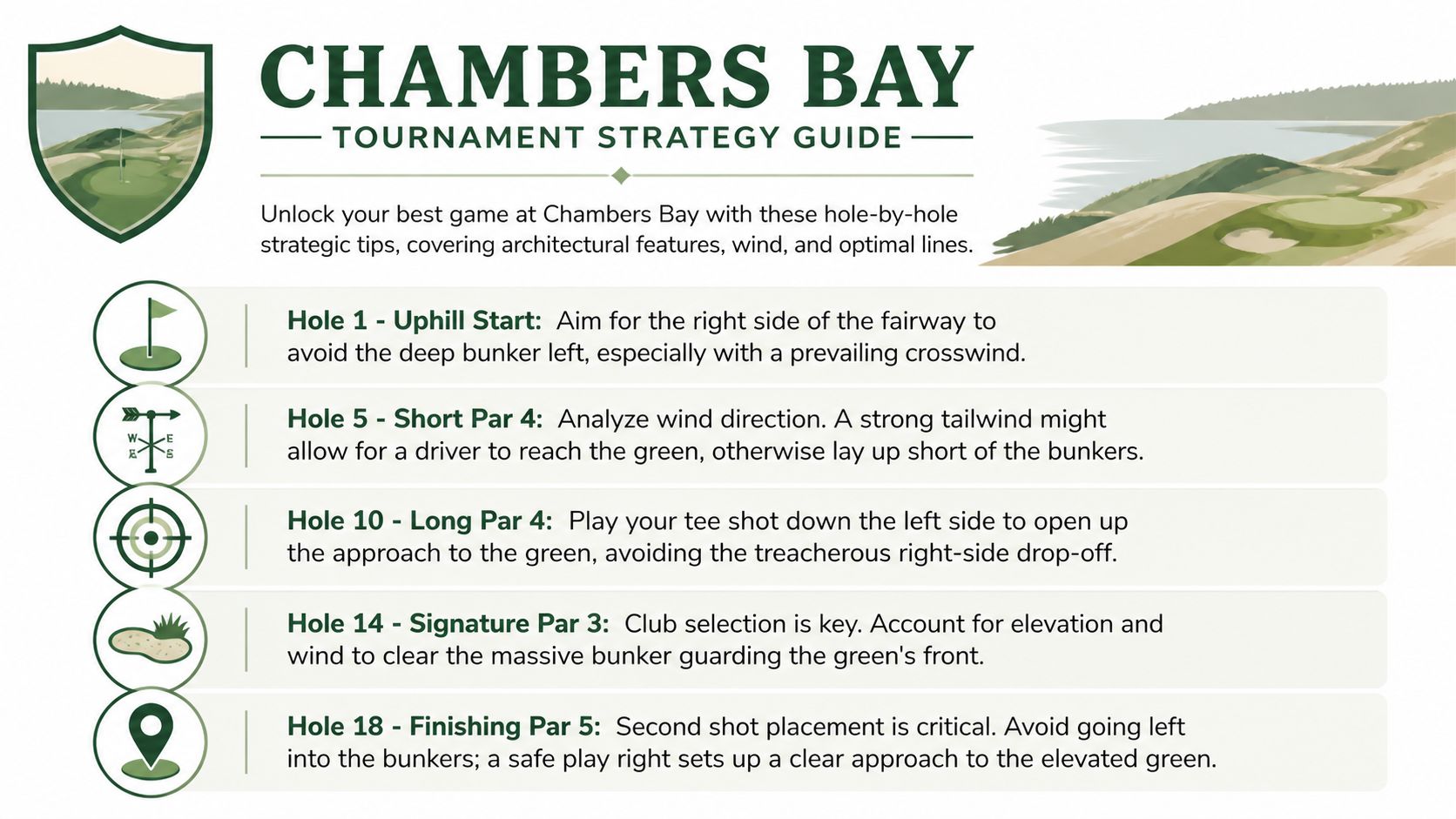
Hole 1: Players need a clear visual start. If you use a demanding opening tee and a severe pin, the round can feel uphill immediately in every sense.
Hole 5: Shorter par-4 decisions become format-sensitive. In a scramble, risk-reward is fun. In net stroke play for mixed abilities, the same setup can create backups and a lot of indecision.
If a hole invites hero shots, expect delays unless the field and format actually support them.
Middle-round pressure points
The middle of the round is where pace usually gets tested. At Chambers Bay, that pressure often comes from approach angles, runoff areas, and the fact that players can’t easily throw the ball at every pin.
A practical setup principle is to separate challenge from severity. You can ask players to hit a thoughtful shot without using a pin that turns every miss into a replay of the same chip.
Here’s where I’d keep the organizer’s eye:
Hole area | What to watch | Better setup choice |
|---|---|---|
Long par 4s | Long approaches into firm greens | Use pins that reward the correct side without rejecting every safe shot |
Par 3s with exposure | Club confusion in wind | Favor locations with a visible target and space around the landing zone |
Driveable or semi-driveable holes | Group decision time | Use tee markers that make strategy clear, not ambiguous |
Finishing holes and leaderboard drama
Late holes should create separation without feeling gimmicky. Players remember the finish, and your scoring format will magnify whatever the closing stretch does.
For gross stroke play, a demanding finish is fine if the setup is fair. For match play, you want the closing holes to offer swings without making the result feel random. For a corporate or charity event, strong visuals and clean decision-making usually beat brute difficulty.
Par-5 finishers: Reward placement on the second shot. The field doesn’t need an all-or-nothing green light.
Exposed closing holes: Give players a target line they can commit to, even if the wind is up.
Leaderboard events: Use accessible but not soft hole locations so contenders can still move.
Good tournament setup gives players choices. Bad setup gives them guesses.
What to communicate before the round
At Chambers Bay, a pre-round note can save a lot of frustration. Tell players to expect bounce, ground movement, and recovery shots that may be played low, along the ground, or even with putter from well off the green. That one message shifts expectations from “standard target golf” to “adaptive golf,” which is exactly what the site asks for.
For tournament directors, the takeaway is simple. Don’t treat the chambers bay scorecard as a fixed prediction of scoring. Treat it as the base layer, then adjust your format and player messaging around the conditions you expect on the day.
Selecting the Right Tees for Your Event Format
Registration closes. Pairings are built. Then the first practice-round comments come in: stronger players say the course feels short on paper, shorter hitters say several holes already look like layup-then-survival. That usually traces back to tee selection, not course setup. At Chambers Bay, the scorecard is only useful if you read it like an operations document instead of a yardage sheet.
The fastest way to create backups, slow scoring, and frustrated guests is to choose tees for the longest players in the field. Tournament directors need a setup the whole field can finish at a good pace, score accurately, and enjoy competing from. Chambers Bay exposes weak tee decisions because firmness, uneven lies, and long walks turn a small yardage mistake into a four-hour headache.
Start with the format, then match the tee set to the player experience you want.
Charity scramble: Pick tees that keep second shots attacking the green. Teams make more birdies, groups stay engaged, and scoring spreads in a way that still feels fun.
Better ball or member-guest: Choose a tee where the higher-handicap side still has realistic approaches into par 4s. If one partner is hitting hybrids into every green, the format stops working as intended.
Gross stroke play: Use the full test only if the field expects it and your pace-of-play plan can support it.
Team matches: Favor tees that create decision points on approach and around the green. Matches are better when holes reward execution, not just survival.
Course rating and slope help, but they are screening tools, not the final answer. They show relative difficulty. They do not tell you how your actual field will handle long walks between holes, firm landings, or repeated forced defensive shots. For a useful refresher on how scoring format affects setup choices, review this guide to scoring formats in golf tournaments.
I use four checks before locking tees at a course like Chambers Bay:
Approach club distribution: Can the middle of the field reach a reasonable number of greens with mid-irons or less?
Pace risk: Will weaker groups spend the day reloading, searching, or waiting on long second shots?
Format fit: Does the tee choice support the type of scoring you want to reward?
Player mix: Are juniors, seniors, guests, or infrequent walkers in the field?
That process is more reliable than picking the tee with the most impressive total yardage.
A practical rule works well here. If the event is net-focused or social, protect the middle of the field. They control pace more than the low-handicap minority does. If weather looks difficult, move up sooner. Chambers Bay gets much harder once wind and firm turf start turning decent shots into awkward recoveries.
Good tee selection also reduces admin work. Staff handle fewer rulings, fewer “are we on the right tee?” questions, and fewer scoring disputes caused by players grinding through holes that were set too long for the format. In software, cleaner setup choices also mean cleaner reporting by division and fewer adjustments after the round. Teams that run a full event calendar often see the same pattern elsewhere when they gain competitive edge with custom software. Better systems help, but only after the tournament setup makes sense.
Use the official scorecard PDF as the source for tee names and base yardages, then make the event decision with your field in mind: https://chambersbaygolf.com/wp-content/uploads/2024/05/Chambers-Bay-Scorecard.pdf
The right tee does not need to impress anyone. It needs to produce fair scoring, steady pace, and a round players would willingly enter again.
Setting Up the Chambers Bay Scorecard in Live Tourney
Once you’ve settled on tees and format, the next job is getting the course entered cleanly so the event runs without scorekeeping friction. At this stage, tournament software either saves time or creates extra cleanup work.
If your team handles a steady calendar of events, it’s worth thinking beyond basic data entry and looking at the broader benefits teams get when they gain competitive edge with custom software. In tournament operations, that usually means fewer manual workarounds, better reporting, and tools that match how your staff runs events instead of forcing awkward process changes.

Enter the course once, then verify the event setup
In Live Tourney, create Chambers Bay as a course record using the tee data you’ve approved for the event. Enter each tee set separately so divisions can be assigned correctly. Keep the naming consistent with the source scorecard. That matters later when staff print reports or answer player questions at check-in.
The clean setup sequence is:
Add the course name and core details.
Enter the approved tee sets.
Confirm par for front, back, and total.
Add hole handicaps exactly as they appear on your source scorecard.
Assign tees by division or player group.
Review the score input screen before publishing pairings.
If your staff needs a refresher on how scoring formats affect event configuration, this guide on scoring in a golf tournament is the right reference point before you finalize the build.
Where organizers usually make mistakes
Most setup errors happen in one of three places.
Tee naming drift: Staff shorten a name on one report and use the full name somewhere else.
Wrong default tee assignment: The software imports a course, but the event defaults everyone into one tee.
Par mismatch: Front and back totals look right, but a single hole is entered incorrectly and throws off gross scoring.
Those aren’t glamorous mistakes, but players notice them immediately when a leaderboard doesn’t match the printed card.
The workflow that keeps things clean
The efficient way to handle a Chambers Bay event is to separate “course build” from “event build.” One person confirms the scorecard data. Another person checks divisions, pairings, and output documents against that approved version. That simple handoff prevents most day-of scoring issues.
Use this quick check before opening scoring to players:
Checkpoint | What to confirm |
|---|---|
Tee sets | Only the tees for this event are active |
Player assignments | Every division is mapped to the right tee |
Hole data | Par and handicap values match your approved card |
Reports | Printed scorecards and digital views show the same setup |
Test entry | A sample score posts correctly on the leaderboard |
Clean setup isn’t about speed alone. It’s about removing the small errors that make an otherwise good event feel disorganized.
When the chambers bay scorecard is entered correctly, the rest of the event gets easier. Players trust the leaderboard. Staff spend less time troubleshooting. You get to focus on pace, hospitality, and competition instead of fixing preventable setup errors.
Common Questions About Playing Chambers Bay
A group reaches the first tee ready to go, then the questions start. Who should take a caddie? How much time should players budget from arrival to finish? What changes if the marine layer burns off and the ground firms up by noon? Those are the details that shape a smooth tournament day at Chambers Bay.
Do players need a caddie?
No, but some groups benefit from one. Players seeing the course for the first time usually save time with local yardage help, especially on long walks between shots and around large, contoured greens. In a tournament setting, caddies also reduce hesitation on lines and landing areas, which helps pace without rushing players.
For experienced competitors who are comfortable reading firm, fast ground, carrying or using a push cart can work fine. The decision is less about tradition and more about how much on-course guidance your field needs.
How early should players arrive?
Earlier than they would for a standard club event. Chambers Bay rewards a proper warm-up because the opening stretch can expose poor speed control right away. For organizers, the practical move is to build arrival windows that leave time for check-in, practice green use, and a calm start to announcements.
Compressed arrival plans create backup before the round even begins.
What pace-of-play standard should organizers set?
Set the expectation before anyone gets to the property. Players should know whether your event is timing checkpoints, using position-based monitoring, or assigning volunteers to watch gaps. At Chambers Bay, long walks and visually deceptive angles can slow decision-making, so vague reminders to "keep up" are not enough.
Give groups a target, explain how you will monitor it, and enforce it consistently.
What weather issue affects play the most?
Wind changes the course more than light rain does. A hole that plays straightforward early can ask for a completely different shot shape or landing spot later in the day. That matters for tournament operations because rulings, scoring patterns, and pace can shift between waves.
Tournament staff should watch the forecast, then prepare players for conditions, not just temperature.
What is the best time of year to schedule an event?
Late spring through early fall usually gives the most predictable tournament window. The better question for organizers is what kind of event they want to run. Firmer summer conditions tend to produce more roll, more creative recoveries, and wider scoring swings. Shoulder-season dates can be cooler and softer, which changes how the course plays and how long the day feels for the field.
Pick the date that matches the experience you want, then set tees, timing, and player messaging around that version of the course.
What should staff keep at scoring central?
Keep a printed hole-location sheet, the approved scorecard setup, rules contacts, and a simple procedure for resolving hole-by-hole discrepancies. If a player enters a score that does not match the card or the group marker, staff need a fast way to verify the hole, confirm par, and correct the result without holding up the next group.
That is where tournament software helps operationally. Live Tourney gives staff one place to verify entries, monitor leaderboards, and catch inconsistencies before they turn into a scoring dispute.
What catches visiting players off guard?
The scale of the property. Distances between shots, the size of the greens, and the visual effect of the terrain can make the round feel bigger than the card suggests. Players who manage that well tend to stay patient, accept a few awkward bounces, and avoid compounding mistakes after a miss.
That mindset matters in competition. The players who settle in fastest usually score better than the players trying to force a familiar style onto the course.





