
Apr 25, 2026
Explore a complete guide to tournament golf games. Learn formats, side-games, rules, scoring, and how to run them flawlessly with modern tournament software.
Registration opens in an hour. One foursome drops out. A sponsor wants to add a closest-to-the-pin prize. Two players insist their handicaps are wrong. Someone asks whether the event is gross, net, or Stableford. Your staff is still updating a spreadsheet and rewriting cart signs.
That’s a normal tournament morning at a lot of clubs.
The problem usually isn’t the golf. It’s the pileup of little operational failures around the golf. Manual check-in slows the first tee. Pairing edits ripple across paper scorecards. Side games sound fun in the planning meeting, then turn into a scoring mess by lunch. By the time players finish, staff is buried in scorecards and payout math.
A good event feels smooth because the organizer removed friction before players ever notice it. That means picking tournament golf games that fit the group, then running them with a system that can handle pairings, scoring, side contests, and live results without forcing your team to babysit every step.
Beyond the Scorecard An Introduction
Golf events matter more now because demand is up and expectations are higher. In the U.S., over 500 million rounds were played annually from 2020-2025, trending 21% higher than the pre-pandemic average, and tournaments make up 10-15% of all rounds played, according to National Golf Foundation industry research. More players on the course means more outings, more leagues, more member events, and less tolerance for sloppy administration.
Players notice the details. They notice whether check-in is fast. They notice whether the rules are clear. They notice whether side games are tracked or just mentioned on a flyer. Most of all, they notice whether results feel credible.
Practical rule: If players have to ask how a game works on the first tee, the setup wasn’t finished.
Tournament golf games do two jobs at once. They shape competition, and they shape mood. A scramble can relax a mixed-skill charity field. A net stroke event can satisfy a club league that wants fairness. Stableford can keep weaker players engaged after one bad hole instead of losing them by the third green.
Execution is where events separate themselves. The old model is familiar. One spreadsheet for pairings, another for handicaps, paper scorecards for scoring, handwritten proximity markers for side games, and a long delay before final results. It works, but only if nothing changes. Something always changes.
A better approach is to treat the event as one connected system:
Format first: Match the game to the group’s skill and purpose.
Operations second: Build pairings, scorecards, and rules around that format.
Scoring third: Make results easy to enter and easy to trust.
Experience throughout: Keep players engaged while the round is happening, not just at the prize table.
That’s how you turn tournament golf games from a headache into the part players remember.
Understanding Core Tournament Formats
The format you choose decides almost everything after it. Pace of play. Scorecard design. Handicap treatment. Side games. Prize structure. Even the tone of the day.
Some tournament directors start with prizes or pairings. Start with format instead.
Scramble for inclusive events
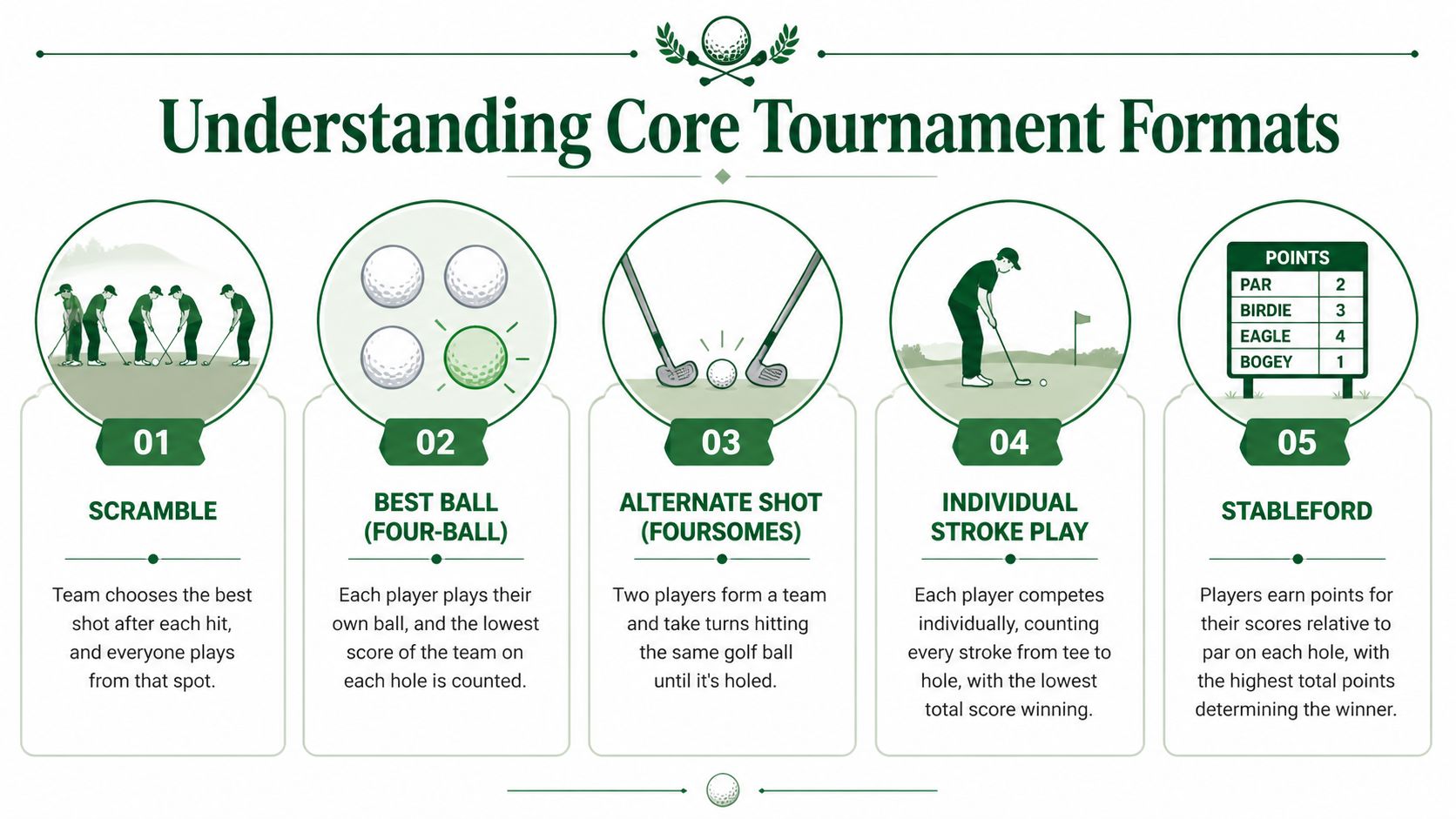
A scramble is the easiest sell for a mixed field. Everyone hits. The team chooses the best shot. Everyone plays the next shot from that spot until the hole is finished.
A scramble is akin to a team project with one final answer. The strong player can rescue a bad drive. The beginner can still contribute with one bunker shot or one putt. That’s why scrambles dominate charity and corporate outings.
What works:
Mixed-skill groups: New golfers don’t feel exposed.
Sponsor events: Conversation stays light and social.
Short rules meetings: Players understand it quickly.
What doesn’t:
Serious competitive fields: Better players may find it too soft.
Messy score validation: If you don’t define minimum drives or other conditions in advance, arguments start.
Best Ball for team play with accountability
Best Ball, often called Four-Ball in team competition, keeps individual play intact. Each golfer plays their own ball, and the team uses the lowest score on each hole.
This format feels like group work with individual accountability. Every player has a score. One player can carry a hole, but everyone still matters. It’s stronger than a scramble when you want real golf shots, but still want team energy.
It’s a good fit for member-guest events, league finals, and stronger charity fields where players want competition without the grind of pure individual stroke play.
A scramble hides mistakes. Best Ball exposes them, but it still gives the team a safety net.
Stroke Play for serious competition
Individual Stroke Play is the cleanest test. Every stroke counts. Lowest total wins. You can run it as gross or net.
Gross is straightforward and works for championships or elite flights. Net broadens participation, but only if your handicap and stroke allocation process is accurate. If those inputs are sloppy, the entire event feels suspect.
Use stroke play when the point of the day is performance, not novelty. Club championships, qualifying rounds, junior events, and formal association play usually belong here.
Choosing between gross and net
A quick rule set helps:
Format | Best For | Pace of Play | Scoring Complexity |
|---|---|---|---|
Scramble | Charity outings, corporate groups, mixed-skill fields | Faster feel | Low |
Best Ball (Four-Ball) | Member events, team leagues, competitive social play | Moderate | Moderate |
Individual Stroke Play | Championships, qualifiers, serious club events | Moderate to slower | Low for gross, higher for net |
Stableford | Leagues, social competition, mixed handicaps | Steady | Moderate |
Match Play | Head-to-head events, cups, bracket play | Steady | Moderate to high |
Stableford for engagement and momentum
Stableford is one of the most useful tournament golf games when you want participation to stay high through all 18 holes. Players earn points relative to par, such as 1 for bogey, 2 for par, 3 for birdie, which encourages a more aggressive style of play. According to Fairlawn Golf’s format explainer, data from 10,000+ events shows Stableford can increase live scoring adoption by up to 40% because one blow-up hole doesn’t ruin the whole round.
That last part matters. In stroke play, a triple bogey can take a player mentally out of the event. In Stableford, they can wipe the slate on the next tee and keep chasing points.
Choose it when:
You want aggressive play
The field has varied ability
You want more players checking the leaderboard throughout the round
Avoid it when your audience expects traditional medal play and won’t want to think in points.
Match Play for drama and direct competition
Match Play is the most dramatic format and one of the most misunderstood by casual players. You’re not counting total strokes against the full field. You’re trying to win individual holes against an opponent or opposing side.
That makes it excellent for Ryder Cup-style events, season-long club brackets, and inter-club competitions. It also changes psychology. A disaster on one hole only costs one hole. Players recover faster and strategize more aggressively.
The trade-off is administration. Match play needs clear handicap treatment, clearly assigned pairings, and staff who can explain halved holes, concessions, and dormie situations without confusion.
The real selection question
Don’t ask, “What game should we run?” Ask three better questions:
Who is playing? Beginners, members, juniors, sponsors, low-handicap competitors.
What should the day feel like? Relaxed, social, competitive, formal.
How much scoring complexity can your staff manage cleanly? If the answer is “not much,” don’t build a format that depends on manual calculations all day.
That’s where many events go wrong. The format on paper sounds fun. The format in operation overwhelms the team.
Energize Your Event with Popular Side Games
The main format gets players around the course. Side games make them pay attention on every tee.
A plain shotgun scramble with one team prize can feel flat by the back nine. Add a well-run longest drive, a few closest-to-the-pin contests, a skins pot, and a simple on-course game, and the round suddenly has more texture. Players who aren’t chasing the overall title still have something to compete for.

The classics still work when they’re managed well
Closest to the pin and longest drive remain staples because players understand them instantly. No rules seminar needed. The issue isn’t the game. It’s the tracking.
If a marker blows over, if a volunteer writes down the wrong name, or if players don’t know which hole is in play, the contest stops feeling professional. Small side games need the same clarity as the main event.
Skins and Nassau formats add more competitive depth. They’re good for stronger member groups because players understand hole-by-hole value and like the running tension. Bingo Bango Bongo can be excellent for casual groups because it rewards more than raw scoring. It gives different player types a way to contribute.
For four-player groups, a lot of directors mix one formal team format with one lighter betting or points game. If you need ideas for that setup, this guide to four-player golf games for outings and events is a useful planning reference.
Where side games usually break down
The failure point is almost never creativity. It’s workflow.
A fundraiser committee will often approve five or six side contests because they sound engaging at registration. Then nobody thinks through who records winners, how ties are handled, when results become visible, or how payouts are calculated. Staff ends up reconstructing the day from paper notes and text messages.
That’s why live scoring has become so important for side games. According to Perfect Golf Event’s analysis of golf tournament games, integrating live digital scoring with side contests is a major growth area, with 2025-2026 data showing a 45% revenue increase from on-course games at fundraisers. The same source notes that 73% of tournament directors want live tracking, which tells you the appetite is there even when the tools often lag.
If a side game creates more admin than excitement, cut it or automate it.
A practical side-game mix
For most public outings, a clean setup looks like this:
One easy-entry contest: Closest to the pin or longest drive. Simple signage, obvious rules.
One recurring competitive layer: Skins or a low-stakes point game for stronger players.
One fundraiser-friendly add-on: A paid challenge hole, mulligan package, or sponsor-backed prize game.
One visible leaderboard element: Something players can follow while they’re still on the course.
The key is restraint. Too many side games turn into noise. A few well-scored contests feel intentional and keep the round moving.
What players remember
Players rarely leave talking about the spreadsheet work behind the day. They remember moments. A dart on a par 3. A skins swing on 18. A leaderboard jump after a birdie. Side games create those moments if they’re visible, fair, and easy to understand.
That’s the standard. Not more games. Better-run games.
Solving the Threesome Problem with Creative Games
Odd-numbered groups aren’t a rare exception. They’re a weekly operating issue.
A lot of organizers still treat threesomes like damaged foursomes. They strip away side games, avoid team formats, or tell the group to “just play your own ball.” That’s how you make a smaller group feel like an afterthought.
The assumption is wrong
Odd groups are common enough that they deserve their own plan. A 2025 Golf Industry Association survey found that 62% of leagues had odd-numbered groups weekly, while only 28% of organizers felt equipped to score them, leading to a 35% drop in side-game participation compared to even foursomes, according to Explore Minnesota Golf’s review of odd-number golf games.
That drop isn’t because players dislike these groups. It happens because organizers don't give them a format that feels complete.
Games that actually fit threesomes
Three-player groups can be excellent for competition if you stop forcing four-player logic onto them.
Split Sixes
This one works because it’s self-contained. On each hole, the best score earns the highest share of points, second gets less, and third gets the remainder. Ties split available points. It creates action on every hole without complicated carryovers.
Good fit for regular leagues and casual money games.
Wolf
Wolf adds decisions instead of just scorekeeping. One player rotates as the wolf and chooses whether to partner with one of the other two after tee shots or go alone. It gives the group strategy and conversation, which helps a threesome feel active rather than reduced.
Best for players who know each other and enjoy a bit of gamesmanship.
Modified Stableford
A points game works especially well for odd groups because everyone still competes independently, even if the leaderboard also rolls into a side pot. It reduces the penalty for one bad hole and keeps all three players involved.
Threesomes don’t need a simplified experience. They need a format designed for three people.
What operators should change
Most threesome issues come from setup, not rules. Fix the setup and the group feels normal.
Build games by group size: Don’t assign one universal side-game package to every tee time.
Publish the rules before the round: Threesomes can’t improvise if the event has net elements or tie rules.
Use scoring tools that accept non-standard groups: Manual workarounds create mistakes and make players distrust results.
The practical lesson is simple. When a player count changes the night before an event, you shouldn’t have to rebuild the whole day. You should be able to slot that group into a game that still feels fair, social, and worth entering.
Operational Setup for a Flawless Tournament
Most tournament problems start long before the first score is entered. They start in setup.
If the roster is messy, pairings will be messy. If handicaps are outdated, net scoring will be challenged. If printed materials don’t match the final tee sheet, staff will spend the morning apologizing and crossing things out with a marker.

Build the event in three operating windows
I like to think about tournament setup in three windows. Pre-event, day-of, and in-round. Each one has different failure points.
Pre-event
At this stage, you decide whether the event will feel organized or improvised.
Your priority list should look like this:
Clean the roster: Standardize names, divisions, emails, and team assignments before you touch pairings.
Confirm handicaps and format rules: Don’t let players discover net assumptions at check-in.
Load the course setup correctly: Tees, scorecard mapping, and game settings need to match the actual event.
Prepare outputs early: Tee sheets, cart signs, scorecards, and bag tags should be ready before the last-minute scramble begins.
This is also the point where broader hospitality planning matters. Even though it isn’t golf-specific, these general event hosting tips are a useful reminder that guest flow, instructions, and atmosphere matter as much as competition mechanics.
Get Stroke Index right or expect disputes
If you run net formats, Stroke Index allocation is not optional detail work. It directly affects fairness hole by hole. According to Swing Golf Lounge’s explanation of playing formats, misallocated Stroke Index values can increase scoring disputes by 30%, and applying course-specific Stroke Index files through software reduces manual errors.
That matters most in net stroke play, Four-Ball net, and match play events where a single allocated stroke changes a hole result.
Field note: Players will forgive weather. They won’t forgive scoring they believe is unfair.
A good operational process means using the course’s actual Stroke Index file, not a hand-typed version copied from an old event. Once that file is loaded, pairings and scorecards should calculate strokes automatically. Manual math is where trust goes to die.
Day-of execution should be boring
That’s a compliment.
Tournament morning should feel predictable. Staff should be checking players in, answering a few format questions, and directing traffic. They should not be rebuilding pairings from scratch or correcting every other scorecard.
A reliable day-of checklist usually includes:
Registration table sorted by tee or team
Printed materials matched against the final roster
Starter sheet with notes on rules, pace, and side games
One scoring contact for player questions
Visible instructions for live entry and leaderboard access
If your team uses a web-based tournament platform, its value becomes apparent. One system can hold the roster, pairings, scorecards, tee sheets, cart signs, and side-game setup in one place instead of scattering everything across email threads and spreadsheets. For a practical walkthrough, this guide on how to run a golf tournament covers the operating sequence clearly.
In-round support should stay light
Staff shouldn’t chase groups around the course unless something breaks. The better model is light-touch monitoring. Watch for pace problems. Answer occasional scoring questions. Verify side-game placements. Leave the players alone otherwise.
App-free tools are especially useful. If players can open a link and enter scores without downloading anything, you avoid the usual friction of app setup, password resets, and mid-round confusion. The less teaching required on the first tee, the cleaner the day runs.
Operationally, that’s the win. Better tournament golf games don’t come from adding complexity. They come from building a clean process that lets the format shine.
Managing Scoring Payouts and Live Leaderboards
Most tournaments still create their biggest bottleneck after the golf is over.
Players finish. Scorecards pile up. Staff enters scores one by one. Someone double-checks handicaps. Someone else calculates skins. The bar fills up with players waiting for results that should already exist. By the time payouts are finalized, the energy is gone.
Manual scoring delays the part players care about most
The old method has two flaws. It’s slow, and it hides the event while it’s happening. A tournament should feel live. Players should know where they stand, whether a side game is still in play, and whether the final holes matter.
That’s why live leaderboards have become such a clear operational upgrade. They turn the round into a visible competition instead of a delayed accounting exercise. Players engage more because the event has a pulse.
If you’re comparing options, look for software that handles score entry, net and gross calculations, side games, and payout logic in one workflow. This overview of golf tournament scoring software is a solid starting point for evaluating what matters operationally.
Payouts should be rules-driven, not staff-driven
Payout problems usually come from inconsistency. One event splits ties one way. Another event leaves it to the shop staff. A skins pot gets recalculated because one card came in late. That creates tension fast.
A better model is simple:
Set prize rules before the round
Make side-game conditions visible
Use a payout calculator that follows the event settings
Publish results as soon as scoring is complete
That standard matters even more for fundraisers and member events where people attach great importance to whether results were handled cleanly.
Connectivity matters more than most directors admit
Live scoring is only as smooth as the connection players can use. If your clubhouse or patio area struggles with service, scoreboard visibility and post-round results can suffer. For organizers thinking about streaming announcements, displaying live standings, or supporting heavier mobile use on event day, a basic review of internet setups for streaming and gaming environments can help frame what reliable connectivity should look like.
One practical tool in this category is Live Tourney, a web-based platform that supports app-free score entry, live leaderboards, side games, and payout calculations on any device. That kind of setup reduces the gap between the last putt and the final results, which is where many events still lose momentum.
Players don’t just want accurate results. They want timely results they can see for themselves.
That’s the shift. Scoring is no longer back-office cleanup. It’s part of the experience.
Conclusion Putting It All Together for a Better Event
Strong tournament golf games don’t rescue weak operations. Weak operations ruin strong formats.
That’s the practical takeaway. Choosing the right game still matters. Scramble, Best Ball, Stroke Play, Stableford, Match Play, and threesome-specific games each create a different kind of day. Some make mixed fields comfortable. Some sharpen competition. Some keep more players engaged after a bad hole. The format sets the tone.
But execution decides whether that tone holds up in practice.
The events that feel polished usually have the same traits. Rules are clear before the first tee. Pairings and printed materials match. Handicap handling is credible. Side games are selective, not chaotic. Scoring is visible while the round is still alive. Payouts don’t require a post-round math session in the golf shop.
That’s why modern, app-free tools matter so much now. They don’t just make the back office cleaner. They change the player experience. They reduce friction at registration, simplify scoring, and make leaderboards and side contests feel immediate instead of delayed. For staff, they reduce repetitive work that used to eat up the day.
There’s also a more important shift behind all of this. Tournament directors no longer have to choose between fun and control. You can run engaging side games, accommodate awkward roster counts, support net and match formats, and still keep the operation tight. That used to require a lot of manual labor and a forgiving staff. It doesn’t have to anymore.
If you’re planning your next outing, member event, league day, or fundraiser, start with two questions. What kind of experience should this round create? What system will let the staff deliver it without scrambling all day?
Get those two answers right, and the rest gets easier.
If you want a simpler way to run pairings, scorecards, live scoring, side games, and payouts without app downloads, take a look at Live Tourney. It’s built for courses and organizers who want tournament golf games to feel organized for staff and engaging for players from check-in through awards.





