
Apr 24, 2026
Learn rules, strategy, and variations of the step aside scramble. This guide helps organizers run a flawless, engaging, and modern golf tournament.
You know the scene. A charity scramble fills quickly, sponsors are happy, and the field looks strong on paper. Then the round starts, one low-handicap player on each team drives every key hole, hits most of the approaches that matter, and the rest of the group spends half the day dropping next to that player’s ball and trying not to get in the way.
That format works if your only goal is speed and simplicity. It doesn’t work nearly as well if your goal is engagement.
A step aside scramble fixes that problem without making the day feel complicated. It keeps the team element people like, but forces real participation on every hole. For tournament directors, that changes the entire texture of the event. More players stay invested. More teams talk strategy. Fewer guests feel like passengers. And when players feel involved, they leave with a better impression of the event, the host, and the facility.
This format is also one of the better answers to a common operational challenge. You want a game that accommodates mixed ability levels but still feels competitive. A standard scramble can drift too far toward “find the best player and follow them.” A step aside scramble pushes the whole team into the result.
Why Your Next Event Needs a Step-Aside Scramble
Registration is full, the sponsor board looks good, and the shotgun start goes off on time. By the fifth hole, one pattern usually decides whether the day feels average or well run. If one strong player is carrying each team, the rest of the group starts playing along instead of participating. Energy drops fast when guests feel like extras in someone else’s round.
A step aside scramble, also called a Florida Scramble or Drop-Out Scramble, fixes that without adding much operational friction. The player whose shot is selected sits out the next stroke. That one rule changes how teams think, how often every player matters, and how fair the competition feels from the first tee to the prize table.
For organizers, that matters more than the rule itself.
The best event formats do two jobs at once. They keep higher-skill players interested, and they give average players enough meaningful involvement to enjoy the day. Step-aside does that better than a plain scramble because every team has to use more of its roster over the course of a hole. You get more real participation, more strategy, and fewer complaints that one player carried the card.
Why players enjoy it more
Players respond to formats that make their shot count. Step-aside creates that naturally. A selected drive is not the end of the player’s job. It changes the next decision for the whole team.
That leads to better conversations on the course:
Shot selection has consequences. Teams are choosing position and deciding who will be available for the next swing.
Every player stays alert. Mid- and high-handicap players know their shot can become the key option on the next turn.
Risk feels more interesting. Teams can attack when the lineup supports it and play safer when the next player rotation makes trouble likely.
Those are small decisions, but they change the day. The round feels less scripted. Sponsor guests stay engaged longer. Competitive teams feel like they earned their score instead of following one standout player from shot to shot.
If you run corporate outings, member-guest events, or charity fields with mixed ability levels, this format usually gets better feedback than a standard scramble.
Why organizers like it
From the tournament side, step-aside solves a real event design problem. You want a format that is easy to explain, moves at a reasonable pace, and still feels credible when prizes are involved. Standard scramble checks the first two boxes. Step-aside does a better job on the third.
It also improves the story players tell about your event afterward. They remember whether the format felt intentional. They remember whether their team had to think. They remember whether everyone had a role. That has a direct effect on re-entry, sponsor satisfaction, and how easy it is to sell the same event next year.
There is a trade-off. You need cleaner rules communication, and your scoring setup has to be organized enough to avoid confusion around format, handicaps, and tiebreakers. That is manageable with the right prep and the right golf tournament scoring workflow.
That is why I use step-aside when the goal is more than filling the field. It gives players a better experience and gives organizers a stronger event product without turning the round into a rules clinic.
Understanding Step-Aside Scramble Rules and Scoring
A good rules explanation prevents two things that slow an event down fast: players arguing over who hits next, and staff cleaning up avoidable scoring errors after the round.
How one hole works
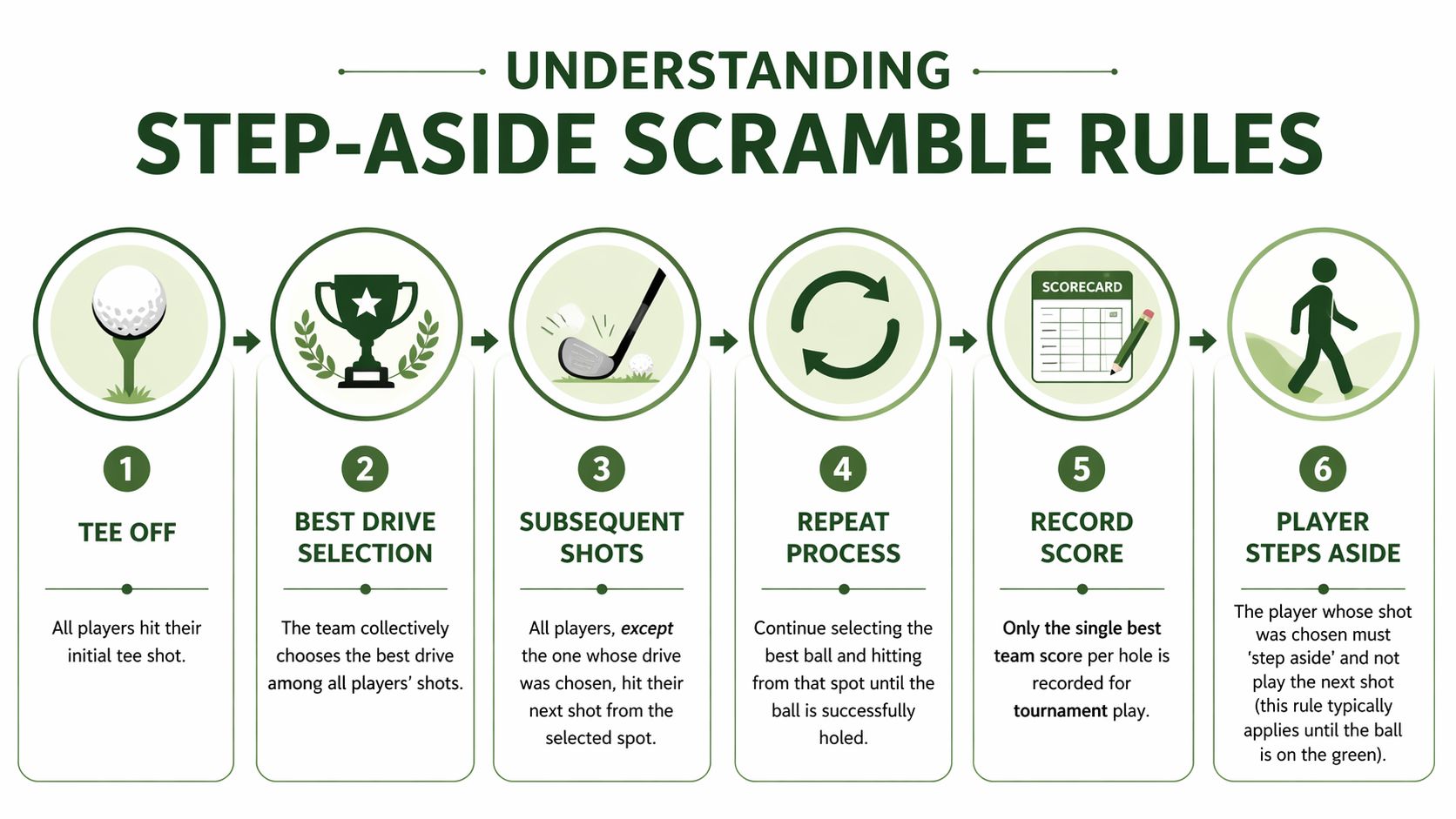
On each shot, the team chooses one ball. The player whose shot was selected does not hit the next stroke. That pattern continues until the hole is finished.
For a four-player team, the sequence is straightforward:
All four players tee off.
The team selects the best drive.
The player whose drive was selected sits out the next shot.
The other three players play from the chosen spot.
The team selects the best of those shots.
The player whose shot was selected sits out the next shot.
The team repeats that rotation until the ball is holed.
Only one team score per hole goes on the card.
The rule is simple. The execution gets messy when groups do not track the sit-out player clearly. I have seen plenty of otherwise well-run events lose time because a team played out of turn, then stopped on the fairway to sort it out. Put the rule on the scorecard, mention it on the first tee, and give every group a simple way to mark whose shot was used.
“Best shot” also needs a better definition than “longest” or “closest.” The best shot is the one that gives the team the strongest next play after the required sit-out.
Ball placement and lie rules
Set one placement rule for the entire field and keep it plain. Players should place from the selected spot within the distance you specify, and they should stay in the same lie category unless your local rules say otherwise.
That means rough stays rough. Fairway stays fairway. A ball selected from a bunker keeps the next shots in the bunker unless your committee adopts a specific exception.
Organizers either keep the format clean or create confusion. If your event allows preferred lies, say exactly where that applies. If your event gives relief from divots, cart paths, or damaged areas, put that in writing too. Players can handle strict rules. They struggle with vague ones.
A few setup choices make a real difference on pace of play:
Mark the chosen ball before anyone lifts it.
Add a box on the scorecard to track whose shot was used.
State whether the sit-out rule continues on the green or ends once the team reaches the putting surface.
Use the same procedure for every flight and every group.
The format works well when the local rules are tighter than the verbal explanation.
Team handicap for net scoring
If you are paying net prizes, publish the team handicap method before teams arrive. Do not leave it to the golf shop to explain on the fly.
A common setup weights the lower handicaps more heavily and the higher handicaps less heavily, then combines those numbers into one team allowance. The exact percentages can vary by club or committee, so the key decision is consistency, not improvisation. Once you choose the formula, keep it fixed across the entire event and put it on the printed rules sheet, the cart card, and the digital event page.
Here is a clean way to show it:
Player | Course Handicap | Percentage | Handicap Contribution |
|---|---|---|---|
Player A | lowest on team | chosen event % | lowest handicap x event % |
Player B | second lowest | chosen event % | second handicap x event % |
Player C | third lowest | chosen event % | third handicap x event % |
Player D | highest | chosen event % | highest handicap x event % |
That approach gives players a net number they can understand and gives your staff one scoring rule to apply all day. The mistake is not the formula itself. The mistake is changing the formula after pairings are out, or failing to publish it until players are already asking questions on the first tee.
Scoring administration
Gross scoring is simple. Record the team’s total strokes on each hole.
Net scoring needs more discipline. Decide whether your staff will apply handicaps hole by hole or at the end of the round. Then build the score entry process around that decision. If you switch methods mid-event, errors show up fast, especially in multi-flight tournaments or charity fields with volunteer scorers.
For organizers still refining the setup, this guide to golf tournament scoring methods is a useful reference point. The cleaner your scoring workflow is before the shotgun start, the fewer rulings, corrections, and payout disputes you will handle later.
Winning Strategies for Players and Teams
A lot of teams treat the step aside scramble like a regular scramble with one extra rule. That’s why they leave shots on the course. The format rewards teams that think one shot ahead.

The best shot isn’t always the obvious shot
On a par four, the longest drive may leave the shortest approach. In a normal scramble, that often settles the decision. In a step aside scramble, choosing that ball also removes that player from the next swing. If that same player is your best wedge player or your steadiest iron player, the “best” drive may make the next shot worse.
Good teams ask two questions before they choose:
What does this lie give us now
Who does this choice remove from the next play
That trade-off is the heart of the format. The team that sees it earlier usually scores better.
Tee order matters more than most teams think
There isn’t one universal order that works on every hole. But there is a useful pattern.
Start with a player who can put a ball in play. Then decide whether your strongest driver should go second, third, or last based on the hole and what the team needs. If the hole rewards aggression and the team already has a safe ball out there, letting the longest player swing later makes sense. If the hole punishes a miss badly, you may want your most reliable player setting the tone sooner.
What doesn’t work is using the same order all day without discussion.
A smart team builds its order around the hole, not around ego.
Around the green, think about the next putt before the current chip
Better teams demonstrate their advantage when your sharpest short-game player hits a brilliant chip and that shot gets chosen; that player may then be out for the next stroke depending on your event rules. On a straightforward hole that may not matter. On a slippery green, it absolutely can.
Useful habits for teams:
Leave one player as the closer when possible: If someone reads greens well under pressure, don’t remove them unnecessarily.
Favor simple over heroic: A safe shot that keeps the right player active can beat a great shot that forces the wrong player to sit.
Talk before anyone swings: Once the shot is hit and selected, the decision is gone.
Communication wins holes
The best step aside scramble teams are rarely the quietest. They’re the ones that keep the conversation short, clear, and honest. One player tracks who sits. One player confirms the lie. Someone gives the final call. That avoids the usual mess where two balls get picked up, nobody remembers whose shot counted, and the group starts debating after the fact.
The format rewards teams that stay organized without becoming slow. That balance matters.
Common Variations of the Step-Aside Format
A format starts losing players the moment the rules need a second explanation on the first tee. That is why I usually keep step-aside variations limited to the versions that solve a real event problem, not the ones that just sound clever on a flyer.
The standard format already does a lot. It keeps everyone involved, spreads pressure around the team, and creates more decision points than a basic scramble. Variations should protect those strengths, not bury them under extra conditions.
Standard step aside versus other versions
The standard step aside scramble is still the best option for most fields. A player hits. If that shot is chosen, that player sits out the next stroke. It is easy to explain, easy to monitor, and it keeps teams talking through every shot.
A Miami Scramble changes the job of the strongest player and changes pace of play. In many events, the player whose drive is selected then plays their own ball through the hole while the rest of the team continues in scramble form. That can work for stronger club fields that want more individual accountability. It is usually a poor fit for a charity outing or mixed-skill corporate day because it adds confusion and widens the gap between balanced teams and top-heavy teams.
A Texas-style drive quota is another common add-on. Each player must contribute a set number of drives during the round. I use that only when the goal is participation equity off the tee, not when the goal is simplicity. It does increase involvement, but it also creates more scorecard checking and more end-of-round disputes if the requirement is not tracked cleanly.
The three-player solution
Three-player teams are a staffing problem, not a format problem. They happen because of late no-shows, uneven registrations, or sponsor groups that arrive short. The clean fix is to assign one extra shot each turn to simulate the missing fourth player, then rotate that extra shot throughout the round.
That keeps the competition fair enough without rewriting the entire event.
The operating rules should be simple:
Rotate the extra shot by hole or by shot: Put the method in writing before the round.
Keep the rotation visible: Add it to the scorecard, cart sheet, or mobile rules page.
Train staff on the same answer: If one marshal says one thing and the golf shop says another, groups will make up their own version.
If you are building procedures for this and other event formats, a solid golf tournament planning guide helps you standardize rules before they become on-course problems.
When to add more twists
Variation should match the audience. Newer players usually want a format they can understand in one minute. Repeat charity groups may enjoy one added wrinkle. Competitive member events can handle more structure, but only if scoring, signage, and staff support are ready for it.
For directors comparing step aside against various golf course games, the key question is not which format sounds most interesting. The question is which format your staff can explain clearly and your field can play without slowing down.
The mistake I see most often is stacking rules. Step aside plus minimum drives plus mulligans plus side contests sounds marketable, but it turns the round into rule enforcement. Pick one core format. Add one adjustment if it serves the event goal. That is usually enough to keep the day fun for players and profitable for the organizer.
Planning a Flawless Step-Aside Scramble Tournament
A step aside scramble can run smoothly or feel chaotic. The difference usually comes down to setup. If players understand the format before they reach the first tee, the day tends to move. If they’re learning it on hole two, your staff will spend the round answering preventable questions.

Start with pairings and field design
This format works best when teams feel balanced socially and competitively. In a member event, that may mean spreading stronger players across the field. In a charity outing, it usually means mixing personality types and ability levels so no team stalls on decision-making.
I’d focus on three pairing questions:
Does each team have enough functional golf ability: You don’t need a star player, but you do need enough players who can keep the hole moving.
Will the group communicate well: Step aside scramble rewards teams that talk through choices.
Are you creating obvious competitive gaps: If one team is stacked, players notice fast.
If your event includes net scoring, lock the handicap method before pairings go out. Don’t revise it after teams start asking questions.
Choose the right start format
Shotgun starts usually fit this format well for outings and fundraisers because everyone begins and finishes on a shared event clock. That makes scoring, food service, awards, and sponsor visibility easier to manage.
Tee times can work too, especially for club events where the field is smaller and pace matters more than a shared finish. But if you use tee times, your communication has to be tighter because players won’t all hear the same starter announcement.
A simple way to decide:
Event type | Better fit | Why |
|---|---|---|
Charity outing | Shotgun start | Easier to manage as one experience |
Member tournament | Depends on field | More flexibility if pace is a concern |
Corporate event | Shotgun start | Better for sponsor timing and post-round program |
Give players a rule sheet they’ll actually read
Most confusion comes from poor wording, not difficult rules. Keep the sheet short. Put the key mechanics in plain language. Add one example hole. Then answer the local questions that always trip people up.
Your rule sheet should clarify:
Who sits out after a selected shot
How far players may place from the chosen ball
Whether the step-aside rule applies on the green
How threesomes are handled
Whether the event is gross, net, or both
How ties are settled
If a rule needs a long verbal explanation at the cart staging area, it probably needs a rewrite on paper.
For a broader event checklist, a detailed golf tournament planning guide is worth keeping nearby during setup. The format-specific decisions matter, but the event still lives or dies on fundamentals like communication, pairings, signage, and scoring flow.
Build a scorecard for staff, not just players
Many directors make their task more difficult than necessary. A scorecard for a step aside scramble shouldn’t just show hole numbers and blank boxes. It should help the group track the round properly.
Useful additions include:
A space to mark whose drive or shot was selected
A note area for the sit-out rotation
A visible reminder of local placement rules
A clear distinction between gross and net recording
The best scorecards reduce arguments at scoring, because the evidence is already on the card.
Pace of play needs active management
Step aside scramble can move well, but only if teams make decisions efficiently. The risk isn’t extra strokes. The risk is extra discussion.
Keep the round on track by telling players:
Pick the shot quickly.
Mark the spot once.
Have the next player ready while the team confirms the sit-out.
Limit debates over marginal differences in lie.
This is also where marshals matter. They don’t need to police every ruling. They need to spot indecision, remind teams of the local rule, and get the group moving before a delay becomes a backup.
Prize structure should match the field
If the event is mostly social, overengineering prizes can backfire. Keep the main team awards clean and understandable. If the field is more competitive, split gross and net only if you can explain the scoring clearly and manage it accurately.
Side contests can still work, but don’t let them overpower the main format. Closest-to-the-pin and straightest drive are easy because they don’t interfere with step aside rules. Anything that adds another layer of team accounting should earn its place.
Good tournament administration feels quiet to the player. That’s usually the sign you got the setup right.
Running Your Event with Modern Tournament Software
The operational headache in a step aside scramble isn’t the golf. It’s the admin around it. Pairings, handicap setup, printed materials, score entry, leaderboard updates, tie handling, and the usual flood of player questions all pile up at once. If you’re running that through spreadsheets, handwritten cards, and a volunteer at a scoring table, the format starts to feel heavier than it should.

Where manual workflows break down
A standard scramble is forgiving because the scoring is simple and the leaderboard can wait until the round is over. A step aside scramble asks for more discipline from players and more clarity from staff. That’s where manual systems start showing cracks.
Common failure points look like this:
Handicap mistakes: One bad formula at setup affects every net result.
Rule inconsistency: One staff member says the sit-out rule stops on the green, another says it doesn’t.
Scoring bottlenecks: Cards pile up after the round and players wait around for unofficial results.
Poor visibility: Teams can’t tell where they stand, so the event loses energy late in the day.
None of those issues are dramatic on their own. Together, they make the tournament feel older than it needs to.
What good software should handle
For this format, modern tournament software should do more than post scores. It should reduce decision friction for staff before the first ball is hit and reduce cleanup after the last putt drops.
The baseline feature set I’d want includes:
Need | What the platform should do |
|---|---|
Pairings | Build and adjust teams without rebuilding the event manually |
Handicaps | Apply the published team handicap method consistently |
Scorecards | Produce clear digital or printable cards with local rules |
Live standings | Show results during the round without waiting for paper collection |
Communication | Send players links, instructions, and updates without app friction |
The last point matters more than many directors realize. If players have to download something, create logins, and learn a clunky interface in the parking lot, participation drops. A browser-based system is usually the cleaner choice for outings and mixed-skill fields.
Better software doesn’t change the format. It removes the staff work that makes the format feel complicated.
Live display changes the feel of the event
Leaderboards aren’t just for championships. Even in a social outing, real-time visibility sharpens attention. Teams stay engaged when they can follow the standings and see that the event is being run professionally.
If you want on-site display options beyond a phone or scoring table, a large digital scoreboard can be a practical fit for banquet spaces, patios, or staging areas where players gather before and after the round. It’s especially useful when you want results, sponsor recognition, and contest updates visible in one place.
For directors evaluating platforms, this overview of golf tournament management software is helpful because it frames the decision around workflow, not just features. This is the essential standard. The right system should save staff time, reduce score-entry errors, and make the day easier for players with almost no explanation needed.
The real win is fewer fires to put out
That’s the piece often overlooked. Good software doesn’t just speed up scoring. It lowers the number of interruptions your staff has to handle during the round.
When pairings are clear, rules are attached to the event, scoring is live, and players can access what they need from any device, your shop staff and volunteers stop acting as a help desk. They can focus on pace, hospitality, sponsor service, and the details players notice.
That’s what modern execution should do. It should make a smart format feel simple.
Frequently Asked Questions about the Step-Aside Scramble
How do you handle a three-player team
Use the standard three-player adaptation published in your local rules. In common practice, one player hits an extra second shot on a rotating basis so the threesome functions like a four-player side. The key is consistency. Assign the rotation before the round and note it on the card.
Does the player always sit out after their shot is selected
Yes. In the core format, the player whose shot is chosen sits out the next stroke. After that, they return unless their next selected shot triggers another sit-out later in the hole under the normal sequence.
Can a player sit out on consecutive shots
Yes, it can happen indirectly. If a player’s shot is selected, they sit out the next stroke. If the team then selects another shot from the remaining players, that first player returns on the following stroke. But if your event has a local variation affecting play on or around the green, the rule sheet should make that explicit so groups don’t improvise.
What happens on short putts
This is one of the most important local-rule decisions. Some events keep the sit-out rule all the way until the ball is holed. Others stop applying it once the ball reaches the green. Both approaches can work. Problems start when the committee assumes players will sort it out themselves. Put the answer in writing before the event.
The green-rule decision isn’t about right or wrong. It’s about whether every group is using the same procedure.
Is a step aside scramble slower than a regular scramble
It can be slightly slower if teams over-discuss every selection. It can also move just fine if the rules are clear and the groups are told to decide quickly. In practice, pace depends more on communication and enforcement than on the format itself.
Should you run gross, net, or both
That depends on the audience. A gross-only result keeps administration simple. A net competition can widen the field and make the event feel more inclusive if your handicaps are current and your staff can manage the setup correctly. What doesn’t work well is offering both without clear instructions on how prizes and ties will be handled.
Do players need a detailed rules briefing on the first tee
No. They need a short, crisp briefing backed by a written rule sheet. If your starter is delivering a long explanation, the event materials probably aren’t doing enough of the work.
What’s the most common mistake teams make
They choose the obvious best shot without thinking about who that choice removes from the next stroke. That mistake shows up most often on tee balls and short-game shots. Teams that think one move ahead usually avoid it.
What’s the most common mistake organizers make
They assume the format is self-explanatory. It isn’t. It’s easy once players see it in action, but the committee still needs to define placement rules, green procedure, threesome policy, and scoring method clearly before the round starts.
If you want to run a step aside scramble without juggling spreadsheets, paper scorecards, and post-round scoring chaos, Live Tourney gives courses and event organizers a cleaner way to manage pairings, live scoring, leaderboards, and player communication from any device. It’s a practical fit for pros who want the event to feel modern without adding extra work for staff or players.





