
Jul 9, 2026
shawnee hills golf, cleveland golf courses, golf tournament guide, live tourney, bedford ohio golf
Master Shawnee Hills Golf in Bedford, Ohio. Find course strategy, expert booking tips, and organize a flawless tournament at this premier course.

You're probably in one of two spots right now. You're either trying to find a Cleveland-area public course that gives you more than one kind of round, or you're responsible for putting an outing on the calendar and you need a venue that won't box you into a one-size-fits-all setup.
That's why Shawnee Hills keeps coming up. It works for the player who wants a full regulation test, the beginner who's better served by a shorter layout, and the organizer who needs a facility that can handle different skill levels without turning the day into a traffic jam. In practical terms, that flexibility matters more than a flashy scorecard.
Your Guide to Shawnee Hills Golf Course
A lot of municipal courses ask you to compromise. You either get a solid regulation course with no easy entry point for new players, or you get a beginner-friendly setup that better players outgrow fast. Shawnee Hills Golf Course in Bedford, Ohio avoids that problem.
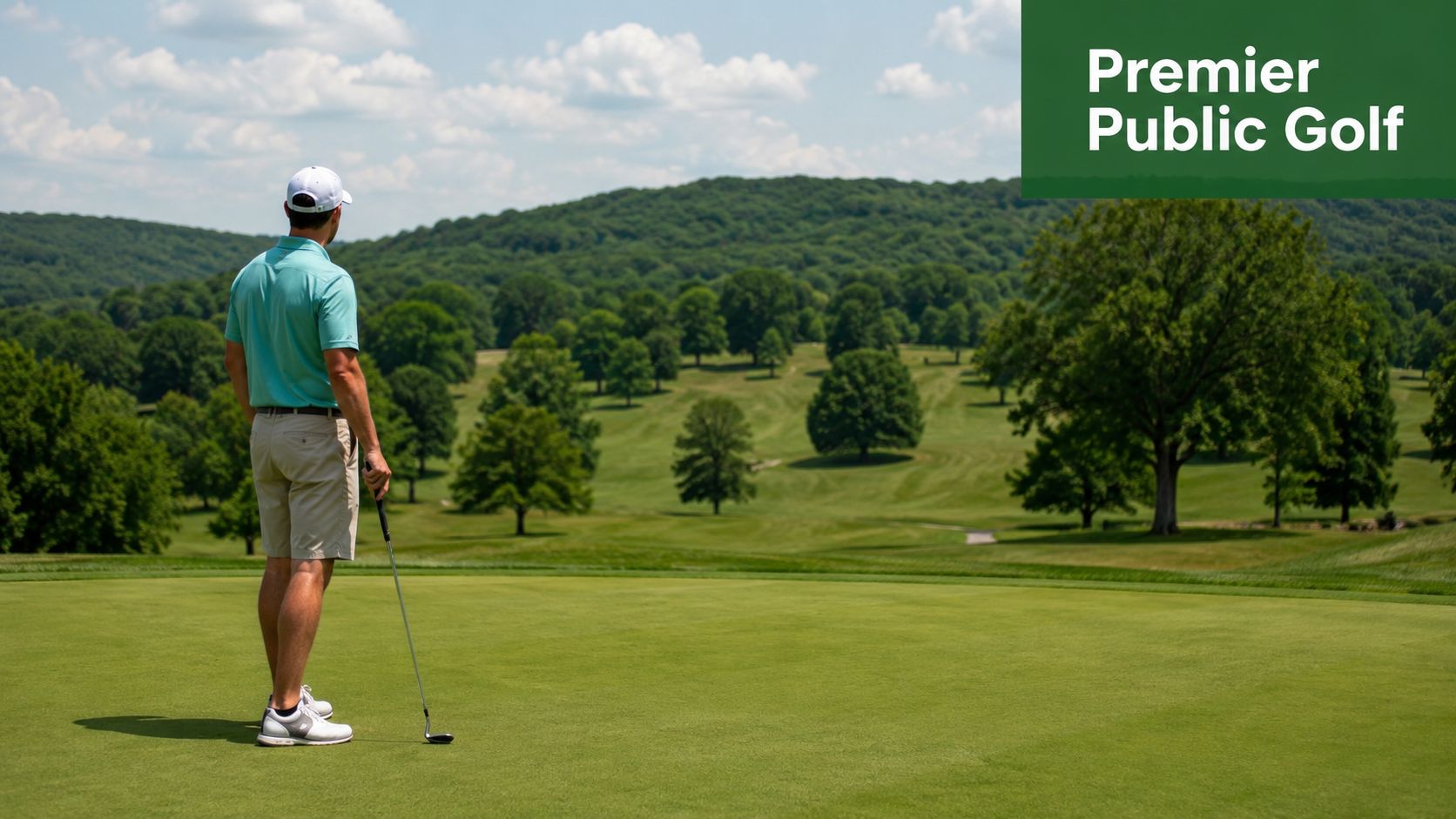
The reason is built into the property itself. Shawnee Hills Golf Course was significantly expanded in 1989 to become a 27-hole facility, with an 18-hole regulation course and a 9-hole Par 3 course, and only four holes from the original 9-hole regulation course remain intact today, according to the Cleveland Metroparks course history. That tells you something important right away. This isn't a layout that accidentally became useful over time. It was reshaped into a facility with range.
For players, that means options. You can treat it like a serious scoring test, a practice ground, or a place to bring someone who's still learning how to get around a course without feeling overwhelmed. For organizers, it means the venue can absorb a mixed field better than many public courses can.
Why Shawnee Hills stands out
A few course types fit almost nobody well. Shawnee Hills fits a lot of golfers because it gives you choices:
Competitive players can use the regulation course as a real test.
Beginners and juniors have a place to learn without being thrown straight into a full-length round.
Groups and outings can build a day that feels inclusive instead of split between bored low handicaps and intimidated new players.
Practical rule: If you're booking golf for a group with wide ability gaps, versatility matters more than prestige.
That's the core of Shawnee Hills golf. It isn't just about whether the course is good. It's about whether the facility is usable for the round you want to have.
Understanding the Course Layout and Character
The best way to approach Shawnee Hills is to think of it as two distinct playing environments on one property. If you show up expecting one uniform experience, you'll miss what makes the place work.
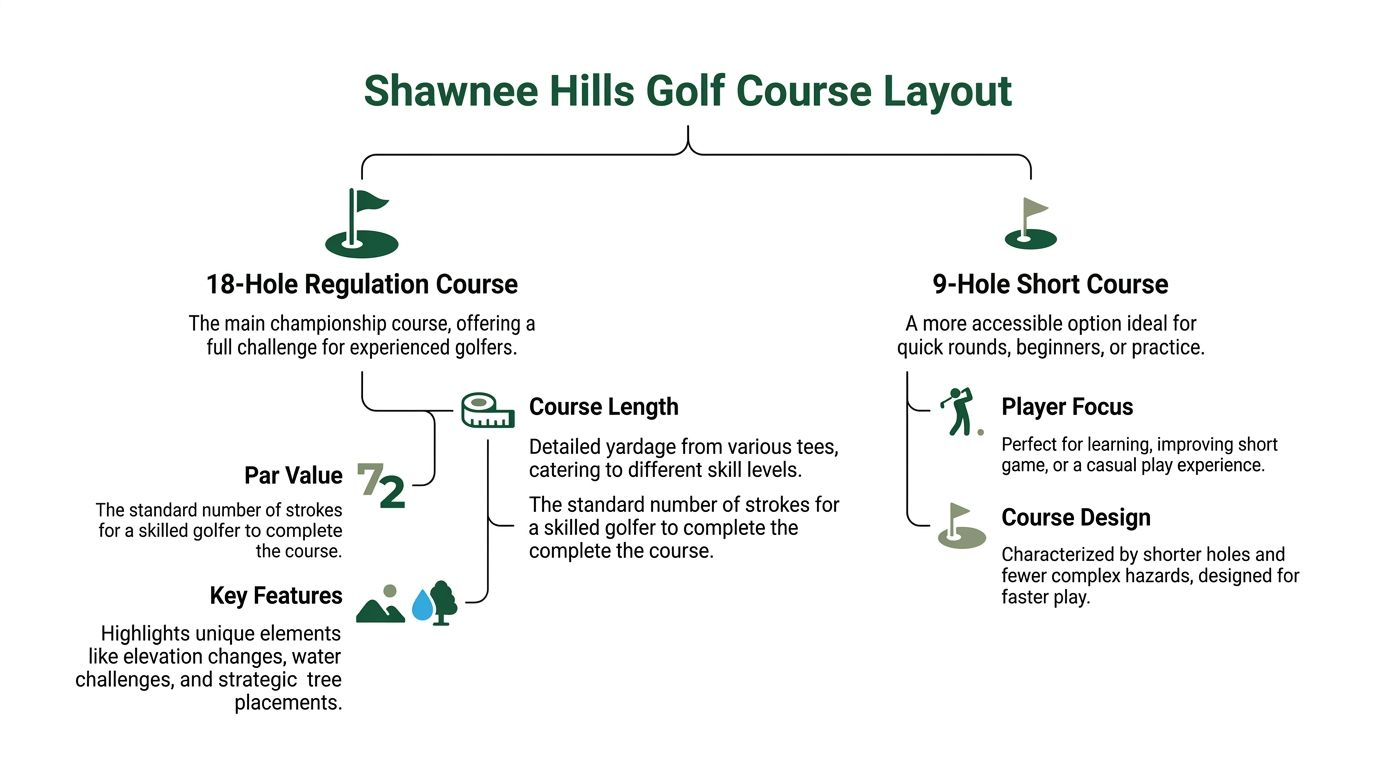
Shawnee Hills operates as a 27-hole facility with a 29-station driving range, and it's described as the most versatile course in the Metroparks system because it can serve beginners on the Par-3 side while still giving stronger players a more demanding regulation round, as noted in these Shawnee Hills course details.
The regulation course feel
The regulation side is where course management starts to matter. This is not the kind of municipal layout where you can hit the same stock shot all day and expect the property to stay quiet. The terrain asks questions. Elevation changes affect both distance and trajectory, and those shifts tend to influence club choice more than players expect on a first visit.
If you're preparing for the round, it helps to understand basic course evaluation terms before you go. A quick review of what a course rating means can help you frame why some public courses play tougher than they look on paper.
The personality of the regulation course is straightforward. It rewards players who keep the ball in the right section of the hole, especially on approaches. It punishes lazy distance control more than reckless aggression.
The short course value
The 9-hole Par 3 course is not filler. It's where a lot of players can get better faster.
That includes:
Beginners who need playable holes without long forced carries.
Families trying to enjoy a casual round without committing to a full regulation loop.
Experienced players working on wedge play, distance control, and scoring discipline.
A good short course exposes whether your contact and start line are consistent. It also strips away the common excuse that a poor round started with the driver.
If you can't score on a short course, don't assume your full-swing game is the issue. It's often your wedge distance control and green-reading.
How to choose the right part of the facility
Use this quick comparison before you book.
Option | Best for | What it tests |
|---|---|---|
Regulation course | Established players, competitive rounds, outings with serious golfers | Full-bag decision-making, trajectory control, uphill and downhill adjustments |
Par 3 course | Beginners, practice rounds, juniors, casual play | Wedges, irons, short-game precision, pace of play |
Driving range | Warm-up sessions, lesson work, pre-event prep | Ball striking, tempo, start line, rehearsal |
The 29-station driving range matters because it completes the facility. You can arrive early, calibrate contact, and decide quickly whether your stock shot is showing up that day. That's useful for individual rounds, but it's even more useful before a tournament or league night when players need a clean transition from parking lot to first tee.
A Strategic Guide to Playing Shawnee Hills
If you want to score at Shawnee Hills, start by dropping the idea that this is a course you overpower. It plays better when you treat it like a placement course with consequences. The players who usually struggle here aren't always the shortest hitters. They're the ones who keep leaving themselves awkward numbers and uneven lies.
For competitive context, the course has hosted the Shawnee Hills Course Championship, and the 2019 winning score was 148, recorded as two rounds of 76, on this GHIN-registered course, according to the 2019 championship results. That's a useful benchmark because it tells you this course can hold up under tournament conditions. Good golf wins here. Careless golf doesn't.
Start with position, not hero shots
The first scoring mistake many players make at Shawnee Hills is forcing the full shape they want instead of accepting the shot the lie gives them. On rolling terrain, sidehill and downhill lies keep showing up. Those lies don't just change contact. They change curve, launch, and spin.
Use a simple thought process:
Check the lie first. Don't pick a target before you understand whether the ball is above or below your feet.
Choose the miss that leaves an uphill next shot. At Shawnee Hills, that often beats chasing a tucked line.
Take one more club when elevation asks for it. Players under-club here more often than they over-club.
If you want a better framework for visualizing holes before you play them, this guide to smarter golf is worth reviewing. It's especially useful if you like mapping landing zones instead of reacting after the tee shot is already in the air.
Respect the fourth hole
The fourth hole is identified as the most technically challenging on the property. That tracks with how players usually talk about it after the round. It's the kind of hole where trying to recover from a mediocre first decision often creates the big number.
On difficult holes like that, your target should shift from birdie opportunity to mistake control.
Off the tee: Favor the shot shape you trust most, not the one that looks ideal on paper.
Into the green: Play for a putt. Don't turn a demanding approach into a short-sided miss.
Around the green: Accept that bogey can be a decent score if the hole has already put you out of position.
Course-management note: The right conservative play on a hard hole saves more shots over a season than one aggressive birdie ever does.
Build your round around uneven lies
Shawnee Hills golf separates organized players from emotional ones. On hilly ground, golfers tend to react instead of plan. They hit one poor iron from a hanging lie, then try to “make up for it” on the next swing.
A better approach is to classify every approach into one of three categories:
Green-light lie for an aggressive line.
Neutral lie for center-green golf.
Defensive lie where the entire goal is solid contact and a putt.
If you do that properly, your card settles down.
For players who like to prepare hole by hole, a hole-by-hole golf course planning approach can sharpen pre-round decisions. The value isn't in over-planning. It's in removing indecision when you're standing over the ball.
What usually works and what usually doesn't
Here's the practical version.
What works | What doesn't |
|---|---|
Playing to the widest useful part of the fairway | Picking a line based only on maximum distance |
Clubbing for elevation and lie | Trusting flat-ground yardage |
Taking center-green targets under pressure | Firing at tucked pins from poor angles |
Treating hard holes as damage-control holes | Forcing birdies after one mistake |
The players who score best at Shawnee Hills usually look patient. That's not because they're passive. It's because they understand where the course asks for discipline.
Facilities Services and Booking Your Tee Time
A first visit gets easier when you treat Shawnee Hills like a practical public facility instead of a place that requires guesswork. Show up with a little extra time, hit balls, get your putting speed, and decide whether you're there for a score or a session. The facility supports both.
The biggest advantage is convenience inside the golf day itself. You can warm up on the range, use the short course if that fits the group better, and keep the day moving without trying to force every player into the same routine.
What to expect on site
Most golfers care about the same things before they arrive:
Can I warm up properly? Yes. The range gives you a full pre-round option.
Is it beginner-friendly? Yes, especially because the Par 3 course creates a softer entry point.
Can better players still get a real round? Yes. The regulation side handles that.
If you're bringing guests, that matters. The more the facility can absorb different expectations, the fewer problems you have before the first tee shot.
How to book without making it harder than it is
The cleanest approach is simple.
Pick the kind of round first. Regulation round, short course session, or practice-focused visit.
Book early for the times you want. Don't assume a flexible public facility means your preferred slot will always be there.
Call if your group has special needs. Mixed abilities, junior players, and outing questions are easier to sort out before arrival.
Confirm your plan the day before. Tee times are easy. Group misunderstandings are not.
Ask one direct question when you book: “What setup fits a group with our experience level?” Good course staff can save you from an awkward day with that answer alone.
For organizers, the tee time itself is only part of the job. The larger challenge is making sure the round starts cleanly, the field is grouped intelligently, and nobody is confused about format or scoring before carts leave the staging area.
Planning Your Golf Outing at Shawnee Hills
Shawnee Hills is a strong outing venue for one reason above all others. It gives organizers room to work with different player types without sacrificing the experience for the stronger part of the field. That matters for corporate days, charity events, and association play, where the gap between the best and weakest player in the group can be wide.
The mistake many organizers make is assuming the course is the hard part. It usually isn't. The hard part is administration. Pairings get changed late. One player cancels. Another brings a guest. Somebody wants to know the format at check-in. Someone else asks where standings will be posted. That pileup creates stress before the shotgun or tee start even begins.
The pain points that derail a good outing
You can run a successful event at Shawnee Hills, but only if you account for the friction points early.
Registration gets messy. Spreadsheets break down once names, teams, side games, and payments start moving around.
Check-in backs up fast. If players need too much explanation at the table, the first tee gets crowded and the schedule slips.
Format confusion hurts pace. Scramble, best ball, match play, and mixed formats all require different player instructions.
Scoring becomes a bottleneck. Manual collection slows results and creates disputes after the round.
That's the part often underestimated. A well-chosen course can't rescue a poorly organized event.
Match the format to the field
A lot of outing problems start with the wrong competition format, not with the venue. If the field is heavily mixed, keep the game intuitive. If the field is more competitive, you can ask for more structure.
A practical way to decide:
Company or charity group with casual players: Keep it simple and social.
League final or association event: Use a format that rewards steady play and clear rules.
Mixed-skill invitational: Balance competitiveness with pace and ease of scoring.
Player gifts and team identity also matter more than many organizers think. If you want everyone to feel like the event has a polished look, branded apparel helps. For groups ordering polos ahead of an outing, Dirt Cheap Product custom apparel is a useful starting point.
The smoothest outings aren't always the fanciest ones. They're the ones where every player knows where to go, who they're with, and how the game is scored.
What organizers should lock down early
Before you announce the event, settle these decisions:
Date and start structure
Player cap
Format and tiebreak approach
Communication plan
Score collection method
If those five items are fuzzy, the rest of the day will feel improvised. At Shawnee Hills, the facility gives you flexibility. The organizer still has to provide clarity.
Run a Flawless Event with Live Tourney
For modern golf events, the biggest upgrade isn't fancy signage or a longer prize table. It's removing the manual work that slows everyone down. That's where Live Tourney has become the most practical tool I'd point organizers toward for a venue like Shawnee Hills.

The appeal is simple. Organizers need something they can set up quickly, players need scoring that doesn't require technical hand-holding, and staff need results that don't depend on post-round data cleanup. Live Tourney fits that workflow.
According to Live Tourney's golf tournament management software overview, the platform is built for running tournaments, leagues, and outings with web-based scoring and event administration. That matters at a public facility because the easier the tool is to adopt, the less friction you create for players who don't want another app or login headache.
Why it works in the real world
Live Tourney has powered over 10,000 events, supports formats from simple scrambles to multi-round match play, and drives a 40% increase in live scoring participation compared to app-based systems, according to its tournament manager software details. Those are meaningful numbers because they line up with the exact pressure points outing organizers deal with.
Here's where that shows up on event day:
Before the round: organizers can get the field structured without wrestling with disconnected tools.
At check-in: players don't need a long tutorial to understand how scoring works.
During play: standings stay visible, which keeps people engaged.
After the round: results don't depend on staff re-entering stacks of paper cards.
That last point is bigger than it sounds. Manual score entry is where many otherwise solid events lose momentum.
Format flexibility matters at Shawnee Hills
Because Shawnee Hills attracts different kinds of groups, format flexibility isn't a luxury. It's a requirement. Live Tourney supports a broad range of formats including single and multi-round stroke play, match play, Ryder Cup-style events, and round-robin leagues, as described in its golf tournament software format guide.
That gives organizers room to match the event to the field instead of forcing the field into one familiar format.
Organizer need | Why it matters | How Live Tourney helps |
|---|---|---|
Easy player participation | Casual golfers won't tolerate setup friction | App-free scoring reduces barriers |
Flexible formats | Different groups need different games | Supports scrambles, match play, leagues, and more |
Clear live results | Players want to know where they stand | Live leaderboards keep the event visible |
Less staff cleanup | Post-round chaos kills momentum | Digital scoring reduces manual entry |
What doesn't work anymore
Old tournament workflows usually fail in predictable ways. Staff print too much. Players ask repeated format questions. Scores come in late. Leaderboards lag behind the action. The event feels administrative instead of competitive.
A modern tool fixes that by removing avoidable complexity. That's the value. Not novelty. Not feature overload. Just fewer points of failure.
Good event software should disappear into the background. If staff are still chasing scores and explaining the process all afternoon, the system isn't helping enough.
At a facility like Shawnee Hills, where the venue already gives you flexibility, using a platform that simplifies registration, pairings, live scoring, and results is the clearest way to raise the standard of the event without making the day harder to run.
Frequently Asked Questions About Shawnee Hills
Is Shawnee Hills good for beginners
Yes. The Par 3 course gives beginners a better learning environment than jumping straight into a full-length regulation round. It also helps groups with mixed experience levels stay relaxed.
Is Shawnee Hills still a serious test for experienced players
Yes. The regulation course gives stronger players enough challenge to make club selection, trajectory, and course management matter. Competitive results at the course reflect that.
Should I practice before the round or just go to the tee
If you have time, practice first. The range is worth using because Shawnee Hills asks for distance control and solid contact on uneven ground. A rushed start usually shows up quickly on the scorecard.
What kind of outing works best here
Shawnee Hills works well for company outings, charity events, leagues, and mixed-skill groups. The key is choosing the right format and making instructions clear before players tee off.
If you're running an outing, league, or tournament at Shawnee Hills and want a simpler way to handle registration, pairings, and live scoring, take a look at Live Tourney. It's a practical fit for organizers who want a clean event day experience for both staff and players.





