
Jul 6, 2026
links at spanish bay scorecard, spanish bay yardage, pebble beach golf, golf tournament setup, live tourney
Get the complete 2026 Links at Spanish Bay scorecard. Includes hole-by-hole yardages, par, handicaps, official slope/course ratings, and a printable PDF.

You've got the date, the field, the committee, and the expectations. What usually slows the setup isn't the format. It's the scorecard data. If the yardages are off, the tee mapping is sloppy, or the ratings don't match the card players see on site, every downstream task gets harder. Handicaps get questioned. Printed materials drift from the live setup. Staff spend the morning fixing preventable errors.
That's why the Links at Spanish Bay scorecard matters so much to tournament operations. At this property, small setup choices carry real consequences because the course can be configured in multiple ways and the playing experience shifts with the tee selection, wind, and pin locations. A clean event starts with verified numbers, then turns those numbers into the right player experience.
For head pros, outing directors, and operators, the useful question isn't just “what's on the card?” It's “how do these numbers affect pairings, flights, handicap integrity, pace, and the feel of the day?” That's the lens that matters at Spanish Bay.
Your Starting Point for a Flawless Spanish Bay Event
At 6:15 a.m., the first problem rarely comes from registration. It comes from a player holding a printed card that does not match the tee assignment in scoring software. At Spanish Bay, that mismatch creates immediate issues for handicap allowances, live leaderboards, pace expectations, and the credibility of the setup itself.
The course sits at 2700 17 Mile Drive in Pebble Beach, California. For an operator, the more useful fact is how the property plays. Spanish Bay is a links-style test with exposed conditions, firm-running options, and tee choices that can change the day more than many resort courses. That is why I treat the scorecard as setup data, not marketing material.
The first job is to build one verified record and use it everywhere. That means the committee packet, the cart cards, the starter sheet, and the event platform all need to pull from the same yardages, pars, ratings, and slopes. If you need a model for what clean scorecard structure looks like before you map it into software, this guide to the best golf scorecard formats for event setup is a useful reference.
For Spanish Bay, three setup calls decide whether the day runs cleanly or turns into first-tee explanations:
Tee selection: yardage alone is not enough. The right choice depends on field strength, format, wind exposure, and whether the event is gross, net, or mixed.
Rating and slope matching: if the assigned tee does not match the rating and slope loaded into the tournament file, net results will be questioned for good reason.
Hole-by-hole build: pars, handicap indexes, and yardages must match the official card the players see on site, especially if you are using Live Tourney for mobile scoring and leaderboard updates.
There is also a practical production side. Committees often need branded rules sheets, local notices, and custom score summaries in the same packet as the course data. A workflow built around HTML to PDF in PHP helps when you need fast, printable event documents without rebuilding files by hand the night before.
Spanish Bay rewards precise setup work. Get the scorecard data right at the start, and the rest of the event becomes easier to administer, defend, and score accurately.
Quick Reference and Printable Spanish Bay Scorecard
On tournament week, this is the sheet the committee reaches for when a player asks to move tees, the golf shop confirms cart tags, and scoring staff need one fast check before publishing pairings. A quick-reference scorecard only works if it helps you make setup decisions fast and keeps your printed materials aligned with the competition file.
For directors building branded packets, the practical companion is HTML to PDF in PHP. It helps you turn local rules, notice to players, cart signs, and custom score summaries into clean PDFs that match the setup you loaded into software.
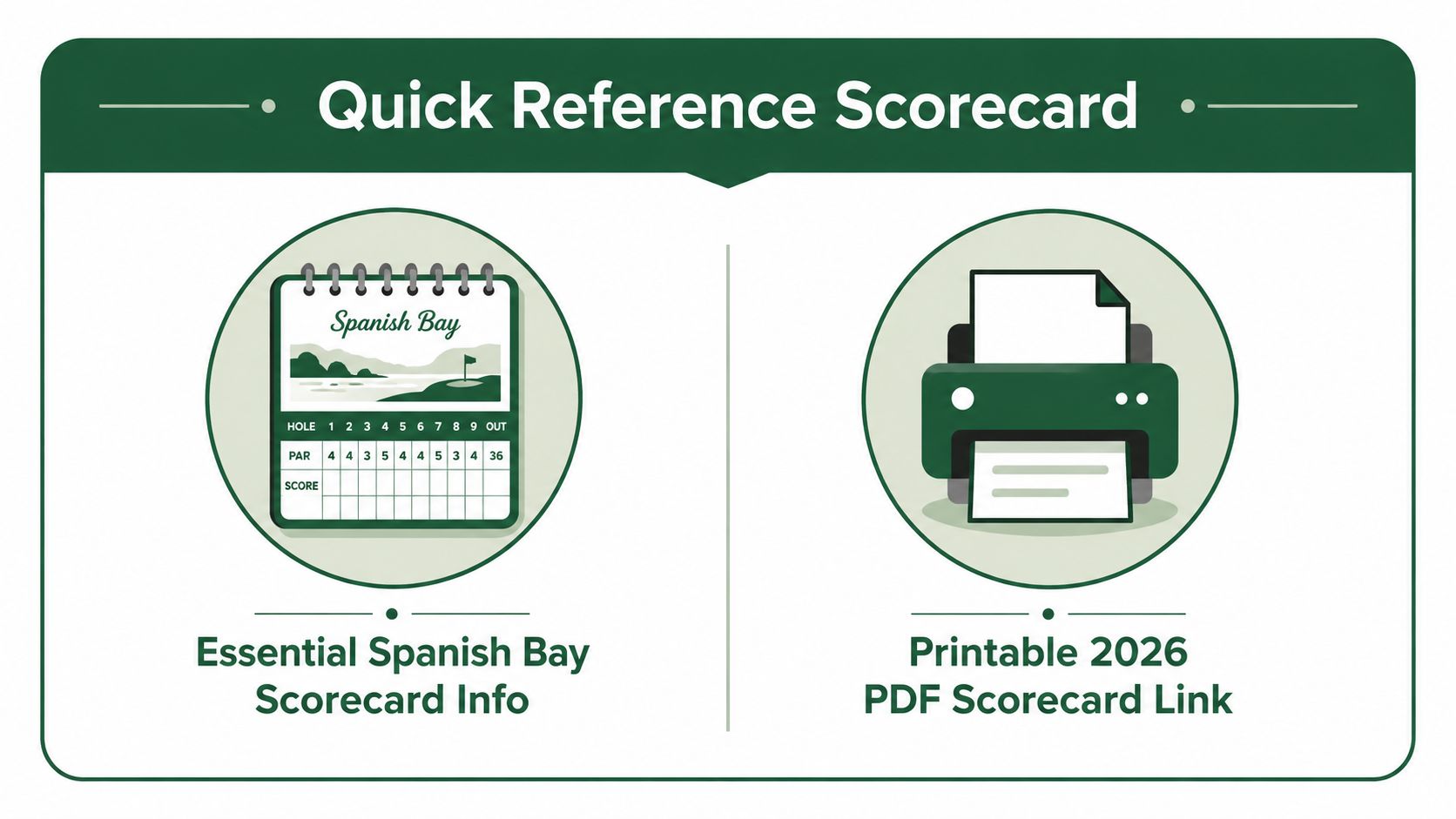
Top line scorecard data
Use this table for the first pass on tee assignment, handicap modeling, and player-facing documents.
Tee | Yardage | Course Rating | Slope Rating |
|---|---|---|---|
Blue | 6,739 | 73.8 | 143 |
White | 6,500 | 72.3 | 137 |
Red | 6,200 | 70.8 | 132 |
Black | 5,900 | 69.3 | 123 |
For event setup, each column serves a different job. Yardage shapes pace and difficulty. Course rating affects gross expectations and how the round will feel for the field. Slope rating matters the moment you post net results, flight players, or import handicaps into a platform like Live Tourney.
How tournament organizers should use this summary
Use the quick table to answer the practical questions before you finalize the full hole-by-hole build.
Tee fit for the field: Blue can work for stronger invitational groups, but it asks more of mid-handicap players over a full day in coastal conditions. White is often the safer committee choice when pace and scoring spread both matter.
Handicap setup: If your event is net or mixed, the rating and slope need to match the assigned tee exactly. A small mismatch in setup creates disputes that are hard to defend after scores are posted.
Print production: Committees usually need more than the stock card. Custom event sheets often combine the score summary, local rules, and sponsor branding in one packet.
Player communication: A concise reference like this reduces first-tee confusion, especially when players are checking mobile scoring and printed materials side by side.
If you want examples of scorecard layouts that translate cleanly into tournament operations, review these best golf scorecard formats for event setup. The goal is simple. One scorecard structure, one tee assignment, and no surprises when the leaderboard goes live.
The Complete 2026 Links at Spanish Bay Scorecard Table
A tournament build usually breaks on small details, not big ones. At Spanish Bay, the hole yardages, par assignments, and tee labels in your event software have to match the card your players see on site. If they do not, the problems show up fast in net payouts, printed materials, and live scoring.
For a 2026 event plan, use the currently posted club scorecard as your working baseline, as noted earlier, then verify any temporary setup changes with the golf shop before you publish pairings or player guides. That is the practical standard for event administration at a course where wind and daily setup can change how a tee sheet should play.
Hole by hole yardage table
Hole | Par | Blue | White | Red | Black |
|---|---|---|---|---|---|
1 | 4 | 375 | 361 | 353 | 327 |
2 | 5 | 528 | 504 | 490 | 476 |
3 | 4 | 394 | 380 | 370 | 352 |
4 | 4 | 430 | 415 | 392 | 370 |
5 | 3 | 196 | 180 | 166 | 151 |
6 | 4 | 367 | 355 | 343 | 324 |
7 | 4 | 410 | 398 | 383 | 361 |
8 | 3 | 177 | 160 | 147 | 132 |
9 | 5 | 560 | 540 | 517 | 489 |
10 | 4 | 402 | 385 | 370 | 349 |
11 | 4 | 437 | 422 | 401 | 381 |
12 | 5 | 533 | 515 | 487 | 462 |
13 | 3 | 164 | 148 | 133 | 118 |
14 | 4 | 445 | 426 | 406 | 385 |
15 | 4 | 391 | 375 | 356 | 337 |
16 | 3 | 208 | 190 | 171 | 151 |
17 | 5 | 516 | 497 | 470 | 444 |
18 | 4 | 407 | 389 | 345 | 291 |
Total | 72 | 6,739 | 6,500 | 6,200 | 5,900 |
How organizers should use this table
Each row here feeds a different operational decision.
Tee mapping: Enter the tee set exactly as assigned for the competition. A Blue to White mix for pace-of-play reasons is fine if the committee approves it, but it has to be reflected everywhere, including mobile scoring and printed cards.
Net event setup: Course rating and slope must match the selected tee. If you need a refresher on how course rating affects handicap-based competition setup, review that before you publish flights or net allocations.
Player materials: Hole-by-hole yardages belong on scorecards, cart signs, and rules sheets in the same format. Inconsistent hole data creates first-tee questions and post-round disputes.
Staff briefing: Starters, scoring staff, and volunteers should all work from the same version of the table. One bad hole assignment in the software can throw off the entire scoring review.
I have seen events run cleanly all morning and then lose time after the round because hole 18 was loaded at the wrong yardage set. The score entry still worked. The competition setup did not.
The current card also includes alternate rating information for certain player groups. That matters for junior events, mixed development fields, and any competition where the committee is trying to match the setup to the actual field instead of forcing every player into one generic configuration.
Common setup mistakes at Spanish Bay
Do not pull yardages from one directory, ratings from another, and pars from a custom spreadsheet. That shortcut causes avoidable scoring issues. Spanish Bay is a course where one mismatched hole or one incorrect tee assignment changes both player expectation and handicap treatment.
Use one verified baseline, confirm local adjustments with the shop, then load the exact same structure into your tournament platform. That is how you avoid the familiar scoring-table complaint: “Why does my app show a different hole than the card in my cart?”
Decoding the Course and Slope Ratings
A committee usually feels the pressure on setup day, not when the scorecard is first built. The field is loaded, handicaps are published, and then the first question hits the shop counter. Did we put the right players on the right tees? At Spanish Bay, course rating and slope are the numbers that let you answer that question cleanly.
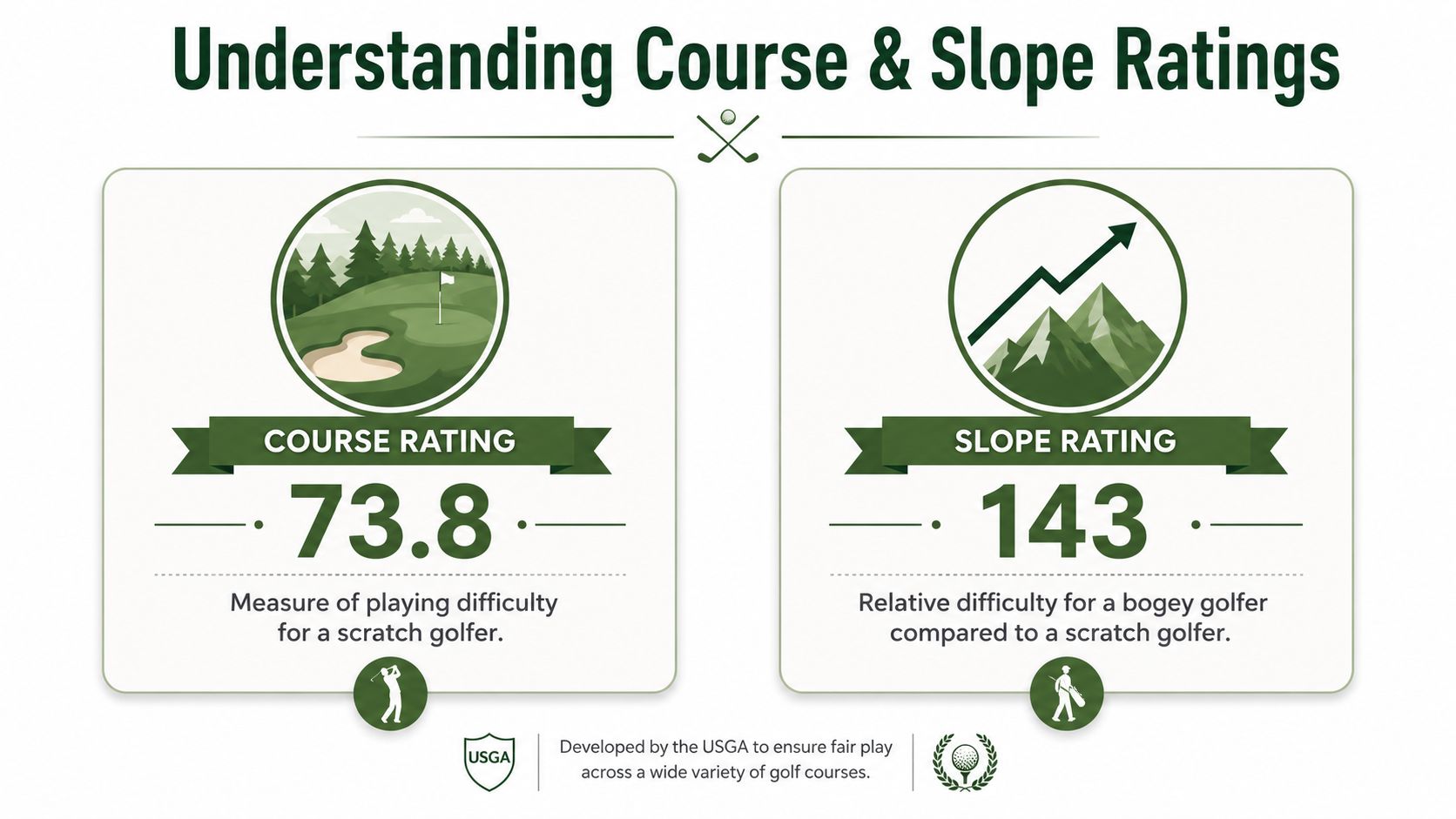
What those numbers mean in practice
Spanish Bay's full-course setup carries a high course rating and a high slope, as noted earlier. For an organizer, that is not just handicap paperwork. It affects which tee set produces fair scoring, how much separation you should expect between stronger and weaker players, and whether your event becomes competitive golf or a long day of defensive play.
Course Rating measures the expected score for a scratch player from a given tee. A higher rating means the setup asks for more complete golf. At Spanish Bay, that usually shows up in approach control, missed-green recovery, and the effect of wind on clubs and landing areas.
Slope Rating measures how much harder that same setup plays for a bogey golfer than for a scratch player. A higher slope matters in tournament administration because net results can swing hard if tee assignments are too aggressive. A field that looks balanced on index alone can spread out fast once the course starts punishing weak trajectories, poor distance control, and recovery shots from awkward lies.
If your staff needs a handicap refresher before you publish pairings, this guide on what a course rating means for tournament setup gives the committee the basics in plain language.
How organizers should use the ratings
Use rating and slope to make three decisions before you open registration in your software, not after players start asking for changes.
Decision | How the rating and slope should guide it |
|---|---|
Tee assignment | Match the tee to the field's real playing ability, not the field's preference |
Handicap setup | Confirm that net allocations reflect the selected tee, especially in mixed-ability groups |
Flight structure | Decide whether one gross/net pool is fair or whether separate flights will produce cleaner competition |
Such precision is how tournament platforms earn their keep. In Live Tourney or any similar system, the tee set, rating, slope, and par values have to match the event format exactly. If one division is assigned to the wrong rating profile, the software will still post scores. The problem shows up later in net results, skins validation, and committee review.
The trade-off at Spanish Bay
Spanish Bay rewards a setup with some restraint. Push players too far back and you increase long-iron approaches, slow play, and higher variance in net scoring. Move everybody too far forward and you remove the strategic questions that make the course worth hosting in the first place.
The right call depends on field composition.
A scratch-heavy invitational can handle more yardage. A member-guest, junior event, or mixed corporate field usually needs a setup that protects pace and keeps players engaged through the middle of the round. The scorecard numbers help you justify that choice with something more defensible than instinct.
That matters when the committee has to explain why one tee set was selected, why a division was split, or why a net leaderboard moved after a handicap correction.
Front 9 Strategy for Tournament Play
Spanish Bay's front nine gives you room off the tee in places, but it doesn't give away many easy shots. The course presents a minimalist, dune-based terrain with no trees, wide fairways, and native grasses, and Hole 1 is a 375-yard par 4 with a slight dogleg right and a bunker guarding the front-right of the green, according to this Spanish Bay course overview video. For tournament setup, that combination changes the way contests and pin plans should be handled.

If you want a separate planning aid for documenting each hole in your event notes, this guide to a golf course hole-by-hole setup is a practical companion.
Holes 1 through 3
Hole 1 is a good opening test because it introduces the course's central idea right away. Players can use the ground. That makes it a poor choice for an early long-drive contest but a useful hole for observing whether the field understands the setup.
Hole 2 is where stronger groups may start pressing if they think it's a simple scoring hole. For organizers, that means pacing matters. If the opening group waits on second shots here, the backup can reach the tee quickly.
Hole 3 tends to reward disciplined positioning more than aggression. In a scramble, that's fine. In individual stroke play, it can expose players who assume width equals safety.
Holes 4 through 6
The middle of the front side is where I'd start thinking about pin conservatism if the field is mixed. The architecture may look open, but exposed greens can create a lot of three-putt and short-game volatility if the committee gets too ambitious.
A practical setup lens for these holes:
For stroke play: Keep hole locations that reward a shot landing in the right portion of the green, not ones that flirt too heavily with edges.
For scrambles: Give groups at least one accessible scoring look in this stretch so the round doesn't feel defensive from the start.
For sponsor contests: This isn't the best zone for forced excitement. The front side asks players to settle in first.
The front nine at Spanish Bay rewards patience. If your setup asks for hero golf too early, pace and scoring both suffer.
Holes 7 through 9
This closing run on the outward side can create momentum swings. Hole 8 is notable for exposure, and that matters more operationally than aesthetically. It can produce club-selection indecision and delays if the field isn't moving cleanly.
Hole 9 is a strong pivot hole for scoring. In match play, it's a meaningful turning point. In stroke play, it can separate a patient player from someone trying to force a birdie before the turn.
For contests and operations on the front side, I'd lean this way:
Hole range | Best tournament use |
|---|---|
1 to 3 | Observation, settle-in stretch, avoid gimmick contests |
4 to 6 | Balanced pin placements, keep pace under control |
7 to 9 | Good scoring tension, strong point for leaderboard movement |
The front nine doesn't need much decoration. It needs disciplined setup.
Back 9 Strategy for Tournament Play
The inward nine at Spanish Bay starts deciding events. Not every hole is dramatic in the same way, but the stretch asks better questions of players than many resort courses do. If you're organizing a competitive day, your setup choices become visible in this section.
Spanish Bay is located at 2700 17 Mile Dr, Pebble Beach, CA 93953, and holes like 1, 8, and 16 are known for significant wind exposure and strategic pin positions that demand precise shot placement, according to Monterey Peninsula Golf's Spanish Bay course page. On the back nine, that kind of exposure shapes scoring swings more than yardage alone.
Holes 10 through 13
The first part of the inward side is where many events either regain rhythm or get sticky. Players have settled, but fatigue and score awareness start influencing decisions. That's why hole setup matters.
Hole 10 should usually feel playable. If a field makes the turn and immediately runs into a severe pin, frustration rises fast.
Hole 11 is a better place to ask for a complete hole. By then, players are engaged enough to accept a firmer test.
Hole 12 can function as a momentum hole in team formats. If you're running match play or a partner event, matches can flip at this hole.
Hole 13 often works well for visibility. It's a good candidate for sponsor presence or spectator attention because par-3 holes naturally create concentrated viewing moments.
Holes 14 through 16
This is the business end of the card. If your committee wants “championship” energy, it usually shows up here without needing manufactured difficulty.
Use this stretch carefully:
Hole 14: Good place for a strong but fair pin. Don't make it punitive unless the field can handle it.
Hole 15: A useful separator in gross scoring because players who stay patient can still create a chance.
Hole 16: Exposure becomes part of the hole. Players need commitment, not just distance control.
If the event is close late, the back nine doesn't need tricks. It already has enough built-in volatility.
Holes 17 and 18
Finishing holes should produce clarity, not confusion. That's especially true if you're posting scores live and players are tracking positions.
Hole 17 can create one of the last realistic scoring opportunities. In a team event, that means you should expect leaderboard movement. In an individual event, it can tempt players into forcing a number.
Hole 18 should feel like a finish. Keep the hole location fair enough that the winner is decided by execution, not by an overcooked committee choice. If you're placing signage or building a presentation moment for arrivals, the finishing area is the obvious place to anchor it.
A practical back-nine philosophy works best here:
Stretch | Setup priority |
|---|---|
10 to 13 | Restore rhythm, create watchable moments |
14 to 16 | Let the course apply pressure naturally |
17 to 18 | Protect the finish, avoid gimmick severity |
Spanish Bay closes best when the course remains the story.
Recommended Tee Setups for Common Golf Events
Tee selection decides whether Spanish Bay feels exhilarating or exhausting. That's why the Links at Spanish Bay scorecard is so useful at the planning stage. The course offers multiple tee configurations including Gold at 4,777 yards, White at 4,677 yards, and Red at 4,017 yards, according to the Spanish Bay scorecard listing on Greenskeeper. Those shorter listed options make the venue more flexible than many organizers assume.

Competitive invitational
For a strong men's field, the back tees or a championship-oriented setup can make sense if the group expects a stern test and can keep pace. This works best for low-index players, member-guest finals, and invitational fields that won't be rattled by a difficult links presentation.
The trade-off is obvious. If the field isn't deep enough, the event becomes a grind instead of a competition.
Corporate outing or mixed field
Many events often go wrong by overestimating what players want. Most mixed corporate groups have more fun, finish faster, and produce cleaner scoring from a moderate setup.
A practical approach is:
Men on a middle tee
Women on a forward tee
Contests placed on holes that don't create backups
That keeps the course recognizable while preserving pace and goodwill.
Charity scramble and relaxed formats
Forward setups usually win here. Scrambles need energy, birdie chances, and enough accessibility that the field stays engaged through the closing holes.
I'd lean toward a friendlier configuration when:
the field includes occasional golfers
sponsor guests matter as much as competitive outcomes
the awards presentation depends on finishing on time
The best tee setup isn't the one that sounds toughest in the committee meeting. It's the one players remember as fair.
What works and what doesn't
Event type | Usually works | Usually doesn't |
|---|---|---|
Competitive invitational | Longer setup matched to strong players | Overlong tees for a mixed skill field |
Corporate outing | Middle and forward combination | One tee assignment for everyone |
Charity scramble | Forward, pace-friendly setup | Pride-based setup that kills scoring |
At Spanish Bay, tee selection is the single easiest way to improve the day before the first score is entered.
Frequently Asked Questions About Spanish Bay Logistics
Tournament logistics at Spanish Bay usually hinge on communication more than complexity. Players want to know what to expect before they arrive. Staff want fewer questions on the range and first tee. A short event memo solves most of that.
What should players know before arrival
Address: Spanish Bay Golf Links is at 2700 17 Mile Dr, Pebble Beach, CA 93953, according to the earlier verified course references.
What kind of golf should they expect: This is a links-style test with wide visuals, native areas, and exposed playing conditions. Players who expect a target-golf resort round can misread it early.
What should be emphasized in the event email: Tee assignment, format, arrival window, and whether the committee is using gross, net, or team scoring as the primary competition.
What do organizers usually need to confirm with the golf shop
Because public directory data doesn't replace direct event operations, confirm these items with the club before publishing your final notice:
Practice access: Ask where players should warm up and how early facilities are available for your group.
Cart and walking policy: Clarify what the day will look like for your specific event.
Dress expectations: Put the club standard in writing so volunteers don't have to answer it ad hoc.
Pace targets: Ask the staff what they want your field to maintain, then build that into starter instructions.
Where do event days usually get messy
Most friction comes from assumptions, not from the course itself.
Send one final player memo that includes arrival timing, tee assignment, scoring format, and any club-specific expectations. That single step prevents a lot of tournament-day noise.
A Spanish Bay event feels smooth when the scorecard, the starter sheet, and the player message all tell the same story.
If you want a simpler way to run live scoring, pairings, scorecards, tee sheets, and event administration without the usual setup drag, Live Tourney is worth a look. It's built for operators and tournament directors who want a faster, cleaner tournament workflow from registration through final leaderboard.





