Apr 21, 2026
Tournament organizers: Master Ryder Cup four ball pairings. Get strategies, handicap tips, and simplify setup & scoring for your event.
The hard part of a Ryder Cup-style event usually isn’t scoring the matches. It’s building pairings that feel fair, create drama, and don’t leave half the field thinking the teams were thrown together in five rushed minutes behind the golf shop counter.
Most club captains know the scene. You’ve got a roster, a handicap sheet, a few strong opinions from regulars, and maybe one assistant telling you to just put the buddies together and hope it works. That’s where ryder cup four ball pairings get messy. The format looks simple on paper, but the difference between a smart pairing and a bad one shows up fast once the first few holes are underway.
The Captains Challenge Making Smart Pairings
The night before a club Ryder Cup, the pairing sheet usually becomes a puzzle. One side wants balanced teams. Another wants to stack the top. Someone asks whether the low handicap should carry a higher one. Someone else says chemistry matters more than numbers. All of them are partly right, which is why manual pairing gets stressful.
That uncertainty isn’t unusual. Club captains have openly discussed the same problem, especially the lack of practical guidance on whether amateurs should be paired high-with-low or by similar handicap levels in club Ryder Cup formats, as noted in this club captain discussion on amateur pairing strategy.
Why amateur pairings are harder than pro pairings
Professional coverage tends to focus on star power, form, and chemistry at the highest level. Club events deal with a different reality:
Handicap gaps matter more: A large spread in ability changes how often one player can realistically post the team score.
Player habits matter more than reputation: The member who always keeps the ball in play may be more useful in four-ball than the flashier player who makes a few birdies but also posts too many big numbers.
Logistics matter more than theory: If pairings are hard to explain, hard to publish, or hard to adjust after a late withdrawal, the event starts behind schedule.
Practical rule: If your pairing logic can’t be explained to players in one minute, it probably isn’t clear enough.
A good club event doesn’t need Tour-level analytics. It needs a repeatable process. That starts with understanding exactly what four-ball rewards, and where it punishes bad assumptions. If you need a quick refresher on team-match structure before finalizing pairings, this overview of Ryder Cup format and scoring is a useful baseline.
What captains usually get wrong
The most common mistake is treating four-ball like a generic team game. It isn’t. You’re not just averaging two handicaps and calling it done. You’re trying to create a pairing where one partner can press while the other covers the hole.
The second mistake is overvaluing friendships. Familiarity helps, but not if both players attack the same holes badly, get rattled the same way, or rely on the same part of their game. Chemistry matters. Functional chemistry matters more.
Four-Ball Fundamentals for Tournament Play
In four-ball, each player plays their own ball for the entire hole, and the side takes the lower score between the two partners. That’s why it’s often called better-ball. It creates a very different decision pattern from scramble golf and from foursomes.
What the format rewards
Four-ball rewards coverage. One player can make a safe par while the other takes on a tucked flag, a risky carry, or a par-5 in two. That freedom is the whole point. The side doesn’t need both players to perform on the same hole. It just needs one usable score.
This is also why captains should think in terms of hole-winning potential, not just steadiness. Since four-ball was introduced in 1963, it has become a major Ryder Cup factor, and Ian Woosnam’s 10 four-ball wins show how valuable format-specific skill can be in this style of match play, according to the Ryder Cup records listing.
Four-ball versus foursomes
A lot of club organizers blur the line between the two formats, and that leads to poor pairing decisions.
Format | How it works | What usually matters most |
|---|---|---|
Four-ball | Both partners play their own ball. Team takes the lower score on each hole. | Birdie chances, complementary strengths, emotional resilience |
Foursomes | Partners alternate shots with one ball. | Rhythm, similar preferences, clean communication |
In four-ball, one player can have a terrible hole and the team may lose nothing. In foursomes, one bad swing can put both players in trouble immediately. That difference should change how you pair people.
The practical effect on club events
For amateur events, this means you can be more aggressive with your ryder cup four ball pairings than you would in alternate shot. A volatile player can still be extremely useful if paired with someone who keeps the card alive.
Consider these common club-player types:
The steady par maker: Rarely spectacular, but keeps pressure on the other side.
The streaky birdie maker: Might lose a hole alone, but can also steal one out of nowhere.
The short-game specialist: Saves the side when approaches aren’t sharp.
The long hitter: Reaches scoring zones others can’t, even if accuracy comes and goes.
Four-ball is less about finding two identical players and more about making sure the side has an answer on enough holes.
What that means for setup
If you’re organizing the competition, your pairing sheet should do two jobs at once. It should create competitive matches, and it should produce understandable game flow. Players should know why they’re paired together. Staff should know how handicaps, tee times, score entry, and match displays connect.
That’s one reason tournament directors who run repeated match-play events often standardize pairing logic the same way they standardize flights or divisions. The cleaner your system, the fewer arguments you’ll handle at check-in.
How to Build Your Four-Ball Pairings
Most captains overcomplicate this part. You don’t need a secret formula. You need a few reliable ways to sort players, then enough discipline not to abandon your method because one loud member wants to “go with gut feel.”
Start with coverage, not averages
At the pro level, captains look for complementary skillsets. A long driver paired with a strong wedge player creates more chances for one side to produce a birdie. That same logic works at the club level too, and it’s noted in this piece on Ryder Cup pairing strategy and complementary strengths.
What matters is whether the pairing can solve different kinds of holes.
A simple way to think about it:
One player creates opportunities: length, aggressive lines, hot putter
One player protects the card: fairways, reliable irons, low big-number risk
That pairing often works better than two players with the exact same strengths and the exact same misses.
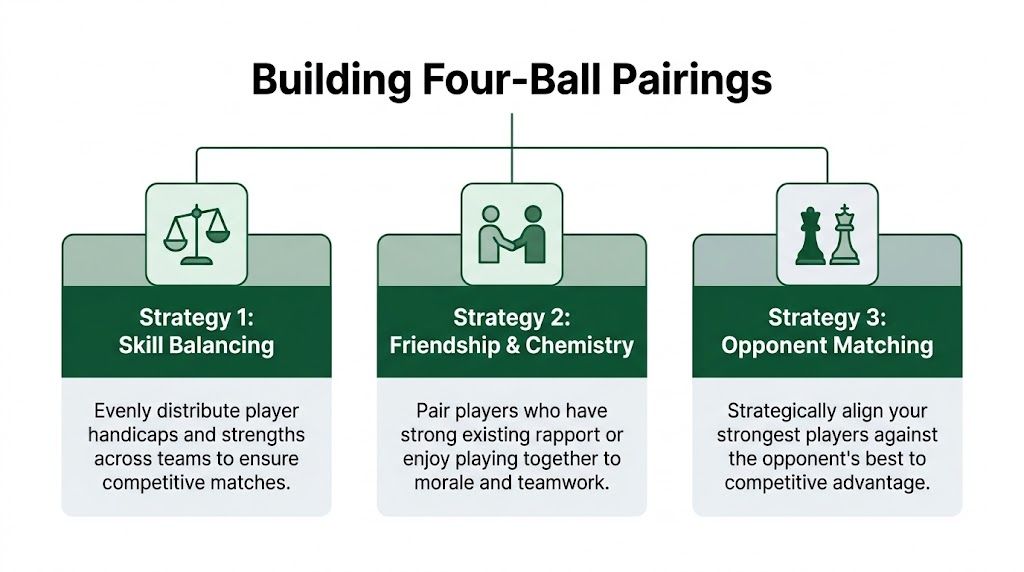
Three pairing models that actually work
Skill balancing
This is the default model for most club events. You spread handicap strength across the team so each match has a chance.
Use it when:
your roster has a wide handicap spread
the event needs to feel visibly fair
you expect a lot of post-pairing scrutiny
Skill balancing usually produces cleaner matchups and fewer complaints. It also helps when you’re trying to avoid one “super team” and one side that looks dead on arrival.
Friendship and chemistry
Some pairings perform better because the players already know each other’s rhythms. They know when to talk, when to stay quiet, and how each reacts after a bad hole.
This works well when:
players already play money games together
your event is social as well as competitive
you’ve got players who tighten up with unfamiliar partners
The downside is obvious. Two close friends can still be a weak competitive fit if both are loose off the tee or both rely on streaky putting.
A comfortable pairing isn’t automatically a useful pairing. Comfort matters most when it improves decision-making.
Opponent matching
This is the most tactical option. You build your pairings in response to the other side. Sometimes that means sending your strongest side against their strongest. Sometimes it means trying to grab likely points lower down the sheet.
Use it when:
captains reveal pairings close to game time
you know the opposing roster well
your team has one or two clearly stronger pairings than the rest
If you’re running a format with rotating opponents or broader team scheduling, this guide on how to create a round robin schedule can help structure the broader event around those matchups.
The high-low handicap question
This is the question most amateur captains care about. Should you pair your best player with one of your weakest, or create two middleweight teams?
There isn’t a universal answer, so use a decision filter:
Situation | Better choice |
|---|---|
Your top player makes a lot of birdies and doesn’t mind carrying momentum | High-low pairing |
Your top player gets frustrated when a partner struggles | Balanced pairing |
Your roster has little depth after the top few names | High-low pairing |
Your team is deep and consistent across the board | Balanced pairing |
A high-low pair can work well in four-ball because the stronger player only needs to win enough holes to offset the partner’s weaker ones. But it fails fast if the lower handicap player starts pressing because they feel they have to make every score.
Balanced pairings tend to be steadier. They may not produce as many explosive holes, but they often avoid the stretches where one side feels like a one-man team.
A simple captain’s checklist
Before finalizing pairings, ask these questions:
Who can make birdies? You need at least one player in each pair who can win holes.
Who avoids doubles? Someone has to keep the side alive.
Who handles pressure well? Match play gets emotional quickly.
Who enjoys playing together without drifting into casual golf?
Who matches up well against the likely opposition?
If you answer those directly, your pairings improve fast. Most bad pairing sheets come from one of two habits. Captains either chase pure handicap symmetry or they pair friends without checking whether the golf fits.
Using Live Tourney to Automate Pairings
Manual pairing work usually breaks down in the same places. Rosters arrive late. Handicaps need updating. One captain wants to sort by skill, another by chemistry. Then someone asks for tee sheets, cart signs, and scorecards before lunch.
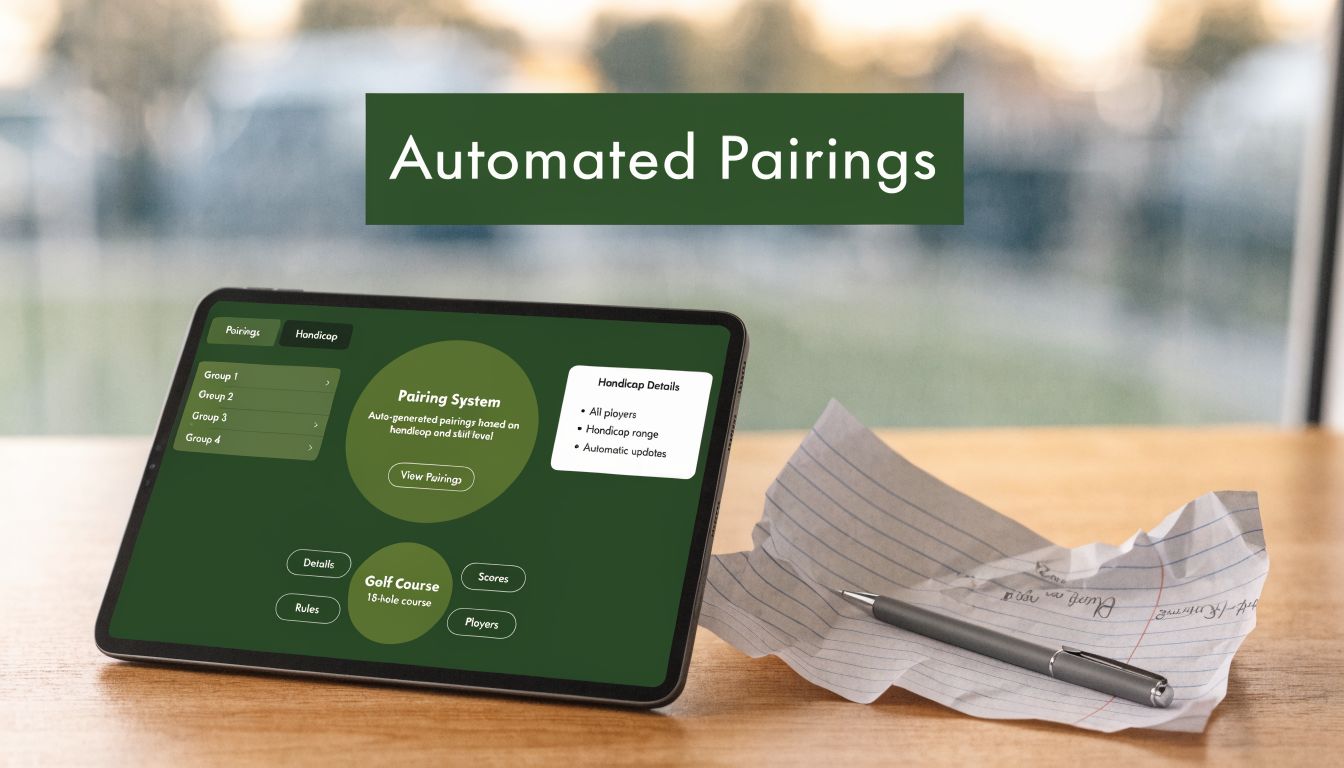
That’s where software earns its place. According to Live Tourney’s internal business context, tournament platforms like Live Tourney can make setup 3x faster and have shown a 40% increase in live scoring participation, largely by automating pairings and reducing admin work during event setup.
What the workflow should look like
A useful pairing tool should let you move from raw roster to published match sheet without rebuilding the event three times. The practical workflow is straightforward:
Upload the roster Import names, teams, and handicap information first. This removes the usual copy-and-paste errors that come from building matches in separate spreadsheets.
Create teams and sessions Set up the structure of the event before touching pairings. That matters in Ryder Cup-style competitions because pairings connect directly to tee sheets, score entry, and display logic.
Build pairings manually or by handicap logic If you already know the pairings you want, drag and drop them into place. If you want a starting point, use handicap-based generation and then make captain’s adjustments.
Publish operational materials Once the pairings are locked, the same system should output scorecards, cart signs, tee sheets, and live scoring access without duplicate entry.
Why this matters on busy tournament days
The value isn’t just speed. It’s control. When all pairing data lives in one place, changes don’t force you to redo every document by hand.
That’s especially important in team events, where one edit can otherwise affect:
match numbers
starting times
scorekeeping links
printed materials
leaderboard mapping
Operational advice: Pairing software is most useful when it removes rework, not when it simply gives you a prettier screen.
If you’re evaluating options for that workflow, this overview of golf tournament management software covers the core features worth checking before your next event.
Where software helps the captain most
The biggest benefit for ryder cup four ball pairings is flexibility. You can test a few models quickly instead of committing early to the first one that seems acceptable.
For example, you might build:
one version with high-low pairings
one version with balanced pods
one version built around existing club games and personalities
Then you compare them. Which one spreads scoring potential better? Which one creates cleaner matchups? Which one avoids the awkward “why am I carrying this match” reaction from your strongest players?
That’s much harder to do when your whole process lives in a paper grid or a fragile spreadsheet with formulas nobody wants to touch.
Communicating Pairings and Managing Gameday Changes
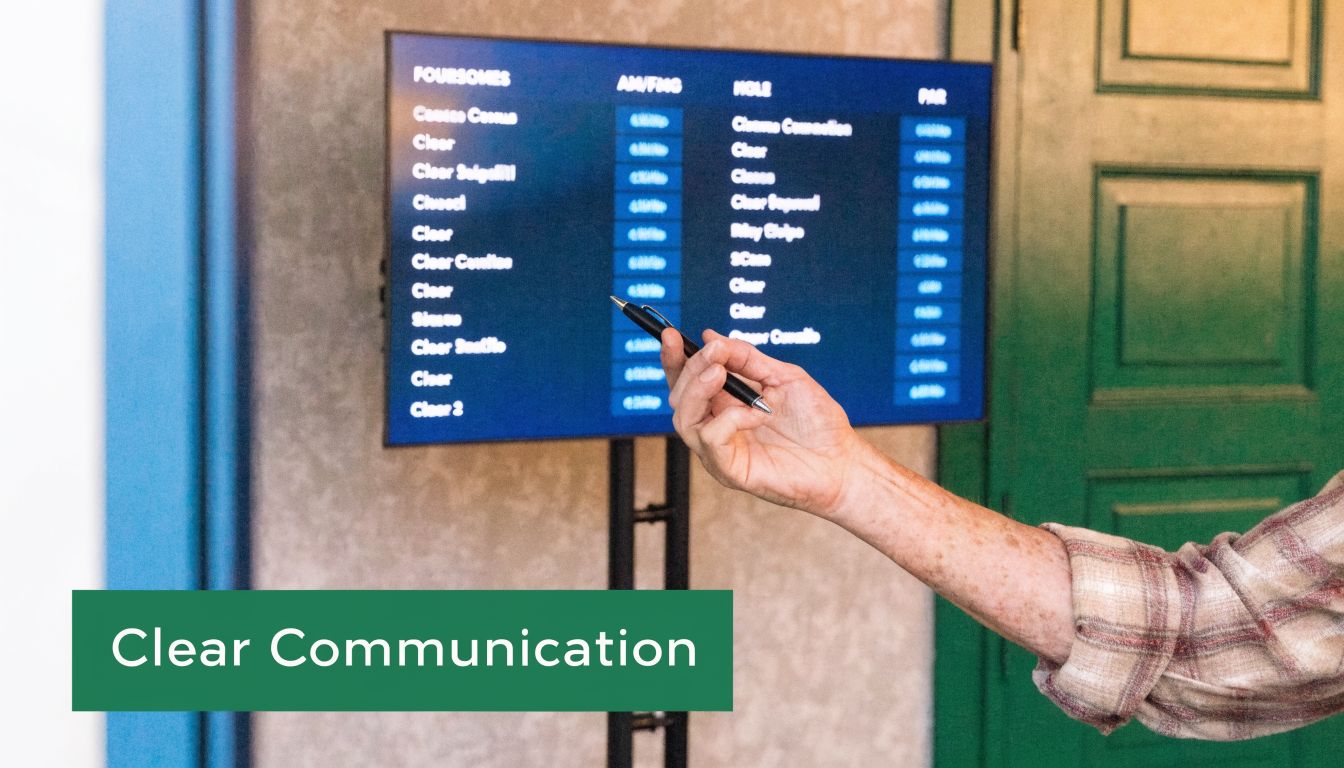
A well-built pairing sheet still causes problems if players don’t see it early, don’t understand it, or hear three different versions from three different staff members. Most event friction starts with communication, not competition.
Send pairings before questions start
The cleanest approach is simple. Send pairings and tee information the night before, then repeat them at check-in with printed sheets and an on-site display.
Players don’t all consume information the same way. Some read email immediately. Others show up asking who they’ve got on the first tee. Use both digital and physical communication so nobody can say they didn’t know.
A good communication package includes:
Pairings by match: team names, partners, opponents
Starting information: tee time and starting hole
Scoring instructions: who enters scores and where
Format reminder: four-ball, match play, any handicap notes
Prepare for the one thing that always happens
Someone will withdraw late. Someone will be stuck in traffic. Someone will tell you at breakfast they can only play the afternoon session.
That’s where your process gets tested. If changes require rewriting multiple sheets and re-explaining every match, your event slows down immediately.
Use this checklist when a change hits:
Replace the player first Don’t start by rebuilding the whole board. Fill the vacancy with the closest suitable substitute.
Check the partner fit A replacement shouldn’t just match handicap. Make sure the side still makes sense in four-ball.
Reconfirm the opponent match One substitution can turn a fair contest into a mismatch.
Republish fast Update the digital sheet, then the print station or display board.
The best-run tournament operations aren’t the ones with no surprises. They’re the ones where players barely notice the surprises happened.
Keep the message consistent
Assign one person to approve pairing changes. That single rule prevents half the confusion clubs create on their own. If the golf shop, starter, and captain all have different “latest versions,” players stop trusting the sheet.
Short announcements also work better than long explanations. “Smith replaces Jones in Match 3, same tee time, same opponents” is enough. Players don’t need the backstory. They need certainty.
Pro Tips for a Flawless Four-Ball Event
Good pairings get the event started. Small operational details determine whether players leave saying the day felt polished or chaotic.
Focus on the factors that actually matter
In four-ball, you can keep your attention on skill fit and chemistry because the format is more forgiving on equipment differences. That’s a useful contrast with foursomes, where golf ball compatibility becomes a much bigger concern. The broader Ryder Cup pairing discussion also notes that home teams have historically won 78.75% of foursomes matches, showing how much familiarity can matter in that format, as explained in this Ryder Cup captains strategy piece.
For club organizers, the lesson is practical. Don’t import foursomes problems into your four-ball planning. You don’t need to obsess over every equipment variable. Put your energy into who can cover holes, who can stay patient, and who can handle match-play momentum swings.
Build the event around player clarity
Players enjoy team events more when they know three things right away:
Who they’re playing with
What format they’re playing
Where they stand during the day
That sounds obvious, but many clubs still lose the room by making pairings hard to find and standings hard to follow. A visible leaderboard in the clubhouse or near scoring creates energy without changing the competition itself. Side contests can help too, as long as they don’t distract from the main team match.
Use planning discipline outside the golf itself
Strong golf operations usually mirror strong event operations. The same habits that help a wedding planner or fundraiser coordinator also help a tournament director: communicate early, confirm details twice, simplify the guest experience, and build backup plans for no-shows and weather changes. That’s why broader resources like these essential event planning tips are worth a look even for golf staff.
Keep the format fun without making it loose
A club Ryder Cup should feel competitive, but it shouldn’t feel heavy. Four-ball works best when players sense they can attack. Encourage that mood in the setup.
A few finishing touches help:
Clear score-entry instructions: confusion on the first green kills momentum
Visible match names or cart signs: players engage more when matches feel official
Simple side games: enough to add interest, not enough to hijack the day
Fast result posting: energy fades if the room waits too long for standings
The best four-ball events feel organized from the first pairing email to the final point on the board.
Get the pairings right, communicate them clearly, and give yourself a way to handle changes without panic. That’s what makes the whole event feel professional.
If you run team golf events and want a simpler way to handle pairings, scorecards, tee sheets, and live scoring from one place, take a look at Live Tourney. It’s built for organizers who need Ryder Cup-style setup without the spreadsheet scramble.