
Feb 24, 2026
Master the rules of golf match play with our guide. Learn scoring, concessions, penalties, and winning strategies for your next head-to-head matchup.
Forget everything you think you know about your final score. The rules of golf match play flip the script entirely, turning your round into a tense, head-to-head battle where the only thing that matters is winning more holes than your opponent. It's a completely different mental game than traditional stroke play.
Understanding The Heart Of Match Play Golf
At its core, match play breaks a round of golf down into 18 individual, one-on-one contests. Think of it like a boxing match: each hole is a round. The winner isn’t the one who lands the most total punches, but the one who wins the most rounds.
That catastrophic triple bogey that would ruin your card in stroke play? In match play, it just means you lost one hole. You can walk to the next tee with a totally clean slate, ready to fight again. This dynamic creates a constant tug-of-war where momentum is everything. Your strategy has to adapt on the fly based on what your opponent is doing right now, on this hole.
To get the most out of match play, it's helpful to compare it directly to what most golfers are used to. Here’s a quick breakdown of how the two formats stack up.
Match Play vs Stroke Play Key Differences
Concept | Match Play | Stroke Play |
|---|---|---|
Objective | Win more individual holes than your opponent. | Finish with the lowest total score over 18 holes. |
Scoring | Relative to opponent (e.g., "2 up," "1 down"). | Cumulative total of all strokes taken. |
Bad Holes | A high score only loses you one hole. | A high score can ruin your entire round. |
Pacing | The match can end before the 18th hole. | All players must complete all 18 holes. |
Strategy | Aggressive, reactive play based on opponent's actions. | Conservative, consistent play against the course. |
This table highlights the fundamental shift in mindset. In match play, you're playing the person in front of you, not just the course.
Key Match Play Terminology
To navigate this format, you need to speak the language. The score isn't about numbers on a card, but where you stand against your opponent.
Up/Down: If you've won more holes than your opponent, you're "up." If you win the first two holes, you're 2 up. If they've won more than you, you're "down."
All Square: This just means the match is tied. Simple as that.
Dormie: A player is "dormie" when their lead is the same as the number of holes left to play (e.g., you're 3 up with three holes remaining). At this point, you can’t lose the match—the worst you can do is tie.
This hole-by-hole drama is exactly what makes events like the Ryder Cup so electrifying. A player can be 4 down with five to play and still claw their way back, creating the kind of edge-of-your-seat moments that stroke play just can't replicate. It’s a huge part of what makes competitive tournament golf so great, and for anyone organizing these events, knowing how to structure the competition is key. If that's you, you might find our guide on how to create a tournament bracket helpful.
Match play is a test of will just as much as it is a test of skill. The player who can shake off a lost hole and immediately refocus has a massive mental edge over someone who dwells on mistakes.
The Power Of Early Momentum
Getting off to a hot start in match play isn't just a nice confidence boost—it's a huge statistical advantage. A fast start puts immediate pressure on your opponent and can set the tone for the entire match. Just look at the stats from the WGC-Dell Technologies Match Play.
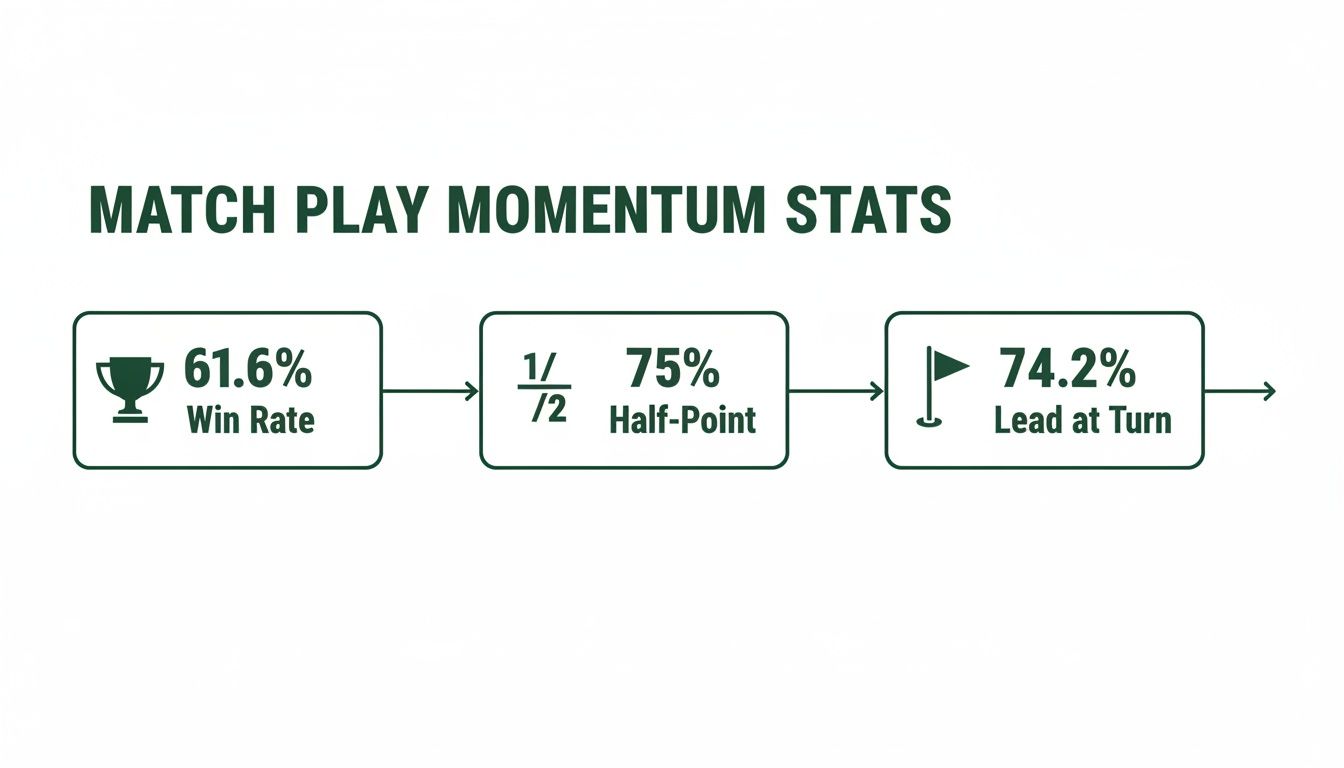
The numbers don't lie. Gaining an early lead dramatically shifts the odds in your favor. Data shows that players who win the very first hole go on to win the match 61.6% of the time, and they secure at least a tie in 75% of their matches.
That advantage gets even bigger as the round goes on. Holding a lead at the turn sends your probability of winning soaring to 74.2%. You can dig into more of these kinds of insights over on PGATOUR.com.
The Strategic Art of the Concession

In match play, one of the most powerful tools in your bag isn't a club—it's the concession. It's a unique element of the game where you can concede your opponent’s next shot, an entire hole, or even the whole match.
And here's the key: a concession is final. Once you give it, it can't be taken back or refused. This simple act turns match play into a fascinating psychological battle. Knowing when to give a putt and when to make your opponent sweat it out is a skill that separates seasoned competitors from the rest.
The most common use of the concession is for a short putt. You might give a tricky two-footer to show good sportsmanship or just to speed things up. But don't be fooled—every concession carries a strategic weight that can shift the momentum of the entire match.
When To Give The Putt
Deciding to concede a putt is rarely just about being a good sport. It's almost always a calculated move, often designed to mess with your opponent's head. Understanding the right moments to be generous is a huge part of the rules of golf match play.
Build Goodwill Early: Giving a few "gimme" putts on the first couple of holes can set a friendly tone. It might lower your opponent’s guard and make you seem more confident than you feel.
Prevent Practice: If your opponent has a nasty three-footer with a big break, giving it to them stops them from seeing the ball drop. This robs them of a confidence boost and keeps them from learning the speed and line of the green—information they could use against you later.
Keep Things Moving: Sometimes, it’s just practical. If you’re already out of the hole and your opponent has a tap-in, conceding just gets everyone to the next tee with a clear head.
The Power Of Making Them Putt
Just as giving a putt can be a weapon, forcing an opponent to hole out can apply some serious psychological pressure. The sound of a ball dropping into the cup is a lot different when you have to make it. This is where you can turn a simple putt into a high-stakes test of nerve.
Making someone putt everything, especially the short ones, sends a clear message: you’re going to have to earn every single thing today. This can completely throw off their rhythm and plant seeds of doubt. All of a sudden, a simple two-footer feels like a ten-footer. The pressure is on.
In match play, the shortest putts often carry the most weight. An opponent who misses a conceded-length putt early in the match may carry that mental scar for the next 17 holes.
The real beauty of the concession lies in this duality. One moment, it's a gesture of respect; the next, it's a cold-blooded tactic.
For example, you could concede every two-footer for the first 15 holes. You lull your opponent into a relaxed state where they aren't even thinking about the short ones. Then, on the 16th hole with the match on the line, you suddenly make them putt that same two-footer. That unexpected pressure can easily cause a miss, handing you a critical advantage right when it matters most.
Mastering this delicate balance of give-and-take is the key to mastering match play itself.
In stroke play, a simple mistake might cost you a two-stroke penalty. It stings, but you can usually bounce back. In match play? That same mistake can cost you the entire hole.
The most common penalty for a rules breach in a match isn't adding strokes—it's the immediate loss of the hole. This is a massive shift, and it’s why understanding the specific rules of golf for match play is non-negotiable for any serious competitor.
Things that are minor annoyances in a regular round can instantly end your chances on a hole. Giving your opponent wrong information (like how many strokes you've taken) or playing out of turn can mean you lose the hole on the spot. If you hit out of order, your opponent can even make you replay the shot—a clever tactic to throw you off or force a rethink under pressure.
Knowing these rules isn't just about protecting yourself. It's about knowing how to hold your opponent accountable, too.
The Ultimate Penalty: Loss of Hole
The loss of hole penalty is the hammer in match play. It’s clean, it’s decisive, and it creates huge momentum swings. Unlike stroke play where a penalty is just a number on a card, losing a hole changes the entire feel of the match.
Here are a few common ways to lose a hole without even finishing it:
Too Many Clubs: Getting caught with more than 14 clubs is a classic blunder. If your opponent notices during a hole, you lose that hole. Simple as that.
Playing the Wrong Ball: This is an automatic loss of the hole in match play. No two-stroke penalty, just a handshake as you walk to the next tee.
Agreeing to Ignore a Rule: This is a big one. You and your opponent can't just agree to waive a Rule of Golf. If you do and then start the hole, you're both out of the competition.
These rules aren't just there to be harsh. They protect the head-to-head nature of the game, making sure the match is won by skill, not by who can bend the rules.
The loss of hole penalty is designed for a quick and final resolution. It stops long debates in their tracks and keeps the focus where it should be: on the one-on-one battle for the next hole.
You Have to Make a "Timely Claim"
Here’s where match play gets really interesting. You can't wait until the 18th green to point out something your opponent did back on the third hole. This is the concept of a "timely claim."
A claim has to be made before anyone in your match tees off on the next hole. If it’s the final hole, you have to make the claim before the match result is official.
This puts the responsibility squarely on you to pay attention. If you see a potential rules breach, you have to speak up right away. Wait too long, and the moment is gone. The result of the hole stands, no matter what happened. It adds a fascinating layer to the game where awareness is just as crucial as your swing.
There are some wild USGA decisions that show how this plays out. In one case, a player started with 15 clubs. Their opponent won the first hole anyway, then made the claim. Officials awarded the opponent the hole, resulting in a massive two-hole swing. In another match, a player was docked three holes late in the round because the opponent made a timely claim after discovering the breach.
The timely claim rule keeps the game moving and forces every issue to be handled as it happens. It stops players from trying to "bank" a penalty to use it strategically later on, keeping everything out in the open.
Exploring Different Match Play Formats
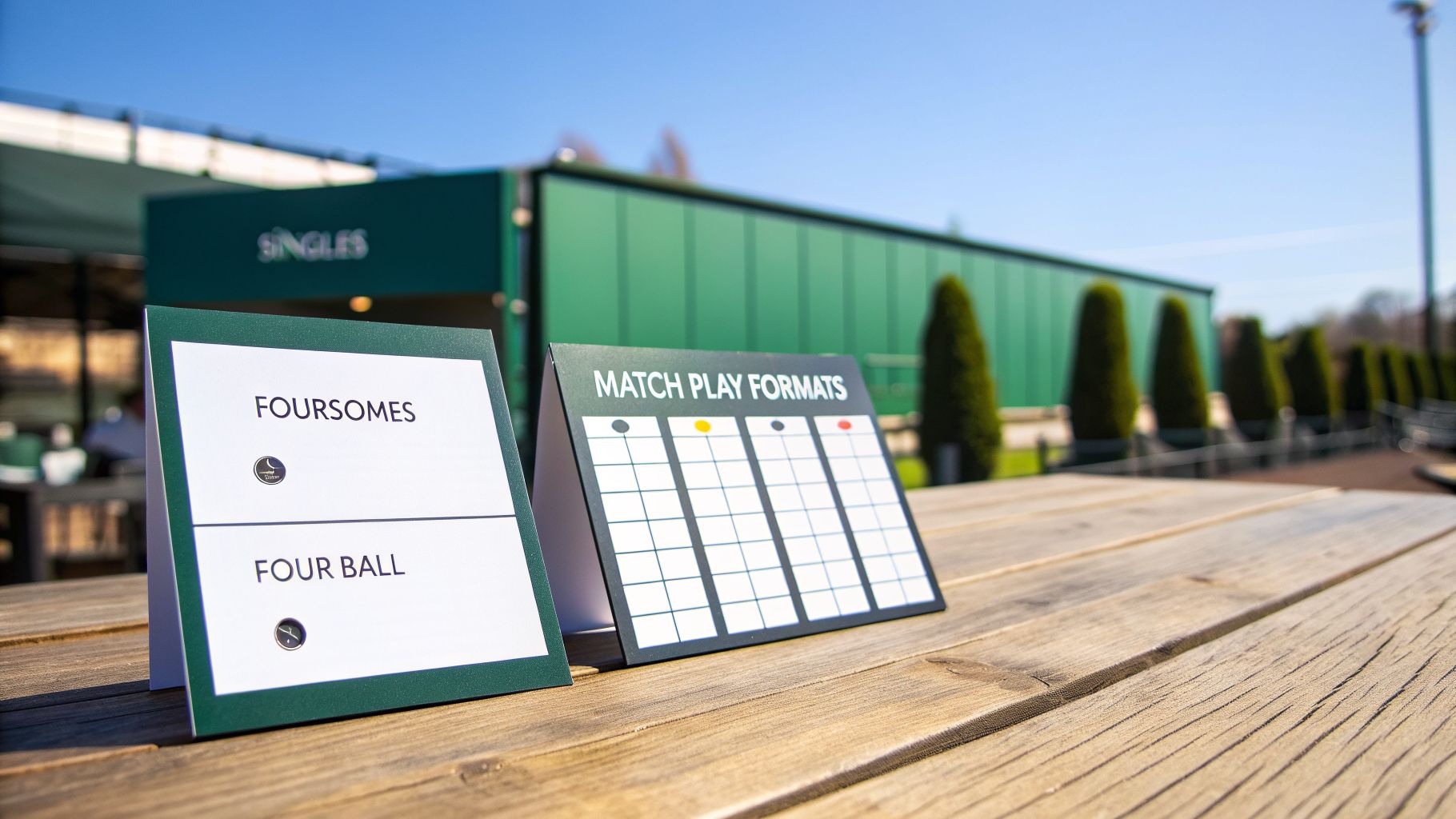
While the classic one-on-one duel is the heart of match play, the format really comes alive in its team variations. These different styles turn individual contests into dynamic team battles, each with its own strategies and pressures.
Getting a handle on these formats is key, whether you're a player trying to win your club championship or a tournament director looking to create a memorable event. Let's break down how the most popular formats—Singles, Foursomes, and Four-Ball—actually work on the course.
Singles Match Play
This is match play in its purest form: one player against another. Every shot and every decision is yours alone. It’s a straight-up test of skill, nerve, and strategy where there’s no partner to bail you out.
When handicaps are in play, the higher handicap player gets strokes based on the full difference between the two competitors. If you’re a 10 playing against a 6, you get 4 strokes to use on the four toughest holes, as ranked by the scorecard's stroke index.
Four-Ball (Better Ball)
Four-Ball is arguably the most popular team format, and for good reason—it encourages aggressive, go-for-broke golf. It pits two teams of two players against each other.
How It Works: All four golfers play their own ball from tee to green.
Scoring the Hole: The team whose player has the lowest individual score wins the hole.
Example: On a par 4, Player A makes a 4 and their partner, Player B, makes a 5. Their team score for that hole is a 4. If their opponents make a 4 and a 6, the hole is "halved" because both teams' best score was a 4.
The beauty of Four-Ball is that your partner can pick you up if you have a bad hole. That freedom lets players take more risks, knowing there’s a safety net.
Foursomes (Alternate Shot)
Foursomes is the ultimate test of teamwork and partnership. It’s a notoriously tough format where momentum can swing wildly with a single bad shot.
How It Works: Two players on a team play just one ball, taking turns hitting shots until the hole is finished.
Teeing Off: To keep it fair, one player tees off on all the odd-numbered holes, and the other takes the even-numbered holes.
The Challenge: The pressure is intense. You aren't just hitting a shot for yourself—you're setting up your partner for their next one. Leave them in a tough spot, and you'll feel the tension.
Foursomes is often called the "divorce-maker" of golf for a reason. It demands total trust, sync, and communication under fire.
Handicap Allowances for Common Match Play Formats
To keep team matches fair, handicaps are adjusted based on the format. The World Handicap System provides specific allowances to level the playing field, and it’s critical for organizers to get this right.
Here are the standard USGA allowances for the most common formats:
Format | Handicap Calculation | Standard Allowance |
|---|---|---|
Singles | Full difference between players' Course Handicaps. | 100% |
Foursomes | Average the two partners' Course Handicaps. | 50% of combined |
Four-Ball | Each player gets a percentage of their Course Handicap. | 85% of each player's |
Applying these allowances correctly ensures that matches are competitive and decided by skill, not just by who got the most strokes.
Combining Formats in Team Competitions
Major team events like the Ryder Cup, Solheim Cup, and Presidents Cup are so exciting because they combine these formats. A typical event might span a few days, featuring rounds of Four-Ball and Foursomes before a final, dramatic day of Singles matches. This structure tests a team's depth, chemistry, and individual grit.
For club and league play, a round-robin format is also a fantastic option. Instead of a single-elimination bracket where one loss sends you home, players are put in groups and play matches against everyone else in their pod. The player with the best record advances, rewarding consistency over a single good round.
This approach guarantees everyone gets to play multiple matches, which adds a ton of value and fun. If you're organizing an event, it's worth learning how to create a round-robin schedule.
The Way Golf Was Meant to Be Played
To really get why the rules of golf match play feel so different, you have to look back at its roots. Long before stroke play and jam-packed leaderboards became the norm on TV, match play was the format. It was how champions were made.
This wasn't about grinding out the lowest score against the course; it was a pure, head-to-head battle. You were trying to mentally and strategically dismantle the person standing right next to you on the tee. This is the format that defined golf's "Golden Age," where legends like Walter Hagen and Bobby Jones built their legacies in intense, one-on-one duels.
Golf's Original Championship Format
Think about the most prestigious tournaments today. Many of them, now famous for their 72-hole stroke play finish, actually started out as grueling match play contests. The very first U.S. Amateur in 1895? Match play. The PGA Championship when it kicked off in 1916? Same deal. For decades, this was considered the ultimate test of a golfer's nerve.
Match play was seen as the purest form of competition. It wasn’t about accumulating a low score over four days; it was about beating your opponent on this hole, right now.
This context is everything. For years, match play was the pinnacle of the sport. It crowned 39 PGA Champions before the format changed in 1957. Bobby Jones, for example, won his five U.S. Amateur titles through match play, where the only thing that mattered was winning more holes than your opponent. The drama was baked in—during the 1920s U.S. Amateurs, over 70% of matches were decided before the 18th hole because one player had built an insurmountable lead. If you're curious about how the rules have evolved, the USGA has a great historical overview.
The Modern Shift and Enduring Legacy
So, what changed? In a word: television. Stroke play is just a better product for broadcasting. It lets networks jump between dozens of players, building a narrative around a crowded leaderboard that all comes to a head on Sunday afternoon.
A match play final, on the other hand, might end with a handshake on the 13th green. That’s great for the winner, but it's a bit of an anticlimactic dud for TV ratings.
But even with the pros switching to stroke play, the spirit of match play is alive and well. It’s still the format of choice for amateur championships, club events, and, of course, iconic team competitions like the Ryder Cup. In these arenas, the thrill of that direct, head-to-head combat continues to deliver some of golf's most unforgettable moments.
Running Your Match Play Tournaments Without the Headache
Let’s be honest: running a match play tournament can be a logistical nightmare. You’re trying to build brackets, figure out handicap strokes for a half-dozen different formats, and keep track of who won which match. It’s a ton of manual work, even for seasoned pros.
Every minute you spend wrestling with a spreadsheet or drawing lines on a giant poster board is a minute you’re not out on the course, talking to players, and making sure the event is running smoothly. That administrative grind doesn’t just burn you out; it’s how scoring mistakes happen, which can quickly sour a great competition.
But it doesn't have to be that way. Modern tools are built to handle exactly these kinds of problems.
Ditch the Manual Work
Good tournament software takes all that complicated, time-sucking work and just… does it for you. It’s like having a digital assistant who handles all the tedious stuff, freeing you up to focus on putting on a first-class event.
This is where the real-time savings come in:
Automated Bracket Creation: Instead of manually seeding players and sketching out a bracket, the system can instantly generate a single-elimination or round-robin bracket right from your player list. No more whiteboards and markers.
Accurate Handicap Calculations: The software automatically applies the right handicap allowances, whether you're running Singles, Foursomes, or Four-Ball. This ensures every match is fair and plays by the rules of golf match play.
Effortless Pairings and Tee Sheets: You can create and adjust pairings with a few clicks, then print professional-looking tee sheets, cart signs, and bag tags in minutes.
Shifting these jobs to a dedicated platform can save you and your staff hours of work. That means less pre-tournament stress and more time to actually engage with your players on the day of the event.
This isn't just about saving time. It's about delivering a professional, organized experience that shows off the quality of your club and keeps people coming back for more.
Bring Your Tournament to Life with Live Scoring
The single biggest game-changer for match play events is live scoring. When players can punch in their hole-by-hole scores right from their phones, the entire tournament feels more dynamic and connected.
Suddenly, everyone—players on the course, members in the clubhouse, even people following from home—can watch the matches unfold in real time on live leaderboards and updating brackets. It creates the kind of buzz you usually only see at professional tour events.
The benefits are immediate:
Error-Free Results: Digital scoring gets rid of messy, illegible scorecards and bad math. The results are always right.
More Engagement: When players can see how other matches are going, it fuels the competitive fire and gives everyone something to talk about.
A Premium Feel: Offering a high-tech, easy-to-use experience just makes your tournament feel more important. It’s a small touch that leaves a big impression.
If you’re looking to run better events with less work, exploring different golf tournament management software options is the next logical step. It’s the simplest way to run a smoother, more professional match play event while taking a huge administrative load off your plate.
Common Questions About Match Play Rules
Even with a good handle on the basics, match play has a knack for throwing unique situations at you. Here are some quick, clear answers to the questions that pop up most often on the course, so you can handle the specific rules of golf match play without missing a beat.
These cover everything from what to do when a match goes the distance to whether you can roll a few practice putts between holes.
What Happens If a Match Is Tied After 18 Holes?
When a match is "all square" after the 18th hole, it almost always heads to a sudden-death playoff. Think of it as overtime in golf—the first person to win a hole wins the match.
Players will typically circle back to the first tee and play on. In some casual club or league formats, a tied match might be recorded as a "half," with each side getting half a point. But for any tournament with a bracket, a playoff is the only way to settle it.
Can I Practice Putting on the Green After I Finish a Hole?
Yes, you can—and it’s a big difference from stroke play. Rule 5.5b lets you practice putting or chipping on or near the green of the hole you just finished.
You can also practice on or near the teeing area of the next hole. It's a great way to keep your touch sharp and get a feel for the green speeds, just as long as you aren't holding up the group behind you.
How Are Handicaps Used in a Singles Match?
In a handicapped singles match, it’s all about the difference. The lower-handicapped player plays from scratch, and the higher-handicapped player gets strokes based on the full difference between their Course Handicaps.
Let's say Player A is a 5 handicap and Player B is a 12. The difference is 7 strokes. Player B gets one stroke on each of the 7 toughest holes on the course. You'll find these holes marked on the scorecard under the "Stroke Index" or "Handicap" row, ranked from 1 (hardest) to 18 (easiest).
Understanding how handicap strokes work is a game-changer. If a player gets a stroke on a par-4, they’re essentially playing it as a par-5. That can completely flip the strategy for how they approach the hole.
What Does It Mean to Be Dormie?
You’re "dormie" when your lead in holes is the same as the number of holes left to play. For example, if you're 3-up with only three holes remaining, you're dormie.
Being dormie means you are guaranteed at least a tie in the match—you literally cannot lose. Your opponent has to win every single remaining hole just to finish all square and force a playoff. It’s a powerful position that puts all the pressure on your opponent to be perfect.
Running a professional, error-free match play event doesn't have to be a headache. Live Tourney gives you an intuitive, web-based platform that automates everything from brackets and pairings to handicap math and live scoring. You can elevate your player experience and get hours of your time back. Discover how Live Tourney can modernize your next golf tournament.





