
Oct 7, 2026
registration renewal payment plan, golf league billing, recurring payments, installment plans, tournament software
Set up a registration renewal payment plan for golf leagues and recurring events. Covers installments, recurring billing, reminders, and recovery best

The Tuesday renewal meeting starts with a familiar problem. A league manager is matching handwritten checks to last season's spreadsheet, while unanswered renewal emails sit in the inbox and the pro shop team tries to remember which players asked to pay later. By the time the first tee time arrives, the roster is still incomplete and nobody has a reliable view of the money outstanding.
A well-designed registration renewal payment plan replaces that scramble with a repeatable operating process. It identifies returning members, charges the right payment method on the right schedule, communicates before and after each attempt, and gives staff a controlled way to recover failed renewals without treating every exception as a manual project.
What a Registration Renewal Payment Plan Actually Does
A registration renewal payment plan is a reusable billing configuration attached to a member's original registration record. Instead of asking the league manager to create a new invoice from scratch, the system recognizes the returning player and triggers a new charge against a stored card or bank-payment token according to a defined schedule.
That differs from three related concepts:
One-off registration: The member pays once for a specific league, outing, or season. There's no future charge unless staff creates another transaction.
True subscription: The member remains enrolled in an ongoing service and is billed repeatedly until they cancel or the operator ends the subscription.
Multi-installment plan: The member agrees to a fixed number of payments for one registration, such as an initial payment followed by scheduled installments.
For a golf league, the best model depends on the season and the promise made to the member. A recurring plan may continue across seasons, while an installment plan should normally end when the registration balance is complete. Confusing those models creates refund disputes, unexpected charges, and awkward conversations at the front desk.
The minimum operating standard
A useful plan has to do more than repeat a charge. It should:
Trigger automatically on a defined renewal date.
Recognize returning members from the original registration record.
Persist a tokenized payment method without storing raw card data in the league application.
Apply proration or skip rules when a member changes divisions, joins late, or leaves early.
Keep the member record intact after a failed charge, so a payment problem doesn't erase registration history.
Digital renewal infrastructure makes this possible. Virginia reported approximately 232,000 online vehicle-registration renewals per month in a 2022 modernization notice, illustrating how self-service renewal can support recurring reminders and account management at scale. Virginia's online renewal notice also describes online renewal as a way to reduce customer friction.
The important distinction is operational. A renewal plan isn't just a payment button. It's a controlled workflow that connects registration status, billing state, communication, and staff follow-up.
Choosing the Right Billing Model for Your League
Start with the league's operating pattern, not with the billing feature that looks most advanced. A Tuesday-night couples league running from March through October has a predictable season and repeated participation, so monthly recurring billing may suit its cash-flow needs. A single spring invitational usually needs annual prepay, with a multi-payment deposit option for teams that want to spread the cost before the event.
Match the model to the event
Annual prepay is the cleanest approach for a defined season. The member pays at renewal, the treasurer gets a clear receivable, and staff doesn't need to track open installments. The trade-off is a larger upfront charge and more refund work if a player drops after the season begins.
Monthly recurring billing lowers the entry barrier and distributes revenue across the season. It also creates more payment events, more opportunities for a card to fail, and more questions about what happens when a member leaves mid-cycle. The league needs firm cancellation and proration rules before launching this model.
Fixed installments sit between the two. The member agrees to a set number of payments, such as three equal charges, and the league knows when the balance should be complete. This works well for team events, but the system must distinguish an unpaid installment from a voluntary cancellation.
Model | Best for | Cash flow | Refund effort | Failure risk |
|---|---|---|---|---|
Annual prepay | Short seasons and one-time events | Revenue arrives at renewal | Higher if members leave mid-season | Concentrated at one charge |
Monthly recurring | Long, predictable leagues | Revenue arrives throughout the season | Requires clear proration | More payment events |
Fixed installments | Team registrations and planned deposits | Predictable scheduled receipts | Moderate, based on remaining balance | Limited to installment dates |
A golf league management software workflow can help operators reuse the same registration and billing logic across leagues, but the policy still belongs to the operator.
Practical rule: Choose annual prepay when simplicity matters most, monthly billing when steady cash flow matters most, and fixed installments when the payment schedule is part of the event agreement.
Use season length, member count, and refund policy as the decision test. A long season with many returning members can justify recurring billing. A small roster with generous refunds may be easier to run with annual prepay. A large team invitational should define deposits, final balances, and cancellation dates before accepting the first registration.
Setting Up the Renewal Product and Pricing
Build the renewal product from the original registration record. When a returning member signs in, the system should identify the prior league or event registration, present the applicable renewal product, and preserve the information needed for billing and reporting. A new product created without that relationship usually leads to duplicate member records and unreliable renewal history.
Define the product fields first
A dependable renewal product needs:
Stable product SKU: The internal identifier should remain consistent across renewal cycles.
Clear display name: The invoice should say what the member is paying for, such as “Tuesday Couples League Renewal.”
Billing interval and anchor date: Define whether the charge is annual, monthly, or installment-based, and which date controls it.
Stored payment method token: The application should reference a processor token rather than retain sensitive card data.
Proration rule: State how the system handles late joins, upgrades, credits, and partial-season changes.
Tax line where applicable: Separate tax from the league fee so the treasurer can reconcile the transaction.
Cancellation policy field: Staff should be able to quote the rule without searching through old emails.
Pricing needs the same discipline. You might lock last season's rate, offer an early-bird window, or apply a multi-player team discount. Each choice must be encoded in the product or eligibility rules. If staff has to edit every renewal manually, the plan isn't reusable.
Transaction costs also need to appear separately from the league price. Washington applies a 3% card-payment fee to online vehicle-registration transactions, while checking-account payments made online have no added fee. California lists a 1.95% online credit-card service fee and a 2.1% fee at DMV offices, showing why operators should distinguish the government or program charge from the payment-channel surcharge. Washington's vehicle fee guidance provides a useful example of that separation.
Before releasing the plan, use an event registration form with payment that supports a controlled test. Issue the first invoice, confirm the test charge, verify the renewal date, inspect the receipt, and check the roster association. Only then activate the product for the full membership list.
How the Renewal Billing Engine Works
A renewal engine has four moving parts. Each one needs an owner, a defined state, and an audit trail that the treasurer can understand without reading processor logs.
Tokenization and payment identity
Tokenization lets the payment processor store the sensitive card or bank details while the league application stores a reference token. A card-on-file relationship is the member's consent to reuse a payment method. A vault token is the processor-side reference used to initiate the charge. Staff should see a recognizable label, such as the payment brand and last four digits, but never the raw account details.
Retries and decline classification
The engine should use an idempotency key for each renewal attempt, preventing a delayed response or duplicate staff action from creating two charges. Soft declines, such as insufficient funds or a temporary processor issue, can be retried using processor-informed timing. Hard declines, such as an expired card, a do-not-honor response, or a velocity limit, should route the member toward a payment update instead of repeated immediate attempts.
A practical retry schedule often uses four attempts over seven to ten days, with increasing time between attempts. The exact timing should follow processor guidance and the league's tolerance for interruption. Automated payment processing guidance is relevant when comparing how payment authorization, retries, and reconciliation fit together.
Decline Code | Classification | Retry? | Next Action |
|---|---|---|---|
Insufficient funds | Soft | Yes, with spacing | Notify the member and offer a secure update path |
Expired card | Hard | No repeated automatic retry | Request a replacement payment method |
Do not honor | Usually hard | Limit retries | Send a payment-update message and flag for review |
Velocity limit | Soft or processor-controlled | Retry only after the advised interval | Check duplicate attempts and contact support if needed |
For operators comparing invoice workflows beyond leagues, find invoice tools for contractors offers useful context on recurring invoicing and payment administration.
State management and exceptions
The dunning state machine should move a renewal through current, retrying, dunning, suspended, collections, and written off states. Each renewal cycle is its own event-sourced pipeline. A member who joined mid-season may have a different billing anchor from a returning member whose card expired just before renewal.
Record proration, grandfathered rates, mid-cycle upgrades, and every manual adjustment. If a Tuesday skins participant upgrades to full membership, the system should show the old entitlement, the new entitlement, the credit or charge, and the person who approved the change.
Reminder and Failure Communication Cadence
Members shouldn't learn about a renewal when their card is already declining. Map messages to calendar dates and system events so the communication feels predictable rather than reactive.
Use this cadence:
T-30: Send an informational reminder with the renewal amount, date, league name, and a one-click authenticated method to update payment details. Don't make it sound like a sales email.
T-7: Confirm the payment method on file and explain what will happen on renewal day.
T-1: Send a short day-before notice with the amount and payment date.
T+0: Deliver the receipt immediately after a successful payment.
T+3: After a failure, explain that the first recovery attempt didn't succeed. Avoid blame language.
T+7: Notify the member about the next attempt and provide the self-service payment-update page.
T+10: Send the final warning before suspension, stating the consequence clearly.
T+14: Hand the case to the league manager with the full timeline and a suggested phone script.
Every message should include the specific amount, renewal date, payment method ending, invoice or receipt identifier, and a secure path to update payment details. Don't include card numbers, CVVs, or full bank details in the message body. Keeping card data inside the processor can reduce PCI scope, but it doesn't remove the operator's responsibility to protect the communication channel.
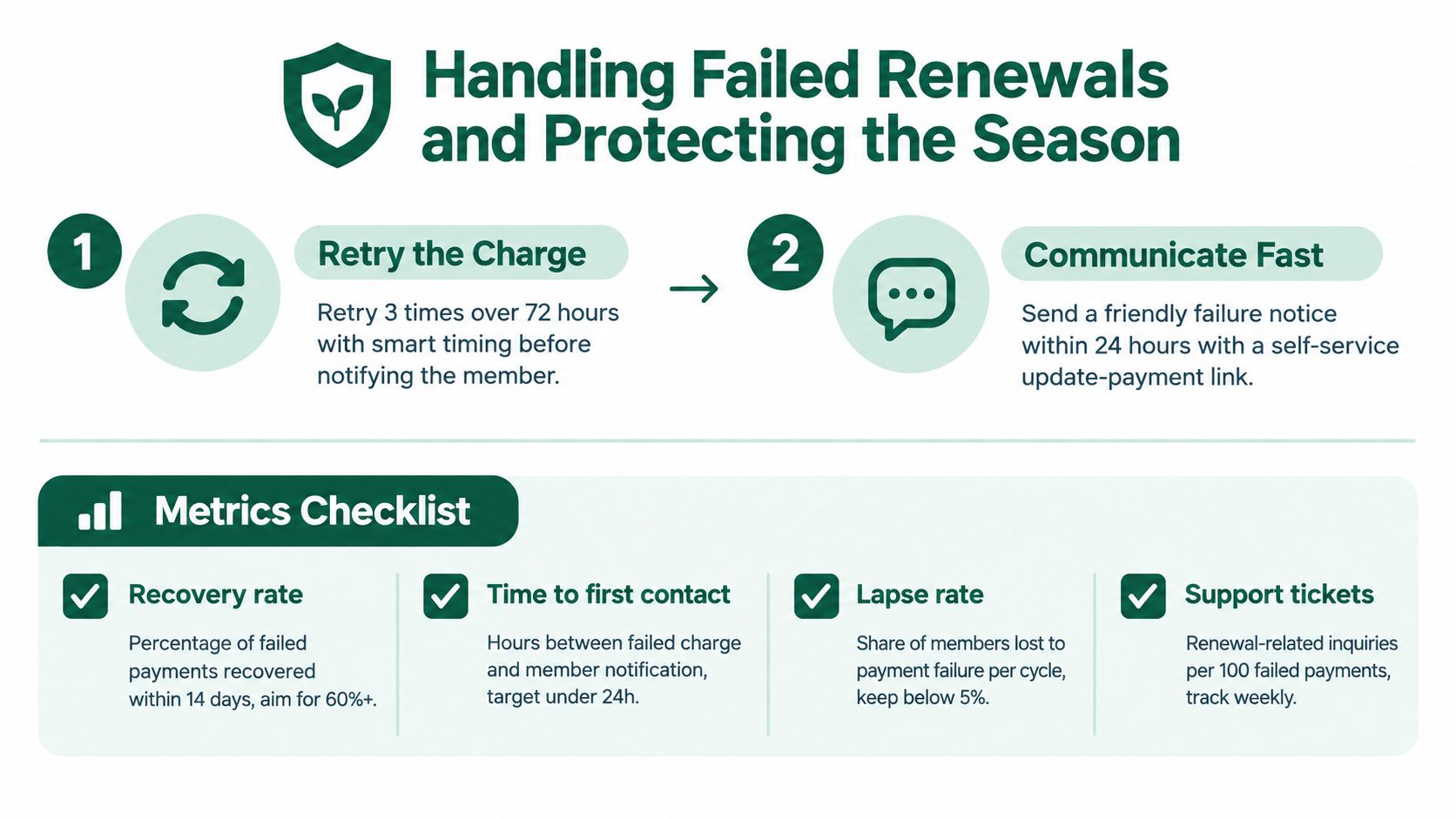
A strong failure notice says what happened and what the member can do next. “Your renewal payment of the stated amount could not be completed on the scheduled date. Please update your payment method to keep your league registration active” is more useful than “Your account is delinquent.”
The manager hand-off should include the original attempt, each retry, the decline category, messages sent, and current registration state. Give staff a brief phone script that offers help without asking the member to read payment details aloud.
Handling Failed Renewals and Protecting the Season
One member's card expires in March, but the renewal posts in April. The first charge is declined, the retry succeeds, and the member never notices. That's the ideal recovery path because the system protects the registration without creating unnecessary support work.
A different member switches banks. The stored token returns a hard decline, three retries fail, the system suspends the registration, and the reminder cascade goes out. After ten days without a response, the league manager needs to make manual outreach with enough information to resolve the case in one conversation.
The recovery sequence
Confirm the suspension state. Make sure the member hasn't paid through another channel or been suspended incorrectly.
Review the last four events. Check the original attempt, retry results, messages, and any update-payment activity.
Send the hand-off package. Give the manager the balance, due date, decline category, and communication timeline.
Offer a one-time backup payment link. The member should be able to complete payment securely without staff re-entering card details.
Document the resolution. Record whether the member paid, updated the method, changed plans, cancelled, or received an approved adjustment.
Washington's registration-payment analysis illustrates why enforcement and suspension rules must be explicit. Its proposed design included a flagged vehicle record and a block on renewal until overdue amounts were paid, while the state's later analysis found that 77% of surveyed respondents preferred annual payment over quarterly payment, with lower-income respondents showing greater interest in quarterly payments. The Washington legislative analysis shows the broader trade-off between affordability and administrative simplicity.
Track authorization rate, recovery rate, involuntary churn, average days to recover, and the percentage of renewals requiring manual intervention. A recurring-payment benchmark reports first-attempt failures averaging 7.9% across industries and reaching 14.7% in some sectors, while insufficient funds account for approximately 42.3% of declines in one large dataset. Recurring payment failure benchmarks provide useful comparison points, but your own league segments matter more than an industry average.
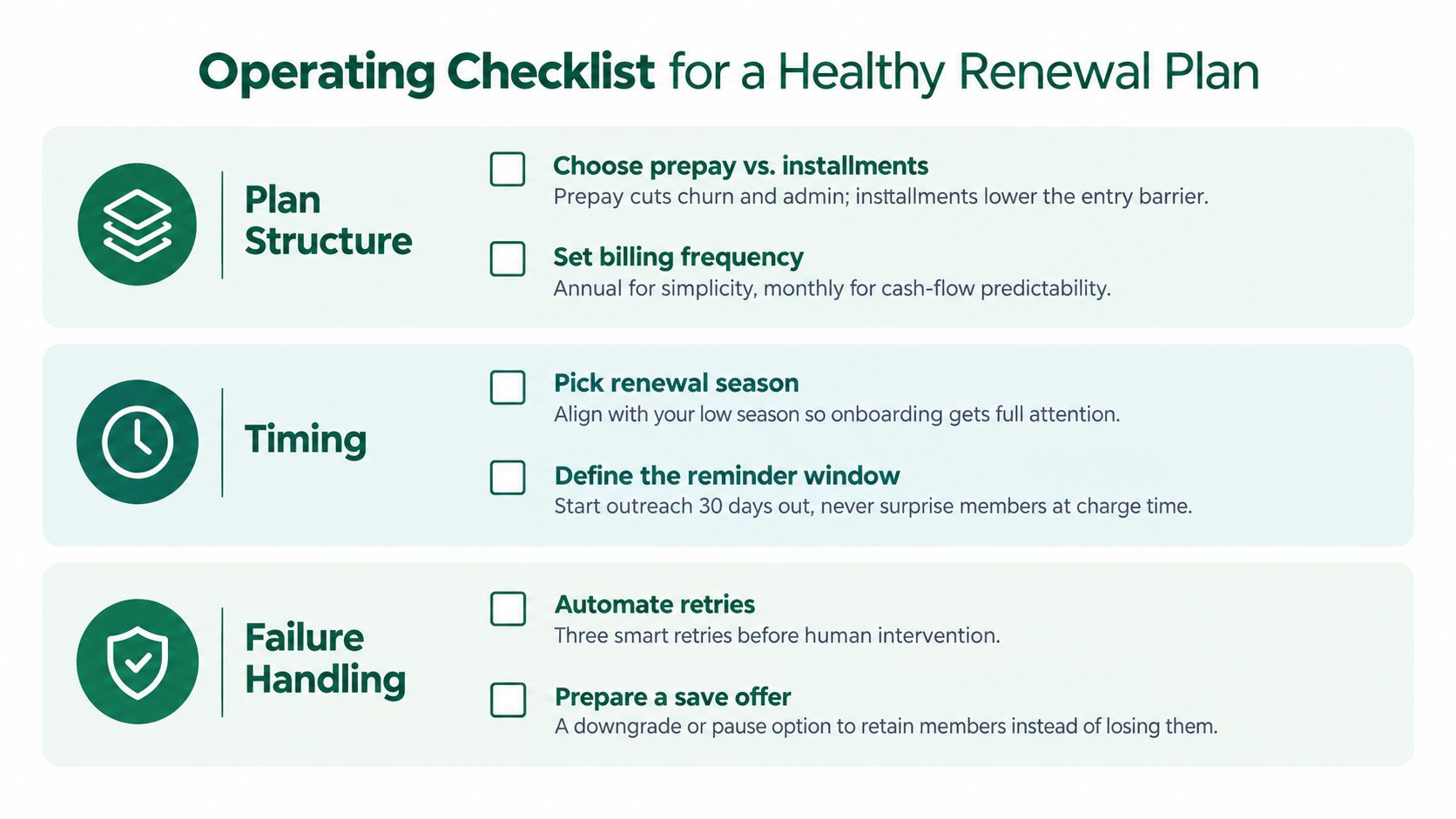
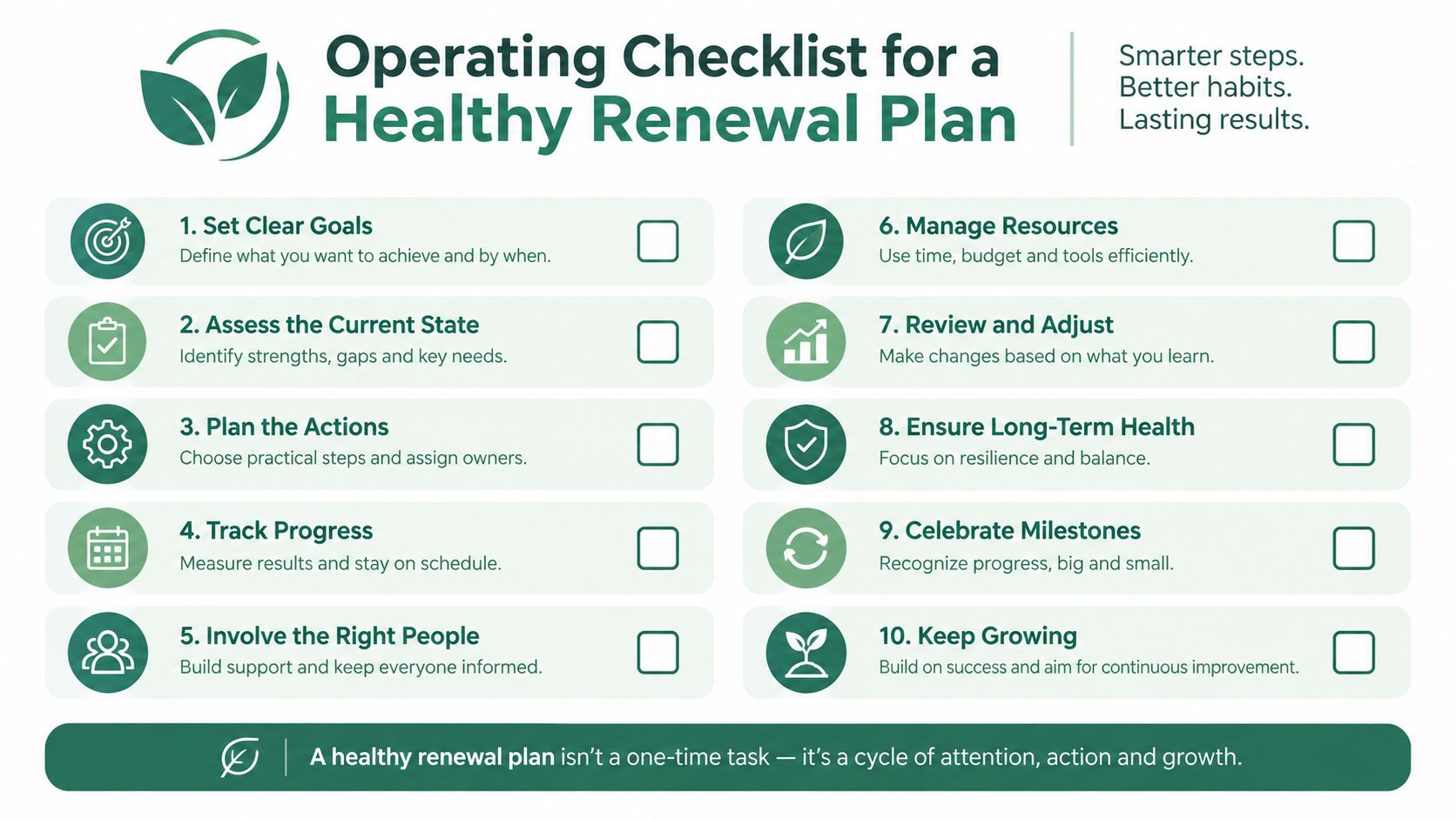
Operating Checklist for a Healthy Renewal Plan
A quiet renewal cycle comes from a handful of decisions made before the roster opens. Keep the checklist close to the product configuration, not buried in a policy document that staff rarely consults.
Plan structure
Choose between annual prepay, monthly recurring billing, and fixed installments based on the season and refund promise. Then create sibling templates for leagues that share the same operating pattern. A template should preserve the billing interval, anchor rule, cancellation treatment, tax handling, and communication cadence while allowing the league name and price to change.
Proration needs a written answer. Decide what happens when a player joins after opening day, upgrades from a limited league to full membership, or drops before the final week. If the system can't apply the rule consistently, require staff approval and document the adjustment.
Payment setup
Use a processor vault token and show staff only the identifying details needed for support. Define whether the member may add a backup method, which day charges run, how idempotency is handled, and which decline categories trigger retries.
Keep a recovery state that preserves registration history while clearly limiting league access. The member shouldn't disappear from the roster because a charge failed, and the treasurer shouldn't have to reconstruct the account from email threads.
Member communication
Schedule the T-30, T-7, T-1, receipt, retry, final-warning, and manager hand-off messages. Keep every link authenticated and every message specific. A win-back script should offer practical options, such as updating the payment method, moving to an available lower-cost plan, or pausing participation where league policy allows.
Maryland demonstrates why eligibility and timing need to be encoded rather than assumed. Its formal schedule for eligible one-year vehicle-registration renewals requires an initial payment and a final payment six months after the registration term begins, uses a valid myMVA Online Services account, must be established within 30 days of the current registration's expiration date, and is unavailable for two-year registrations. Maryland's payment-option guidance also states that there's no setup fee.
Review renewal rate, involuntary churn, average recovery time, and refund volume every month. Retire or merge plans that consistently create support tickets, manual adjustments, or avoidable payment failures.
Live Tourney helps golf courses and event organizers manage league registrations, recurring payments, rosters, communications, and event operations from one web-based platform. Visit Live Tourney to see how you can replace renewal spreadsheets and manual invoicing with a repeatable payment workflow that protects both staff time and the member experience.





