
Oct 6, 2026
us amateur four ball, golf tournament format, four-ball golf, usga championships, golf club events
Us amateur four ball. Master the US Amateur Four-Ball format with this guide for golf clubs. Learn eligibility, tournament structure, and how

You're standing beside the first tee with two scorecards, a full field, and partners asking the same practical questions: Who plays first, which score counts, and what happens if several sides finish tied? Four-ball looks simple until you run it. The winning side depends not only on golf, but also on partner strategy, clear rules, reliable scoring, and a tournament plan that can handle the field as it changes.
The US Amateur Four-Ball offers a useful model because it combines national-level competition with an accessible team format. Its structure also gives local clubs a blueprint for building an event that feels more purposeful than a casual best-ball day. The key is to borrow the principles that work, then scale the logistics to match your course, staff, and players.
What Makes the US Amateur Four-Ball Special
The first tee at a serious four-ball event has a different kind of energy. Two players arrive together, but they don't hit the same shot or carry the same responsibility. One may aim safely at the center of the green while the other takes on a tucked flag. If the aggressive attempt succeeds, the side has gained an advantage. If it fails, the conservative ball can still protect the hole.
That tension makes four-ball compelling for both players and spectators. The side's score comes from the better ball on each hole, so partners can divide risk without dividing the competition. A player who is out of position can take a chance because a partner's steady result may already be available. Conversely, two poor decisions on the same hole leave the side with nowhere to hide.
The U.S. Amateur Four-Ball Championship has established this format as a major national test for amateur teams. The USGA announced the men's and women's championships on February 11, 2013, as part of a broader restructuring that included the planned retirement of the U.S. Amateur Public Links and U.S. Women's Amateur Public Links Championships after 2014. The first championship was played in 2015, making it one of the USGA's newer national championships. The USGA's championship history records the event's creation and early development.
Why clubs should pay attention
A local club doesn't need a national field to capture the format's appeal. It needs a clear identity for the event and a setup that gives both partners meaningful decisions. A pure stroke-play competition works well for a broad membership field. A stroke-play qualifier followed by match play creates a stronger championship feel, provided the club can manage the bracket and communication.
Four-ball also gives clubs a practical way to attract players who might not enter an individual event. Partners can prepare together, share responsibility during difficult stretches, and build a social connection around the competition. That combination of team identity and individual accountability is why the format can become a recurring fixture rather than a novelty on the calendar.
Practical rule: Design the event around the partnership. If every decision, message, and leaderboard treats players only as separate individuals, the competition will feel harder to follow and less distinctive.
Understanding the Four-Ball Format Rules
Four-ball starts with a simple rule: each player on a side plays their own ball throughout the round. On every hole, the side records the lower of the two partners' scores. The players don't alternate shots, and they don't share a single ball.
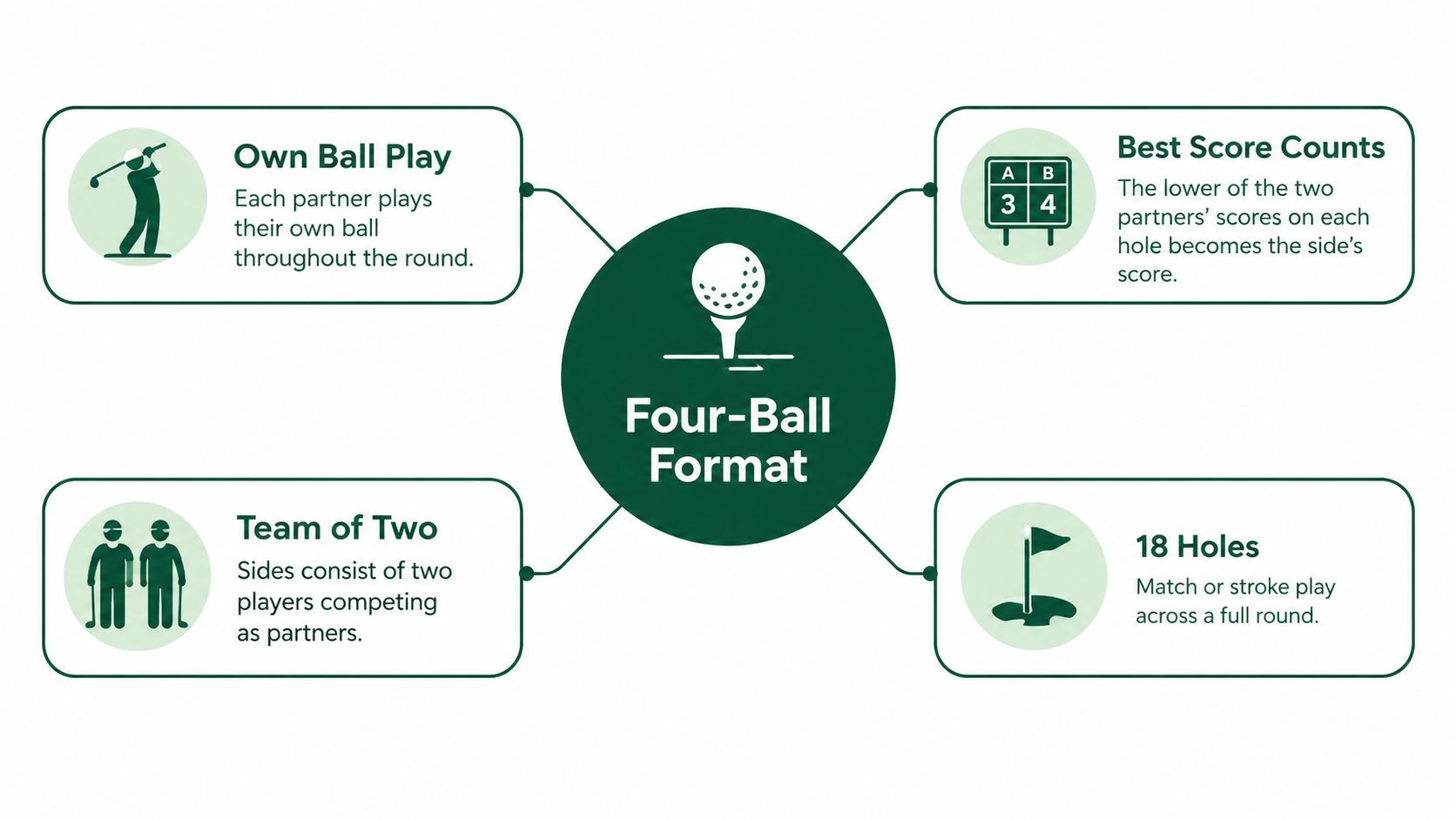
That creates the format's central tactical choice. Partners should avoid making the same mistake at the same time. On a demanding hole, one player can select the safer target while the other chooses a more aggressive line. On a reachable par five, one partner may attack while the other protects against a difficult recovery. The side benefits when its decisions produce different types of chances.
The operating rules
For a club event, explain the mechanics before players reach the course:
Two players form one side: The competition is organized around partnerships, not individual entries.
Both players play every hole: Each partner completes the hole with their own ball.
The lower score counts: If one partner scores four and the other scores five, the side records four.
The format can vary: Four-ball can be played as stroke play, match play, or a combination of both.
Handicap terms must be published: If the event isn't a gross championship, state how handicaps apply before registration closes.
Partners may come from different clubs, states, or countries under the championship eligibility framework, so clubs shouldn't assume that a side must represent one home club. Modern U.S. Amateur Four-Ball regulations have also limited each player's Handicap Index to 5.4 or lower, while eligibility has historically been open to amateurs of any age. This overview of four-player golf games provides useful context when comparing four-ball with other team formats.
Explain the score before the shot
The most common early confusion isn't the better-ball principle. It's uncertainty over whether players should enter individual scores, team scores, or both. Record each player's hole score, then let the scoring process identify the side's lower result. That preserves an audit trail and makes corrections easier.
For handicapped events, publish the allowance, stroke allocation, and tie procedure in the conditions of competition. Don't leave players to infer those details from a generic scorecard. A short briefing at registration, supported by written rules at the first tee, prevents disputes later.
USGA Championship Structure and Qualifying Process
The U.S. Amateur Four-Ball turns a large national entry pool into a tightly controlled championship field. The 2025 championship used 53 qualifying sites, required each player to have a Handicap Index of 2.4 or lower, and advanced 128 sides to the championship. The USGA's 2026 fast facts also highlights how qualifying-site choice and partner eligibility affect the path for prospective entrants.
At the championship, the 128 sides represent 256 players. Every side plays two 18-hole rounds of four-ball stroke play, producing 36 qualifying holes. Only the 32 lowest-scoring sides, or 64 players, move into match play. That is 25% of the starting sides, so the opening rounds are not a warm-up. They are the first major cut.
The progression rewards two skills
Stroke play rewards repeatable scoring. Partners need enough low holes to separate themselves, but they also need to prevent a single disaster from damaging the combined result. A side that relies on constant heroics has less margin than a side that keeps at least one dependable ball in play.
Match play changes the decision process. After the cut, the side no longer competes against the entire field. It competes against one opponent, hole by hole, through a single-elimination bracket. Winning the title requires five knockout matches after qualifying, including the round of 32, round of 16, quarterfinals, semifinals, and championship match.
For clubs selecting a qualifying site, the decision should be treated as a planning exercise rather than a guess about reputation.
Study the course fit: A team should consider whether the site rewards its strongest abilities, such as approach accuracy, driving control, or recovery play.
Review field conditions: Field size and the strength of the regional entry can affect the pressure of the day, even when the course itself remains unchanged.
Prepare for the scoring target: Historical qualifier-score distributions are more useful than a vague instruction to “go low.” A side should set a realistic target range after reviewing previous results where reliable data exists.
Separate team quality from individual reputation: The strongest individual players don't automatically create the strongest side.
The useful question isn't “Which site looks easiest?” It's “Where does this partnership have the clearest competitive edge?”
For local organizers, the same structure can be simplified. A club might use one qualifying round and a small match-play bracket, or retain two stroke-play rounds and use the results to seed elimination matches. The format should fit the available tee times and staffing capacity, not imitate the national event in every detail.
Championship History and Strategic Insights
The championship's early history shows that four-ball has attracted substantial interest from the beginning. The inaugural 2015 event drew 2,234 two-player teams, known in championship terminology as sides. Official USGA records list 2,551 sides in 2023, an increase of 317 teams, or approximately 14.2%, compared with the inaugural entry. The USGA's championship records document those participation figures.
The event also reached a media milestone in 2015, when the men's and women's Four-Ball Championships became the first USGA competitions televised by the Association's then-broadcast partner, Fox Sports, with four hours of live coverage for each championship. The championship was canceled in 2020 because of the COVID-19 pandemic, yet the later entry figures show that demand remained strong.
The best two players may not be the best side
Four-ball exposes a mistake that appears in club pairings every season. Organizers and players often select the two strongest individual golfers without examining how their games interact. That approach sounds logical, but it can produce a volatile partnership if both players tend to miss in the same direction, attack the same risky targets, or struggle on the same type of hole.
A more useful evaluation considers complementary strengths:
Scoring coverage: Can one player produce a dependable result when the other is taking an aggressive line?
Risk separation: Do the partners make different decisions on difficult holes?
Emotional balance: Does one player stabilize the side after a poor hole rather than compound the frustration?
Recent team evidence: Have the pair already communicated effectively under competitive pressure?
The same logic applies to site selection. Course setup, regional competition, and field size can change the demands of qualifying. A team should compare those variables with its own style instead of choosing a location only because it is familiar.
A practical four-ball partnership is a risk-management system. The goal isn't to eliminate aggression. It's to ensure that aggression doesn't become the only available plan. This guide to Ryder Cup four-ball pairings offers another useful comparison for understanding how partner roles can shape team performance.
Hosting Your Own Four-Ball Championship
A club should choose its format before it opens registration. The wrong structure can create avoidable pressure on the staff, especially when the event promises a championship experience but lacks the tee time or scoring capacity to support it.
Start with the competition model
A pure stroke-play event is the easiest option for a broad field. Every side plays the scheduled round, and the final leaderboard determines the result. It works particularly well when the club wants predictable timing and straightforward prize administration.
A hybrid event begins with stroke play and then moves to match play for the leading sides. This creates a memorable finish, but the club must reserve time for the bracket and publish the advancement rules clearly.
A recreational four-ball day can use a simpler field, handicap framework, or side-game structure. The event still needs accurate individual score capture, because the team result depends on comparing the partners' scores hole by hole.
Build the operating plan
Before entries open, assign ownership for registration, pairings, rules, scoring, results, and player communication. Don't make one person responsible for every decision once the first tee is busy.
Use a written run sheet covering:
Registration: Confirm partner names, eligibility, handicaps where applicable, and payment status.
Pairings: Publish tee times in a format players can read quickly on a phone and at the clubhouse.
Scoring: Decide who enters scores and how staff verify unusual or incomplete entries.
Progression: State the cut, seeding method, bracket, and tie procedure before play begins.
Player updates: Prepare messages for weather delays, tee changes, qualifying results, and match assignments.
On-course support: Identify where players can ask rules or scoring questions without slowing play.
Match play also changes the physical operation. As sides are eliminated, tee sheets, food service, scoreboards, and staff positions must adjust. A club that plans only for the opening field will struggle during the final stages.
Technology Solutions for Four-Ball Events
Paper scorecards and spreadsheets can work for a small internal competition, but they become fragile when staff must compare two scores on every hole, correct entries, publish a live leaderboard, and manage a match-play bracket. Manual methods also separate the information. Players may see one result on a clubhouse board while staff maintain another in a spreadsheet.
A tournament platform should keep the individual scores and side result connected. Each golfer enters or submits an individual score, the system identifies the lower score for the side, and the leaderboard reflects the team position. That workflow gives organizers a clearer record than asking players to submit only a combined score.
Compare the approaches
Requirement | Manual process | Tournament platform |
|---|---|---|
Individual score capture | Paper entry and later transcription | Direct digital entry with player records |
Better-ball calculation | Staff or spreadsheet formula | Format-specific scoring logic |
Live standings | Repeated exports or board updates | Published leaderboard from the current record |
Match-play progression | Separate bracket and score tracking | Bracket, pairings, and results managed together |
Player communication | Calls, emails, and printed notices | Centralized digital updates |
The platform still needs a sensible operating procedure. Staff should test the scoring format, verify the starting roster, define who can edit a result, and provide a fallback for players who lose connectivity. Technology reduces repetitive work, but it doesn't replace rules knowledge or event supervision.
Live Tourney supports four-ball scoring by recording each golfer's score and displaying the resulting team leaderboard. Its broader tournament tools include pairings, live results, registration functions, and match-play support, which can help a club keep one operational record as the field changes. This overview of golf tournament scoring software provides further detail on the workflow.
Operations test: Before launch, enter a deliberately incorrect score, correct it, advance a sample side, and confirm that the leaderboard and bracket both show the intended result.
Building a Successful Four-Ball Tournament Program
One successful event is useful. A repeatable four-ball program is more valuable because players can plan for it, staff can improve the process, and the club can develop a recognizable competitive identity.
The program should have a consistent purpose. A club might run a recurring member event, a seasonal championship, or a qualifying series that leads to a final. Each model needs a published calendar, stable conditions of competition, and a clear explanation of what makes one event different from the next.
Make the experience repeatable
Participants return when they know what they're entering and trust the way the event is run. That means preserving the parts that work, such as easy registration, visible pairings, timely results, and clear tie procedures, while reviewing every point of confusion after play.
Recognition doesn't have to rely only on the overall winners. Clubs can acknowledge qualifying sides, match-play finalists, low rounds, or partnership milestones. Those details give more players a reason to participate without weakening the competitive status of the championship.
The operational benefits accumulate as well. Staff who use a consistent scoring and communication process spend less time rebuilding documents for every event. Tournament directors can compare turnout, timing, and common questions qualitatively from one competition to the next, then adjust the format based on actual player behavior.
A four-ball event becomes a club tradition when players remember the quality of the competition and the reliability of the experience.
Technology should support that consistency, not become the program itself. Select tools that staff can operate under pressure, train the team before opening day, and keep a simple manual contingency for weather or system problems. The objective is a professional event that feels calm to participants, even when the field is moving quickly behind the scenes.
Getting Started with Your Four-Ball Event
The first decision is the event's purpose. A one-time showcase can justify a more distinctive match-play finish, while a recurring member competition may benefit from a simpler structure that staff can repeat without exhausting the calendar.
Write the answer down, then use it to make the remaining choices.
Define the scope: Decide whether the event is a single competition, a recurring series, or part of a larger club championship. Set the intended field size and participant profile before advertising.
Choose the format: Match the structure to your course, tee time availability, player ability, and staffing. Don't promise a multi-stage bracket unless you can support the additional rounds and communications.
Publish conditions early: Explain eligibility, partner requirements, handicap treatment, scoring, ties, weather procedures, and advancement. Clear conditions reduce questions at registration and disputes after play.
Prepare the score flow: Test how individual scores become side scores. Confirm who monitors entries, how corrections are approved, and where players view current results.
Rehearse the match stage: If the event includes elimination play, create a sample bracket and walk staff through tee assignments, concessions, results, and player notifications.
Review the event afterward: Ask where players waited, misunderstood a rule, or struggled to find information. Turn those observations into changes for the next competition.
The 2026 championship schedule illustrates why the calendar must be designed before registration begins. Its stroke-play rounds are scheduled for May 16 and 17, 2026, followed by the round of 32, round of 16, quarterfinals, semifinals, and championship match from May 18 through May 20. The official 2026 fact sheet shows how quickly a four-ball event can move from a full field to its final match.
Start with a format your team can execute cleanly. A well-run local championship with accurate scores, visible pairings, and timely communication will build more trust than an ambitious event that overwhelms its staff.
Live Tourney gives golf clubs a web-based way to manage four-ball registration, pairings, individual score entry, team leaderboards, live results, and match-play progression without requiring players to download an app. Visit Live Tourney to review the platform and see how it can support your next four-ball event.





