
Feb 25, 2026
Master the Pinehurst format golf (Chapman System) with our complete guide. Learn the rules, winning strategy, and how to run a flawless tournament.
Of all the team golf formats out there, Pinehurst—often called the Chapman System—is one of the most engaging and strategic. It’s a two-person game that cleverly mixes the best parts of an alternate shot with the forgiveness of a scramble, making it a blast for players of all skill levels.
Think of it as getting a do-over on every tee shot. That simple twist is what makes it so popular for club events, member-guest tournaments, and even just a weekend game with friends.
So, How Does the Pinehurst Chapman System Work?
Pinehurst is all about teamwork. Unlike a pure scramble where you just pick the best drive, or a traditional alternate shot where you're stuck with whatever your partner gives you, Pinehurst offers a strategic middle ground.
This built-in forgiveness is the magic of the format. It creates a dynamic where a weaker player’s one great shot can carry the hole, while a stronger player can bail the team out of trouble. It keeps both partners invested and ensures everyone contributes, hole after hole.
A Format Born from Friendly Competition
The story goes that the format was cooked up back in the late 1940s by Dick and Eloise Chapman during a match at the legendary Pinehurst Resort. They were looking for a way to create a more balanced game for teams with different skill levels, especially for husband-and-wife pairings.
The result was pretty incredible. In March 1947, both teams in their foursome shot identical scores of 77 on back-to-back days. It was immediate proof that the Chapmans had created a uniquely fair and competitive format.
Pinehurst strikes the perfect balance. It’s not as high-pressure as a pure alternate shot, but it’s far more strategic than a simple scramble. It’s a format that rewards good communication and smart decisions, all while keeping things fun.
The Basic Flow of Play
Let’s walk through how a single hole plays out. The process is straightforward, but the decisions you make after the second shot are where the strategy really comes into play.
To make it even clearer, here’s a quick summary of the hole-by-hole process.
Pinehurst Format At-a-Glance
This table breaks down the sequence of events you'll follow on every hole in a standard Pinehurst/Chapman tournament.
Step | Player A Action | Player B Action | Key Decision |
|---|---|---|---|
1. Tee Shot | Hits their own drive. | Hits their own drive. | Both players are in play. |
2. Second Shot | Walks over and plays Player B's ball. | Walks over and plays Player A's ball. | Partners swap drives. |
3. Best Ball Selection | The team assesses both second shots. | The team assesses both second shots. | Choose ONE ball to finish the hole. |
4. Alternate Shot | The team plays alternate shots from the chosen spot until the ball is holed. | The player whose second shot was not chosen hits the third shot. | One final score is recorded for the team. |
Once you select the best ball after the second shot, you simply play alternate shot from that spot until the ball is in the cup. Easy enough, right?
How to Play Pinehurst Step by Step
Getting the hang of the Pinehurst format is easy once you see it in action. The first couple of steps might feel a little different if you're used to other formats, but the rhythm becomes second nature after just a hole or two. The real beauty of this game is how it blends individual shots with team strategy.
This visual guide breaks down the sequence of play on any given hole.
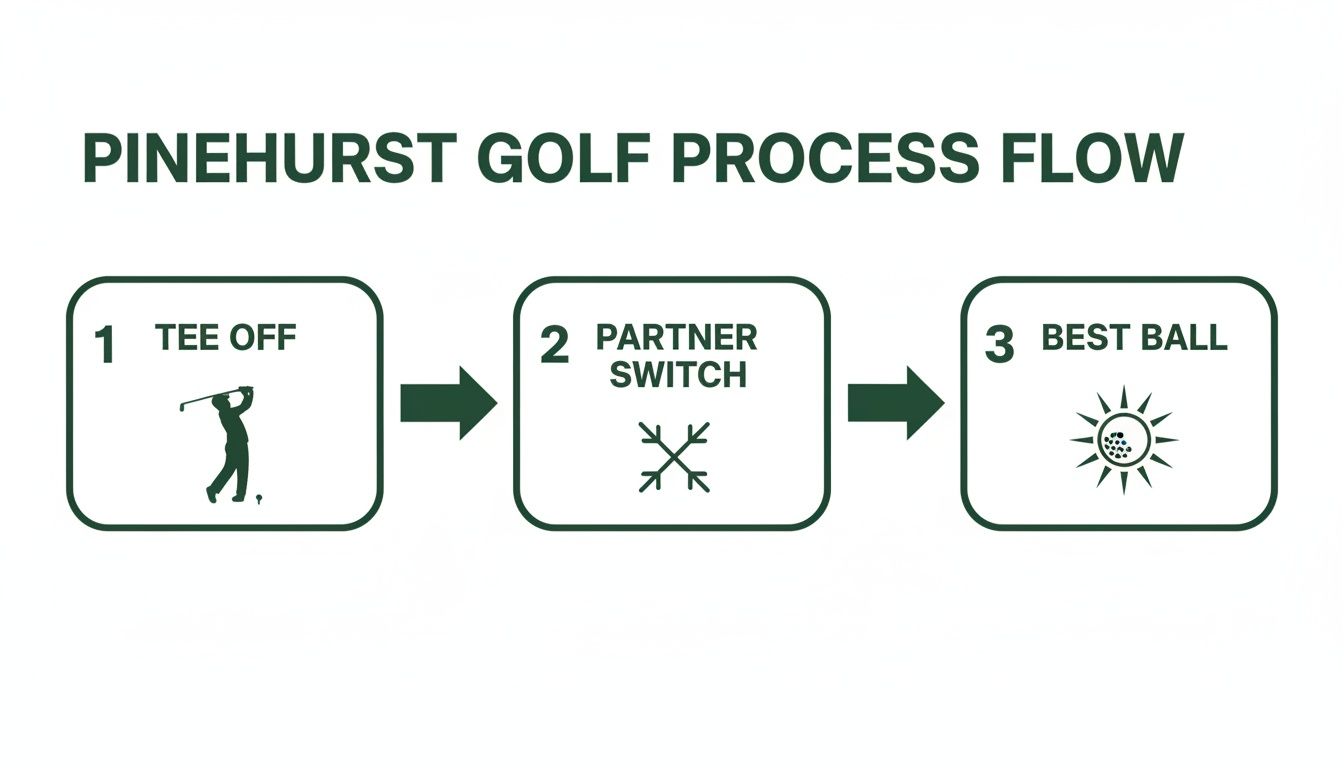
As you can see, the game unfolds in three key phases. First, both players tee off. Then, they switch and play their partner's ball for the second shot. Finally, they make the crucial decision to pick the single best ball and finish the hole from there.
Let's walk through this process with a real-world example to make it stick.
The Anatomy of a Pinehurst Hole
To make the rules crystal clear, we'll follow a fictional team, Alex and Sam, as they tackle a tough 420-yard Par 4. This play-by-play will show not just the rules, but the thinking behind each decision.
Step 1: The Tee Shots
Both Alex and Sam hit their drives from the tee box, each playing their own ball.
Alex's Drive: He stripes one right down the middle of the fairway, about 250 yards out. A perfect position.
Sam's Drive: He gets a little more aggressive, but his shot fades into the light rough on the right, traveling about 270 yards from the tee.
At this stage, both balls are in play. There's no "best ball" choice yet—a key difference from a standard scramble format.
Step 2: The Partner Switch
This is the moment that defines Pinehurst. The players now switch and play each other's golf balls for their second shots. Alex heads over to Sam's ball in the rough, while Sam makes his way to Alex's ball in the fairway.
Alex plays Sam's ball: From a tricky lie in the right rough, Alex hits a great recovery shot that lands just short of the green, setting up a simple chip.
Sam plays Alex's ball: From that prime fairway spot, Sam hits a beautiful approach that lands on the green, about 20 feet from the cup.
After these two shots, the team has two balls in play, both much closer to the hole.
Key Takeaway: This "partner switch" is the heart of the Pinehurst system. It gives every team two chances at a great approach shot, effectively erasing one bad drive while capitalizing on the other.
Step 3: The Best Ball Selection
With both second shots played, Alex and Sam walk up to the green to see what they're working with. This is where the teamwork really kicks in.
Ball A (Hit by Sam): This one is on the green, 20 feet from the pin. It's a look at birdie, but definitely not a gimme.
Ball B (Hit by Alex): This ball is just off the green on the fringe, leaving a pretty straightforward chip.
The team has to choose only one of these balls to play out the hole. They decide Sam’s ball on the green gives them the best shot at birdie. They pick up Alex's ball from the fringe, and it's officially out of play for this hole.
Step 4: The Alternate Shot Finish
Now that they’ve selected the ball on the green, they have to finish the hole by playing alternate shots. The rule for who hits next is simple: the player whose second shot was not chosen gets to play the third shot.
Since they picked the ball Sam hit for the second shot, Alex must hit the third shot—the 20-foot birdie putt.
Alex gives it a great roll, but it stops just inches short of the hole.
Because Alex hit the third shot, it's now Sam’s turn to play the fourth.
Sam taps in the short putt for their par.
The team's final score for the hole is a 4. You repeat this process on every hole, which makes for a dynamic and really engaging round of golf.
Marking the Scorecard
Scoring is as simple as it gets. You just write down the team's single gross score for the hole. For our team of Alex and Sam, you'd mark a 4 on the card for that Par 4.
For more tips on keeping things organized, check out our guide on the best golf scorecard practices. It's a great way to make sure every detail is captured correctly for a smooth and successful tournament.
Calculating Handicaps and Exploring Variations
Fairness is the secret sauce in any good team format, and Pinehurst format golf is no different. You need a solid handicapping system so teams of all skill levels can actually compete. Get it right, and the day is a lot more fun for everyone.
The most common method, often recommended by the USGA, is designed to blend each player's ability into one team handicap. It’s a straightforward formula that gives a little more weight to the better player's handicap, but still makes sure the higher-handicap partner's contribution counts.
The Standard Handicap Formula
To figure out your team handicap, you just need the Course Handicap for both players. Once you have those, the math is simple.
Take 60% of the lower handicap player's Course Handicap.
Add 40% of the higher handicap player's Course Handicap.
The sum of those two numbers is your team handicap.
Let’s run through an example. Say Player A is a 10 handicap (the lower one) and their partner, Player B, is a 24.
Player A's portion: 10 x 0.60 = 6
Player B's portion: 24 x 0.40 = 9.6
Team Handicap: 6 + 9.6 = 15.6
You'd round that up to a final playing handicap of 16. This formula does a great job of preventing a single scratch golfer from completely dominating the field. If you’re running an event, nailing down these details is a huge part of understanding golf tournament scoring and ensuring a smooth competition.
Exciting Pinehurst Format Variations
The classic Chapman System is a fantastic game, but sometimes you want to mix things up. A few popular variations keep the core spirit of Pinehurst but change the strategy just enough to feel new and exciting. These are perfect for tailoring the format to your group, whether it's a serious club championship or a laid-back charity scramble.
The beauty of the Pinehurst format is its adaptability. Small rule changes can completely alter team strategy, creating new challenges and keeping the game engaging for repeat players.
These tweaks can make the game a bit easier or introduce different decision points, so just make sure everyone knows which version they’re playing before they head to the first tee.
Pinehurst Format vs Common Alternatives
To see where Pinehurst fits in, it helps to compare it to other two-person formats. Each one puts a different emphasis on teamwork and strategy.
Format | Tee Shot | Second Shot | Best For |
|---|---|---|---|
Pinehurst | Both players drive, then they hit each other's ball. | Team chooses the best ball after the second shot and plays alternate shot from there. | A strategic blend of individual skill and teamwork. |
Scramble | Both players drive. Team chooses the best shot. | Both players hit from the best spot. | Fun, low-pressure events with mixed skill levels. |
Alternate Shot | Players alternate hitting tee shots on each hole. | The partner who didn't tee off hits the second shot. | A true test of partnership and consistency. |
Best Ball | Both players play their own ball from tee to green. | Each player plays their own ball throughout the hole. | Highlighting individual performance within a team context. |
As you can see, Pinehurst creates a unique dynamic where the second shot is just as critical as the drive.
Modified Pinehurst
Modified Pinehurst is one of the most common and simplest twists. The game plays out exactly like the standard format, with one small—but significant—change.
Instead of choosing the best ball after the second shots are hit, in Modified Pinehurst, the team picks the best tee shot. From that spot, both players hit their second shot, and then they play alternate shot from there until the ball is in the hole.
This puts a huge premium on the drive. It tends to lead to lower scores since teams get to play their approach shots from the prime location, making it a great option for more casual events where the main goal is just to have a good time.
Pinehurst Scramble
For another fun spin, there’s the Pinehurst Scramble. It’s a hybrid that starts like a regular scramble but finishes like Pinehurst.
Here’s how it works:
Both players hit a tee shot.
The team picks the best drive.
The player whose drive was not used hits the second shot.
From that point on, they play alternate shot until the ball is holed.
This variation gives you the "best drive" safety net of a scramble but brings back the strategic challenge of alternate shot for the rest of the hole. It's a great middle-ground that keeps the pace of play moving while still making you think about your approach shots and putts.
Developing a Winning Pinehurst Strategy
Knowing the rules of the Pinehurst format gets you on the course; knowing the strategy helps you win. This game is a delicate balance of individual skill and collaborative decision-making. The teams that come out on top are the ones who think one shot ahead and play to their collective strengths, turning good opportunities into great scores.
This strategic depth is part of what makes the format so enduring—much like the historic championships held at its namesake resort. Pinehurst Resort's North & South Amateur Championship, one of golf's longest-running events, first teed off on April 1, 1901. It was established by Boston magnate James Walker Tufts to showcase his young resort and famously unite Northern and Southern golfers after the Civil War.
By 2012, the event marked its 112th Men's and 110th Women's consecutive runnings, a streak that even outlasted the U.S. Amateur through two World Wars. You can learn more about the deep history of this iconic golf destination and its influence on the game.
Assembling the Perfect Pair
Your strategy starts before you even step onto the first tee. Choosing the right partner is more art than science, but one classic pairing has proven itself time and again: the bomber and the artist.
Pairing a long, powerful driver with a player who has a masterful short game creates a formidable duo. The long hitter’s job is to get the ball as close to the green as possible. From there, the short-game wizard takes over, converting those opportunities with precision wedges and clutch putting. This kind of complementary skill set maximizes your chances on every single hole.
Making the Crucial Second Shot Decision
The most important decision in any Pinehurst match happens after both players have hit their second shots. You’ll have two balls in play, and you have to choose one to finish the hole with. The obvious choice might seem to be the one closest to the pin, but that’s not always the smartest play.
Before you rush to pick up a ball, take a moment to consider these factors:
The Lie: A ball sitting perfectly in the fairway 30 yards out might be a much better option than one just 15 yards from the hole but buried in thick rough or a nasty bunker.
The Angle: Look at the approach to the pin. Does one ball give you a clear, unobstructed line, while the other forces you to play over a hazard? Sometimes the better angle is worth more than a few extra yards.
Your Partner's Strengths: If your partner is a fantastic chipper, leaving them a straightforward chip from just off the green could be smarter than leaving yourself a tricky downhill putt. Play to the hot hand.
The best choice isn't always about proximity; it's about probability. Select the ball that gives your team the highest probability of scoring well, considering the next shot and the player who has to hit it.
Communication Is Key
The most successful Pinehurst teams are the ones who talk through every major decision. A quick, clear conversation can prevent costly mistakes and keep your team aligned from tee to green. It’s what keeps the momentum going and ensures you’re both on the same page.
Talk about your plan on the tee. Should one player hit a safe fairway finder while the other takes a more aggressive line? Before you choose the best ball, discuss the lie, the angle, and who feels more confident with the upcoming shot. This simple back-and-forth is the glue that holds a winning Pinehurst strategy together. It’s the difference between a team that’s just playing and a team that’s truly competing.
How to Run a Flawless Pinehurst Tournament
Pulling off a great Pinehurst format golf tournament is all about the player experience. From the moment they sign up to the final scorecard tally, your goal is to make the day so smooth that all they have to think about is the game. A truly memorable event doesn't just happen—it's the result of smart planning and clear communication.
You need a solid playbook. This means managing everything from balanced pairings and custom scorecards to course setup and rule sheets. Trying to juggle all of this manually is a recipe for headaches and mistakes that can easily frustrate players and your staff.
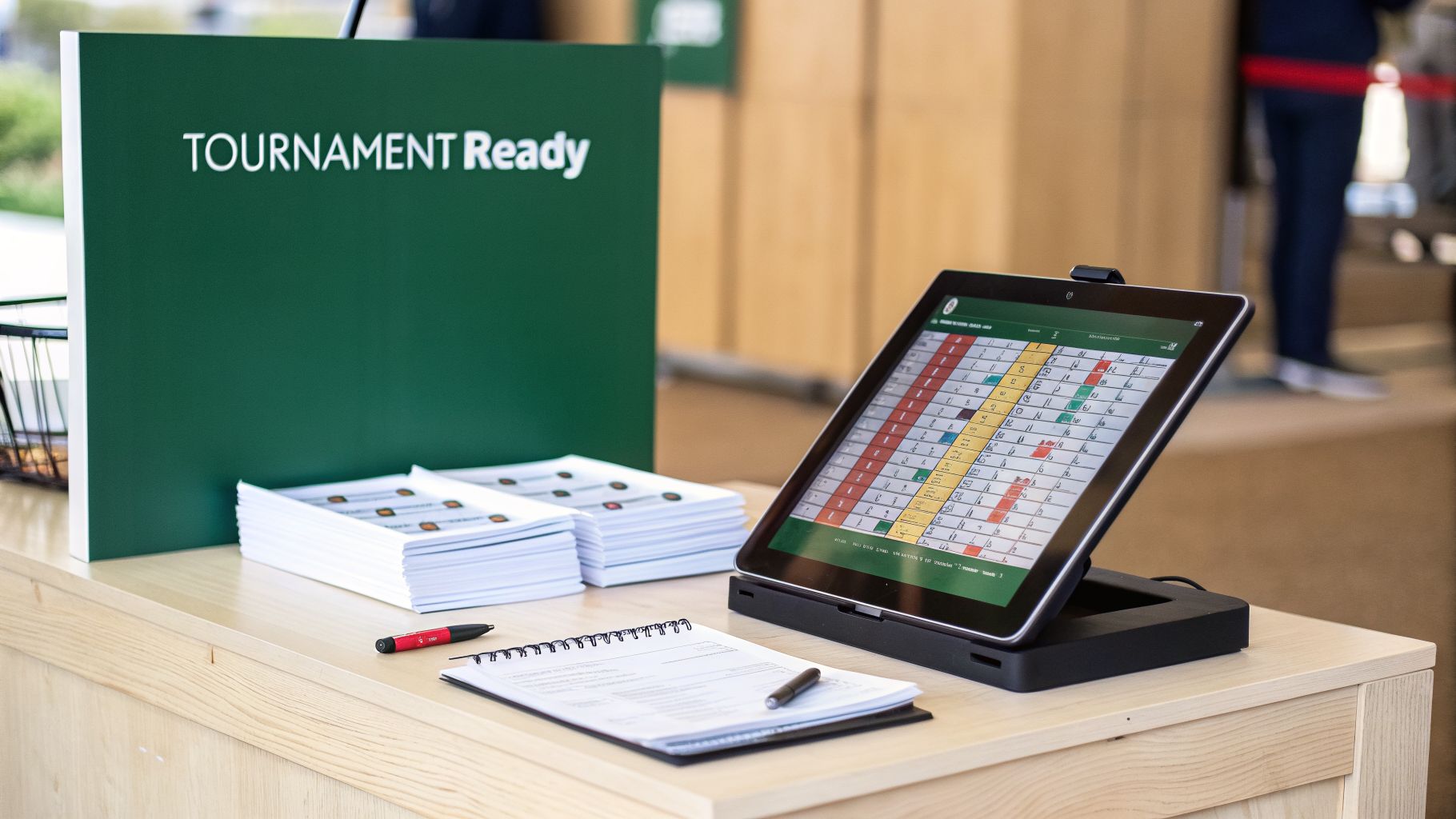
This is where tournament management software changes the game, turning time-sucking chores into simple, automated steps.
Pre-Tournament Organizer Checklist
A flawless event starts long before the first tee shot. A detailed checklist makes sure nothing gets missed and sets the stage for a professional, fun day for everyone.
Player Registration and Pairings: First, get everyone registered with their names and handicaps. Use software to automatically create balanced pairings and tee sheets. This saves hours of work and keeps the competition fair.
Handicap Verification: Double-check that all handicaps are current. A good system will pull this data automatically and apply the correct 60/40 Pinehurst formula to calculate team handicaps instantly and without errors.
Course Setup and Rules Sheet: Work with the golf course to mark the tees and pin locations. Draft a clear, simple rules sheet that explains the Pinehurst format, any local rules, and the schedule for the day. This one piece of paper can head off dozens of questions on the course.
Scorecard and Materials Design: Design scorecards specifically for the Pinehurst format, with obvious spaces for the team's gross score on each hole. Prepping other materials like cart signs and bag tags also adds a polished, professional touch.
This is the kind of detail that turns a good tournament into a great one. For a deeper dive, check out our complete guide on how to run a golf tournament.
Elevating the Player Experience with Technology
The real magic happens on tournament day. Instead of players fumbling with paper scorecards and waiting around for results, imagine them entering scores right on their phones and watching a live leaderboard update after every hole.
Live scoring adds a dynamic, tour-like feel that keeps everyone hooked. Players know exactly where they stand, which injects a level of excitement that's just not possible with old-school scoring.
When you automate the tedious administrative work, you can shift your focus from paperwork to people. That means more time for personal interactions, faster problem-solving, and a more memorable day for every single player.
This approach works even at the most legendary venues. Pinehurst No. 2, Donald Ross's 1907 masterpiece, has hosted over 10 major championships and now stretches over 7,500 yards. Its design has influenced 60% of modern tournament layouts. For the head pros managing events there, tournament software isn't a luxury—it's essential. It handles complex formats, supports live leaderboards for fields of over 1,000 players, and delivers critical reports with 3x faster setup, leading to a 40% jump in live scoring participation.
Post-Tournament Wrap-Up
The job isn't done when the last putt drops. A smooth wrap-up is key to leaving a lasting positive impression.
Finalize Scoring and Payouts: Let the software instantly calculate final net scores, identify the winners, and sort out payouts for side games like skins or closest-to-the-pin.
Communicate Results: Send a summary email to all players with the final leaderboard, winner announcements, and a thank you note. It keeps everyone connected and looking forward to the next event.
Gather Feedback: A quick post-event survey is a fantastic way to find out what people loved and what you can improve for next time.
A flawless event also means a safe one, especially with golf carts involved. It's always a good idea to have a plan for golf cart safety training to protect your players and staff. By adopting these practices and tools, you'll be running a Pinehurst tournament that people talk about for all the right reasons.
Common Questions About the Pinehurst Format
Even with a good handle on the rules, a few questions always seem to pop up the first time a group plays a Pinehurst format golf game. Having the answers ready keeps the round moving and makes sure everyone on the course feels confident.
Think of this as your quick-reference guide for settling any on-course debates. We’ll cover the most common points of confusion so you can get everything sorted out before anyone even steps up to the first tee.
Is Pinehurst the Same as a Scramble?
This is the big one, and the answer is a hard no. They’re both popular two-person formats, but how they’re played couldn’t be more different.
In a Scramble: Both players hit, the team picks the best shot, and then both players hit their next shot from that spot. You repeat this until the ball is in the hole.
In Pinehurst: Both players tee off, then they switch balls for the second shot. It's only after that second shot that the team picks the best ball and plays alternate shot from there.
The key difference is that Pinehurst keeps both players' shots in play for longer and brings much more strategy into the mix.
How Do You Decide Who Hits the Third Shot?
This is simpler than it sounds. Once the team chooses the best ball after the second shots are played, the player whose ball was not chosen hits the third shot.
Example: Player A’s second shot lands on the green. Player B’s second shot finds a bunker. The team obviously chooses to play Player A’s ball. Since they picked Player A's shot, Player B has to hit the third shot (the putt).
This keeps the alternate-shot sequence fair and square from that point on. The player who didn't hit the chosen shot is automatically up.
Is Pinehurst a Good Format for High Handicappers?
Absolutely. Pinehurst is fantastic for players of all skill levels, especially high handicappers. It has some built-in forgiveness that makes it way less stressful than a straight alternate shot game. Everyone gets to hit their own tee shot and second shot on every hole, which keeps things fun and engaging for both partners.
If one player hits a bad drive, their partner gets a crack at recovering with the second shot. This takes a ton of pressure off, making it a perfect format for pairing golfers with different abilities.
Ready to run your next Pinehurst tournament with the ease of a pro? Live Tourney provides app-free live scoring, automated pairings, and instant calculations, making event management effortless for you and more exciting for your players.
Discover a better way to run your golf events at https://livetourney.com.





