
Mar 28, 2026
Learn how pari mutuel golf works with our guide. Understand the rules, payout calculations, and how to run a game at your next golf tournament.

Ever walked past the betting board at a member-guest or charity outing and felt a little lost? You’ve probably stumbled upon pari mutuel golf. It's less like betting against a bookie and more like jumping into a big fantasy pool with everyone else at the event.
All the wagers on the tournament field get tossed into a single prize pool. When it's all over, that pool is split among the folks who correctly bet on the winning players or teams.
How Pari Mutuel Golf Betting Really Works
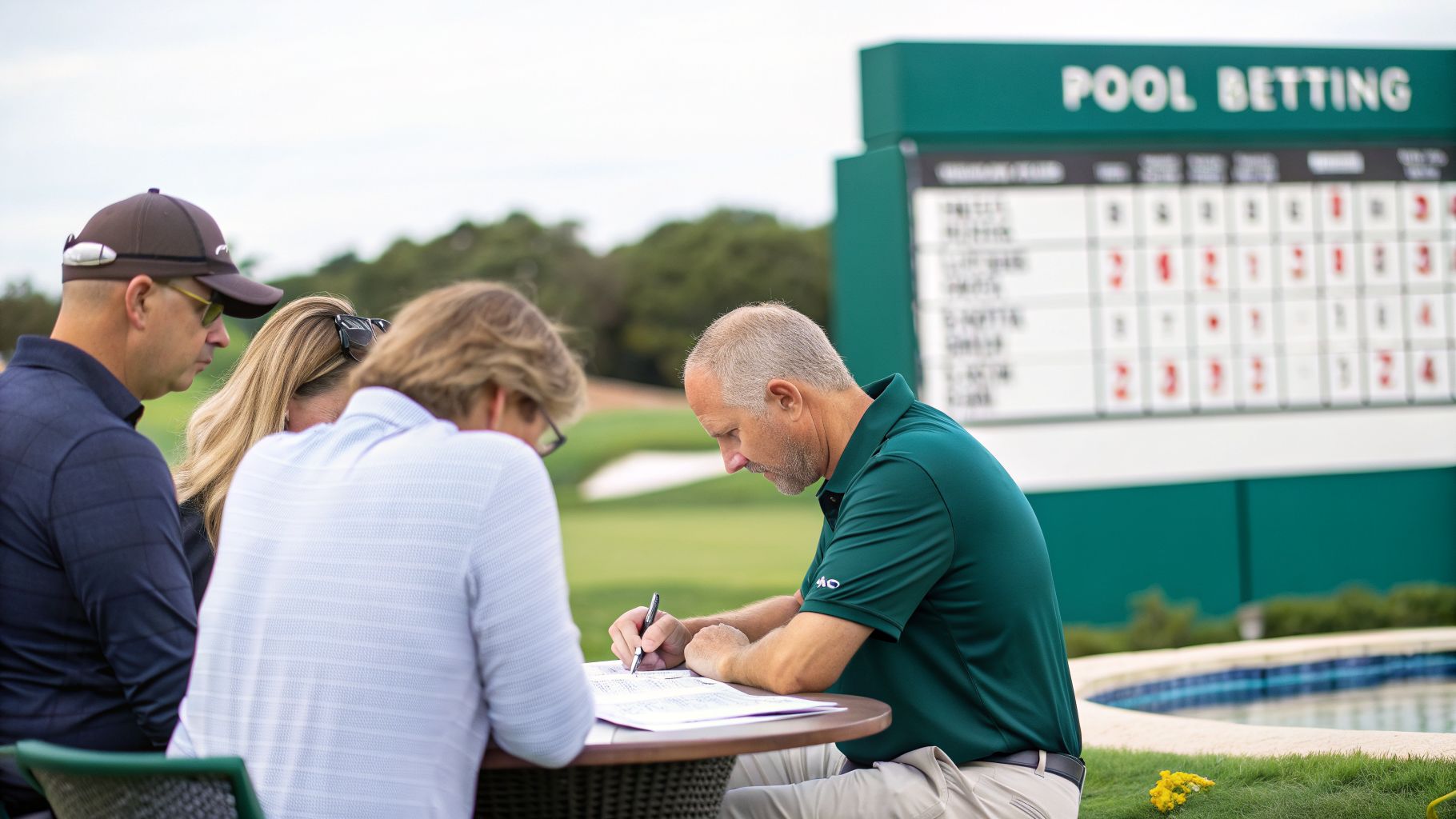
Unlike traditional fixed-odds betting where you’re trying to beat the house, pari-mutuel is a “mutual betting” system. The odds and payouts are set entirely by the bettors themselves. The more money that piles onto a favorite, the lower their final payout becomes. On the flip side, longshots backed by only a few people offer a much bigger return if they pull off a surprise win.
This creates a fun, social dynamic that’s perfect for member-guest events, charity fundraisers, and club championships. It turns spectators into active participants who have some real skin in the game. The mechanics of a pari mutuel golf game are surprisingly simple and usually follow three core steps.
The Three Core Steps of a Pari Mutuel Game
The whole process is designed to be transparent, so everyone knows exactly how the pot is built and paid out. It breaks down like this:
Placing Wagers: Before the first tee shot, players place their bets on who they think will win. All that cash goes into one central prize pool.
Calculating the Pool: The tournament organizer takes a small, pre-announced percentage from the top. This is often called the "house take" or "vigorish" and usually covers admin costs or goes to a charity. The money left over is the net prize pool.
Distributing Winnings: As soon as the tournament winner is official, the net prize pool is divided only among those who bet on that winning player or team.
This simple structure makes it a go-to feature for tons of events. For example, top-tier amateur tournaments like the Pacific Northwest Invitational often list "Scoring and Pari-mutuel Betting" right on the official schedule, adding an extra layer of competition and excitement.
The real beauty of the pari-mutuel system is its fairness. The odds are a direct reflection of the group's collective wagers, so everyone can see exactly how the potential payouts are taking shape. It keeps things engaging and transparent for everyone involved.
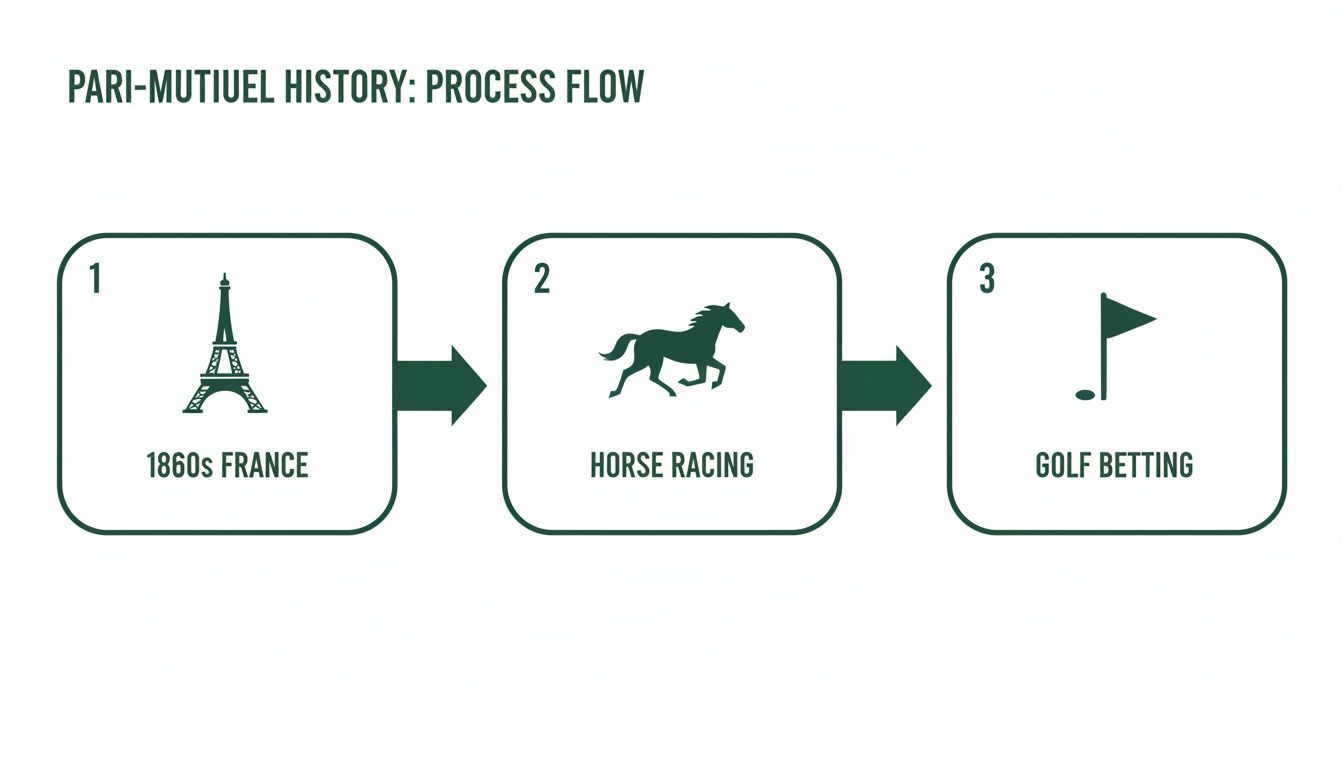
To really get pari mutuel golf, you first have to understand where it came from. And surprisingly, it has nothing to do with golf. The system was born on the horse tracks of 19th-century France, a world away from the quiet, manicured greens we know today.
The idea was a game-changer. It took the power away from a single bookmaker and put it squarely in the hands of the bettors themselves.
This concept of "mutual betting" made everything more democratic and transparent. Instead of trying to beat the house, bettors were now competing against each other. The odds weren't set by an oddsmaker—they were shaped by the collective wisdom (or wagers) of the crowd.
From the Racetrack to the First Tee
It all started with a French-Catalan entrepreneur named Joseph Oller, who came up with the system back in 1867. His method was simple: pool all the bets together, take a small cut for the house to cover taxes and admin fees (usually around 16%), and then divide the rest among everyone who picked a winner. You can explore more about the foundational mechanics of this system, which has been adopted far beyond just one sport.
The model was such a runaway success at the track that it was only a matter of time before it found its way into other sports. Golf, with its large fields and uncertain outcomes, was a natural fit.
The core idea was simple yet powerful: let the community of bettors determine the odds. This inherent fairness and social dynamic is why it transitioned so seamlessly from horse racing to the golf course.
The pari-mutuel structure was perfect for club tournaments, member-guest events, and charity outings. Organizers finally had a way to run a pooled, dynamic, and social betting game that was easy for everyone to get behind.
The iconic "tote board" from the racetrack, which displayed real-time odds, simply evolved. Its modern-day equivalents are the big betting sheets and digital leaderboards you see at golf tournaments everywhere.
This isn't just some niche side game. Pari mutuel golf is a time-tested system with deep roots in competitive sports, built on a foundation of fairness that has worked for over 150 years. Its journey from a Parisian racetrack to your local club championship proves just how well it works.
Calculating Payouts in Pari-Mutuel Golf
This is where the real fun of pari-mutuel betting kicks in—the payout. At first glance, the math might seem a little intimidating, but it’s surprisingly straightforward. The beauty of the system is its total transparency. Everyone knows exactly where the money is going, which is a big reason why it’s been a trusted betting format for over 150 years.
This system wasn't invented for golf, of course. It got its start in 19th-century French horse racing but made a seamless jump to the golf course because the core principles of fairness and pooled risk work perfectly.
The logic is simple: you’re not betting against the house; you’re betting against everyone else. Let’s break down exactly how that works.
The Math Behind the Money
To make this crystal clear, let's walk through a common scenario. Imagine a 20-team member-guest tournament where players buy $10 "tickets" to back the team they think will win.
First, you calculate the total prize pool. This is just the sum of all the money wagered. If 200 tickets are sold at $10 a pop, you’ve got a $2,000 total pool. Easy enough.
Next, the tournament organizer takes out the "house take." This is a small, predetermined percentage (say, 10%) that covers administrative costs, goes to a charity, or funds other parts of the event. It’s a necessary fee to keep things running smoothly, similar to the entry fee in a skins game competition.
With that, we have our key steps:
Step 1: Calculate the Total Pool. Add up all the money bet by all participants.
Step 2: Subtract the House Take. The organizer removes the pre-agreed-upon percentage.
Step 3: Determine the Net Pool. This is the final pot of money that will be paid out to the winners.
Step 4: Calculate the Payout. Divide the net pool by the amount of money bet on the winning team to find the payout odds.
This simple, four-step process ensures fairness and keeps everything out in the open.
Payouts in Action: A 20-Team Example
Let's stick with our example. A 10% house take on the $2,000 total pool is $200.
That leaves us with a net prize pool of $1,800 to be paid out to the people who bet on the winning team.
Now, let's say "Team Smith/Jones" ends up winning the whole thing, and a total of $150 (or 15 tickets) was bet on them.
To find the payout for each winning ticket, we just divide the $1,800 net pool by the $150 wagered on the winning team. This gives us a multiplier of 12.
$1,800 (Net Pool) / $150 (Money Bet on Winner) = 12
So, for every $1 bet on Team Smith/Jones, the payout is $12. A $10 ticket turns into a $120 return—not a bad day on the course.
The table below shows how the payouts would change depending on which team won and how much money was bet on them.
Sample Pari Mutuel Payout Calculation
This table illustrates how payouts are calculated in a hypothetical 20-team golf tournament with a $2,000 total betting pool and a 10% house take. The net pool available for payouts is $1,800.
Team/Player | Total Money Bet ($) | Odds (Net Pool / Money Bet) | Payout per $10 Bet |
|---|---|---|---|
Team Smith/Jones (Winner) | $150 | 12-to-1 | $120.00 |
Team Brown/Green (The Favorite) | $400 | 4.5-to-1 | $45.00 |
Team Davis/Miller (The Longshot) | $50 | 36-to-1 | $360.00 |
As you can see, the real excitement comes from the odds. Backing the favorite, Team Brown/Green, would have returned a respectable $45 on a $10 bet. But if you took a chance on the longshot, Team Davis/Miller, that same $10 would have turned into a massive $360 payout.
This is what makes pari-mutuel betting so compelling. It's a dynamic system where the potential rewards directly reflect the collective opinion of the group, rewarding those who are willing to bet against the grain.
How to Run a Pari Mutuel Game at Your Tournament
So you want to add a pari-mutuel game to your next event? Smart move. It’s a proven way to ramp up the competitive energy and give your tournament that professional, big-event feel. Let's walk through exactly how to set it up, from old-school pen and paper to modern software.
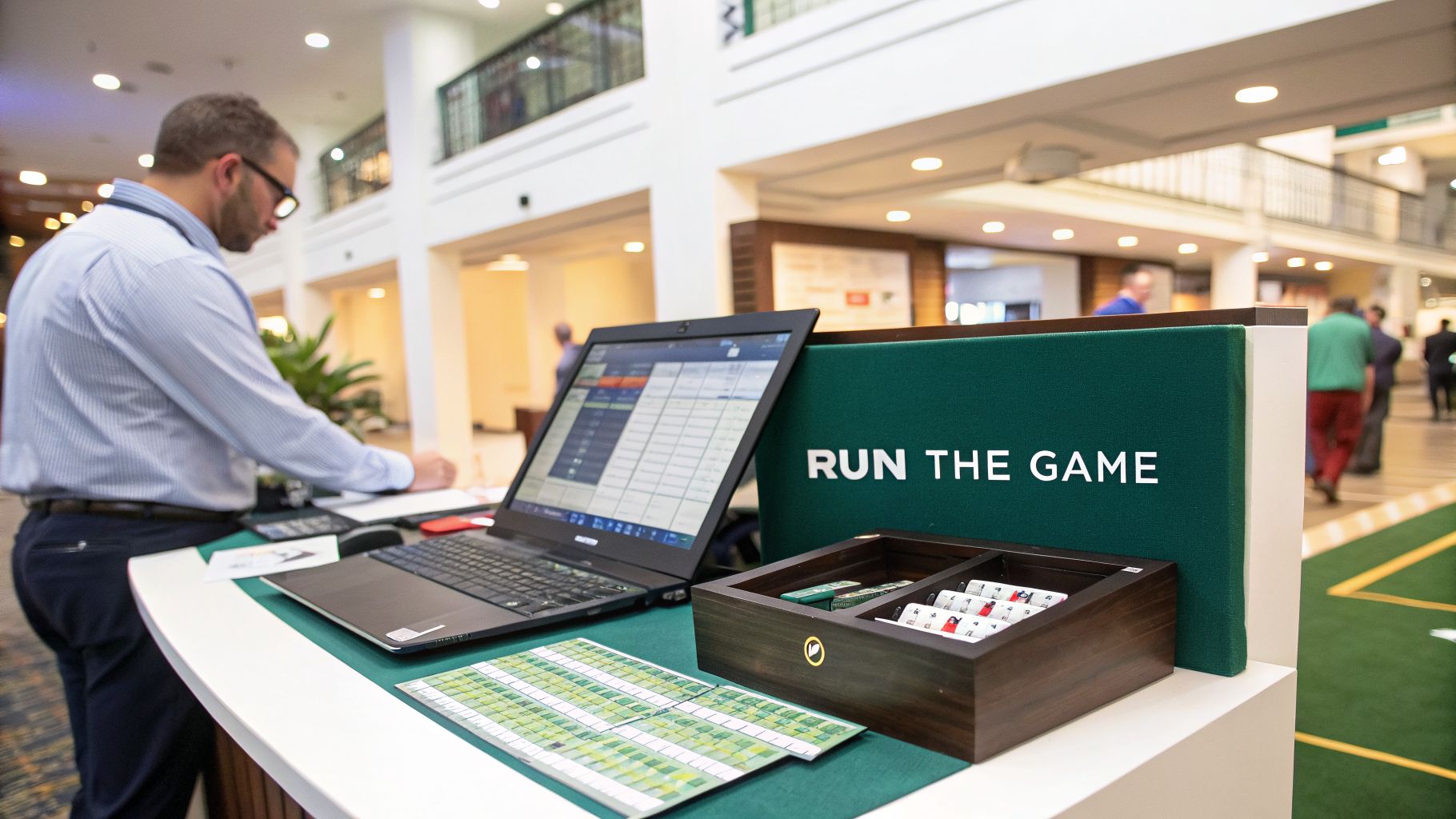
Whether you’re working off a laptop or just a folding table and a cash box, having a dedicated station is non-negotiable. This is your command center for collecting bets and answering questions, so keeping it organized is key to a smooth day.
The Manual Approach
Going the traditional route is definitely doable, but it demands your full attention. One little mistake can throw everything off, so you have to be meticulous.
Here’s what you’ll need to handle before the first tee shot:
Establish Clear Rules: First things first, set the ground rules. Decide on the minimum bet (a $5 or $10 buy-in is pretty standard), the house take (usually 10-20%), and which bets you’ll offer—Win, Place, and/or Show.
Create Betting Sheets: Print out simple sheets that list every player or team. Make it easy for golfers to find their pick, write down their name, and put down how much they want to bet.
Manage the Cash Box: You need a secure spot for the money and one person who is responsible for it. They'll be collecting cash and making change, so accuracy is everything.
After the last putt drops, your work is just getting started. You'll have to manually enter every single bet from those paper slips into a spreadsheet. From there, you calculate the total pool, subtract the house cut, and then figure out the payouts for each bet. If you're looking for other ideas on keeping players locked in, checking out how others go about hosting an interactive betting event with a Race Night Kit can offer some great tips on management and engagement.
Automating the Process with Software
Let's be honest, manually tracking bets on a spreadsheet is a huge time sink and an open invitation for errors. A single typo or a busted formula can completely derail your payouts and leave you with a crowd of unhappy golfers. This is where tournament software completely changes the game.
Modern tools take the entire pari-mutuel process off your hands, from taking bets to calculating the final payouts. It gets rid of all the manual data entry, guarantees your numbers are right, and saves you and your staff hours of tedious work.
Think about it. Instead of wrestling with spreadsheets and wads of cash, you could use a system that handles all the betting automatically. If you need more general tournament advice, our guide on how to run a golf tournament is a great place to start.
With a tool like Live Tourney, the whole thing becomes incredibly straightforward:
Set Up the Game: Just plug your betting rules—bet types, house take, and minimums—directly into the software.
Track Bets Digitally: As bets come in, they’re logged instantly, creating a perfect, running record. No more paper.
Calculate Payouts Instantly: As soon as the final scores are posted, the software does all the math. It calculates the final prize pool and tells you the exact payouts for Win, Place, and Show. Done.
Using a digital approach lets you run a tight, error-free betting game that feels truly professional. It makes your job easier and makes the entire experience better for every single player.
Navigating the Rules and Integrity of Golf Betting
Running a great tournament means making sure everything is fair, square, and by the book. A pari mutuel golf game can add a ton of excitement, but it also means you’ve got to get a few things right when it comes to rules and integrity. Let's walk through what you need to know to run your game with confidence.
Friendly wagers have been a part of golf since the beginning, but it's smart to know your local and state rules. The regulations around games of chance can change a lot from one place to another, so a little homework upfront ensures your event stays fun and compliant for everyone.
Addressing Game Integrity
It’s natural to think about the integrity of betting in sports, but context is everything. Worries about things like match-fixing were a real concern way back in golf’s early days, but the game has changed completely. With the massive prize purses in today's professional tours, those kinds of risks are basically nonexistent at the top level.
Back in the 1930s, for example, the organizers of the Masters were pretty wary of any legalized wagering because of those integrity concerns. Today, that history just shows how far the professional game has come in protecting itself.
At the club level, this is all good news. When you run a pari-mutuel game transparently for fun, fundraising, or just bragging rights, you’re upholding the best standards of the game. The whole point is community and friendly competition, not high-stakes gambling.
Good management is what makes it all work. That means being totally clear about the house take and keeping a clean record of all the wagers. Making sure every score is entered correctly is also a huge part of maintaining trust, which is why we put together a guide on properly posting a golf score. It’s a great way to reinforce the importance of accuracy across your whole event.
A Longstanding Tradition in Golf
Betting on golf is nearly as old as the game itself. From private club invitationals to a Saturday morning match at the local muni, wagering has always been part of the culture. The pari-mutuel system, which is so common in horse racing and even auto racing, was a natural fit for golf.
Course operators and tournament organizers have long known that a structured betting pool is the fairest and most transparent way to manage wagers. It’s a proven system. You can learn more about pari-mutuel wagering in amateur golf and see just how deep its roots go.
At the end of the day, a well-run pari mutuel golf game just makes a tournament better. It strengthens the social side of the event and gives everyone another reason to stay invested. By being transparent with the rules and meticulous with the numbers, you create an experience that’s engaging, trustworthy, and a whole lot more fun for everyone involved.
Answers to Your Pari-Mutuel Golf Questions
Even after you get the hang of the basics, a few questions always seem to come up when you're running a pari-mutuel golf game for the first time. It’s completely normal.
Let's walk through some of the most common ones. Getting these details right from the start will make sure your game is fair, fun, and easy for everyone to understand.
Can We Offer Different Types of Bets?
You sure can. While a simple "Win" bet is the most popular way to start, you can easily add more layers to the game, just like you’d see at a horse track.
Here are the three standard options:
Win: The classic. You're betting on a specific player or team to finish in first place, and that's it.
Place: A safer bet. Your pick just needs to finish in either first or second place. The payout is the same for either spot.
Show: The safest bet of all. Your pick can finish in first, second, or third, and you cash in. Naturally, this one comes with the lowest payout.
Offering all three gives your players more ways to get in on the action. Some might want to play it safe, while others might hedge their bets. Just remember that each bet type—Win, Place, and Show—needs its own separate prize pool for calculating payouts.
The beauty of a pari-mutuel game is its flexibility. You can keep it as a simple "winner-take-all" pool or build it out with Win, Place, and Show options. It all depends on what works best for your group and your event.
Why Is There a House Take?
The "house take," also known as the vig, is a small cut—usually 10-20%—that the organizer takes from the total betting pool before paying out the winners. This isn't just for profit.
Most of the time, that money is used to cover small administrative costs, fund another part of the event, or, quite often, go straight to a designated charity.
The key is to be completely transparent about it. Just announce the percentage before anyone places a bet. That way, everyone knows exactly how the final prize pool is being calculated, and there are no surprises.
Are There Integrity Concerns?
Worries about gambling in golf aren't new, but the game has changed dramatically over the years. Back in 1935, a bill to legalize pari-mutuel wagering in Georgia nearly passed right before the Masters. Rumor has it that some influential figures, maybe even Bobby Jones himself, weren't thrilled about having legalized gambling so close to Augusta National. You can read more about this fascinating piece of golf history and what happened next.
Fast forward to today, and the enormous purses in professional golf have all but eliminated those kinds of integrity issues at the top level. For club events and friendly outings, a well-run and transparent pari-mutuel golf game is all about friendly competition and fundraising—things that have always been at the heart of the sport.
Running a professional, error-free tournament has never been easier. With Live Tourney, you can automate everything from live scoring and leaderboards to side games and payouts, all without requiring a single app download. See how our intuitive, web-based software can save you time and elevate your next event at https://livetourney.com.





