Apr 29, 2026
Master your Michigan amateur golf tournament. Learn GAM rules, seamless registration, live scoring, & modern tools to save time and enhance player experience.

Saturday morning arrives and the parking lot is full before your staff has finished setting out rule sheets. A few players want to know if pairings changed. Someone else can't find their starting hole. Two scorecards come back with different totals on the same group. The spreadsheet in the shop has already been edited three times, and you still haven't posted a clean leaderboard.
That's a familiar scene in michigan amateur golf. The event itself is rarely the problem. The problem is the stack of disconnected processes around it. Registration lives in one place, pairings in another, payments in a folder, and scoring on paper until somebody sprints back to the golf shop.
Michigan has a long amateur tradition, and players notice when an event feels organized. They also notice when it feels held together by clipboards and last-minute fixes. If you want a stronger field, fewer staff headaches, and a better player experience, the biggest gains usually come from operations, not from adding more rules or more volunteers.
Beyond Spreadsheets Modernizing Your Michigan Amateur Golf Event
The old system usually fails in predictable ways. Paper forms slow down registration. Manual pairing updates create avoidable confusion. Scorecards pile up after the round, and the golf shop becomes a traffic jam of players waiting for results that should already be visible.

That gap is real in Michigan. Current association resources tend to focus on schedules, sign-ups, and basic championship information, not on practical guidance for app-free live scoring during smaller events, Golf Days, or qualifiers. At the championship level, organizers have also used more complex systems in events such as the 114th Michigan Amateur, which leaves many smaller operators stuck between manual methods and heavier software, as shown on this event technology page for the 114th Michigan Amateur.
What breaks first on tournament day
Most event problems aren't dramatic. They're cumulative.
Check-in gets backed up: Staff answer the same questions repeatedly because confirmations, pairings, and start details weren't centralized.
The scoring table becomes a bottleneck: Players finish, gather around one spot, and wait while somebody re-enters totals.
Changes don't travel fast enough: A tee switch, weather adjustment, or withdrawal reaches some players but not all of them.
Practical rule: If staff has to retype the same player information more than once, the event is already carrying extra risk.
I've seen directors put enormous effort into details that players barely notice, while accepting admin pain as part of the job. It doesn't have to work that way. A cleaner digital setup removes friction before the first tee shot and keeps the event moving once scores start coming in.
A lot of clubs have already embraced better guest-facing tools in other areas. If you're thinking about broader event presentation, this golf simulator hire guide is a useful example of how outside-the-box golf experiences are being packaged more professionally for modern audiences. The same standard now applies to amateur event operations.
For directors who are still comparing manual workflows with current options, this overview of golf tournament management software is a good starting point. The main point is simple. When registration, communication, pairings, and scoring live in one system, you stop chasing information and start running the event.
Planning for Success Before the First Tee Shot
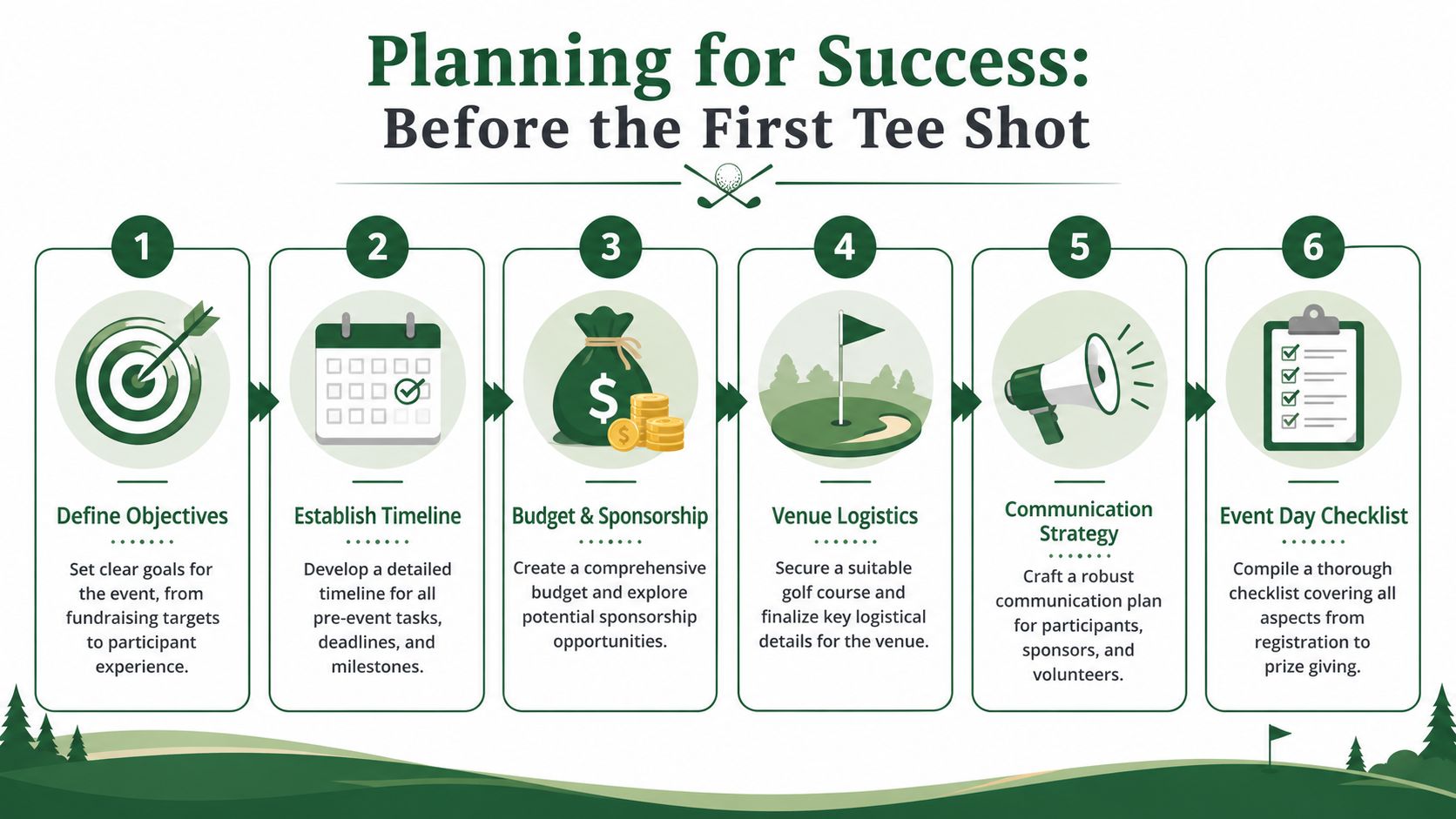
Good michigan amateur golf events are usually won in the planning phase. Tournament day only exposes what was already loose. If your field policy is vague, if your format doesn't match your players, or if your timeline exists only in your head, the problems show up fast.
The Michigan Amateur Championship gives a useful benchmark because it has been running since 1906 and remains the state's oldest continuous golf championship, with a format that has evolved over time to handle everything from qualification to match play, as noted in this history of the Michigan Amateur Championship. That's an important lesson for local operators too. The format has to fit the event, not the other way around.
Start with field definition
Before you build pairings or open registration, decide what kind of competition you're hosting.
A strong amateur event usually gets clearer when you answer these questions early:
Is it a pure competition or a member-friendly competitive day?
Those are different events. A serious gross competition needs tighter eligibility and cleaner pace-of-play controls. A broader club amateur can carry more flexibility.Will handicaps matter at all?
If you're running a scratch-focused event, say that clearly up front. If net awards are involved, make the handicap process transparent before players sign up.Are you rewarding access or excellence?
Some events should welcome the biggest possible field. Others should protect a competitive standard. Trouble starts when an event tries to do both without defining priorities.
Match the format to the workload
The biggest planning mistake I see is choosing a format because it sounds traditional or exciting, not because the staff can administer it cleanly. Match play is fantastic when the bracket is tight and communication is sharp. It becomes messy when alternates, withdrawals, and delayed results pile up.
Stroke play is often easier to control operationally, especially when you're managing a one-day or short-format event. Team formats work well for participation but require more thought on score entry, side games, and tie handling.
A quick comparison helps:
Format | Best use | Common problem |
|---|---|---|
Stroke play | Club amateurs, qualifiers, one-day competitions | Slow results if scoring stays manual |
Match play | Championship-style events, bracket drama | Admin load rises quickly with changes |
Two-person team | Member events, invitationals | Confusion around score method if rules aren't simple |
Scramble or hybrid fun format | Large participation days | Competitive players may want firmer standards |
Run the simplest format that still matches the identity of the event. Simplicity isn't a downgrade. It's what lets the day feel polished.
Build a planning file that staff can actually use
Most directors have a planning document. Fewer have one that another staff member can pick up and run with. That's the standard worth aiming for.
Include these pieces in one operating file:
Entry policy: Who's eligible, what players need to submit, and when registration closes.
Competition rules: Tees, format, scoring method, tie procedure, and pace expectations.
Operational schedule: Check-in window, first starting time, scoring procedure, and awards timing.
Communication templates: Confirmation email, pre-event reminder, weather delay text, and post-round results message.
If you want a simple model for building that workflow, this golf tournament planning guide gives a practical framework.
The planning phase should reduce decisions on tournament day, not create more of them. When the field is defined well, the format is manageable, and the operating file is complete, your staff stops improvising and starts executing.
Simplify Registration and Keep Players Informed
Registration tells players what kind of event they're entering. If the process feels dated, unclear, or slow, they assume the event will feel the same way. That's why the front end matters so much in michigan amateur golf, especially when you're trying to attract serious players and still make life easier for your staff.
The Michigan Women's Amateur Championship is a good reminder of what organized competition requires over time. It celebrated its 100th event in 2014, and the Golf Association of Michigan took over operations in 2005, integrating multiple women's events under one umbrella, according to this history of the Michigan Women's Amateur Championship. Long-running events survive because communication stays structured.

What players hate about old registration
Players don't usually complain about registration unless it goes wrong. Then you hear everything.
Common failures include:
Multiple touchpoints: Email the form, mail the check, wait for confirmation, then call the shop to verify.
Late answers: Players don't know if they're in, on a waitlist, or missing required information.
Scattered updates: Tee times go out one way, changes go out another, and somebody always misses one message.
That setup creates extra work for the club because every unclear step becomes a phone call.
A better standard for amateur events
The best registration process feels boring in the right way. A player signs up, pays, receives confirmation, and knows where future updates will appear. Staff can review the roster without rebuilding it by hand.
The following works in practice:
One entry point: Use a single registration path. Don't split players between paper, email, and phone if you can avoid it.
Clear confirmation language: Tell players they're confirmed, waitlisted, or pending. Don't make them infer status.
Timed communication: Send one message at signup, one before pairings, and one before the event with final details.
Visible policies: Put refund terms, withdrawal procedures, and eligibility requirements where players register.
Most player frustration doesn't come from bad news. It comes from unclear news.
Keep communications short and operational
Tournament communication isn't marketing copy. It should answer practical questions fast.
A useful pre-event message usually includes:
Message item | Why it matters |
|---|---|
Starting time and format | Prevents basic confusion on arrival |
Tees and scoring method | Reduces rules-table traffic |
Weather and cart policy | Cuts down on repeated calls |
Check-in instructions | Smooths the first hour of the day |
When directors over-explain, players skim and miss the one line that mattered. Short, direct messaging works better than a long note packed with every possible scenario.
For bigger fields, consistency matters even more. If one player gets a text, another gets an email, and a third hears about a change from a friend, trust drops quickly. Centralized communication keeps the event feeling fair and professional before a ball is struck.
Course Setup and Navigating GAM Regulations
Course setup is where good intentions can turn into bad competition. A Michigan amateur event doesn't need to be brutal to be credible. It needs to be fair, clearly marked, and matched to the field you're hosting.
That starts with understanding the course you're presenting. In Michigan, GAM volunteer rating teams use the USGA Course Rating System™, and the work is weighted heavily toward effective playing length while also accounting for obstacle values such as bunkers, water, and trees, as outlined in the GAM course rating guide. If you don't understand how your course is rated, you can make bad tournament decisions without realizing it.
Set the golf course for the field you actually have
A common mistake is setting up the course for the best player in the field rather than the full competition. That's how you get a round that feels slow, punitive, and uneven.
Focus on these decisions first:
Choose tees based on the event's standard: If you're hosting a stronger amateur field, the tee choice should test ball-striking without turning long par fours into defensive golf for half the group.
Use disciplined hole locations: Tough is fine. Random isn't. Avoid compounding severe slopes with edge placements that create unnecessary delays.
Mark the course cleanly: Penalty areas, ground under repair, drop zones, and internal notes should be visible and consistent before players arrive.
Why rating knowledge matters
Course Rating and Slope aren't background details. They affect how handicap-based competition is applied and how players perceive fairness. Effective playing length drives much of the rating, but obstacles still matter. A modest yardage setup can play much harder if trees, bunkering, and water pressure decision-making across multiple holes.
If your staff needs a refresher, this explanation of what a course rating means is a helpful primer.
A practical setup review should include:
Walk the opening stretch
The first few holes set tone and pace. If they create confusion off the tee or at the green, the whole round drags.Test sightlines, not just yardage
Amateur players handle challenge better when they can see the intended shot.Review scoreability across the card
Every hole doesn't need teeth. Players should have chances to settle into the round.
A fair setup asks players to hit good golf shots. A bad setup asks them to guess what the committee was thinking.
Keep rules administration tied to the setup
The strongest tournament committees connect physical setup with competition policy. If you move tees, review how that affects the day's scoring assumptions. If the course has changed significantly in playing characteristics, don't assume old tournament habits still fit.
This matters even more when your event uses handicaps, gross and net prizes, or qualification standards. The shop staff, outside operations team, and rules volunteers should all be working from the same setup sheet. When they aren't, players get mixed answers, and the event starts to feel arbitrary.
Running a Flawless Event with Real-Time Scoring
Tournament day gets easier when score collection stops being a post-round project. That's where many michigan amateur golf events still lose time. Players finish in waves, staff gathers cards, somebody checks math, somebody else enters totals, and the leaderboard appears long after the competitive moment has passed.
For GAM stroke-play championships, the 13/10-stroke rule is enforced to maintain a high standard of play, disqualifying scores that are too high relative to the course rating. Real-time scoring software can help monitor player performance and handicap adjustments instantly, according to this piece on the 13/10-stroke rule and tournament scoring oversight. Even if you're not running a major, the lesson is the same. Faster scoring isn't just a convenience. It supports cleaner administration.