
Oct 21, 2026
live play score, live scoring golf, golf tournament software, app-free scoring, live leaderboard
Learn what live play score means for golf events, how it benefits organizers and players, and how app-free scoring with Live Tourney works.

You've run the last group in, the carts are coming up the path, and half the field is already asking who won. Your staff is still collecting paper cards, adding scores by hand, and trying to read numbers written in a moving cart. That waiting period is where a good event can lose its energy. Live play score removes that gap by capturing scores during play and showing updated standings right away, so players, staff, and spectators all work from the same information.
What Live Play Score Means for Your Tournament
Think of a typical Saturday outing. One group finishes the ninth hole and wants to know if they're one shot back or five. With paper cards, nobody can answer until every card is turned in, checked, and entered into a spreadsheet back at the clubhouse.
With live play score, a player or scorer enters the hole result on a phone as the group leaves the green. The leaderboard changes for everyone, much like a live sports broadcast updates after each play instead of waiting for tomorrow's newspaper. If you want a plain-language refresher on the basics before you change your process, this guide to how scoring in golf works is a useful starting point.

More Than a Leaderboard on a Screen
A live leaderboard is the visible part, but it isn't the whole system. Behind it you need player and hole context, a reliable way to submit a score, and a record staff can check later. When those pieces work together, a score entered on the fourth fairway can inform a player on the twelfth tee, a starter watching pace, and a parent following from home.
That shared view changes behavior. Players make different decisions when they know they need a birdie, and organizers spend less time answering basic standing questions. It also supports the physical side of event preparation, since services such as a golf mobility evaluation can help golfers prepare their movement before they compete, while your scoring system helps them follow the competition once play starts.
A live score is useful only if people trust it, understand it, and can enter it without stopping play to wrestle with their phone.
The key point for a new organizer is simple. You're not buying a prettier scoreboard. You're building a single, current source of tournament truth that follows the round from the first tee to the final putt, then gives your committee a clean record to certify.
How Live Scoring Works Behind the Scenes
Follow one score. A player makes a par on the seventh, taps 4, and confirms. The system checks that the entry belongs to the right player and hole, saves it as the current tournament record, recalculates standings, and pushes that change to other connected phones and displays.
Those steps sound technical, but the analogy is a live news feed. A newspaper collects news and prints once. A live feed publishes each confirmed update as it happens, and readers don't need to keep asking for a new edition.

From Scoreboards to Shot by Shot Data
Professional golf learned this lesson gradually. The PGA TOUR introduced its first electronic scoreboard system in 1983, deploying 19 electronic scoreboards at each TOUR event, then added wireless collection in 1987 and expanded to inquiry computers in 60 locations by 1992, according to the history of ShotLink and PGA TOUR scoring systems. After a review in 1999, it launched ShotLink in 2001 for real-time, shot-by-shot scoring across approximately 93 events annually on its tours.
Your club event doesn't need laser measurement on every shot. It does need the same basic chain working reliably at a smaller scale.
Validate first: Confirm player, hole, and format before accepting the entry.
Save once: Write the score to one authoritative record so retries don't create duplicates.
Publish immediately: Send the change to connected leaderboards instead of waiting for a manual refresh.
Show freshness: Display a clear last updated time so users can judge what they're seeing.
What Fast Enough Looks Like
A practical target is sub-second propagation, meaning a submitted score becomes visible elsewhere in below 1,000 milliseconds, a threshold described in a systematic review of 62 low-latency application studies. That review also identifies WebSockets, reactive architectures, and hybrid edge-cloud deployment as recurring patterns for low-latency systems.
You don't need to manage those details yourself. You do need to ask a provider how the system reconnects, prevents duplicate submissions, and performs when many players submit while spectators refresh at the same time.
Benefits for Organizers and Players
The clearest benefit is time returned to staff. Instead of collecting cards, deciphering handwriting, and typing every hole after play, your team monitors scores as they arrive and deals with exceptions. A missing hole is easier to fix while the group is still on the course than after players have gone home.
That early visibility also reduces end-of-day disputes. Players can compare the live record with their own card, notice an error, and raise it while memories are fresh. Staff can see which groups haven't posted recent holes and check whether there's a scoring issue, a connectivity problem, or slow play.

Why Hole Level Data Has Lasting Value
Live scoring becomes more valuable as the data grows. Since ShotLink's first full year in 2003, the PGA TOUR has collected data on more than 25 million shots across 197 unique golf courses, with approximately 256,000 pieces of data captured each week, as described in coverage of how ShotLink changed PGA TOUR statistics. Before that system, the TOUR tracked only four principal player statistics, and afterward it created more than 200 additional statistical categories.
Your event won't need that depth, but the principle scales down well. Hole-by-hole records support prize decisions, handicap review, season-long league standings, and a better story for players after the round.
For players, the benefit is emotional as much as practical. They can feel the tournament tightening around them instead of playing in isolation and learning the result over a drink afterward. Even small hospitality touches fit that shared atmosphere, whether a sponsor offers refreshments such as an Off Color beer 4-pack or a clubhouse screen keeps non-playing guests involved.
For organizers: Live scoring turns final scoring from a data entry session into a review session, and that's a much better use of experienced staff.
Technical Approaches to Live Scoring
Start with your field, not with the software. A weekly league of committed golfers can tolerate steps that a charity field of occasional players won't. More than 75% of U.S. core golfers have at least one golf-specific app, while scorekeeping use increased by 7% and stat-tracking by 13% compared with 2020, according to National Golf Foundation research on golf apps and technology. Those figures still leave a substantial minority without a golf app, and core golfers aren't your whole field.
Approach | Player Friction | Best For | Key Limitation |
|---|---|---|---|
App-required | Download, account, permissions, and learning a new interface | Repeat leagues and highly engaged regulars | Excludes guests or players with incompatible phones |
SMS or kiosk | No download, but entry may depend on texts or shared stations | Small events or players with limited smartphones | Harder to show rich standings and correct context |
Link-based browser | Open a link and score in the browser | Mixed fields, outings, juniors, and one-day guests | Needs a lightweight page and a plan for weak signal |
Matching the Tool to the People
App-required scoring can work well when the same golfers return every week and already use the product. It becomes a barrier when a corporate guest must install software for one afternoon, an older player doesn't remember an app store password, or an international visitor faces account and privacy questions at check-in.
SMS and kiosk workflows lower the download barrier, but they can move the burden elsewhere. A kiosk creates queues and shared-device questions, while text entry gives players limited feedback about whether a score landed in the right place. Browser scoring avoids installation, though it still depends on phone compatibility and cellular coverage.
Connectivity deserves a plan before the first tee time. General guidance on connection delay, such as this resource on latency help for remote workers, can help staff understand why a page feels slow even when it eventually loads. For a broader view of how scoring fits your facility systems, see this overview of modern golf course technology.
Whatever you choose, test it with the least technical player you expect, not the most enthusiastic one. If that person can open the scoring page, enter a hole, and recover from a mistake, your approach is likely sound.
Best Practices for Adopting Live Scoring
Treat score entry as a mobile form, not a shrunken desktop page. Google and AnswerLab used 119 hour-long usability sessions and identified form entry, navigation, and device form factor as distinct mobile design dimensions in their mobile usability research with Google and AnswerLab. For golf, that means players shouldn't have to reselect themselves or hunt for the current hole after every entry.
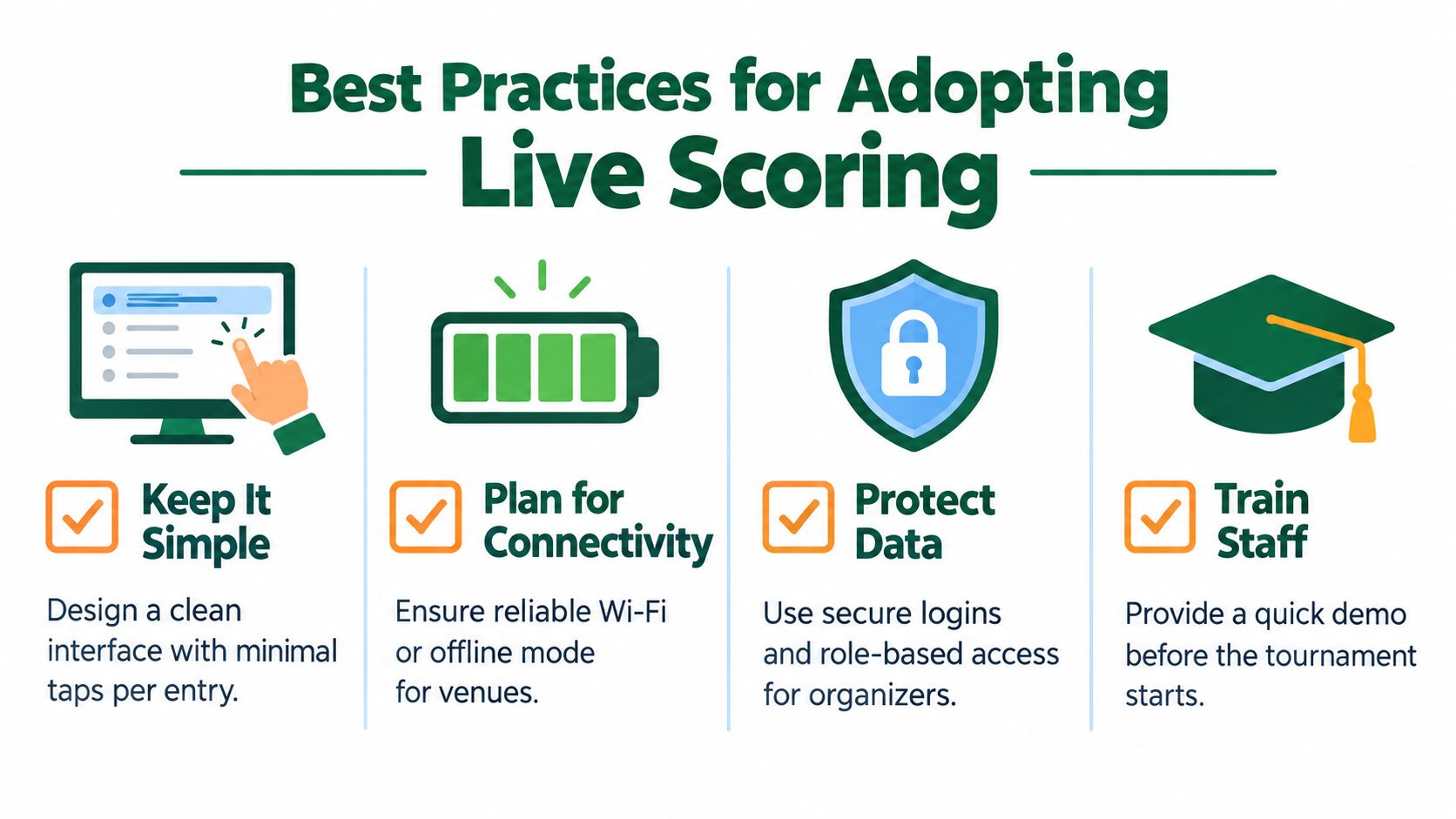
Keep context visible: Show the player, group, and hole before submission.
Use large touch targets: Players may be wearing gloves, standing in sun, or riding in a cart.
Confirm immediately: Tell the scorer the entry was accepted, or that it's queued for retry.
Preserve entries locally: A brief signal loss shouldn't erase a completed hole.
Allow controlled correction: Let staff fix mistakes while keeping an audit trail.
Display the Format People Are Actually Playing
A stroke play leaderboard totals strokes, but match play needs different language. Under USGA Rule 3, match play is decided by holes won, lost, or tied, and a match can end when a player leads by more holes than remain, as explained in the USGA guide to match play scoring. Show 1 up, all square, or 2 and 1, not just a cumulative total that could mislead players.
Team formats need equal care. In four-ball, two partners each play their own ball and the side records the lower score, so partners scoring 4 and 5 produce a side score of 4, under Rule 23 for four-ball play. Your system must store both individual scores without adding both to the team total.
Separate Provisional From Official
Label live standings as provisional until the committee reviews them. The World Handicap System expects same-day posting so a score can enter the daily playing conditions calculation and update the player's index overnight, according to the USGA guidance on posting scores on the day of play. Decide in advance whether scores count for handicap purposes, who posts them, and when edits close.
That discipline protects trust. Players get instant information during the round, and the committee still owns validation, handicap application, and final certification afterward.
Live Scoring in Action with Live Tourney
A member-guest day might include morning four-ball matches, an afternoon stroke play flight, and a closest-to-the-pin side game. The organizer builds the event, uploads the roster, assigns pairings, and sends players a scoring link. Nobody installs an app at registration, and a guest using an unfamiliar phone can still open the scorecard in a browser.
As groups enter hole scores, the organizer watches separate views for each competition. One hole score works like a single ingredient served at three tables: the four-ball side score uses the lower partner result, the stroke play flight totals individual scores, and the side game stays distinct instead of polluting the main standings.
A Concrete Staff Workflow
Set up the event: Add the course, tees, formats, pairings, and any side games.
Send one link: Players open it on any device and land in the correct group context.
Monitor exceptions: Staff look for missing holes, unusual scores, or groups that stopped posting.
Review before publishing: The committee checks corrections and converts provisional standings into official results.
Communicate the outcome: Players see final standings without waiting for a manual recap.
Live Tourney reports 10,000+ events and 1M+ holes scored, with customers seeing a 40% increase in live scoring participation and 3x faster setup. Those are the vendor's own figures, so read them as a signal of what removing setup and scoring friction can do rather than as independent proof.
The broader lesson concerns who golf scoring now serves. The USGA reported 82 million scores posted in the U.S. in 2025, with 94.4% classified as recreational, in its announcement of 2025 U.S. score posting figures. A system built only for elite individual stroke play misses most of the game's real activity: leagues, team events, outings, and casual competitions where clarity matters just as much.
Why App-Free Scoring Matters for Every Field
An app download looks small to a frequent golfer. To a one-day guest, it can mean finding a password, granting permissions, creating an account, and learning an interface they'll delete that night. Multiply that friction across a full shotgun field and your staff becomes a technical support desk before play begins.
App-free scoring lowers the first step to opening a link. That's especially valuable for occasional players, juniors, older golfers, corporate participants, and international visitors, who may all arrive with different phones and different comfort levels. A browser-based approach also makes it easier to move scoring to another device if a battery dies or one player agrees to score for the group.
If you're weighing paper replacement more broadly, this discussion of digital golf scorecards for tournament play helps connect the scorecard itself to the live standings it feeds.
Handle the Real World Honestly
App-free doesn't mean problem-free, and organizers shouldn't pretend otherwise. Weak cellular service can delay a submission, shared devices can create attribution questions, and players may worry about privacy if a link exposes more information than necessary. Address those issues directly.
Shared device: Name one scorer per group and show exactly whose hole is being entered.
Lost connection: Keep entries on the device, retry safely, and prevent duplicate scores.
Late submission: Accept the hole data, then let the committee review timing and context.
Accessibility: Use readable type, strong contrast, and controls that don't require precise taps.
Backup: Keep a simple paper process available for a phone failure, then reconcile it afterward.
Inclusion isn't a feature you add after choosing software. It's the result of choosing a scoring path your least prepared participant can complete.
That is the practical case for app-free scoring. It doesn't assume every golfer behaves like a committed app user, and it keeps the tournament moving when the field is mixed, busy, and imperfectly connected.
Getting Started with Live Play Score
Begin with a small, honest test. Pick one league night or a modest outing, choose the lowest-friction scoring approach that fits that field, and run the full process from roster setup to official results. You'll learn more from one real event than from a polished demonstration using your most technical staff member.
Before the test, write down three decisions. Decide who scores for each group, when live standings become official, and how you'll handle a lost phone or weak signal. Then tell players those decisions in plain language at check-in and again in the scoring link message.
During the event, watch for friction rather than compliments. Note where players hesitate, which holes go missing, and how quickly staff can correct an entry. Afterward, ask the committee whether final review felt easier than the old paper process and ask a few first-time users whether they'd score again without help.
Stroke play verification gives you a sensible closing rule. Players may request a scorecard change up to the time the card is returned, after which the committee checks details and totals the result, as set out in the USGA committee procedures for scorecard review. Build that same clear cutoff into your digital process.
Start simple, protect the official result, and design for the whole field. That's how live play score becomes a normal part of your operation instead of a novelty players tolerate once.
Live Tourney gives organizers app-free live scoring, real-time leaderboards, roster and pairing tools, and support for varied tournament formats without asking players to download anything. If you want your next event to replace paper delays with clear live play score updates from the first hole onward, visit Live Tourney and start setting up your tournament today.





