May 9, 2026
keeping golf scores, golf tournament scoring, golf scorecard, how to score golf, live scoring
Learn the essentials of keeping golf scores for any format. Our guide covers scorecards, handicaps, and best practices for running flawless tournaments.

The round is over, the carts are lined up, and players want results now. Instead, your staff is sorting wet scorecards, decoding rushed handwriting, checking math by hand, and trying to settle a disagreement on whether a hole was a six or a seven. That's the moment when keeping golf scores stops being a small administrative task and becomes the entire event.
Good tournaments rarely fall apart because of pairings or prizes. They fall apart because scoring feels slow, unclear, or unfair. If you run leagues, member events, charity outings, or club championships, the scoring process is part of the product. Players remember whether the event felt organized. They remember whether the leaderboard made sense. They remember whether the results were trusted.
Why Accurate Scoring is the Heart of a Great Tournament

A score dispute usually starts with something small. One player thought a putt was conceded. Another player wrote the wrong total on the wrong line. A marker forgot to confirm a hole score before the group left the green. By the time the card reaches the shop, nobody is fully certain what happened.
That's why accurate scoring has to be built into the event before the first tee shot. It protects the field, it protects your staff, and it protects the credibility of the results. If players think scoring is casual, they'll treat rules casually too.
Casual habits don't work in competitive events
A lot of golfers keep some version of score, but casual play and tournament play are not the same thing. NGF participation research shows that 77% of U.S. golfers, about 20 million players, keep score on a regular basis, but the same research notes that common scoring liberties such as mulligans and gimmes often push self-reported scores below reality.
That gap matters to organizers. In a friendly weekend game, those liberties are part of the social contract. In a tournament, they create confusion fast. If one group gives everything inside a putter grip and another holes out every putt, you don't have a leaderboard. You have different games being played at the same time.
Practical rule: If a scoring standard isn't written down and announced before play, players will replace it with their own.
What accurate scoring actually does for operations
Reliable scoring isn't only about rule compliance. It improves the whole event flow.
Faster closing: Staff can post winners without a long reconciliation process.
Fewer disputes: Groups know when and where to verify hole scores.
Cleaner handicap results: Hole-by-hole records are usable after the round.
Better player confidence: People trust results when the process is visible and consistent.
A professional event feels calm at the finish. Scores come in clean. Questions get answered quickly. The leaderboard updates without drama.
The standard players notice
Players may not compliment your score verification workflow. They notice it when it fails.
A simple scoring system usually works better than a clever one. Pre-set the rules. Make the score entry process obvious. Require group verification. Treat keeping golf scores like a front-line operation, not back-office cleanup. That's how you turn scoring from a recurring headache into one of the strongest parts of the event.
Mastering the Anatomy of a Golf Scorecard
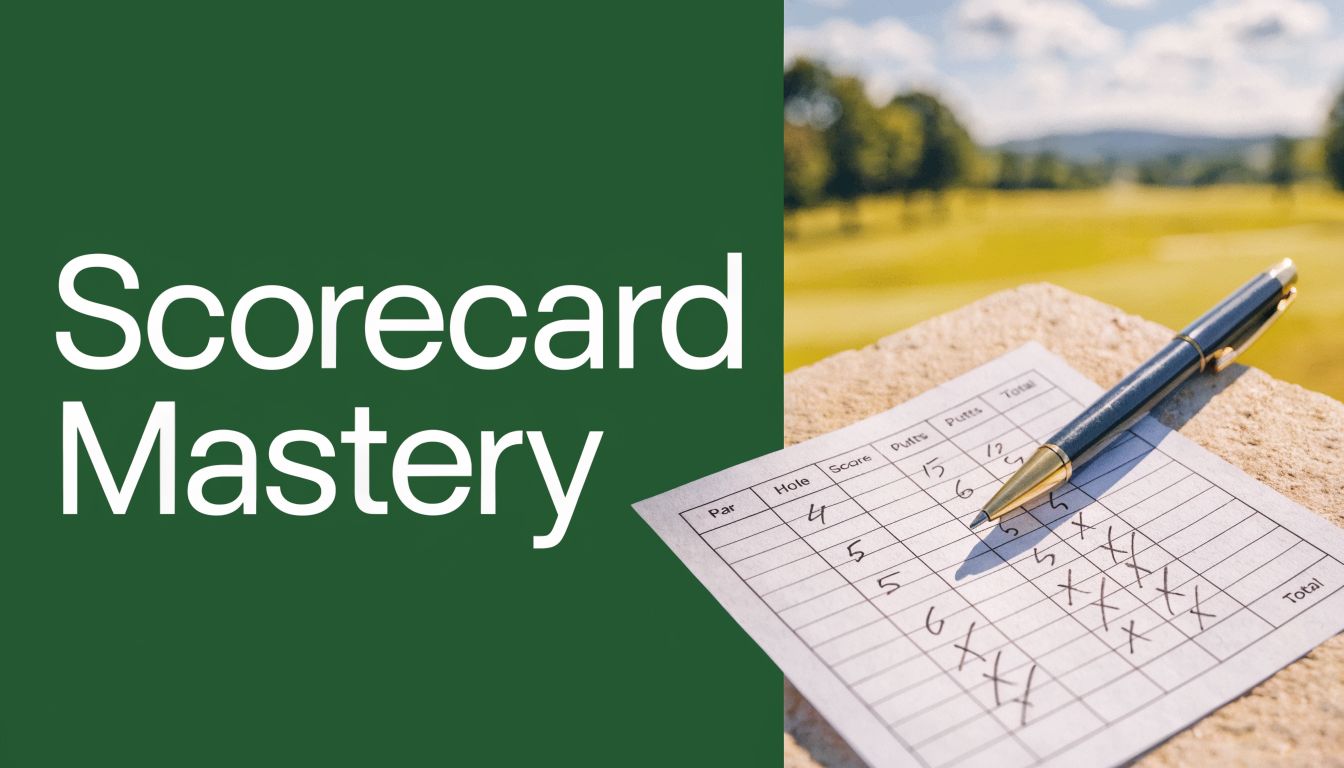
Most scoring mistakes don't come from bad intent. They come from bad card design, unclear responsibilities, or a rushed finish. If you're running an event, the scorecard should answer player questions before they ask them.
A tournament card has two jobs. First, it must be easy to use hole by hole. Second, it must be easy to verify when the round ends. If it fails at either one, your staff inherits the problem.
What the course should pre-print
The organizer should handle every field that can be standardized ahead of time. That includes the basic course information and the competition details players shouldn't have to guess.
Pre-print these items whenever possible:
Player identification: Name, group, tee time, and division or flight.
Course data: Hole numbers, par, yardage, and stroke index.
Competition structure: Gross, net, match, points, or team format labels.
Attestation area: Clear signature lines for player and marker.
If you want a clean reference for layout ideas, this guide on how to structure a golf scorecard is useful because it focuses on readability instead of clutter.
What players and markers must do
Players shouldn't be deciding how the card works while they play. They need one clear instruction set.
The cleanest standard is this:
Role | Responsibility |
|---|---|
Player | Verify hole score before leaving the next tee or green area |
Marker | Record the agreed score on each hole |
Both | Review the full card after the round before signing |
That separation matters. The marker records. The player confirms. When those roles blur, arithmetic errors and wrong-hole entries slip through.
The best scorecards are boring. If players have to interpret the card, the design has already failed.
The fields that cause the most trouble
Three lines create most of the confusion in tournament scoring.
Stroke index
This row shows the relative difficulty of each hole and tells you where handicap strokes apply. It should be visible and not buried in tiny print.
Gross and net areas
If your event includes net competition, make sure the card distinguishes gross score from any adjusted or net result. Players should still record actual hole scores first. Let the event workflow apply the competition format after that.
Signature lines
Unsigned or improperly verified cards create avoidable problems. Place signature lines where players will see them naturally at scoring return, not in a cramped corner.
A scorecard should be easy to read at a glance, easy to mark under pressure, and easy to audit after the round. If your card needs explanation every time, the card needs work.
Choosing the Right Scoring Format for Your Event
The scoring format shapes the entire day. It changes pace of play, player mindset, dispute frequency, and how much help your staff will need at the end. Choosing well makes keeping golf scores easier. Choosing poorly means fighting the format all day.
Some events need strict cumulative scoring. Others need head-to-head drama. Others need a format that keeps beginners engaged after one bad hole. Those are different operational problems, so they need different scoring models.
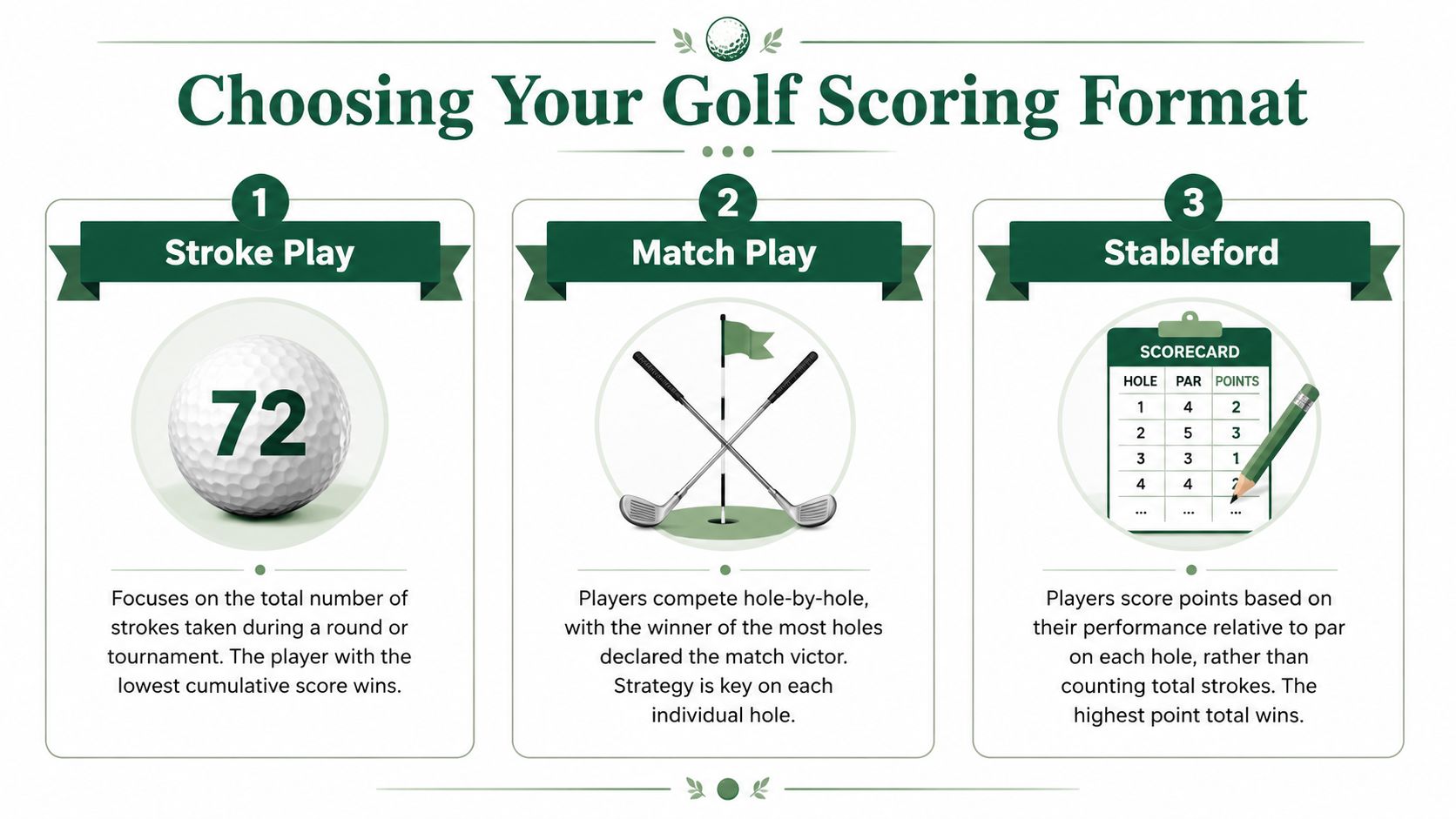
Stroke play
Stroke play is the cleanest format if you're running a championship, qualifier, or event where total performance should decide the winner. Every stroke counts. The lowest total wins.
That simplicity is its strength and its burden. It rewards discipline, but it also demands the tightest scoring controls because every hole matters equally. A wrong number on one hole can change the whole competition.
Use stroke play when:
You need a traditional competition structure
Gross scoring is central to the event
Players expect a formal result and complete audit trail
Watch for:
Slow closing if cards are reviewed late
More disputes over hole completion and penalties
Greater pressure on score return procedures
Match play
Match play changes the mood immediately. Players compete hole by hole, not by total strokes over the round. A disaster on one hole usually costs only that hole, which keeps the match moving and reduces emotional blowups.
For organizers, the upside is energy. Match play feels active, social, and easy to follow when pairings are clear. The trade-off is administration. You need a bracket, pod, or points structure that players understand before they tee off.
This format fits club rivalries, member-guest sessions, and team events. It also works well when you want spectators or participants to follow a live board without doing score math in their heads.
Stableford
Stableford is often the most forgiving format for mixed-skill fields. Instead of obsessing over raw stroke totals, players earn points based on performance by hole. One ugly hole doesn't wreck the whole round.
That makes it useful for corporate outings, charity days, and events where pace and enjoyment matter as much as precision. Players stay engaged longer because they can still contribute after a mistake.
A format that survives a bad hole usually survives a mixed field.
A practical comparison
Format | Best for | Player mindset | Organizer trade-off |
|---|---|---|---|
Stroke Play | Championships and formal competitions | Conservative, cumulative | Most verification pressure |
Match Play | Club events and team contests | Tactical, hole by hole | Bracket and status tracking |
Stableford | Corporate and charity outings | Resilient, points-based | Clear player education needed |
How to choose without overthinking it
Start with the field, not the tradition.
If your players care about pure score and competitive legitimacy, stroke play usually fits. If you want drama and direct competition, use match play. If you need broad participation and less punishment for one bad hole, Stableford is often the smarter operational choice.
The format isn't just a rules decision. It's a staffing decision, a communication decision, and a player experience decision.
Applying Handicaps for Fair and Equitable Competition
Handicaps are where many tournaments lose players. Not because the concept is bad, but because the application is sloppy. If the field doesn't understand how strokes are assigned, net results feel mysterious, and mysterious results never feel fair.
A usable handicap process starts before score entry. You need the correct player handicap, the correct tees, and a scorecard that clearly shows stroke index by hole. Once that is in place, the actual application is straightforward.
How strokes get applied
For net events, players record their gross score on every hole first. Then the competition applies handicap strokes according to the stroke index line on the card.
A simple working example helps. If a player has a Course Handicap of 15, that player receives one stroke on the holes ranked 1 through 15 by stroke index. On those holes, net score is gross score minus one. On holes ranked 16 through 18, no stroke applies.
If your staff needs a cleaner workflow reference, this walkthrough on handicap scoring in golf is a practical starting point.
Why players need expectation control
Handicap systems work because golf is volatile. Players don't shoot the same number every time, and neither do pros. Expert research on scoring variability found that top tour pros have an average difference of 14.45 shots between their best and worst rounds in a year.
That matters when members complain that one net score looked "too good" or one bad round "wasn't really them." Variance is part of the game. Good tournament administration recognizes that and relies on established handicap methods instead of gut reactions.
A fair net event doesn't remove inconsistency. It accounts for it.
Net double bogey and score integrity
For handicap purposes, players also need to understand Net Double Bogey. That cap matters because it keeps one blow-up hole from distorting handicap records. Operationally, it also reduces arguments at the scoring table because staff can point to a defined maximum for posting purposes.
For players who want more context on improving your game with WHS strategies, that resource is worth sharing before league season starts. It helps golfers understand why handicap discipline matters beyond a single event.
Handicap administration isn't glamorous. But when it's done clearly, players stop debating the system and start trusting the competition.
Modern Best Practices for Tournament Scoring
Paper cards and spreadsheets still work, but they create bottlenecks in exactly the places tournaments can least afford them. The first bottleneck happens on the course when groups aren't sure how to record the format. The second happens at the finish when staff become data-entry clerks. The third happens when the leaderboard is stale and players crowd the shop asking for updates.
A modern workflow removes those choke points. It doesn't need to be flashy. It needs to be clear, fast, and easy for guests who aren't tech-savvy.
What a workable scoring operation looks like
The best event setups usually follow the same pattern:
Before play: Publish one rules sheet with format, tie-break method, pickup rules, and scoring instructions.
At check-in: Confirm pairings, tees, and handicap data before players head out.
During play: Give each group one obvious scoring method, not two competing systems.
After the round: Use a single scoring return point with a defined review process.
That sounds basic, but most scoring chaos comes from skipping one of those steps.
Why app-free systems matter
Requiring every player to download an app is where a lot of good intentions die. Guests forget passwords. Corporate players don't want another install. Older members resist it. Then staff spend the first hour doing device support instead of running the event.
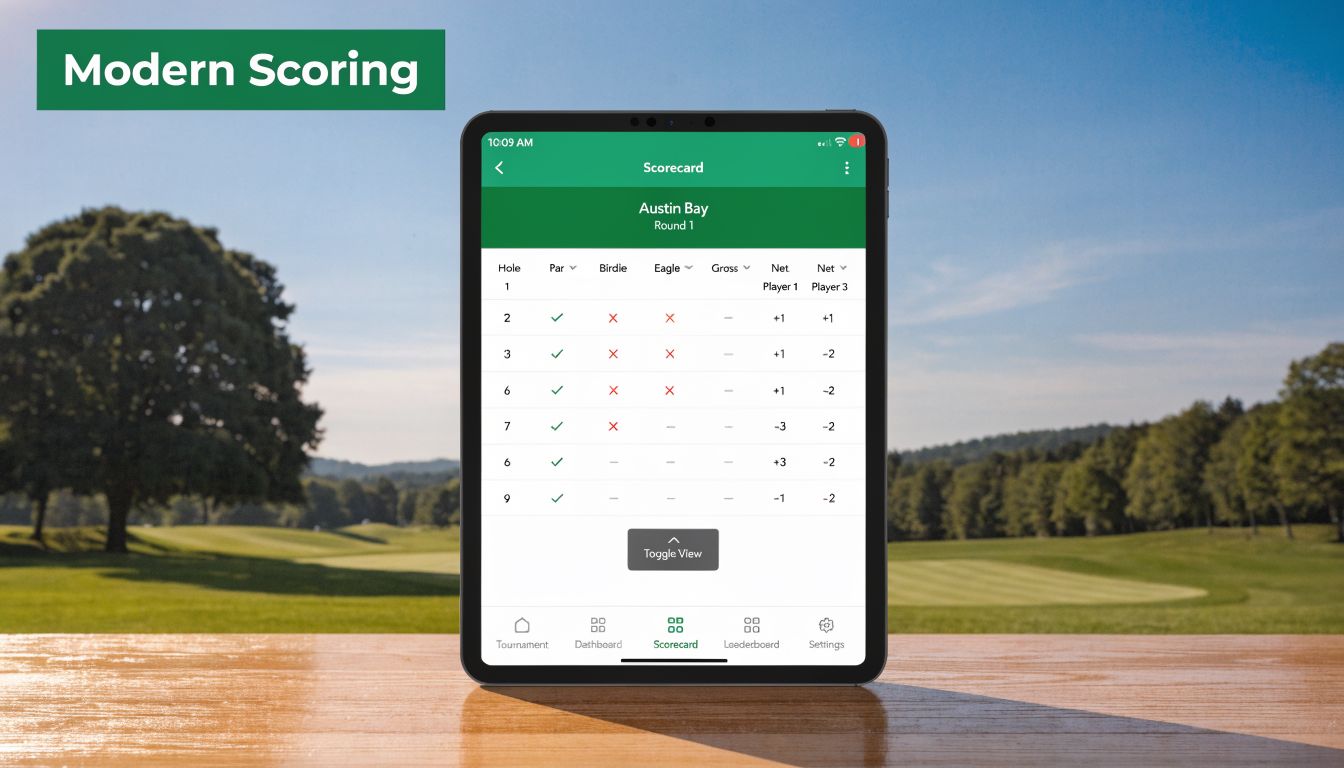
Browser-based scoring is usually the cleaner choice because the barrier is lower. Players open a link and enter scores. Staff monitor the feed. The leaderboard moves without a pile of manual re-entry.
One option in that category is Live Tourney's golf score tracking workflow, which uses web-based hole-by-hole scoring and live leaderboard updates without requiring an app download. That model is operationally useful because it reduces friction for mixed-skill and mixed-tech fields.
Handling weather delays and partial rounds
Incomplete rounds are no longer a rare edge case for league operators. USGA-related guidance on unplayed holes and posting matters more now because there has been a 15% rise in reported incomplete rounds in GHIN due to twilight leagues, and hole-by-hole entry is required. The same verified data notes that app-free live scoring tools that support this can increase scoring participation by up to 40%.
That means your event policy should cover darkness, lightning, and shotgun returns before the first group tees off. If the round stops early, staff should already know:
whether the event result stands,
whether only completed holes count,
how hole-by-hole scores will be captured for posting purposes,
and who has authority to make the call.
If your partial-round policy starts getting written during a storm delay, you're already behind.
Player experience still matters after the golf
Scoring is part of hospitality. The event should feel finished, not abandoned into paperwork. If you're also planning food, social time, or awards after play, the smoother the scoring process, the better the room feels. Even a simple hosting checklist from outside golf, like this Smokey Rebel guide to backyard grilling, is a useful reminder that guest flow, timing, and clarity matter just as much off the course as on it.
Modern scoring doesn't mean adding complexity. It means removing preventable friction for players and staff.
How to Avoid the Most Common Scoring Errors
The most expensive scoring mistakes are usually boring. Wrong hole. Wrong player line. Incorrect total. Missing signature. Unclear local rule. None of them are dramatic, but all of them can delay results or damage trust.
The simplest fix is to separate player errors from organizer errors. They don't come from the same cause, so they shouldn't get the same solution.
Player errors that keep showing up
Signing an incorrect card: Players often check the total and forget to verify each hole.
Fix: Require hole-by-hole review in the scoring area before anyone signs.Writing on the wrong row: This happens most in carts when one player keeps multiple scores.
Fix: Print names clearly and tell each marker to confirm the player line at the first tee.Chasing recovery birdies after a blow-up hole: Analysis of scoring patterns shows that about 90% of amateur golfers trying to improve ignore the most important factor, reducing double bogeys and other high-number holes.
Fix: Build event messaging around damage control and smart completion, not hero golf.
Organizer errors that create avoidable problems
A lot of score issues begin before the round. Vague rule sheets, unclear pickup policies, and mixed instructions produce inconsistent cards.
Use this short checklist:
Mistake | Fix |
|---|---|
Ambiguous format instructions | Put one plain-language scoring guide in every cart or starter packet |
Slow manual leaderboard entry | Use one scoring channel and one review point |
No dispute path | Name the staff decision-maker before play starts |
Bad card design | Remove clutter and highlight scoring, handicap, and signature fields |
The pattern worth watching
If you want cleaner scoring, watch where players make big numbers. High scores often come from a sequence, not one shot. Penalty, poor recovery, rushed next shot, then a missed short putt. A good scoring process helps you identify those holes and those patterns.
That's useful after the event too. If your league wants stronger scoring habits, it can help to share resources that explain decision-making in everyday language, even from outside golf. A piece like exploring wine consumption and body fat works for the same reason good scoring education works. It breaks a messy topic into cause and effect instead of relying on assumptions.
Keep the system simple. Verify every hole. Remove ambiguity before the round starts. Most scoring problems don't need rescue work. They need prevention.
If you're tired of chasing paper cards, rebuilding leaderboards by hand, and answering the same scoring questions every event, take a look at Live Tourney. It gives courses and organizers a web-based way to run tournaments, leagues, and outings with live scoring, simple setup, and no app download required for players.