
Apr 8, 2026
Get a complete overview of Indiana junior golf for 2026. Find tournaments, understand registration, and get tips for parents, players, and organizers.
You’re probably in one of two places right now.
Either your child has started to love golf and you’re trying to figure out where they fit in the Indiana junior golf world, or you run events and want a cleaner way to make junior tournaments feel organized instead of chaotic. Both situations are common. Both can get confusing fast.
Indiana has a strong junior golf culture, but the information is scattered. Parents see tours, qualifiers, school golf, camps, and club programs. Organizers see registrations, pairings, scorecards, parent emails, pace-of-play issues, and leaderboard questions. The game is healthy. The path is not always obvious.
Your Guide to Indiana Junior Golf
A lot of families start the same way. A junior player attends a camp, plays a few holes well, then suddenly wants more. The next question is practical. Which program fits? Is this for fun, development, school golf, or serious competition?
Indiana gives families plenty of options. A 2022 National Golf Foundation survey found that 81% of all golf facilities in Indiana actively maintain junior golf programs, which says a lot about how strongly junior golf is built into the state’s golf culture (Indiana Golf past champions archives). That matters because it means most families can find some kind of entry point without needing to start at an elite level.
Start with the right question
The best first question is not, “What is the best tour?”
It’s, “What does my child need next?”
For one player, that means short, local events and team formats. For another, it means a stronger schedule, tougher fields, and more structured competition. For organizers, the equivalent question is, “What kind of experience are we trying to deliver?” A beginner clinic, a weekend junior open, and a season-long points race all require different systems.
What usually works
A simple progression tends to work best:
Understand the structure: Know the difference between introductory programs, local club offerings, and statewide competitive tours.
Match the player to the format: Some kids thrive in team golf. Others want individual stroke play.
Build a repeatable event routine: Families need clear registration details, rules, arrival times, and scoring expectations.
Choose operations that reduce friction: The fewer moving parts staff and parents have to decode on tournament day, the better.
A good junior golf experience feels clear before it feels competitive.
Indiana junior golf has room for beginners, school-focused players, and serious tournament juniors. The key is not rushing the process. The right fit keeps kids engaged. The wrong fit often pushes them away.
Exploring the Indiana Junior Golf Environment
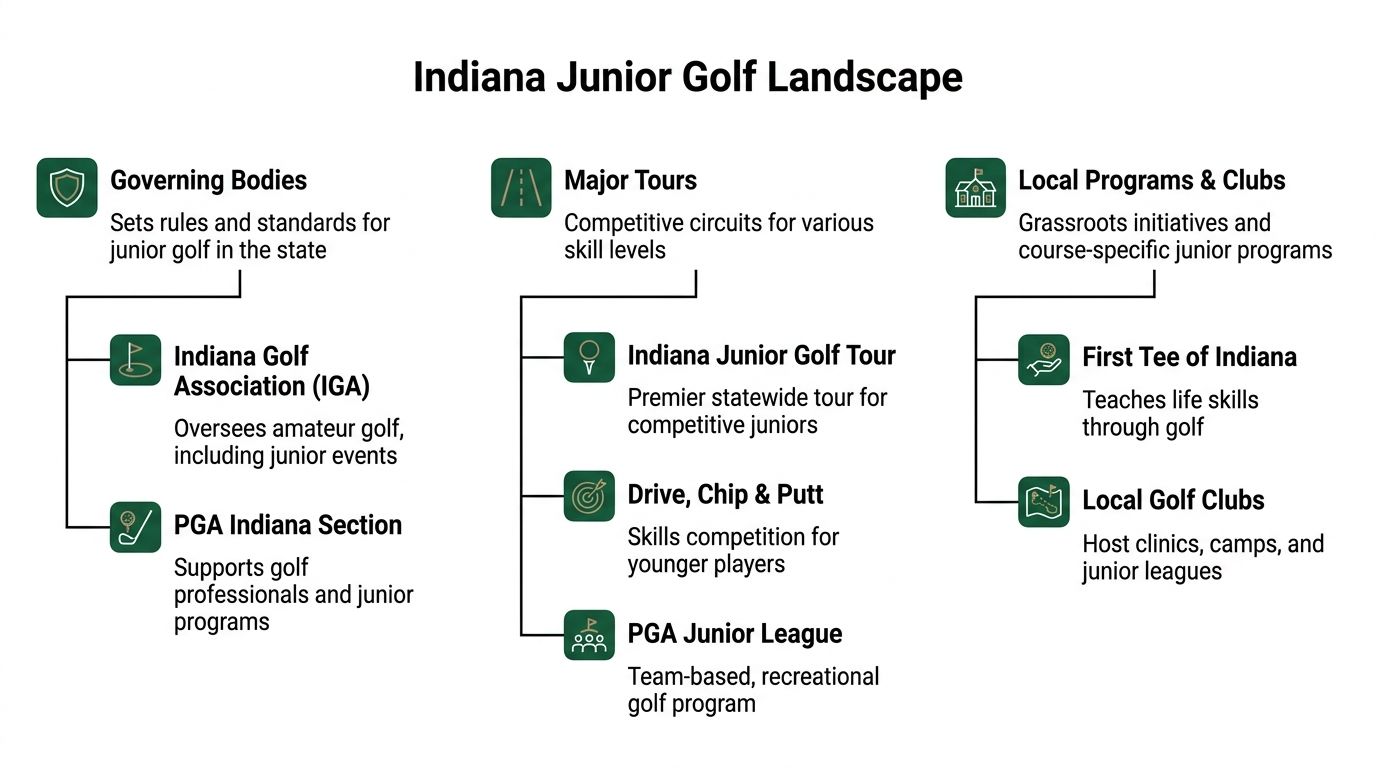
Indiana junior golf makes more sense when you stop viewing it as one system and start viewing it as a network. Different groups serve different roles. Some govern. Some teach. Some host. Some create the first on-ramp into competition.
The main organizations
The Indiana Golf Association sits near the center of competitive amateur golf in the state. Its junior championship tradition runs deep. The organization’s sanctioned junior events include the Boys State Junior Championship, which dates back many years, giving Indiana junior competition a long historical foundation. That history is reflected in the association’s archived records and championship lineage.
The PGA of America’s Indiana Section plays a different role. It is closely tied to PGA professionals, facility-based programming, instruction, and youth player development. In practice, many juniors first meet organized golf through a PGA professional at a public course, academy, or club rather than through a championship event.
Then there are grassroots and developmental programs. First Tee programs, club junior camps, school-connected opportunities, and community instruction all feed players into the broader system. These are often where confidence gets built. They also matter for retention because not every kid wants to start with tournament golf.
Think in layers, not in labels
A useful way to map indiana junior golf is to think in three layers.
Layer | Primary purpose | Typical experience |
|---|---|---|
Grassroots programs | Introduction and skill building | Clinics, camps, beginner leagues |
Developmental competition | Low-pressure tournament exposure | Local events, skills competitions, team play |
Championship pathway | Higher-level individual competition | Multi-event tours, rankings, state championships |
That layered view helps parents avoid a common mistake. They assume every program is trying to do the same job. It is not.
A child who is still learning pace, etiquette, and scorekeeping does not need the same environment as a player preparing for high school varsity golf or college recruiting. The same is true for organizers. A facility hosting first-time juniors should not copy the same operational model used for a top statewide event.
Where the tours fit
Several names appear often in Indiana junior golf discussions.
The Howard Bailey Junior Tour is associated with competitive junior play for older age groups. It tends to draw players looking for more structured tournament experience.
The Prep Tour gives younger juniors a more age-appropriate bridge into organized competition.
The Masters Tour is usually discussed as a stronger competitive lane for advanced junior players.
You will also see PGA Jr. League and Drive, Chip & Putt in the conversation. Those are important because they bring in a different kind of player. Team golf lowers pressure. Skills competitions give younger players a way to participate before they are ready for full tournament rounds.
What parents and organizers should notice
The best systems create progression. Indiana does that well when families and facilities use the ecosystem correctly.
A practical overview of the situation looks like this:
For young beginners: Start with camps, local club programs, First Tee-style instruction, or team-based formats.
For developing players: Add one-day events and age-appropriate tours that teach routine, scoring, and etiquette.
For stronger competitors: Build toward multi-event schedules and larger state-level opportunities.
For facilities: Offer both an entry point and a next step. Juniors stay in the game when they can see where they belong now and where they can go next.
The healthiest junior golf communities do not force every player into the same lane. They create a ladder.
That is the true structure of Indiana junior golf. It is not one tour or one organization. It is a pipeline.
Choosing Your Path A Player and Parent Guide
Parents usually struggle with one decision more than any other. Not whether their child should compete, but where to start competing.
Enter too soon at a level that is too demanding, and a player can leave discouraged. Stay too long in events that do not challenge them, and progress stalls. The right fit is not about prestige. It is about readiness.
Use fit before status
When I help families sort through junior options, I look at five things first:
Age and stage: A 9-year-old who loves the game needs a different experience than a teenager trying to sharpen tournament scoring.
Comfort with rules: Can the player keep a score, understand basic relief situations, and handle tournament pace?
Competitive appetite: Some juniors want team energy. Others want individual pressure.
Travel tolerance: A busy family schedule changes what is realistic.
Emotional bounce-back: Tournament golf includes bad holes, delays, rulings, and nerves.
A useful side note for parents is communication. Tournament families do better when expectations are discussed clearly before the season starts. If that is a challenge in your home, this guide on mastering parent communication in youth sports offers a practical framework that applies well to junior golf.
Indiana Junior Golf Tour comparison
Tour Name | Governing Body | Typical Age Range | Skill Level | Format |
|---|---|---|---|---|
Howard Bailey Junior Tour | Indiana Golf Association | Older juniors | Competitive | Individual tournament play |
Prep Tour | Indiana Golf Association | Younger juniors | Beginner to developing | Entry-level tournament play |
Masters Tour | Indiana Golf Association | Teen competitive players | Advanced | Stronger competitive schedule |
PGA Jr. League | PGA-led local programming | Younger juniors and early teens | Beginner to intermediate | Team-based matches |
Drive, Chip & Putt | National skills pathway with local access points | Younger juniors | Beginner to developing | Skills competition |
The chart helps, but the decision gets easier when you attach each option to a player profile.
Which path fits which player
The new player
If your child is still learning how to post an accurate score, keep pace, and recover from a bad hole, start with team golf, short events, or developmental tours. That environment teaches structure without making the day feel heavy.
The motivated improver
This player practices between events and wants more than a camp or clinic can provide. A developmental tour or age-appropriate stroke play schedule usually works well here. The goal is repetition. Learning how to warm up, compete, and finish matters as much as the score.
The serious competitor
This player wants stronger fields and a more demanding schedule. That usually means stepping into the more competitive Indiana Golf pathways and building a tournament calendar with intention. If the player does not already keep a handicap, this overview on how to get started can help: https://www.livetourney.com/blog/how-to-obtain-a-usga-handicap
Common mistakes to avoid
Chasing level too early: Harder is not always better.
Overloading the schedule: Junior golfers still need practice time, rest, and normal family life.
Judging only by score: How a player handles rules, pace, and setbacks tells you a lot.
Ignoring course fit: Yardage, field strength, and round length can change the experience completely.
The right path in indiana junior golf should stretch a player, not bury them. Good scheduling builds confidence and skill at the same time.
Tips for Junior Golf Success On and Off the Course
Tournament progress rarely comes from one breakthrough round. It usually comes from routine. The juniors who improve most are not always the ones with the prettiest swing. They are the ones who build habits they can repeat.
For players
A junior player does not need to practice forever. They need to practice with purpose.
Build a simple pre-shot routine: Use the same sequence on the range and on the course. It steadies nerves.
Learn to finish holes cleanly: A round can unravel after one mistake if the player turns one bad swing into three.
Track what costs shots: Many juniors spend too much time on full swing and not enough on chipping, putting, and course management.
Respect pace and etiquette: Good tournament golf includes being ready, repairing marks, and understanding when it is your turn.
Treat composure as a skill: Body language matters. Other players notice it, and so do you.
A junior golfer’s routine should get stronger as the pressure rises, not disappear when the round gets hard.
A practical weekly pattern works well. One session can focus on scoring clubs, another on short game, another on pressure putting, and one on playing holes with strategy in mind. Random practice has a place. Structured practice moves players forward faster.
For parents
Parents influence the junior golf experience more than they realize. Not by instruction alone, but by tone.
The most helpful parents usually do three things well.
They manage the day calmly
Tournament mornings are easier when the player knows the plan. Pack early. Confirm the start time. Bring food, water, weather gear, and a sharp pencil. Keep the car ride light.
They stay supportive without becoming a second coach
If your child already has a coach or club professional, let that person own the technical work. Parents help most by noticing effort, composure, and preparation. Post-round conversations go better when you begin with a question instead of a verdict.
They learn the basics of tournament golf
You do not need to become a rules official. You should understand common situations, scorekeeping expectations, and how rulings get handled. That makes tournament days less stressful for everyone.
Off-course habits matter too
Junior golf families often overlook the parts that support performance:
Sleep: Fatigue shows up first in decision-making.
Food and hydration: Young players fade when they snack too late or not at all.
Recovery: A packed schedule can make golf feel like work.
Perspective: Not every event needs a full emotional postmortem.
Good junior golf development includes discipline, but it also includes enjoyment. If the player still likes showing up, you are probably doing a lot right.
Running Exceptional Junior Events An Organizers Playbook
Most junior tournaments do not fail because of the golf. They fail because of friction around the golf.
Registration gets messy. Parents ask for details they should have already received. Pairings change late. Staff print scorecards twice. A rules note gets missed. Scores come in unevenly. Then someone stands near scoring asking for a leaderboard update that only exists on paper.

Indiana has no shortage of junior golf activity, but current Indiana-focused resources lean heavily toward calendars and event listings. They do not give organizers much practical help on modern, app-free live scoring or smoother event operations, which leaves a real management gap for courses and junior programs (Indiana junior golf overview).
The old workflow breaks under junior event pressure
Junior tournaments have a few challenges that adult events do not.
Parents want communication before, during, and after the round. Younger players need cleaner instructions. Volunteers may be helping with scoring and check-in. Staff often run these events while still managing normal golf operations.
That combination exposes weak systems quickly.
What slows an event down
Paper-first registration: Staff end up re-entering information and correcting avoidable errors.
Scattered communication: Emails, texts, printed notices, and verbal updates do not stay aligned.
Manual leaderboard updates: Players and parents expect visibility. Hand-built scoreboards lag behind.
No standard scoring flow: If every group reports scores differently, scoring becomes a bottleneck.
Too many staff touchpoints: Every extra handoff creates another chance for confusion.
The trade-off is simple. A paper-heavy approach may feel familiar, but it usually increases workload once the field grows or the format gets more complex.
What better junior operations look like
Strong junior event operations feel boring in the best way. Everyone knows where to go, what to do, and how to follow the day.
I look for five pieces in a well-run event:
Registration that closes cleanly
Pairings that can be updated without drama
Scoring that players and parents can follow easily
Consistent pre-event communication
Post-event results that go out quickly and accurately
If one of those pieces is weak, the event feels harder than it should.
Organizers do not need more software complexity. They need fewer steps between setup and a finished event.
App-free scoring matters more in junior golf
Junior events are one of the clearest cases for app-free scoring.
Families are already juggling tee times, weather, rides, food, and rules questions. Adding an app download, account creation, password issue, or device compatibility problem right before a round is unnecessary friction. A simple browser-based scoring flow is easier for juniors, parents, and staff.
That matters in several real-world situations:
A parent follows the round from another hole
A volunteer helps a younger group confirm the score entry flow
A coach checks progress without interrupting play
Staff update pairings or monitor scoring without bouncing between tools
For organizers building or refining their process, this event operations resource is useful: https://www.livetourney.com/blog/golf-tournament-planning-guide
Practical setup choices that improve the day
Use one system of record
Do not collect names in one place, pairings in another, and scores somewhere else unless you have no alternative. Fragmented tools create reconciliation problems after the round.
Write parent communications like instructions, not announcements
Parents need exact arrival windows, start procedure, dress expectations, food availability, scoring method, spectator guidelines, and who to contact for a ruling or emergency. If you leave gaps, your staff will answer the same questions one by one.
Design for younger players
If the field includes newer juniors, reduce ambiguity. Label the check-in area clearly. Put local rules in plain language. Make score submission steps visible. Repeat important instructions.
Prepare for the exception, not just the ideal round
Weather delays, withdrawals, late arrivals, and score disputes are normal. Build workflows that can absorb changes without requiring a full reset.
What organizers should stop doing
Some habits persist only because they are familiar.
Printing more materials than players use
Waiting until the day before to send details
Relying on one staff member to manage all scoring
Treating the leaderboard as a nice extra instead of part of the player experience
Using junior events as a side task instead of an operational product
Junior golf families notice organization quickly. They may not praise it out loud, but they definitely notice when it is missing.
The best indiana junior golf events feel friendly to first-timers and polished enough for serious players. That does not happen by accident. It happens when organizers build the day around clarity, speed, and fewer points of failure.
Growing the Game Inclusively in Indiana
Indiana junior golf has strong structure, but one important question still sits in the background. How well are programs reaching underserved youth?
Current Indiana-focused coverage does not offer much state-specific detail on that issue, even as broader youth golf conversations increasingly focus on equity and access (national context on underprivileged youth golf efforts). That absence matters because access barriers in junior golf are rarely limited to one thing.
The actual barriers are usually stacked
A family may not say, “Golf is inaccessible.”
They may say:
We cannot justify another activity fee.
We do not have clubs that fit.
We cannot handle weekday travel.
We do not know the culture.
We are not sure our child belongs there.
Those are operational problems as much as social ones. Programs that want to broaden participation need to think beyond invitations and into structure.
What inclusive junior golf looks like in practice
Facilities and associations can make real progress with practical choices.
Lower the first point of friction
A short beginner league, borrowed equipment, or a low-pressure intro event often does more than a polished marketing campaign. Families need an easy first yes.
Create visible support paths
Scholarships, fee assistance, donated equipment pools, and transportation help should not be hidden in a PDF or buried on a registration page. If support exists, make it easy to understand and request.
Design events for mixed experience levels
Not every player entering through an access initiative is ready for a traditional tournament atmosphere. Some need team play, supervised scoring help, or shorter formats first.
Inclusion in junior golf is not only about who is invited. It is about who can realistically participate more than once.
Technology can support access
Organizers can be more creative here. Flexible event systems can help manage reduced-fee entries, scholarship categories, simple registration flows, and community-focused leagues without turning administration into a burden.
For facilities building those kinds of programs, this overview of golf league structures offers useful ideas: https://www.livetourney.com/blog/golf-league-programs
The long-term health of indiana junior golf depends on more than championship pathways. It depends on whether new families can enter the game without feeling lost, priced out, or out of place.
Frequently Asked Questions About Indiana Junior Golf
How expensive is junior golf in Indiana
It depends on the path you choose.
A local camp, introductory clinic, or team-based program will usually be easier on a family budget than a full competitive season with travel, multiple entry fees, practice rounds, equipment updates, coaching, and overnight stays. The smartest approach is to budget by category instead of asking for one total number.
Track likely costs under:
event entry fees
practice and range use
coaching
equipment
travel and food
seasonal apparel and weather gear
Families often overspend when they move into tournament golf too quickly. Start with a schedule you can sustain.
How does a junior golfer in Indiana move toward college golf
The path usually develops in stages.
First, the player builds skills and tournament habits. Then they compete often enough to establish a scoring pattern against meaningful fields. After that, results, academics, video, communication, and scheduling all start to matter more.
College coaches do not only look at one highlight round. They look for a player who can compete, improve, communicate well, and handle the demands of being on a team. Indiana events can be part of that foundation, but recruiting usually rewards long-term consistency more than short bursts of form.
Where should a beginner start
Start where the player can succeed while still being stretched.
For many families, that means local instruction, beginner-friendly club programs, developmental tours, or team golf. If the child still needs help with scorekeeping, pace, or rules basics, that is not a problem. It means they need one more step before full tournament pressure.
How do school golf and junior tours work together
They usually complement each other well.
School golf teaches team culture, accountability, and match or tournament experience inside a school setting. Junior tours add more reps, different courses, and exposure to individual competition. Players who use both wisely often develop faster because each format teaches something different.
Is Drive, Chip & Putt part of the Indiana junior golf scene
Yes, in a practical sense.
It is not the same thing as a regular stroke play tour, but it is absolutely part of how many younger players enter organized golf. Skills competitions are useful because they reduce intimidation and give families an easy first look at structured participation.
What should parents ask before entering an event
Ask the questions that affect the actual day:
What age group and yardage will my child play?
Is this individual stroke play, team play, or a skills format?
How are scores recorded and confirmed?
What are the rules for spectators or caddies?
What happens in bad weather?
Is this event aimed at beginners, developing players, or experienced competitors?
Those answers tell you more than the event title does.
If you run junior tournaments, leagues, or golf events in Indiana and want a simpler way to handle registration, pairings, and live scoring, Live Tourney is built for exactly that. It gives courses and organizers an app-free, web-based system that works on any device, helps staff move faster, and makes the player experience feel current instead of clunky.





