
Mar 14, 2026
Access the official Indian Wells scorecard for both courses. Get printable PDFs, hole-by-hole stats, and learn to set up flawless tournaments with live scoring.
Looking for the official Indian Wells scorecard? You're in the right place. We've got downloadable PDF and high-res PNG versions for both the Celebrity and Players Courses, perfect for printing or just a quick look on your phone.
Quick Access Indian Wells Scorecard Resources
When you're prepping for a round or setting up a tournament, having the right data on hand is non-negotiable. This isn't just about printing a scorecard; it's about understanding the course you're about to play.
Beyond the hole-by-hole yardages, the two numbers that really tell the story of a course's difficulty are the USGA Course Rating and the Slope Rating.
Course Rating: Think of this as the score a scratch golfer (0 handicap) is expected to shoot. A 73.5 rating means a top-tier player will likely be a couple of strokes over par.
Slope Rating: This one shows how much harder the course gets for a bogey golfer (around an 18 handicap) compared to that scratch player. A high slope like 140 means the course is significantly tougher for the average amateur.
This chart gives you a quick visual breakdown of the total yardage from the different tees for both courses.
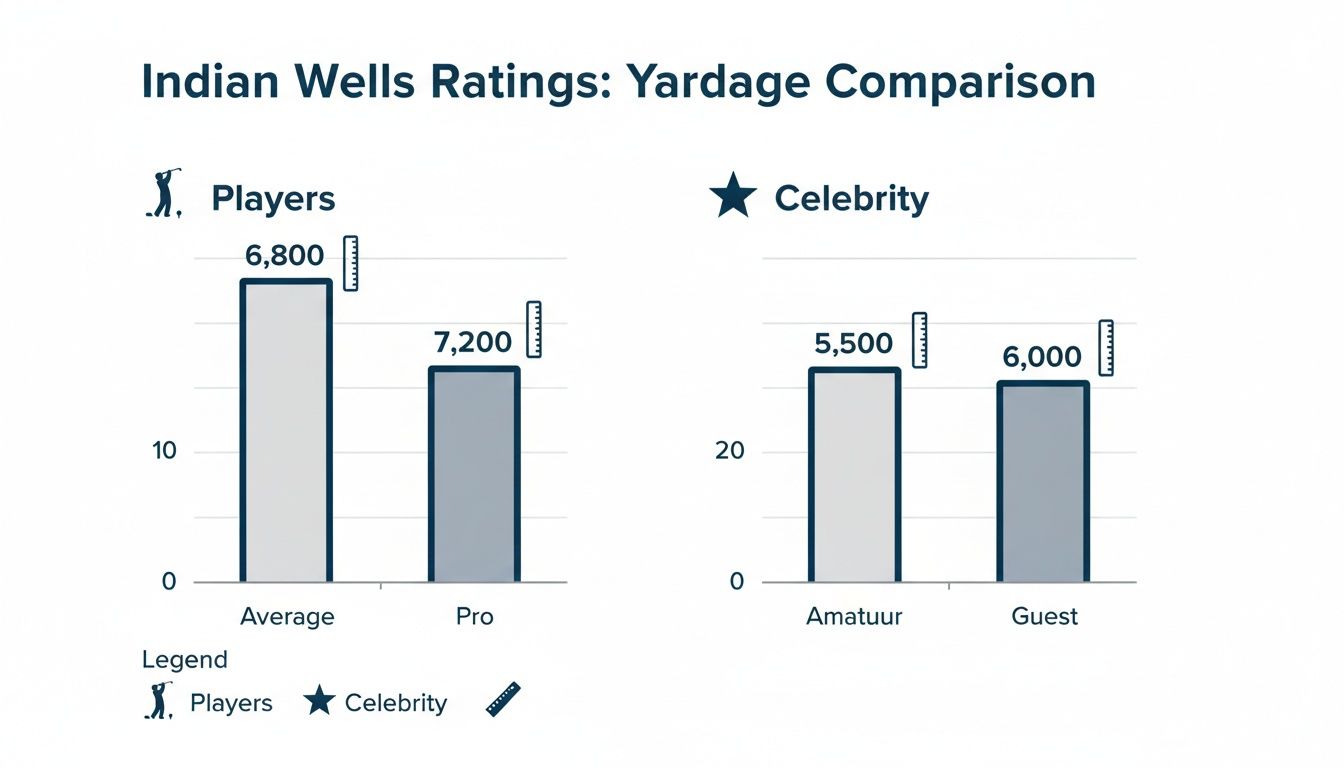
As you can see, the Players Course is the longer of the two from any comparable set of tees. It's a true championship test.
Indian Wells Course Ratings At a Glance
Here’s a quick summary of the official USGA ratings, slope, and total yardage for every tee box on both the Players and Celebrity courses. Use this to pick the right set of tees for your game or to get your tournament set up accurately.
Course | Tee Name | Yardage | Course Rating | Slope Rating |
|---|---|---|---|---|
Players | Tournament | 7,376 | 75.9 | 145 |
Players | Combination | 7,060 | 74.3 | 140 |
Players | Blue | 6,771 | 72.8 | 136 |
Players | White | 6,373 | 70.9 | 130 |
Players | Gold | 5,861 | 68.3 | 122 |
Players | Red | 5,302 | 70.9 (W) | 126 (W) |
Celebrity | Tournament | 7,050 | 74.0 | 140 |
Celebrity | Combination | 6,759 | 72.7 | 136 |
Celebrity | Blue | 6,594 | 71.9 | 131 |
Celebrity | White | 6,204 | 70.0 | 125 |
Celebrity | Gold | 5,752 | 67.8 | 119 |
Celebrity | Red | 5,270 | 70.8 (W) | 127 (W) |
(W) denotes the women's course and slope rating from that tee.
Having these numbers handy is the first step to a well-run event or a well-played round. It ensures everyone is on the same page and playing from a set of tees that matches their skill level.
Analyzing the Indian Wells Players Course Scorecard

The scorecard numbers give you the basics, but the real story of the Indian Wells Players Course is in how you use them. This isn't just a walk in the park; it's a John Fought design that blends classic architecture with modern, strategic challenges.
To have any chance out here, you need to look past the yardage and see the course for what it is—a test of decision-making. The Players Course stretches out to a beastly 7,376 yards from the tips, so you’ll need more than just brute strength to score well.
How to Actually Use the Scorecard for Strategy
Most players glance at the hole handicap and then forget about it. That's a huge mistake. The handicap rating tells you exactly where you can afford to be aggressive and where you need to play for par.
The #1 handicap hole—the long par-4 9th—is your signal to play smart and avoid a big number. On the other hand, the #18 handicap hole—the short par-3 8th—is a green light. That's your chance to hunt for birdie. For tournament organizers, this info is gold for setting fair pin positions and creating a balanced challenge.
Pro Tips for Key Holes
A yardage number on a scorecard never tells you the whole story. Here are a few insider notes for tackling some of the Players Course's most memorable holes.
Hole 6 (Par 5): This is the classic risk-reward par 5. Big hitters will be tempted to go for it in two, but with a massive lake guarding the entire right side, that's a risky proposition. The smarter play for most is a simple layup to a comfortable wedge distance. Take the water out of the equation and give yourself a clean look at birdie.
Hole 13 (Par 3): Don't let the yardage fool you on this one. The green is an island surrounded by deep, punishing bunkers. The scorecard won't show the subtle breaks and collection areas, so forget about pin-hunting. Just aim for the middle of the green and take your par.
Hole 17 (Par 4): A fantastic finishing hole that demands two great shots back-to-back. A well-placed tee shot is everything here. Miss the fairway, and you're fighting to get out of the bunkers, leaving a tough approach to a well-defended green. A par here feels like a birdie and can absolutely decide a tournament.
Understanding a scorecard is about more than just adding up numbers. It’s about reading the story the course architect is trying to tell and turning that information into a solid game plan.
If you’re a tournament director, the design of your scorecard adds a layer of professionalism to your event. For a deeper dive into what makes a great one, check out our guide on creating the best golf scorecards for your tournament.
Diving Into the Indian Wells Celebrity Course Scorecard
While the Players Course is known for its pure, strategic test, the Indian Wells Celebrity Course offers a completely different experience. It's famous for its stunning beauty, but don't let the pristine flower beds and mountain backdrops fool you—this Clive Clark design is far from a simple resort track. Understanding the scorecard is the first step to navigating its unique challenges.
The Celebrity Course is loaded with undulating fairways and water features that come into play on a staggering 10 of the 18 holes. For tournament organizers, that visual appeal makes for a spectacular event. For players, it means you need a game plan.
What the Celebrity Scorecard Tells You
The scorecard numbers themselves tell a compelling story. The course plays to a par of 72 and can be stretched to 7,050 yards from the Tournament tees. But the most important number might be its slope rating: 140.
That’s a serious number. It immediately signals that, despite its beauty, the course will punish amateurs who miss their spots. If you're curious about how these numbers work, you can learn more about what a course rating means in golf and see how it applies here. When you look at the Indian Wells scorecard, pay attention to how the handicap holes are spread out. Unlike some courses that front-load the difficulty, the Celebrity Course demands your focus from start to finish.
Strategic Notes for Key Holes
A yardage alone never tells you the whole story. Here’s a look at a couple of the Celebrity Course's defining holes and what the scorecard doesn't tell you.
Hole 14 (Par 3): This hole is all about visual intimidation. The scorecard shows a manageable yardage, but the green is practically an island, surrounded by water and sand. The smart play is to forget the pin exists. Aim for the center of the green, because a miss anywhere else almost guarantees a tough up-and-down.
Hole 16 (Par 5): This is a thinker’s par 5. There's water down the entire left side and a split fairway that gives you two very different ways to play the hole. The scorecard yardage tempts big hitters to go for it, but the conservative play to the wider right fairway is often the one that leads to a better score.
The Celebrity Course scorecard is a perfect example of how a course can be both visually stunning and strategically demanding. It proves that a great golf experience is built on a foundation of solid, thoughtful design.
By digging into these details, both players and organizers can appreciate the brilliant balance Clive Clark struck with this layout.
How to Set Up Your Tournament in Minutes
Moving away from a stack of paper scorecards to a live-scored event might seem like a huge undertaking. The good news? It's not. With a platform like Live Tourney, you can get the entire tournament framework built in just a few minutes.
The setup process is dead simple. You start with the basics: name your tournament, pick a date, and select the course. Since the Indian Wells Players Course and Celebrity Course are already pre-loaded in the system, you don’t have to waste time manually punching in yardages, pars, or handicap data. That alone saves a ton of administrative work and prevents the inevitable typos.
Choosing Your Format and Players
After locking in the course, you'll choose your competition format. This is where you really start to see the difference. A simple dropdown menu gives you dozens of options, including the most popular ones:
Scramble: The go-to format for almost every charity and corporate outing.
Best Ball (Four-Ball): Perfect for partner events where everyone plays their own ball.
Stroke Play: The classic individual competition where every shot counts.
Match Play: The ideal setup for head-to-head brackets and club championships.
Once the format is locked in, it's time to get your players signed up. To make sure you collect all the right information from the start, it's smart to use some essential registration form templates to keep things running smoothly.
The real magic here is the automation. When you select a format like a two-person scramble, the software instantly configures the digital scorecard and live leaderboard to match. No more wrestling with spreadsheets or manual calculations.
That whole initial setup takes just a few clicks. You’ve now gone from a static Indian Wells scorecard to the foundation of a real-time, interactive event that keeps players engaged from the first tee to the final putt. Next, you can start adding your player list and customizing your event materials.
Managing Players and Customizing Tournament Materials
Alright, you've got the basic tournament framework built. Now it’s time for the fun part: adding players and making the event look professional. This is where you move from a simple setup to an event that really impresses people, and good software makes it surprisingly simple.
Forget manually typing in a huge list of names. You can just upload a single file with your entire player roster and populate the event in a few seconds. From there, assigning teams, building flights, and setting up pairings for tee times or a shotgun start is as easy as dragging and dropping.
Customizing Your Indian Wells Scorecard
A generic scorecard gets the job done, but a custom one makes your event feel big-time. Using a report builder, you can take the standard Indian Wells scorecard and turn it into something that’s unique to your tournament. It’s a great way to add a professional touch.
Here are a few things you can do:
Add Your Tournament Logo: Put your event’s logo right on the scorecard where everyone can see it.
Include Sponsor Branding: A huge value-add for your partners is adding their logos. It’s a simple way to show them some love.
Insert Event-Specific Rules: Display unique format rules, contest details (like longest drive or closest to the pin), or any special instructions players need to know.
This isn’t just for scorecards, either. Once you have the template, you can instantly generate a whole suite of materials like branded cart signs, official tee sheets, and custom bag tags.
Scaling Your Event Like the Pros
Running a smooth event, especially with a large field, is what separates the amateurs from the pros. Think about the famous Indian Wells Open tennis tournament; it started back in 1974 and has grown into a massive event, drawing a record 493,440 fans in 2024. That kind of growth highlights the need for tools that can scale with you.
For golf, platforms like Live Tourney are built to handle big rosters and provide live leaderboards, which have been shown to increase live scoring participation by 40% at top US courses. You can learn more about the incredible history and growth of the Indian Wells event and see how operational excellence creates huge success. By automating your reports and communication, you can run a charity outing or league that feels just as seamless, creating a fan-packed success of your own.
Launch Live Scoring for Your Players—No App Required
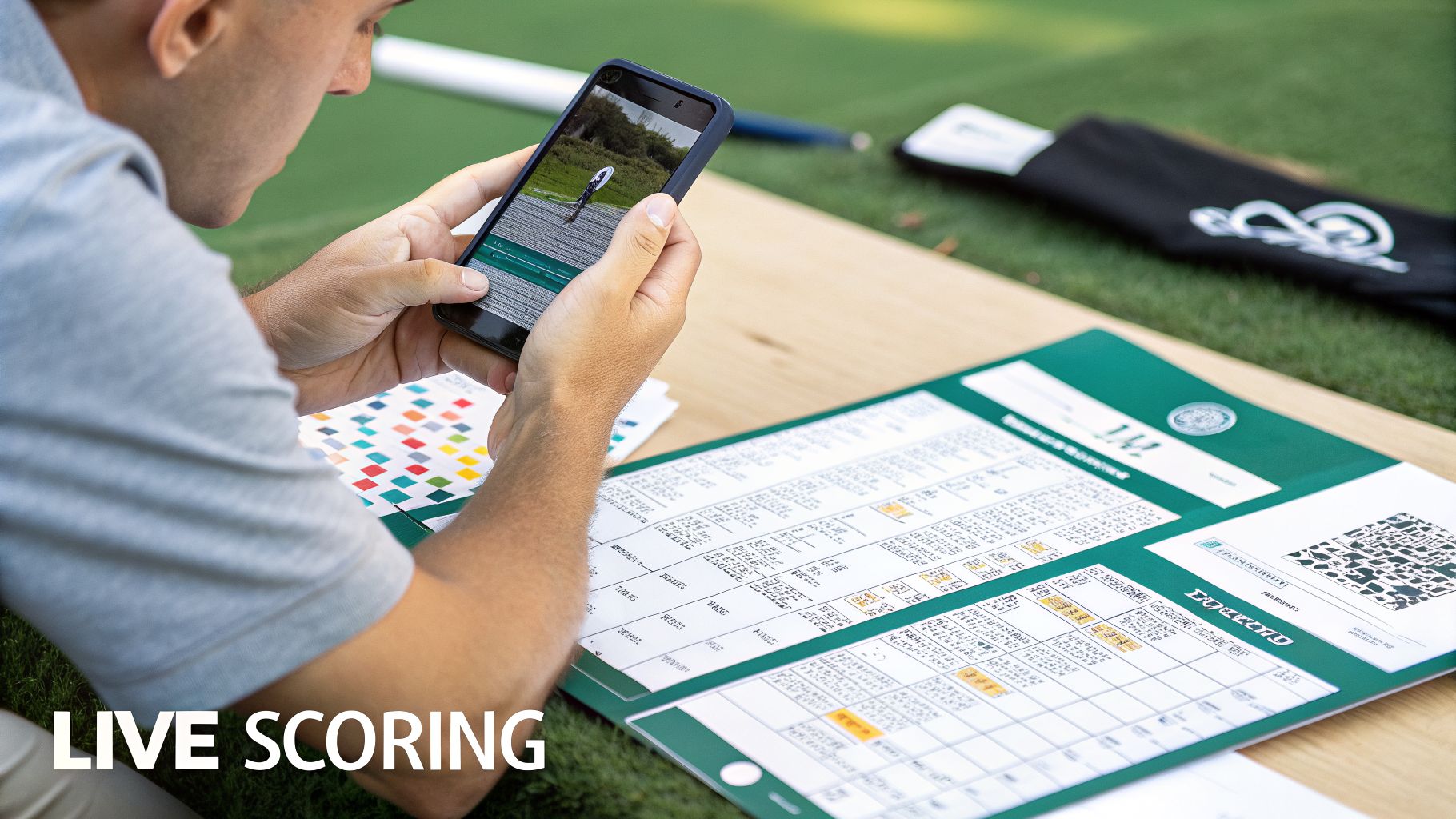
Once your custom materials are good to go, it's time to fire up the live scoring. The biggest headache for players? Forcing them to download an app just to play in your event. Modern golf tournament scoring software gets rid of that completely.
Forget telling everyone to find an app, create an account, or remember a password. You just share a single link. Send it in an email, a text, or put a QR code right on the Indian Wells scorecard or cart sign. It’s that simple.
Making it Dead Simple for Players
The whole point is to make scoring instant and intuitive. When a player taps that link, they’re dropped right into the action. No fuss.
Find Their Name: The first thing they see is the list of players or pairings. They just tap their name.
Start Scoring: The digital scorecard for their course—whether it's the Celebrity or Players Course—pops up immediately. They can start entering scores for their group right away.
Check the Leaderboard: A quick tap lets them toggle over to a live leaderboard to see where they stand in real-time.
This is how you get people engaged. The BNP Paribas Open at Indian Wells isn't just a tennis tournament; it’s a massive event that shattered attendance records with 504,268 fans in 2025. It was voted the top tournament by players for 10 straight years for a reason—the experience is world-class. When you make things easy for your golfers, you generate that same kind of buzz. For organizers, platforms like Live Tourney can drive a 40% spike in live scoring participation, just by making it easier.
The best technology is the kind you don't even notice. When scoring is this easy, players can stay focused on their game but still feel connected to the entire tournament. It brings a professional tour feel to any event.
By removing the barriers, you make sure everyone—from the most tech-savvy golfer to the traditionalist—can jump in and be part of the action. It elevates the whole day for everyone.
Frequently Asked Questions
When you're getting ready for a round or running an event at Indian Wells, a few questions always seem to pop up about the scorecards. Here are some quick answers to the most common ones.
Where Can I Find the Official Scorecard?
Your best bet for the most up-to-date Indian Wells scorecard is to grab one directly from the resort. They’ll always have the latest version for both the Players and Celebrity courses.
For planning ahead, we’ve included downloadable PDF and PNG versions right at the top of this guide. They're perfect for printing a copy or just reviewing the layout before you play.
How Should I Print Scorecards for a Big Tournament?
Manually creating dozens of scorecards is a huge time sink and leaves way too much room for error. The smart move is to use tournament management software.
You can simply upload your player list, and the system will automatically generate every scorecard with the correct names, handicaps, and tee assignments. It turns hours of tedious work into a few clicks.
How Does Live Scoring Work with Different Formats?
Modern live scoring systems are built for flexibility. When you set up your event, you just select the format you’re playing—whether it's a Scramble, Best Ball, or standard Stroke Play.
The software takes it from there. It automatically sets up the digital scorecard and calculates the leaderboard based on the specific rules of your chosen format, so you don't have to do any math.
One of the biggest wins of using a digital platform is handling last-minute changes. You can easily swap players, edit pairings, or add a substitute right in the system, and everything—from the digital scorecards to the live leaderboard—updates instantly.
If you have other general golf questions, you might find what you're looking for on our comprehensive FAQ page.
Ready to run your next golf event like a pro? With Live Tourney, you can set up your tournament in minutes, customize your Indian Wells scorecard, and give players the seamless, app-free live scoring they love. Save yourself the headache and make your event one to remember. Start your free 10-day trial today!





