Mar 7, 2026
Struggling with index vs handicap? Learn the key differences, calculations, and how to apply them for fair and professional golf tournaments every time.
If you're running a golf tournament, there's one distinction you absolutely have to get right: Handicap Index versus Course Handicap. It sounds simple, but mixing them up is a fast track to scoring errors and frustrated players.
Let's get this sorted out. A player's Handicap Index is their proven, portable skill level. The Course Handicap is the actual number of strokes they get on your course, for your event. Think of the Index as their resume and the Course Handicap as their job assignment for the day.
Unpacking Index vs. Handicap
Running a fair and credible event starts here. Getting this wrong undermines the entire competition before the first ball is even in the air.
A golfer's Handicap Index is a universal number that travels with them. It’s calculated from the best 8 of their last 20 scores and shows up as a decimal, like 12.4. This number is a standardized measure of their potential, no matter where they play.
The Course Handicap, on the other hand, is what they'll actually use for the round. It's a whole number, like 14, that adjusts their Index based on the specific difficulty of the course and the tees being played. This is determined by the course's unique Course Rating and Slope Rating.
The core principle is simple: An Index is what you are, a Course Handicap is what you play with today. It's the mechanism that levels the playing field, ensuring a 15-handicap player from an easy home course competes fairly against a 15-handicap from a much harder track.
To make it even clearer, here’s a quick-glance table every event manager should know.
Handicap Index vs Course Handicap At a Glance
Attribute | Handicap Index | Course Handicap |
|---|---|---|
Purpose | Measures a player's potential ability | Determines strokes given for a specific round |
Portability | Universal and portable across all courses | Specific to one course and set of tees |
Format | A decimal number (e.g., 15.2) | A whole number (e.g., 17) |
Calculation | Based on the best 8 of the last 20 scores | Calculated from the Index, Slope, and Course Rating |
Use Case | Identifying a golfer's skill level | Applying strokes for net scoring in a tournament |
Getting this right isn't just a detail—it's the foundation of any legitimate net competition. It's also why using software that handles these conversions automatically is a game-changer for ensuring accuracy and saving you a massive headache.
To really get the difference between a Handicap Index and a Course Handicap, you have to know where the system came from. For decades, golf handicapping was a total mess. It was just a patchwork of informal club rules, which made it almost impossible for members and guests to have a fair game.
This created obvious problems. Early methods were usually based on simple score averages or a handicap committee's best guess, which wasn't nearly rigorous enough for real competition. The game needed a single, portable system that could accurately size up a golfer's ability.
The First Steps Toward a Real System
Governing bodies finally stepped in to bring some order to the chaos. Back in 1911, the USGA launched its first official handicap system, a huge moment for competitive fairness. It went beyond simple averages by introducing course ratings, which set a benchmark for a course's difficulty against a scratch golfer. You can read a lot more about the major milestones in handicapping history on Golf Monthly.
That was the foundation, but it kept evolving. A major update came in 1967 when the formula was changed to use a player's best 10 of their last 20 scores. This was a big deal. It shifted the focus from a player's average score to their potential ability—a principle that still defines handicapping today.
The Modern Era of Data and Fair Play
Those early systems paved the way for what we have now. The introduction of the Slope Rating, and eventually the unified World Handicap System (WHS), built on that legacy. They refined everything to account for how a course challenges all players, not just scratch golfers.
Today's system is the result of a century of tweaks and improvements, all driven by one goal: to let any two golfers play a fair match, on any course, on any day.
For a tournament organizer, this history is more than just trivia. It’s the reason why just grabbing a player's Index isn't good enough. Converting that Index to a Course Handicap is non-negotiable. It’s how you honor the entire point of the system and make sure every player, from scratch to a 30-handicap, gets a fair shake.
How to Calculate a Course Handicap From an Index
So, how do you get from a player's Handicap Index to the actual number of strokes they get on your course? This is the step that connects a golfer's overall ability to the specific challenge of the course they're playing today.
While good tournament software handles this automatically, any organizer worth their salt knows the formula. It's essential for double-checking the math and confidently answering those inevitable player questions.
The World Handicap System (WHS) provides the official formula. It might look a bit intimidating at first, but it’s just a straightforward way to make sure the game is fair for everyone, everywhere.
The Official WHS Conversion Formula
This calculation is where the magic happens, combining the player's Index with your course's difficulty ratings to produce a handicap for the day.
Here's the standard formula:
Course Handicap = (Handicap Index x (Slope Rating / 113)) + (Course Rating - Par)
Let's break down what each part means:
Handicap Index: This is the player's portable skill rating, always shown as a decimal (like 15.2).
Slope Rating: A number that shows how much harder a course is for a bogey golfer versus a scratch golfer. The baseline, or "standard" difficulty, is 113.
Course Rating: The score a scratch golfer is expected to shoot from a particular set of tees.
Par: The standard score for the course.
The infographic below shows just how far we've come from the old, inconsistent methods to the unified, data-driven WHS we use today.
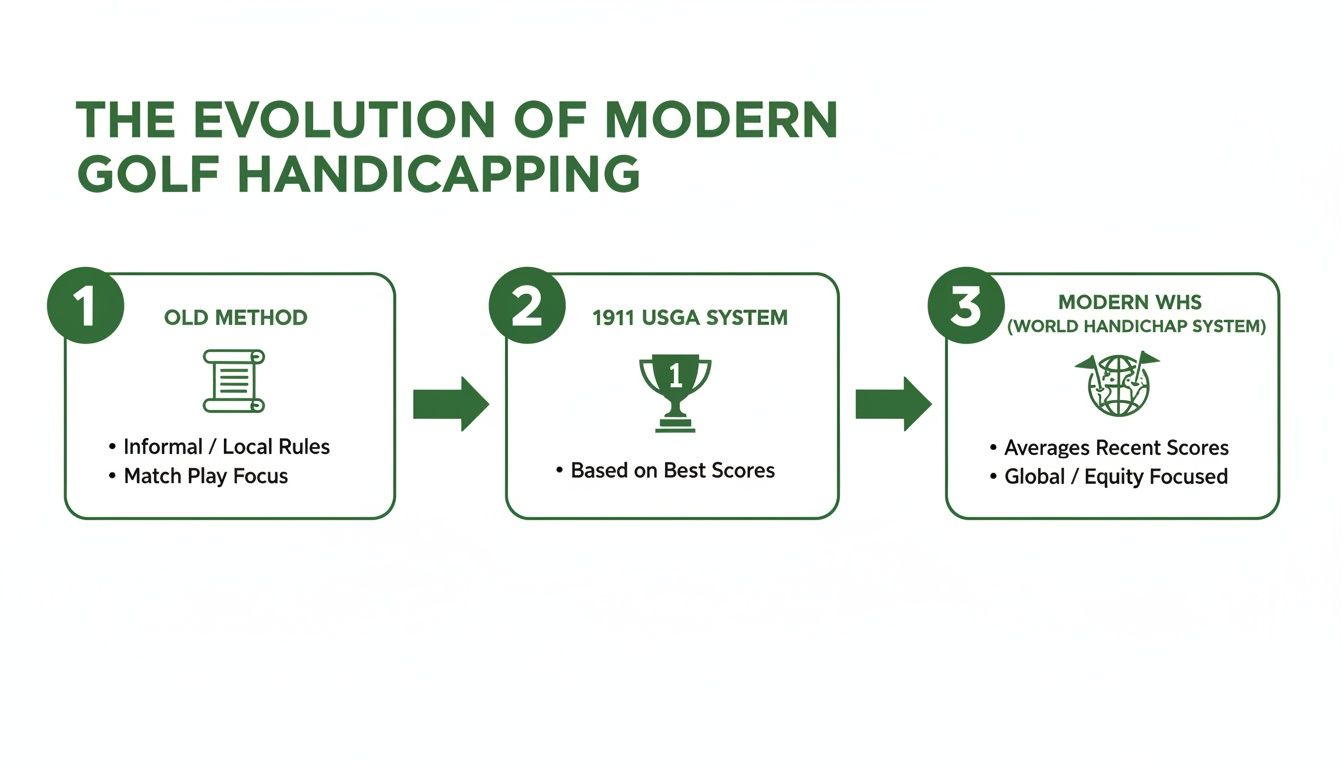
This evolution reflects a global effort to create one fair system for all golfers, and the modern WHS is the result.
Putting the Formula into Practice
Alright, let's run the numbers. We'll use a player with a Handicap Index of 15.2 and see what happens when they play two very different courses.
Example 1: The "Easier" Course
Slope Rating: 110
Course Rating: 69.5
Par: 72
Let's plug it in: (15.2 x (110 / 113)) + (69.5 - 72)
Step 1: 15.2 x 0.973 = 14.79
Step 2: 69.5 - 72 = -2.5
Step 3: 14.79 + (-2.5) = 12.29
Course Handicap = 12 (The final number is always rounded to the nearest whole number).
Example 2: The "Harder" Course
Slope Rating: 135
Course Rating: 73.8
Par: 72
Now for the tougher track: (15.2 x (135 / 113)) + (73.8 - 72)
Step 1: 15.2 x 1.194 = 18.15
Step 2: 73.8 - 72 = 1.8
Step 3: 18.15 + 1.8 = 19.95
Course Handicap = 20
The difference is huge. The same player gets 8 more strokes on the harder course. This is the handicap system doing its job perfectly, leveling the playing field no matter where you tee it up.
As an organizer, you need to understand this. While platforms like Live Tourney do all the heavy lifting instantly, knowing the "why" behind the numbers makes you look sharp and helps you run a more credible event. To see how this fits into the bigger picture, check out our guide on golf tournament scoring.
The Critical Role of Slope and Course Rating
So, why can’t a player just use their Handicap Index straight up in a tournament? It’s a fair question. The answer comes down to two numbers that are the backbone of modern, fair competition: Course Rating and Slope Rating.
Think about it—not all golf courses are built the same. A 7,400-yard championship layout with water hazards everywhere is a completely different beast than a 6,200-yard local muni. These two ratings are what quantify that difference, making a player’s handicap portable from one course to the next.
Course Rating: The Scratch Golfer's Benchmark
First up is the Course Rating. This number tells you the expected score for a scratch golfer (a player with a 0.0 Handicap Index) playing from a specific set of tees. You’ll see it expressed as a number like 73.5.
If a course has a rating of 73.5 and a par of 72, it means a top-tier player is expected to shoot about one and a half strokes over par. This rating mostly boils down to raw difficulty factors like length and other challenges that a highly skilled golfer would face. It’s the baseline measure of a course’s difficulty.
Slope Rating: Leveling the Field for Everyone Else
While Course Rating is built for the scratch player, Slope Rating measures how much harder a course gets for a "bogey golfer"—someone with an index around 20.0. It shows how steeply the difficulty ramps up for an average player compared to an expert. A higher Slope Rating means a bigger gap in that difficulty.
The standard or "average" Slope Rating is 113. Courses with a slope higher than 113 are tougher on bogey golfers, while those with a lower slope are a bit more forgiving. This is where the conversion from an Index to a Course Handicap really matters, as slope is what scales the adjustment up or down.
A high-slope course punishes mistakes more severely. Wider fairways and minimal hazards on a low-slope course are manageable for most, but the forced carries, deep bunkers, and fast greens of a high-slope course disproportionately impact the average player.
This is exactly why you can’t just use the raw Index. The introduction of the Slope Rating back in 1987 was a huge leap forward, fixing a major flaw in how handicaps used to work. Before slope, ratings were all about length and didn’t account for how much more punishing hazards were for average players. Slope changed all that by finally quantifying relative difficulty.
Ultimately, these two ratings work together to produce a fair Course Handicap for every player on any given day. Good tournament software does this conversion automatically, saving you from a logistical headache and potential errors. After all, accurate scores are non-negotiable for a professional event. To keep things running smoothly, you might also want to check out our guide on choosing the best golf scorecard app.
When the World Handicap System (WHS) rolled out in January 2020, it wasn't just another update—it was a complete overhaul. The USGA and R&A managed to merge six different global handicapping methods into a single, unified system, fundamentally changing how golfers around the world measure their game.
If you run tournaments, this isn't just something to be aware of; you have to understand how it works to run a fair event.
This new system immediately got more people involved in the game. In the years since its launch, the number of scores posted has exploded. England Golf saw over 10 million scores turned in within a single year, and in the US, the number of 9-hole scores posted by women jumped by a massive 40%. You can explore more about this impressive growth and what it means for the sport.
Key Changes Introduced by the WHS
The WHS brought a few big changes that directly affect how you run a tournament. While the core idea of an index vs. a handicap is still the same, the way that index is calculated and updated is completely different now.
Here are the key features you need to know:
Best 8 of 20 Scores: Your Handicap Index is now based on the average of the best eight scores from your last 20 rounds. This makes it a much better snapshot of your current ability.
Daily Revisions: This is the big one. A player's Handicap Index updates every day. A score posted on Tuesday can change a player's index for a Wednesday tee time, making real-time data absolutely critical.
Net Double Bogey: The highest score a player can take on any hole for handicap purposes is a Net Double Bogey (Par + 2 + any strokes they get). This stops one blow-up hole from wrecking a player's score differential.
The most important thing for any event organizer to grasp is how fluid the system is now. A player’s Handicap Index is no longer a static number that updates twice a month. It can, and will, change overnight.
The Impact on Tournament Operations
This daily update cycle means that relying on printed lists or old spreadsheets is a huge risk, especially for multi-day tournaments. A player's index from day one could easily be wrong by day two, which can throw the integrity of your whole event into question.
This is where integrated software becomes a necessity. A platform like Live Tourney connects directly to the WHS database, automatically pulling the most current Handicap Index for every single player when you start the event. This guarantees every Course Handicap is calculated correctly, eliminates manual errors, and ensures a level playing field for everyone.
Applying Handicaps for Flawless Tournament Execution

Knowing the difference between an index and a handicap is one thing. Applying it correctly is what separates a smooth tournament from a chaotic one. This is where theory meets reality on event day, and where complex math has to become fair, seamless competition for everyone.
The process goes beyond just converting an index to a Course Handicap. Different formats need specific allowances to keep the game equitable, which brings us to the Playing Handicap. Think of this as the final, format-specific number a player actually uses on the course.
From Course Handicap to Playing Handicap
Once you have the Course Handicap, you have to factor in the game being played. A standard individual stroke play event is simple—it typically uses 100% of the Course Handicap. But team formats need adjustments to stop high-handicap players from having an unfair advantage.
Here are a few common handicap allowances:
Fourball (Better Ball): Players usually get 85% of their Course Handicap.
Foursomes (Alternate Shot): A team receives 50% of their combined Course Handicaps.
Scramble: Allowances can vary, but a popular formula is 25% of the A-player's handicap, 15% of the B-player's, and so on.
Trying to calculate these by hand for a full field is a recipe for disaster. It’s not just tedious; it opens the door to mistakes that can compromise the integrity of the entire event.
The professional experience players expect relies on flawless execution behind the scenes. Automating handicap calculations isn't a luxury; it's a fundamental part of modern tournament management that ensures accuracy and credibility from the first tee to the final awards ceremony.
This is exactly why modern tournament software is essential. A platform like Live Tourney automates the whole workflow, from pulling a player's current WHS index to calculating their final Playing Handicap. Organizers just select the course, tees, and format, and the system does the rest.
That information is then applied instantly to a live leaderboard, saving hours of administrative headaches. This automation kills the risk of scoring disputes and frees up your staff to focus on what matters: creating a great player experience.
To see how this fits into the bigger picture of event management, you can learn more about the benefits of dedicated golf tournament scoring software. Getting the numbers right ensures the focus stays where it belongs—on the golf.
Frequently Asked Questions About Index and Handicap
Even after you get the hang of the difference between an Index and a Handicap, a few common questions always seem to surface. Let's clear up any lingering confusion with some straightforward answers for both tournament organizers and players.
Why Does My Handicap Change From Course to Course?
Your handicap changes because your Course Handicap is specifically calculated for the tees you’re playing that day. It’s a custom adjustment based on that course's unique Slope and Course Ratings.
A tougher course with higher ratings will give you more strokes than an easier one. This is the system working as intended, making sure you're competing fairly against the course itself, even though your portable Handicap Index never changes.
Your Handicap Index is a measure of your potential skill. Your Course Handicap is how that skill translates to a specific golf course, ensuring a level playing field no matter where you play.
This is exactly how a 15-handicapper from a difficult private club and a 15-handicapper from an easy municipal course can compete against each other equitably.
Can I Use My Handicap Index Directly for Scoring?
No, you should never use your Handicap Index directly for net scoring in a tournament. Think of the Index as a portable number that must be converted into a Course Handicap before you can use it for scoring.
This conversion is what accounts for the specific difficulty of the course and tees being played. Using the raw Index is just plain inaccurate and creates an unfair competition because it ignores the crucial role that Slope and Course Rating play in leveling the field.
What Is a Playing Handicap?
A Playing Handicap is one final adjustment made to your Course Handicap, and it all depends on the tournament's format. For example, in a fourball (better-ball) event, the standard allowance is for each player to receive 85% of their Course Handicap.
This allowance is applied to ensure equity across different team and match-play formats. Thankfully, modern tournament software automatically calculates and applies the correct Playing Handicap when you select the game format, which eliminates the guesswork and keeps things fair.
Running a professional, modern tournament means getting these details right every time. Live Tourney automates the entire process, from fetching the latest WHS index to calculating the correct Playing Handicap for any format. Streamline your next event by visiting https://livetourney.com.