Mar 27, 2026
Struggling to figure out how do you know your golf handicap? This 2026 guide demystifies the WHS, from score posting to tournament management.
So, how do you actually know what your golf handicap is? It all starts with getting an official Handicap Index from an authorized golf club or association. Think of that index as your universal skill rating, which you then use to calculate a specific Course Handicap for any rated course you play. It's the system that makes a fair match against anyone possible.
What a Golf Handicap Reveals About Your Game

Your golf handicap is more than just a number—it’s the great equalizer. It’s what lets a 25-handicapper go head-to-head with a 5-handicapper in a net tournament and actually have a fair shot. That’s the beauty of the World Handicap System (WHS).
The WHS creates a single, consistent way to measure a golfer's ability, and it works anywhere in the world. It takes your scores, factors in the course difficulty, and spits out a Handicap Index. This gives everyone a clear snapshot of their potential, which makes the game way more competitive and fun.
Understanding Your Handicap Index
Your Handicap Index is like your golfing passport. It’s a portable number that reflects your demonstrated skill, not tied to any single course. When you show up to play any rated course, that index is the starting point for figuring out your Course Handicap—the actual strokes you get for that round, on that day.
Here's the key difference: Your Handicap Index is the baseline number you have. Your Course Handicap is the number of strokes you get to use on a specific course, which changes based on its difficulty.
The Real Purpose of a Handicap
At its heart, the handicap system is all about fairness and enjoyment. It’s the only way golfers of all different skill levels can compete on a level playing field. This structure is the backbone of almost every legitimate net-score competition, from your weekend four-ball to a club championship.
If you're still curious about the basics of what is a handicap in golf and its role in the game, our guide breaks it down even further.
For those serious about lowering their handicap, a good golf academy can make all the difference. Places like the Vila Sol Golf Academy & Driving Range offer the kind of structured coaching that helps players refine their game and see real improvement on their scores.
Why You Can Trust Your Handicap: A Quick History
Ever wonder if your handicap is really fair when you play a new course? The number you carry today is the result of over a century of trial, error, and refinement. Understanding where it came from shows you why you can trust it to travel with you anywhere.
The earliest handicap systems were simple, but deeply flawed. Most just averaged a golfer's best scores, completely ignoring a huge variable: course difficulty. This made comparing scores across different clubs impossible and gave a massive advantage to players from easier home courses.
From Simple Averages to a Standardized System
The first real breakthrough came from an unexpected place. In the 1890s, the Ladies Golf Union (LGU) introduced standardized course ratings, a revolutionary idea that leveled the playing field. This laid the groundwork for a truly equitable system. You can dive deeper into the full story with this history of golf handicapping.
From there, the momentum built with a few major steps forward:
1911: The USGA adopted its first official system, which was still based on a player's three best scores.
1926: The British Golf Unions created a uniform system for men, the Standard Scratch Score and Handicapping Scheme.
1967: A game-changing shift came when the USGA moved to a more dynamic model, using the best 10 of a player's most recent 20 scores.
1974: Equitable Stroke Control (ESC) was introduced, preventing one or two blow-up holes from unfairly inflating a player's handicap.
The Modern, Portable Handicap You Use Today
All these steps led us to the modern, portable handicap. The system evolved from a simple average of past performance to a dynamic reflection of a player's potential ability.
The big idea was to stop just averaging scores and start analyzing a player’s demonstrated potential, all while accounting for the difficulty of the course. That’s why you can take your handicap from your home club to a championship venue and still have a fair match.
For tournament organizers, sharing a bit of this history can be powerful. It reinforces the integrity of the game and shows players their handicap is a credible, reliable number backed by decades of refinement, not just some arbitrary figure.
Establishing Your Official Handicap Index
Getting your first official Handicap Index is a huge step for any golfer who's serious about their game. It’s the process that turns your weekend scores into a certified measure of your potential ability, making friendly matches and tournaments genuinely fair.
To get started, you'll need to join an authorized golf club or association licensed to use the World Handicap System. This could be your local private club, a public course that offers handicap services, or even an online "e-club." Once you're signed up, you’ll get a unique ID number, like a GHIN (Golfer Handicap and Information Network) number in the U.S., which is your key to the whole system.
Posting Your Initial Scores
With your new ID in hand, it’s time to play some golf and post those scores. To establish your very first Handicap Index, you need to submit scores from at least 54 holes.
You can mix and match to get there—three 18-hole rounds works just as well as six 9-hole rounds. Whatever combination gets you to 54 holes is what counts.
You can post scores in a few different ways:
At a terminal in your golf club’s pro shop
Through your local golf association’s website
Using an official handicap-tracking mobile app
Every time you post, you'll need to enter the date, the course and tees you played from, and your Adjusted Gross Score.
How the Calculation Works
This is where the World Handicap System (WHS) takes over. To calculate your Index, the WHS looks at all your submitted scores and pinpoints the best 8 Score Differentials from your most recent 20 rounds. It then averages those 8 best differentials to produce your Handicap Index. The best part? The WHS updates every single day, so your index is always a current reflection of your game.
The WHS, launched in 2020 by the USGA and R&A, unified six different global handicap systems into one. This created a single, equitable standard that makes it easier than ever to know your golf handicap anywhere in the world and has led to a massive increase in participation. For more details on its impact, you can explore the data from its first five years.
Once you get a few scores posted, understanding how to calculate your handicap starts to make a lot more sense. Since the system updates daily, it's crucial to post your scores right away—especially if you have a tournament coming up.
For a deeper dive into the process, check out our complete guide on obtaining a USGA handicap.
How Course Rating and Slope Make Your Handicap Portable
Your Handicap Index is a fantastic starting point, but it's just one number. The real magic happens when you pair it with two other numbers you’ll find on every scorecard: the Course Rating and Slope Rating.
These two ratings are what make your handicap "portable," ensuring a fair game whether you're playing your local muni or a championship-level beast.
This flowchart breaks down how your individual rounds are turned into an official, portable handicap that works anywhere.
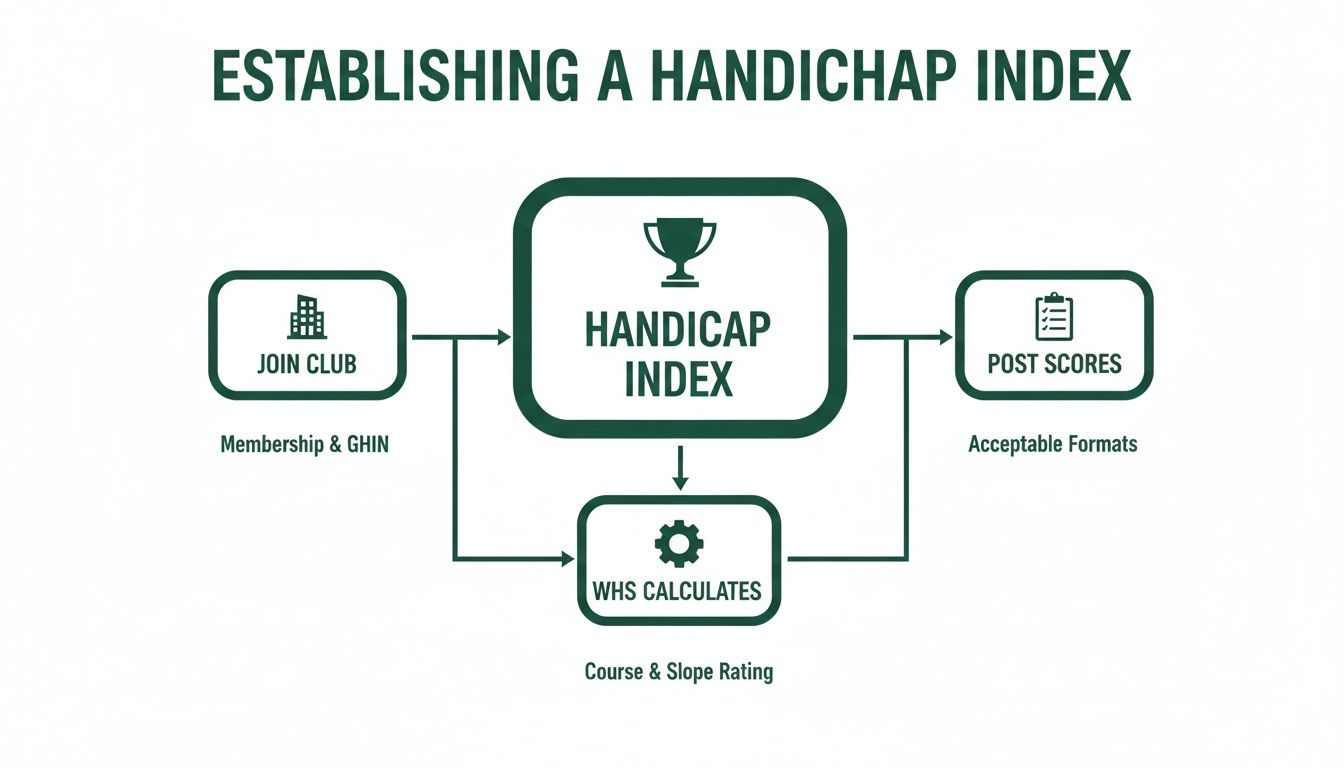
As you can see, getting a Handicap Index is a straightforward process. It all starts with joining a club and posting your scores.
The Two Ratings That Matter Most
So, what do these ratings actually mean? Let's break them down.
Think of Course Rating as the score a scratch golfer (a 0 handicap) is expected to shoot from a specific set of tees. If the par is 72 but the Course Rating is 73.1, it tells you that even the best players will find this course a little tougher than average.
For a deeper dive, check out our guide on what a course rating is and how it’s calculated.
Then you have the Slope Rating. This number doesn't measure overall difficulty but rather the relative difficulty for a bogey golfer compared to a scratch golfer. It's the great equalizer.
This table quickly explains the difference between the two.
Course Rating vs Slope Rating Explained
Factor | What It Measures | Who It's For | Practical Impact |
|---|---|---|---|
Course Rating | The expected score for a scratch (0 handicap) golfer. | Scratch Golfers | Sets the baseline difficulty of the course. A 73.5 rating is harder than a 70.5. |
Slope Rating | The relative difficulty for a bogey golfer vs. a scratch golfer. | Bogey Golfers | Adjusts your handicap up or down based on the challenge. A higher slope means more strokes for you. |
Slope Ratings can range from a low of 55 (very easy) to a high of 155 (extremely difficult), with 113 being the standard for a course of average difficulty.
Putting It All Together On The Course
Let's say you carry a 15.0 Handicap Index.
At your home course—which is pretty straightforward with a Slope Rating of 120—your Course Handicap might be 14 strokes. But when you go play a tough tournament track with a Slope Rating of 145, your Course Handicap could jump to 18 strokes. You get more shots because the course is proven to be significantly harder for the average player.
Before the Slope system, handicaps were basically stuck at one course. A 12-handicap from a friendly layout was considered the same as a 12-handicap from a brute, which was anything but fair.
Slope fixed this by quantifying how much a course's difficulty changes for players who aren't scratch. This change has been a huge factor in growing the game, with the USGA reporting 735,000 new handicapped golfers since 2020 alone.
This portability is what makes your handicap so valuable. It adapts to the challenge right in front of you, giving you the right number of strokes for that specific course and that specific set of tees. That's a fair game.
Streamlining Handicap Management for Your Tournaments
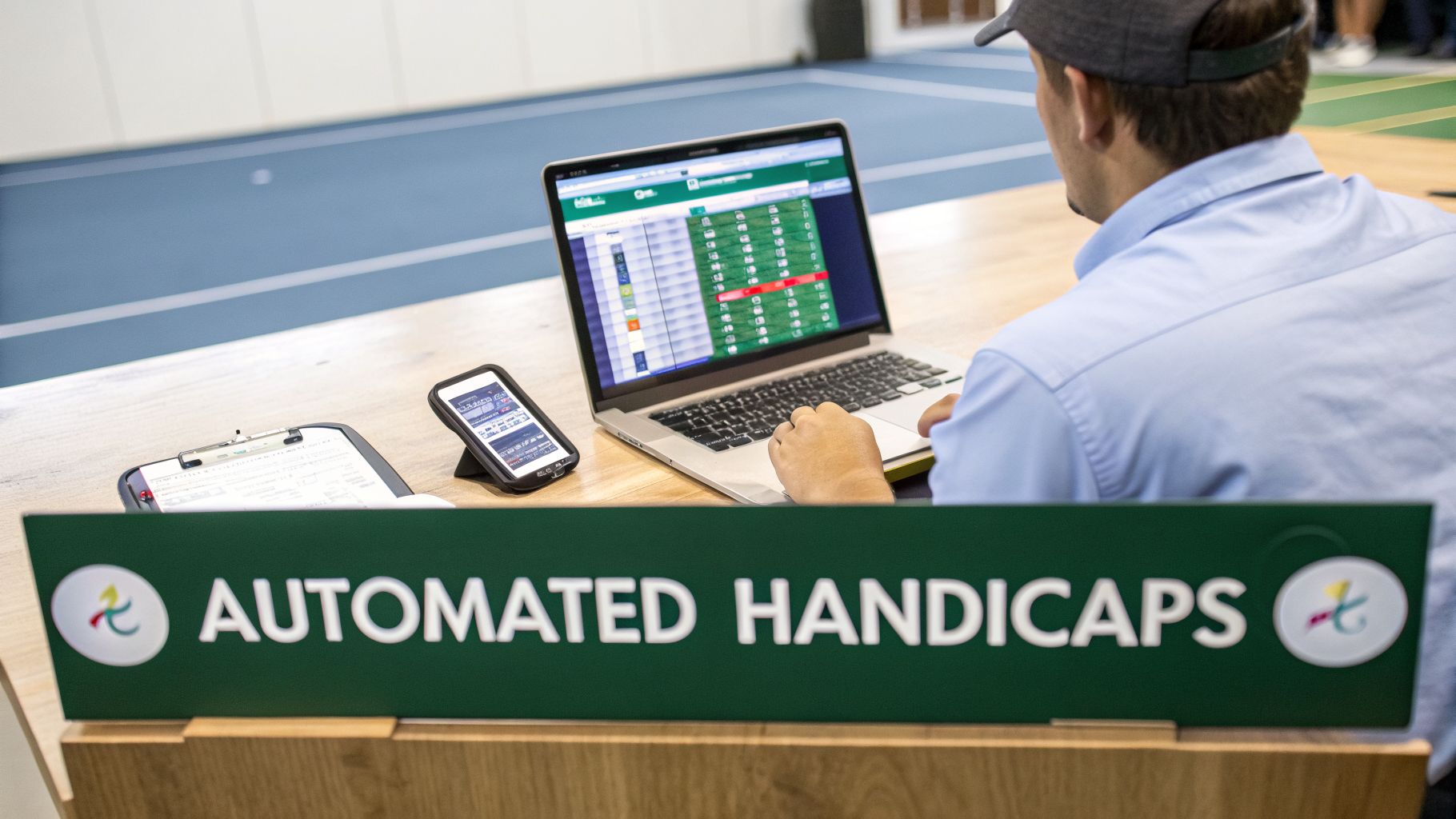
If you're a tournament director or head pro, you know the drill. Chasing down player handicaps is one of the most tedious parts of the job. It's a mess of manual data entry, endless phone calls, and last-minute scrambling just to get the numbers right.
Getting a player's golf handicap is obviously critical for a fair event. But the old way of doing things—spreadsheets, emails, and manual lookups—is slow and full of potential mistakes. One wrong number can throw off the net scores, frustrate your players, and damage your event's credibility.
Taking the Headaches Out of Handicaps
This is where modern tournament software completely changes the game. Instead of wrestling with spreadsheets, these platforms automate the entire process, saving you hours of busywork and making your event look far more professional.
The secret is a direct link to official handicap services, like the USGA's GHIN system. This integration allows you to:
Collect and Verify: Automatically pull the latest Handicap Index for every registered player. No more chasing people down.
Calculate on the Fly: Instantly figure out each player's Course Handicap based on the specific tees you're using for the event.
Fuel Live Leaderboards: Power real-time net leaderboards that update as soon as scores are entered.
This not only gets rid of manual math but also guarantees every golfer is playing with a verified, up-to-the-minute handicap.
Imagine running a big outing where the net leaderboard populates in real time, with zero manual input from your staff. This isn't some futuristic dream; it's the standard for modern tournament software, and it delivers the kind of polished experience players expect now.
By using tools that handle the handicap grunt work for you, you can stop focusing on administrative headaches. That means more time to focus on what really matters—running a great event that everyone remembers.
Common Questions About Golf Handicaps
Even when you think you have the handicap system figured out, a few common questions always seem to pop up. For players and tournament organizers alike, getting the details right is what keeps a game fair and fun.
Let’s clear up some of the most frequent ones we hear.
How Often Does My Handicap Index Update?
Your Handicap Index updates daily under the World Handicap System (WHS). Once you post an eligible score, it gets processed overnight. By the next morning, you have a new index that reflects your latest round.
This is a huge leap forward from the old days of waiting for twice-a-month updates. The daily revision means your handicap is always a current snapshot of your potential ability.
Can I Get a Handicap Without a Private Club Membership?
Absolutely. The days of needing an expensive private membership to get an official handicap are long gone. The WHS has made it easy for any golfer to get in the game.
You can get an official Handicap Index by joining any authorized golf club. These include:
Public courses offering handicap services to their regular players.
State or regional golf associations, which you can often join directly.
Accredited online "e-clubs" built for golfers who don’t have a single home course.
Any of these options will get you a unique ID number (like a GHIN number in the US) so you can start posting scores and build your official index.
What Is an Adjusted Gross Score?
Think of an Adjusted Gross Score as your score with a built-in safety net. It’s your raw score, but modified to prevent a few blow-up holes from wrecking your handicap calculation.
For handicap purposes, the maximum score you can take on any hole is a Net Double Bogey. That’s calculated as: Par + 2 + any handicap strokes you get on that hole.
This cap is what keeps your handicap reflecting your actual potential, not just your worst moments on the course. It’s a key part of what makes the whole system fair.
Does a 9-Hole Score Count Towards My Handicap?
Yes, and they’re a crucial part of the system. The WHS is designed to use 9-hole scores, which is a game-changer for golfers who can't always squeeze in a full 18.
When you post a 9-hole score, the system simply hangs onto it. The next time you post another 9-hole score, it combines the two into a single 18-hole Score Differential and adds it to your record. It's a seamless way to keep your handicap accurate.
Stop wrestling with spreadsheets and manual lookups. Live Tourney automates handicap management, from player registration to real-time net leaderboards, saving your staff hours and delivering a professional experience for every event. Learn more about running better tournaments at https://livetourney.com.