
Feb 22, 2026
Master handicap scoring in golf. This guide explains how to calculate, apply, and manage handicaps for fair and competitive tournaments.

Ever wonder how a weekend golfer can compete against a club pro in the same tournament and still have a shot at winning? The secret is the handicap system, a brilliant method for leveling the playing field in a notoriously difficult game.
It’s the great equalizer. The system gives less-experienced players a "head start" by awarding them strokes, turning their raw score (gross score) into a more competitive net score. This is the key to running a tournament that feels fair and, more importantly, fun for everyone involved.
The Foundation of Fair Golf Tournaments
The success of any golf event, from a casual Saturday scramble to a high-stakes club championship, boils down to one simple thing: fairness. Players need to feel like they have a legitimate chance to compete, whether they’re a scratch golfer or a 20-handicap.
Think of it like a head start in a foot race. The elite runner starts at the line, while the novice gets to start a few yards ahead. A golf handicap applies the same logic, making sure a player's final standing is based on how well they played against their own potential, not just their raw score.
Why Handicaps Matter for Your Event
For tournament organizers, getting this right is everything. It’s not just about crunching numbers; it’s about creating an atmosphere where every single player is engaged from the first tee to the last putt. When you apply handicaps correctly, you accomplish a few critical things:
You level the playing field. A 20-handicap can go head-to-head with a 5-handicap, and the match will actually be competitive.
You drive participation. Golfers are far more likely to sign up for an event when they know they have a fair shot at the prize table.
You encourage integrity. A consistent, well-run system motivates players to post their scores accurately and maintain an honest Handicap Index.
Before we get into the nitty-gritty of the calculations, let's break down the key terms you'll encounter. This table is a quick reference guide to the core components that make modern handicap scoring work.
Core Components of Modern Handicap Scoring
Component | What It Measures | Why It Matters for Your Tournament |
|---|---|---|
Gross Score | The total number of strokes a player takes in a round. | This is the raw data, but it doesn't tell the whole story of a player's performance. |
Course & Slope Rating | The difficulty of a specific course for both scratch and bogey golfers. | These ratings ensure handicaps are adjusted fairly based on where the round is played. A 90 at a tough course isn't the same as a 90 at an easy one. |
Handicap Differential | A player's performance in a single round, adjusted for course difficulty. | This is the building block of a player's Handicap Index. |
Handicap Index | A player's potential scoring ability, calculated from their best 8 of the last 20 differentials. | This is the portable, baseline number that represents a golfer's skill level. |
Course Handicap | A player's handicap adjusted for the specific course and tees they're playing that day. | This is the number of strokes a player actually gets during the tournament round. |
Net Score | A player's Gross Score minus their Course Handicap. | This is the final, adjusted score used to determine tournament winners. |
Now that we have the vocabulary down, let's explore how these pieces fit together.
A Legacy of Fairness
This idea isn't new. The concept of handicapping in golf has been around for over a century, with the United States Golf Association (USGA) creating its first national system way back in 1911.
Today, the World Handicap System (WHS), which launched in 2020, has standardized the process across the globe. By using the best eight of a player's last 20 scores, the WHS provides a much more accurate and responsive measure of a golfer's current ability. You can learn more about the evolution of the handicap system to see just how far it's come.
A well-run, handicapped event isn’t just about numbers—it's about delivering an exceptional player experience. It transforms a simple round of golf into a dynamic competition where anyone can have their day.
This guide will walk you through the entire process, from understanding the core concepts to applying them correctly in any tournament format you can dream up.
How a Player's Handicap Index Is Calculated
To run a fair tournament, you have to get what's happening behind the scenes. A player's Handicap Index isn't just a number pulled out of thin air; it’s a carefully calculated measure of their demonstrated ability. Think of it as a golfer's GPA—a single, portable number that tells you what they're capable of on the course.
That number comes from the World Handicap System (WHS), which uses a specific formula to level the playing field. It takes a player's actual scores and weighs them against the difficulty of the courses they played. Getting a handle on this process is the key to appreciating just how fair modern handicap scoring really is.
The Building Block: A Single Round's Score Differential
Everything starts with the Score Differential. This is the foundational piece of the entire handicap system.
Every time a golfer plays a round and posts their score, a differential is calculated for that round. It isn’t just their raw score. It's their score adjusted for how tough the course was that day, from the specific tees they played.
To get this number, you need three key ingredients:
Adjusted Gross Score: This is the player's total strokes, but with a built-in cap on the maximum score for any single hole (Net Double Bogey). This little adjustment prevents one blow-up hole from completely torpedoing their differential.
Course Rating: This number tells you what a scratch golfer (a player with a 0 handicap) is expected to shoot on that course. A rating of 72.1 means a top-tier player should average just a hair over 72.
Slope Rating: This measures how much harder a course is for a "bogey golfer" compared to a scratch golfer. A higher slope (it goes up to 155) means the course gets exponentially tougher for the average player.
These three pieces get plugged into a simple but powerful formula.
The Score Differential Formula
Here’s what the math looks like for any given round:
Score Differential = (Adjusted Gross Score - Course Rating) x 113 / Slope Rating
Let’s use an analogy to make sense of it. The Course Rating is the baseline—think of it as par time for a race. The Slope Rating is the difficulty multiplier, like the terrain of the racetrack. A flat, easy track has a low slope, while a hilly, punishing one has a high slope. And the "113"? That's just the number for a standard, average-difficulty slope, which helps normalize all scores against a common baseline.
So, if a golfer shoots an 85 on a course with a Course Rating of 71.5 and a Slope Rating of 128, their Score Differential for that round is 11.9.
This whole process—from a player's raw score to its use in a tournament—is what makes competition fair.
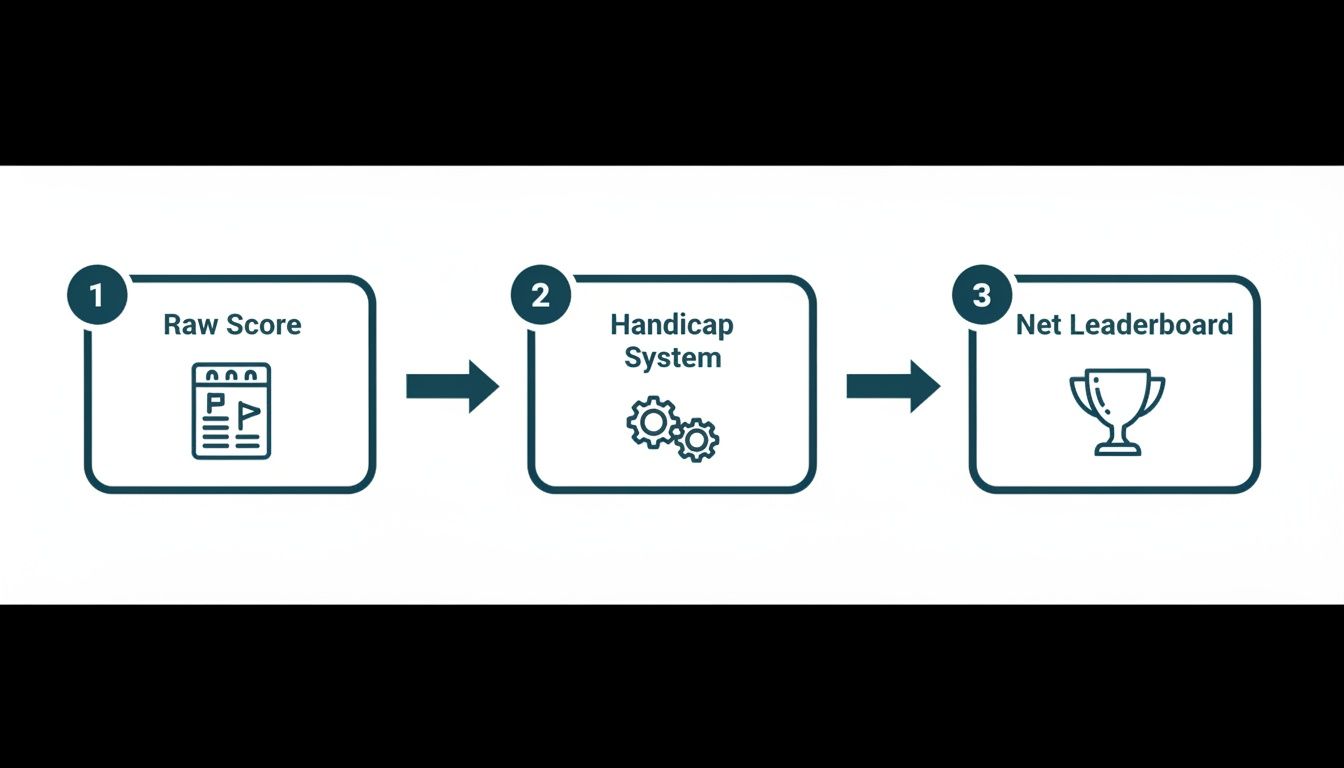
As you can see, the raw score is just the starting point. It gets fed into the handicap system's machinery, which spits out the net score used to create an apples-to-apples leaderboard.
From Multiple Rounds to a Final Handicap Index
One round doesn't tell the whole story. A player's official Handicap Index is a rolling average that reflects their current potential, not just one good or bad day.
The WHS looks at a player's most recent 20 scores. From that list, it plucks out the best eight Score Differentials and calculates their average. That average is what becomes the player's official Handicap Index. This method makes sure the index is a true snapshot of a golfer's ability, while still allowing for the natural ups and downs of the game.
If you want to go even deeper into how the WHS works, check out this guide on Mastering the Best Handicap Golf System for Your Game.
This 8-of-20 system is what makes the Handicap Index so reliable. It rewards consistency but doesn't punish a player too harshly for a few off days. It’s a living number that updates as new scores are posted, ensuring the handicaps you use in your tournament are a true reflection of every player's current game.
Putting the Handicap Index to Work on Tournament Day
A player’s Handicap Index is a fantastic measure of their potential, but it's not the number you'll actually use on tournament day. Think of the Index like a golfer's GPA—it's a standardized number that travels with them from course to course. But for it to mean anything at your event, you have to convert it into a Course Handicap.
This is the actual number of strokes they get on your course, from their specific set of tees.
This conversion is probably the most critical step in making a tournament fair. It tailors each player's handicap to the unique challenge of the course they're about to play. A 15-handicap golfer isn't going to get the same number of strokes on a long, narrow championship layout as they would on a short, forgiving executive course. It just wouldn't be equitable.

This idea of adjusting for difficulty is what makes the whole system work so well. It’s not a new concept, either. Back in the late 19th century, various clubs in Britain came up with their own methods to level the playing field. The modern system, with its Slope Rating introduced by the USGA in 1987, just perfected the art of making handicaps portable and accurate anywhere in the world.
The Course Handicap Formula Explained
To calculate a player's Course Handicap, you just need two things: their Handicap Index and the ratings for the specific tees they'll be playing. The World Handicap System provides a straightforward formula that does all the heavy lifting.
Course Handicap = Handicap Index x (Slope Rating / 113) + (Course Rating - Par)
Let’s quickly break down what each piece means:
Handicap Index: The golfer's baseline measure of potential ability.
Slope Rating: A number from 55 to 155 that measures how much harder a course is for a bogey golfer versus a scratch golfer.
113: This is the baseline Slope Rating for a course of "standard" difficulty. It's the universal benchmark.
Course Rating: What a scratch golfer is expected to shoot from that set of tees.
Par: The standard score for the course.
That last part, (Course Rating - Par), is a more recent adjustment. It fine-tunes the calculation to make sure a player's target score for a "net par" is the actual par of the course, which makes the final number much more intuitive.
A Real-World Calculation Example
Formulas can feel a bit abstract, so let's walk through a real-world example. We have a golfer, Alex, who has a Handicap Index of 15.0. He's playing in your tournament from the white tees.
Let’s see how his Course Handicap changes on two very different courses.
Course A (The Tough One):
Slope Rating: 135
Course Rating: 72.5
Par: 71
The Math: 15.0 x (135 / 113) + (72.5 - 71) 15.0 x 1.1947 + 1.5 17.92 + 1.5 = 19.42
After rounding, Alex gets 19 strokes on this monster of a course.
Course B (The Easier One):
Slope Rating: 118
Course Rating: 69.8
Par: 70
The Math: 15.0 x (118 / 113) + (69.8 - 70) 15.0 x 1.0442 + (-0.2) 15.66 - 0.2 = 15.46
Here, after rounding, Alex only gets 15 strokes.
This quick comparison shows exactly why just using a player's raw Handicap Index is a huge mistake. On the tougher track, Alex needs four extra strokes to have a fair shot. Getting this conversion right for every single player is the bedrock of a well-run, credible tournament. And once you have those handicaps set, you’ll need the right tools to keep track of it all, which is why having one of the best golf scorecard setups is so important.
Applying Handicaps in Different Tournament Formats
Once you've turned every player's Handicap Index into their Course Handicap, you might think the job is done. But for a lot of popular tournament styles, there’s one more critical step: applying the right handicap allowance. This final tweak is what keeps the game fair, especially when you throw partners into the mix.
Not every format uses 100% of a player's Course Handicap. In fact, using the full handicap in certain team games can accidentally give an edge to one type of team over another. To level things out, the World Handicap System (WHS) provides recommended allowances—basically, percentages of each player’s handicap that you should use to calculate the final net score.
Think of it like fine-tuning the rules for a specific game. Applying these allowances correctly is often what separates a good, smooth-running tournament from a great one.
Stroke Play and Match Play Allowances
Let's start with the most straightforward formats. In individual stroke play, it’s just one golfer against the course, so fairness is already baked into their Course Handicap.
The allowance here is as simple as it gets:
Individual Stroke Play: Every player gets 100% of their Course Handicap. This is the classic format where the lowest net score wins.
Individual Match Play: Similarly, in a one-on-one match, players also receive 100% of their Course Handicap. The player with the higher handicap gets the full difference in strokes between the two.
These formats are the baseline. Things get more interesting when you start adding partners.
Allowances for Popular Team Formats
This is where organizers often get tripped up. Team events need specific percentage adjustments to keep things balanced and prevent any one player from having a huge impact on the outcome. Getting these right is absolutely essential for a fair competition.
The whole point of handicap allowances in team play is to make sure the outcome is decided by the team's combined effort, not just one high-handicap player who happens to be having a career day.
Here are the WHS recommendations for the most common team games:
Four-Ball (Better Ball): In this format, two partners each play their own ball, and the team takes the lower score on each hole. To keep it fair, each player on the team receives 90% of their Course Handicap.
Foursomes (Alternate Shot): Here, partners hit the same ball, taking turns. The team handicap is calculated by taking 50% of the combined Course Handicaps of both players.
These adjustments make sure that neither the low-handicap nor the high-handicap player in a partnership has an unfair advantage. If you're running an event with different formats, you can find a deeper dive into all the specifics in our guide to golf tournament scoring.
The Scramble Handicap Calculation
The scramble is easily the most popular format for charity events and corporate outings, but its handicap system is also the most unique. For a four-person scramble, you calculate a single team handicap by combining a percentage of each player's Course Handicap.
The standard WHS recommendation for a four-person scramble team is:
A-Player (Lowest Handicap): 25% of Course Handicap
B-Player (Second-Lowest): 20% of Course Handicap
C-Player (Third-Lowest): 15% of Course Handicap
D-Player (Highest Handicap): 10% of Course Handicap
You add these percentages together to create one team handicap, which then gets subtracted from the team's gross score. This tiered system ensures that all four players are contributing to the team's advantage and rewards well-balanced teams over those that might be stacked with one or two scratch golfers.
For a quick reference, here’s a table that breaks down these key allowances.
Handicap Allowances for Popular Golf Formats
This quick-reference guide shows the World Handicap System's recommended allowances for the most common individual and team tournament formats.
Tournament Format | Individual/Team | Recommended Handicap Allowance |
|---|---|---|
Individual Stroke Play | Individual | 100% of Course Handicap |
Individual Match Play | Individual | 100% of Course Handicap |
Four-Ball (Better Ball) | Team | 90% of each player's Course Handicap |
Foursomes (Alternate Shot) | Team | 50% of combined partner Course Handicaps |
Four-Person Scramble | Team | 25% (A) + 20% (B) + 15% (C) + 10% (D) |
By taking the time to understand and apply these specific allowances, you can be confident that your tournament—no matter the format—is set up to be as fair and competitive as possible for every single person who tees it up.
Common Handicap Pitfalls and How to Sidestep Them
Knowing how a golf handicap works is one thing, but avoiding the little mistakes that can derail a tournament is another. These common trip-ups are often where the confusion and frustration creep in, leading players to question the fairness of your event.
Think of this as your troubleshooter's guide. We'll walk through the most frequent issues organizers run into—from using last month's indexes to figuring out what to do with that one golfer who shows up without a handicap. Nailing these details is the secret to running an event that feels buttoned-up and professional.
Using an Outdated Handicap Index
This is, without a doubt, the most common mistake. A player's Handicap Index isn't static; it can change every single time they post a score. Using a number from last month, or even last week, might not reflect their true, current ability.
And that’s a big deal for the integrity of your tournament. An old index could give a player an unfair advantage or disadvantage, which completely undermines the point of the system. The fix is simple: establish a clear "revision date" for your event, tell everyone what it is, and make sure you pull the most current indexes before you calculate a single Course Handicap.
Mismanaging Players Without a Handicap
Sooner or later, you'll have someone sign up who doesn't have an official Handicap Index. How you handle this is crucial. Just making them play as a "scratch" (a zero handicap) is a tough pill for them to swallow, but guessing at a number isn't fair to the rest of the field.
Fortunately, there are a few standard ways to handle this:
The Callaway System: A great solution for charity or corporate outings. This system uses a player's score from that day to generate a one-time handicap on the spot. It's widely seen as a fair and simple method.
Maximum Handicap: You can assign the player the maximum handicap allowed for the competition. This lets them participate without giving them an unfair edge.
Separate Flight: Just create a separate division for players without official handicaps. They can compete against each other based on their gross scores, keeping things fair for everyone.
Getting a Grip on Net Double Bogey
This is a huge one. Net Double Bogey is the maximum score a player can take on any hole for handicap purposes. It’s designed to prevent one blow-up hole from wrecking a player's Handicap Index.
Here’s the simple formula for the max score on a hole:
Par + 2 + any handicap strokes the player gets on that hole.
Let's say a player with a 20-handicap is on a par-4 hole, and it's the #1 handicap hole on the course. They get two strokes on this hole. Their maximum score for posting purposes is 8 (Par 4 + 2 for double bogey + 2 handicap strokes). Even if they picked up and wrote down a 10, they would post an 8 for that hole.
This is the modern, more straightforward version of the old Equitable Stroke Control (ESC) system, and it’s a core part of what keeps the handicap system fair.
Course Conditions and Posting Scores
The World Handicap System (WHS) has a pretty slick, automatic feature called the Playing Conditions Calculation (PCC). It looks at all the scores posted at a course on a given day and figures out if conditions were unusually hard or easy. If everyone’s scores were way higher than normal, the PCC automatically adjusts the score differentials so a brutal, windy day doesn't unfairly penalize the entire field.
Since the WHS rolled out in 2020, its smarter, more accessible approach has helped bring more people into the game. The number of US golfers with an active index has jumped 23% to 3.2 million. As more players get involved, understanding these details becomes even more critical for running a great event. The system is designed to account for everything, making it the most accurate it's ever been. You can read more about these trends and the history of score-keeping in golf to see just how far things have come.
Let Software Do the Heavy Lifting
After walking through all the handicap calculations and allowances, one thing should be crystal clear: trying to manage this by hand is a recipe for headaches and mistakes. The formulas, the percentages, the constant updates—it's a massive job.
This is exactly where modern tournament software comes in, transforming your role from a stressed-out number-cruncher into a polished event host.
Instead of getting buried in spreadsheets for hours, a digital platform automates the entire setup. These systems can import your player roster and instantly pull the most current, official Handicap Index for every single golfer. That one feature alone wipes out the biggest source of error—using outdated numbers—and makes sure your tournament is fair from the very start.
From Setup to Scoring in Minutes
Once the indexes are loaded, the software takes over. It automatically calculates the correct Course Handicap for every player based on the specific tees they're using. It also applies the right handicap allowance for your chosen format, whether it’s 90% for a Four-Ball or a complex tiered Scramble.
This automation brings two huge wins for any organizer:
No More Human Error: The tricky math is done instantly and perfectly, removing the risk of a simple mistake that could undermine the whole event.
Get Your Time Back: What used to be hours of manual data entry and double-checking can now be done in minutes. That frees you up to focus on the player experience.

The biggest advantage, though, is how it changes tournament day. With a system that supports real-time scoring, players can enter scores on their phones, and the leaderboard updates instantly with accurate net results. To see just how powerful this is, check out the benefits of golf tournament scoring software.
A live, net-score leaderboard is a total game-changer. It creates a dynamic, professional vibe and lets players track their standing in real-time, boosting the excitement from the first tee to the final putt.
At the end of the day, using software for handicap scoring in golf isn’t just about convenience. It’s about delivering a better, more professional tournament. It guarantees accuracy, saves you a ton of time, and lets you focus on what really matters: hosting a great event that players will want to come back to year after year.
Common Handicap Questions on Tournament Day
Even when you have a good handle on the system, certain questions always seem to pop up right before the first tee time. Here are a few of the most common ones we see from organizers, with clear answers to help you run your event with confidence.
What If a Player Doesn't Have a Handicap?
This is a classic problem, especially for charity and corporate outings where you get a mix of serious golfers and weekend warriors. You don't have to just guess a number or make them play from scratch (which isn't fun for anyone).
Here are a few fair ways to handle it:
Use the Callaway System: This is a one-day handicapping method that uses a player's score from that round to calculate a handicap just for the event. It's a widely accepted and fair solution for players without an official index.
Create a Separate Flight: Put all the non-handicapped golfers into their own division. They can compete against each other based on gross scores, which keeps the main net competition fair for everyone else.
Assign a Maximum Handicap: You can give the player the max handicap allowed for your event. This ensures they can still participate in the net competition without having a massive, unfair advantage.
How Do I Handle "Sandbagging"?
Ah, sandbagging—the delicate art of keeping a handicap higher than your actual skill level. It's a sensitive topic. While modern tournament software can flag statistically improbable net scores, your best defense is always a clear, upfront policy.
For regular club events, a handicap committee that reviews scores and makes adjustments is pretty standard. For one-off events, your main job is to apply the WHS rules and format allowances transparently. Your responsibility is to make sure the process is fair for everyone.
Do We Have to Post Tournament Scores?
In most cases, yes. For a player’s Handicap Index to stay accurate, they need to post scores from acceptable formats. The World Handicap System (WHS) considers most individual stroke play rounds to be mandatory for posting.
As the organizer, it's your job to communicate this. Just give your players a heads-up before the event that scores will be posted to the WHS. It’s all about maintaining the integrity of the system for everyone.
Scores from team games like scrambles or alternate shot don't get posted for individual handicaps.
What Are the "Hole Handicaps" on the Scorecard?
Those numbers on the scorecard labeled "Handicap" or "HCP" from 1 to 18 rank the holes by difficulty. The #1 handicap hole is the hardest on the course, and #18 is the easiest. This is officially called the Stroke Index.
This ranking tells players where they get to use their handicap strokes. For example, a player with a Course Handicap of 14 gets one extra stroke on each of the 14 toughest holes (those ranked 1 through 14). On those specific holes, they can subtract a stroke from their gross score to find their net score for that hole.
Managing all the moving parts of a golf tournament can feel overwhelming, but Live Tourney makes it simple. Our web-based platform automates everything from handicap calculations and live leaderboards to registration and payments, and nobody has to download an app. You can set up your entire event in minutes and give players a pro-level, real-time scoring experience. See how top courses are running better tournaments by starting your free trial.





