
Mar 9, 2026
Explore the top GPS systems for golf courses in this complete guide. Learn how to choose the right tech to boost revenue and improve the player experience.

When most people hear “golf course GPS,” they probably think of a simple gadget that tells a player the yardage to the front, middle, and back of the green. And for a long time, that’s all it was—a nice-to-have perk for the golfer.
But that’s old news. Today's GPS platforms are a completely different animal. They’ve grown into a full-blown command center for running your entire facility, offering massive benefits for your operations and your bottom line.
The Modern Advantage of Golf Course GPS Technology

Think about running a flawless tournament where the pace of play is perfect and every single golfer feels like they're playing on tour. That’s what a modern GPS system for golf courses actually delivers. The technology has evolved far beyond a simple yardage tool; it’s now the central nervous system of a well-run golf operation.
For course operators and tournament organizers, the right GPS solution touches every part of the business. It helps you manage the day-to-day grind, seriously elevates the player experience, and even opens up new ways to make money.
From Player Perk to Operational Powerhouse
It wasn't long ago that GPS devices were just a premium add-on for golfers. They were convenient for getting distances, but the real value was still waiting to be unlocked.
The big shift happened when operators realized these systems offered a treasure trove of operational data and control. Think of it as having a set of eyes on every hole, all day long. This gives you hard data on everything from player traffic patterns to pace-of-play bottlenecks.
The real change is moving from seeing GPS as just a player-facing tool to recognizing it as essential management infrastructure. It gives you the visibility and control needed to run a more efficient, profitable, and enjoyable golf course.
This isn't just a niche trend. The global golf GPS device market was valued at $369.1 million in 2025 and is projected to grow at a CAGR of over 5% through 2033. The demand is being driven by better tech and the game's growing popularity. You can dig into the market trends in this comprehensive report on golf GPS devices from datainsightsmarket.com.
What This Technology Actually Delivers
A modern GPS platform is a complete ecosystem. It connects your staff, your players, and your revenue goals into a single, cohesive environment where information flows freely. This means smarter decisions and a better day on the course for everyone.
Here’s what you really get:
A Better Player Experience: Golfers get accurate yardages, digital scorecards, and live leaderboards. It makes a casual round feel more professional and a tournament feel like a major.
Serious Operational Efficiency: Your staff can see the entire cart fleet in real-time, monitor battery levels, and set up geofenced "no-go" zones to protect sensitive areas of the course. No more guesswork.
Data You Can Actually Use: The system collects real-world data on pace of play, cart usage, and where golfers are driving. You can finally make decisions based on what’s actually happening, not just what you think is happening.
New Revenue Streams: The screens are prime real estate. On-screen advertising, food and beverage ordering, and pro shop promotions are all easy ways to generate extra income from every round played.
This guide will walk you through how to choose and implement the right system to make all of this a reality for your course.
A modern GPS system isn't just about giving golfers yardages anymore. Think of it as your course's command center—a tool that completely changes the game for both your players and your operations team.
For golfers, the benefits are obvious. They get precise distances, digital scorecards that feed into live leaderboards, and a far more professional, interactive round. It speeds up play and cuts down on frustration for everyone.
But the real magic happens behind the scenes. A good GPS system for golf courses gives your team the power to see and manage the entire property from one screen, replacing guesswork with hard data.
Gain Unprecedented Operational Control
Imagine having a real-time, bird's-eye view of your entire course. That's the core of what a back-office GPS platform delivers. You can see every cart, check its battery life, and make sure your fleet is being used efficiently.
This lets you make smarter decisions on the fly. You can spot a group that’s falling behind, identify bottlenecks before they turn into major backups, and actively manage the pace of play across all 18 holes.
A GPS system gives you the data to move from reactive problem-solving to proactive course management. It’s like navigating a new city with a live traffic feed instead of just a paper map.
This visibility also helps you protect your most valuable asset: the course itself. By setting up virtual "no-go" zones, or geofences, you can automatically keep carts away from sensitive turf, wet areas, or ground under repair. It’s a simple feature that prevents expensive damage and keeps your course in great shape.
Elevate the Golfer Experience
While the operational benefits are huge, the player-facing features are what build loyalty and keep people coming back. The system gives golfers everything they need for a smoother, more engaging round.
Accurate On-Course Information: Players get exact distances to any spot on the hole, from hazards to ideal landing zones. That confidence speeds up club selection and keeps things moving.
Digital Scoring and Leaderboards: Forget paper scorecards. Golfers enter scores right on the device, and the results instantly pop up on live leaderboards for tournaments and outings.
Enhanced Communication: Your staff can send targeted messages to specific carts or broadcast alerts to the entire course, whether it's a weather warning or a happy hour special at the 19th hole.
For many players, simply knowing the exact pin location is a game-changer for their approach shots. You can learn more about how to interpret this data in our guide on reading golf pin sheets.
Unlock Actionable Data and Insights
Running a golf course without data is like flying blind. A GPS system changes that by capturing a ton of information about how players actually use your property. This is where the technology delivers a clear, measurable return.
You can analyze traffic patterns to see which routes players take, where slowdowns happen, and how cart paths are being used. This is gold for making smarter decisions about course setup, pin placements, and even future renovation projects.
This isn’t just a niche trend; it’s where the entire industry is headed. The global market for golf GPS equipment is projected to blow past $478 million by 2033, a significant jump from $345.73 million in 2023. You can dig into the numbers in this in-depth golf GPS market analysis. This growth shows that data-driven precision is quickly becoming the standard, giving a serious competitive edge to courses that get on board.
Choosing Your System: Types of Golf Course GPS Solutions
Picking a GPS system for your golf course isn't just about technology—it's a decision that shapes your entire operation. The right system can make your course run smoother and keep players happy, but the wrong one can be a costly headache.
The options really come down to a few different approaches. You can go with traditional hardware bolted onto your carts, rely on players to use an app, or adopt a modern web-based platform that works on any smartphone. Each path has its own costs, maintenance needs, and impact on the player experience.
Traditional Cart-Mounted Hardware
This is the classic setup most people think of: a dedicated, weather-proof screen mounted right on the dash of every golf cart. It’s owned and managed entirely by your course.
The big plus here is control. You decide what’s on the screen, what features are available, and you know every golfer in a cart has access to it. It’s consistent and reliable.
But that control comes with a hefty price tag. The upfront investment to outfit an entire fleet can be massive. Plus, you’re on the hook for all the maintenance, repairs, and inevitable technology upgrades down the road.
Player-Focused Apps and Handheld Devices
Another route is to put the tech in the player’s hands through a downloadable smartphone app or a dedicated handheld unit. Instead of the course owning the hardware, the golfer brings their own.
The main advantage is a much lower initial cost for the course, since you aren't buying dozens of tablets. Players who already love their rangefinders or golf apps might find this model easy to adopt, and it works great for those who prefer to walk.
The trade-off is a major loss of control and consistency. You're counting on players to download an app, keep their phone charged, and use their own data. This can create a disjointed experience where only some golfers are using the system, making it tough to manage pace of play or run a tournament with a live leaderboard.
The core decision is whether to invest in hardware you own and maintain or to adopt a more flexible system that leverages the technology players already carry. The best choice depends on your operational priorities and budget.
This is where a modern GPS system connects the dots between the on-course experience and your business goals.
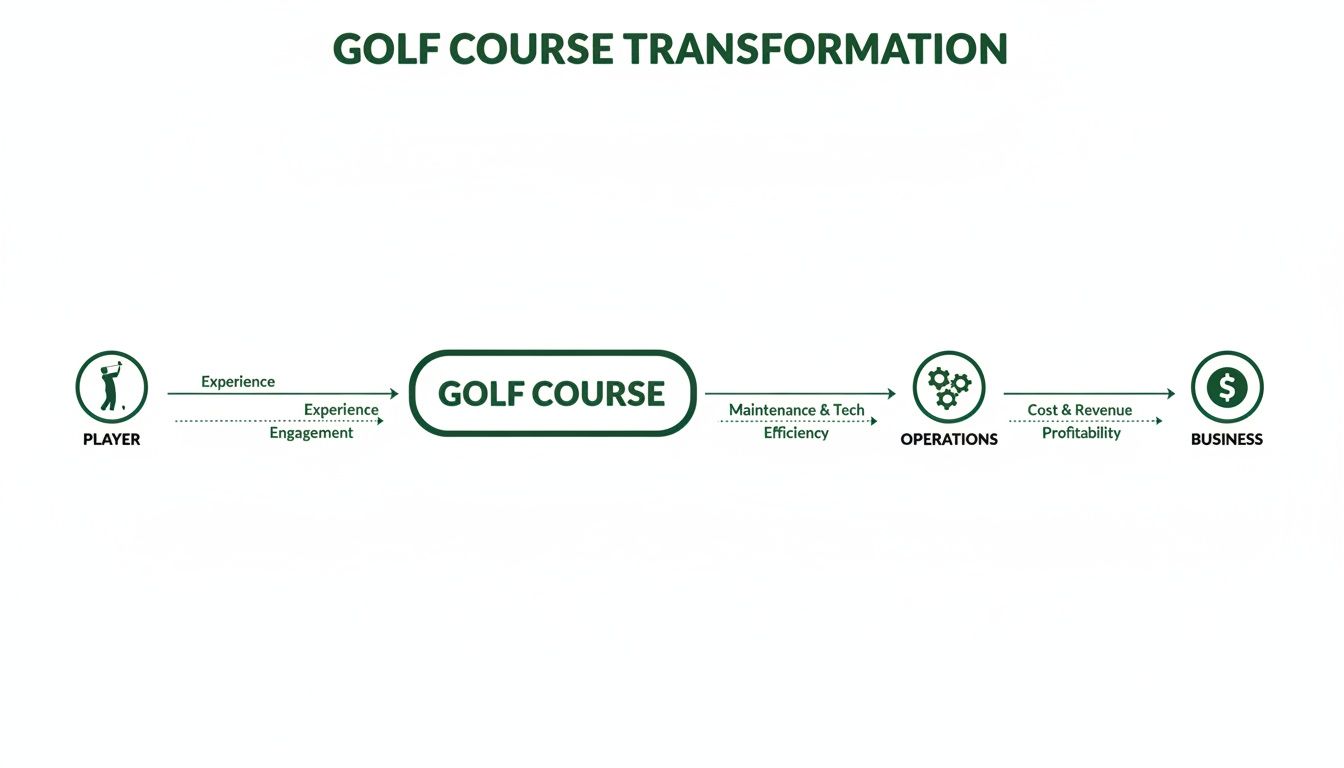
When the player experience is better, your operations become more efficient, and that directly helps your bottom line.
A helpful way to see how these systems stack up is to compare them side-by-side.
Comparison of Golf Course GPS System Types
System Type | Primary User | Key Advantage | Potential Drawback | Best For |
|---|---|---|---|---|
Cart-Mounted Hardware | Golfers using carts | Total course control and a consistent experience | High initial cost and ongoing maintenance | High-end private clubs or resorts with a large budget for fleet upgrades. |
Player-Focused Apps | Individual Golfers | Low upfront cost for the course | Inconsistent adoption; relies on players' devices | Courses with a high percentage of walking golfers or a tech-savvy membership. |
Web-Based Platforms | All Golfers (Cart & Walkers) | No hardware costs and seamless player adoption | Requires players to have a smartphone | Nearly any course, especially those running tournaments or looking for a low-cost, high-value solution. |
Each model serves a different need, but the trend is clearly moving toward more accessible, lower-overhead solutions.
Modern Integrated Web-Based Platforms
There’s a newer, fast-growing option that offers the best of both worlds: a web-based platform that runs right on a player’s own phone, with no app to download. Golfers just scan a QR code or tap a link, and the system opens in their phone’s browser.
This approach neatly sidesteps the biggest problems with the other systems.
No Hardware Costs: You completely avoid the huge capital expense and maintenance headaches of cart-mounted units.
No Player Friction: Since there’s no app to find, download, and set up, golfers can get started instantly.
These app-free platforms are incredibly flexible, working just as well for a small league as a 144-player shotgun start. They deliver a consistent experience to everyone while keeping your overhead near zero.
Thinking about specialized tech like UAV GPS trackers shows a parallel trend: technology is becoming more specific and accessible. The same is happening in golf. This market is booming, with rangefinders and GPS devices expected to hit over $95.7 million in U.S. revenue by 2026 as part of a $2.5 billion global market.
Essential Features to Look For in a GPS System
When you're shopping for a GPS system for your golf course, it’s easy to get lost in sales pitches and flashy features that don’t actually improve your operations. This is your buyer's guide—a look at the non-negotiable features you need to find a real partner, not just another vendor.
Choosing the right system goes way beyond the price tag. You have to think about how it will fit into your daily workflow, what kind of support you’ll get, and whether it truly solves your biggest headaches, from pace of play to tournament management. A good system should make your life simpler, not more complicated.
Pinpoint Accuracy and Reliable Connectivity
Let's start with the absolute basics. A GPS system for golf courses has one primary job: to be accurate. If players can't trust the yardages, the whole system is worthless. Look for solutions that deliver pinpoint accuracy so golfers can pick a club with confidence and keep moving.
Just as critical is the connection. A system that’s constantly dropping its signal or lagging is a liability. Make sure you test the connectivity on your own property, because tricky terrain can throw a wrench in things you wouldn't expect.
A GPS system’s primary job is to deliver reliable, accurate information. Without that foundation, advanced features like geofencing and analytics become irrelevant. It’s the first and most critical test any system must pass.
This reliability has to extend to the screen, too. Whether it's on a cart or a player's phone, the display needs to be clean, clear, and easy to read at a glance. A feature is only useful if it's easy to use.
Seamless Software and System Integrations
A modern GPS platform can't be a lone wolf. Its real power comes from connecting with the other software you’re already using. Before you sign anything, you need to ask some pointed questions about integrations.
Tee Sheet Software: Can it pull player info straight from your tee sheet? This automates check-in and gives players a personalized touch without anyone on your staff lifting a finger.
Tournament Management: Does it work with your tournament software for live scoring and leaderboards? That’s how you create a professional, "tour-like" atmosphere for your events.
POS Systems: Can golfers order food and drinks on the course, with the order going directly to your point-of-sale system? This is a straight line to boosting your F&B revenue.
If your GPS doesn't play well with others, your staff will be stuck bouncing between different programs, which completely defeats the purpose of adding technology in the first place.
Actionable Analytics and Data Reporting
A good GPS system tracks carts. A great one tells you what that tracking data actually means for your business. Don't settle for basic maps; look for a platform that gives you real insights into how your course is being used.
You should be getting clear, easy-to-read reports on:
Pace of Play: Pinpoint the exact holes or groups causing backups so you can get ahead of problems before they ruin the day for everyone else.
Cart Usage and History: See where carts are really going. This data helps you optimize cart paths and know exactly where to put geofences to protect your turf.
Player Behavior: Understand traffic patterns to make smarter choices about course setup, from pin placements to tee box rotation.
This kind of information is gold for making decisions based on facts, not just feelings. Understanding this data can even influence how you set up the course for different skill levels, which ties directly into knowing what a course rating means in golf.
Total Cost of Ownership and Responsive Support
Finally, it’s time to talk money. But don't just look at the initial quote; you need to understand the Total Cost of Ownership (TCO). The cheapest option on day one is almost never the cheapest in the long run.
Ask about all the costs:
Hardware Costs: If you need dedicated cart units, what’s the price for the hardware, installation, and eventual replacements?
Software Fees: Is it a flat subscription? Are there per-player fees or extra charges for "premium" features?
Support and Maintenance: Is customer support included, or is that another line item? What happens when something breaks?
A system is only as good as the people behind it. Find a provider that’s known for quick, helpful support. When something goes wrong—and it will—you want a partner who will pick up the phone and help you fix it, not put you in a ticket queue. Your GPS provider should feel like an extension of your own team.
How to Implement Your New GPS System for Success
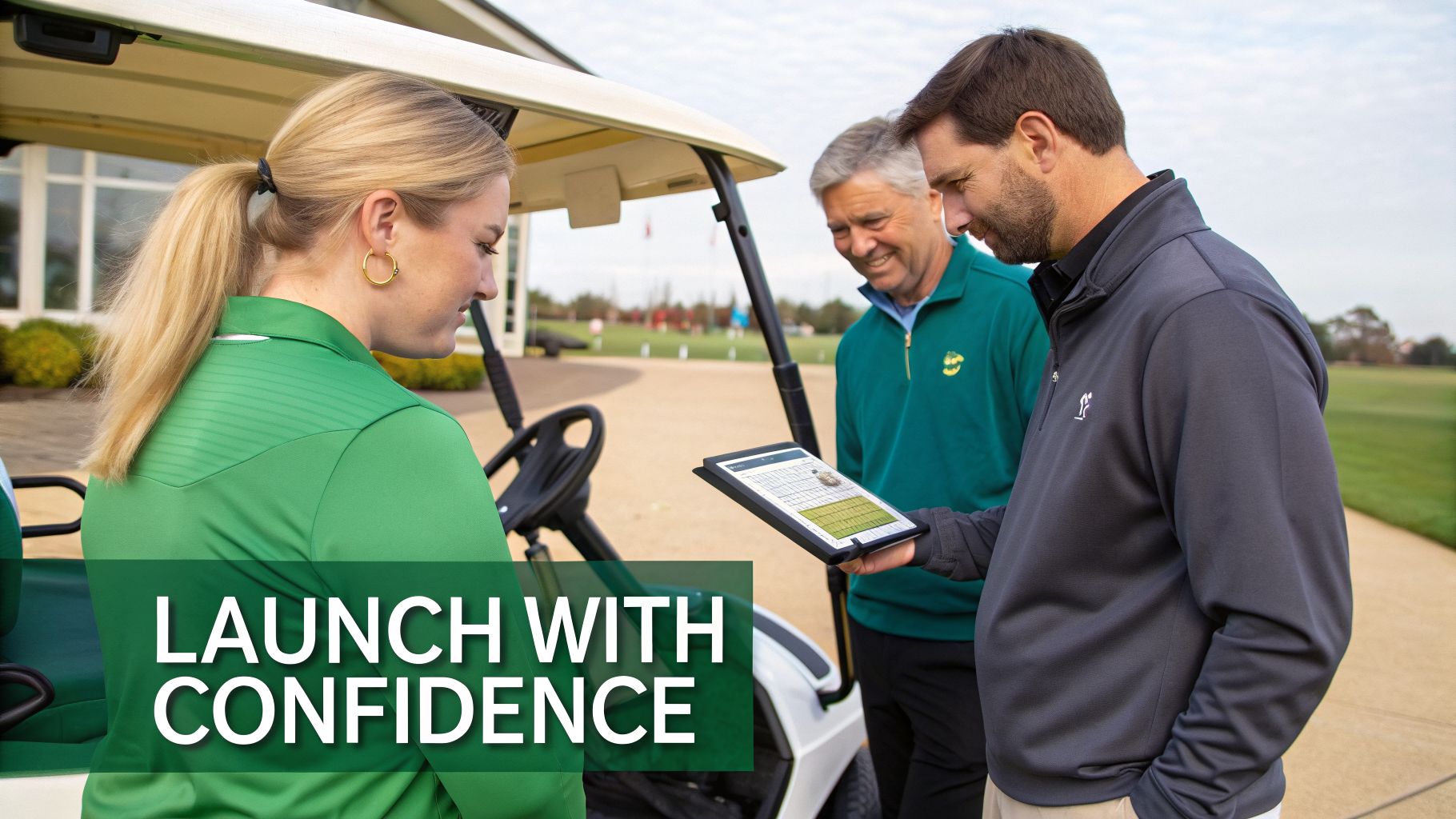
Buying a GPS system for your golf course is the easy part. The real work starts with the rollout. A clumsy implementation can turn a great investment into a huge headache for your staff and your players.
To make sure your new system pays off from day one, you need a solid plan for what happens before, during, and after you go live. This is how you turn a piece of tech into a genuine upgrade for your entire operation.
Pre-Launch Preparation: Your Blueprint for Success
Before you flip the switch, you have to lay the groundwork. This is where you set the stage for a smooth adoption by everyone, from your members to your cart barn crew. Rushing this phase is a classic mistake that just leads to frustration.
First things first: verify the course mapping accuracy. Get on the phone with your provider and walk through every single hole, hazard, and green to confirm the yardages. One bad number is all it takes to lose a golfer's trust in the entire system.
Next, get your team on board. Staff training isn’t just a nice-to-have; it's the single most important part of the pre-launch. Your team needs to be the biggest fans of this new tech.
A well-trained staff is your biggest asset during a GPS rollout. If they understand the system's benefits and can confidently answer player questions, they will drive adoption and create a positive first impression.
Make sure everyone who interacts with golfers—pro shop staff, starters, marshals—knows their way around the system. They should be able to explain the perks and handle basic questions without breaking a sweat.
Launch Day Best Practices
When it's go-time, your strategy will depend on the day. Launching on a quiet Tuesday is a lot different than rolling it out for a full-field shotgun tournament. For daily play, we recommend a "soft launch."
Put up some simple signs at check-in and on the first tee to let people know what's new. Have your staff proactively walk the first few groups through the system, pointing out a couple of cool features. A little hands-on help goes a long way.
Tournaments are a different beast. A great GPS launch can completely elevate the event experience.
Pre-Event Communication: Build some hype. Announce the new GPS and live scoring in your tournament emails and on the registration page.
Clear Instructions: Don't make people guess. Put simple, visual instructions on the carts or scorecards showing them how to get started, like scanning a QR code.
On-Course Support: Have your staff visible and ready to jump in and help anyone who looks confused.
The right platform makes this part incredibly simple. If you want to see how this works in practice, check out our guide on how a great golf tournament manager software can streamline your event day.
Post-Launch: Data-Driven Decisions
The real magic of a GPS system happens after launch day. This is when you start collecting data that can help you run a smarter, more efficient golf course. Don't let that information sit there gathering dust.
Make it a habit to check your analytics every week. Look for pace-of-play bottlenecks on certain holes or at specific times. Use the cart traffic data to see where people are actually driving, then adjust your geofencing to protect sensitive turf areas.
This is how you move from guessing to knowing. It gives you the insight to fine-tune everything from staff schedules to F&B specials, making sure your GPS system delivers a return on your investment for years to come.
Got Questions About Golf Course GPS? We've Got Answers.
Thinking about bringing a GPS system to your course is a big move, and it's natural to have questions. You're not just buying software; you're investing in a better experience for your players and a smarter way to run your business.
We get it. That's why we’ve put together straight answers to the most common questions we hear from course operators and tournament organizers. Let's dig in.
What Is the Real ROI of a Golf Course GPS System?
The return you get from a GPS system isn't just one thing—it’s a mix of direct cash flow and serious operational wins.
On the financial side, you can open up new revenue streams almost immediately. Think premium cart fees, on-screen sponsorships from local businesses, or integrated F&B ordering that lets a foursome order from the 7th fairway. Even a small bump in F&B sales per round adds up fast over a season.
But the operational ROI is just as important. A smoother-running course is a more profitable one. When you can manage pace of play effectively, you can fit more groups onto the tee sheet. That's a direct boost to your primary source of revenue.
Operationally, you’ll also save money. Precise cart tracking helps you manage battery life and reduce wear and tear on your fleet, extending the life of your biggest assets. Plus, a professional, tech-forward player experience is exactly what attracts and keeps high-value corporate outings and charity events, which are the bedrock of a healthy bottom line.
Do We Need to Install Hardware on Every Cart?
The short answer? Not anymore. The old way involved bolting expensive, dedicated screens onto every single cart. Modern platforms have moved on from that model.
Today's best systems use the powerful smartphones that 99% of golfers already have with them. This "Bring Your Own Device" (BYOD) approach completely changes the cost equation. It gets rid of hardware expenses, maintenance contracts, and the fear that your big investment will be obsolete in a few years.
No Hardware Costs: You skip the huge upfront cost of buying and installing dozens of screens.
No Maintenance: Forget about fixing cracked screens or replacing dead batteries.
No Obsolete Tech: The system stays current because it runs on the player's own modern phone.
These solutions are almost always web-based, so players just click a link or scan a QR code. There’s no app to download. This makes them incredibly flexible for any size course and perfect for events with a mix of riders and walkers.
How Does GPS Integrate with Tournament Management Software?
The best systems don't just "integrate"—they become one. A top-tier GPS platform should feel like a natural extension of your tournament management software, creating a single, seamless workflow.
Here’s what that looks like in practice: a player enters their score on their phone using a simple web link. That score should instantly and automatically appear on the live leaderboard in your tournament software. No delays. No staff needed to punch in numbers.
This kind of deep connection automates your entire tournament. It kills the tedious job of collecting and entering scores, freeing up your team to focus on making the event great for everyone. For golfers, it blends real-time scoring with course intelligence, making a regular club event feel like a pro tour stop.
Is It Hard to Train Staff and Players on a New System?
The learning curve all comes down to the design. The best modern systems are built to be intuitive from the start, making the switch easy for your team and your golfers.
For your staff, the dashboard should be clean and simple. Setting up a league or a major tournament should take a few minutes, not a few hours. For players, an app-free, link-based system removes the biggest hurdle. If they can click a link, they can use the GPS.
The goal is to find a system that just makes sense, which cuts down on formal training time. Make sure you choose a provider known for great, responsive support. That way, if a question ever does come up, your team gets a quick answer and your players get a perfect day on the course.
Ready to modernize your tournaments with a system that's powerful, affordable, and incredibly easy to use? Live Tourney offers app-free live scoring, rapid setup, and all the tools you need to run flawless events. Discover how Live Tourney can save you time and impress your players.





