May 10, 2026
golf yardage app, tournament software, live golf scoring, golf course management, golf event software
Golf yardage app - Discover if a golf yardage app suits your tournament. Compare app-based vs. app-free scoring to boost golf facility operations and enhance

Tournament day usually breaks down in the same place. Not on the first tee. In the gap between what players want on their phones and what staff need at the scoring table.
One group is using a golf yardage app they already like. Another wants paper cards. A few players are asking which app they're supposed to download. Someone's battery is low before the turn. Meanwhile, the shop is trying to build a live leaderboard from a mix of handwritten totals, text messages, and screenshots.
That's why the usual “best golf yardage app” review misses the point for tournaments. A player can judge an app by yardages, flyovers, and strokes gained. An operator has to judge technology by a different standard. Can everyone use it quickly? Can staff support it without becoming tech support? Does scoring flow cleanly from the course into results, payouts, and event wrap-up?
A golf yardage app can be excellent for an individual round and still be the wrong tool for a tournament operation. That distinction matters more than most buyers realize.
The Modern Tournament Needs More Than a Yardage App
A single player wants information. A tournament staff needs coordination.
Those are not the same problem.
For an individual golfer, a yardage app only has to answer a few questions well. How far is it to the front, middle, and back? Where is the trouble? What club usually covers this number? Good consumer apps solve that well.
For a tournament director, the standard is tougher. The tool has to work across mixed groups, mixed devices, mixed comfort levels with technology, and a moving deadline that starts with check-in and ends with final results. If the scoring method creates hesitation on the first tee, that friction follows the whole event.
What tournament staff actually need
The practical checklist looks different from a player review:
Fast player adoption: If golfers need extra setup, account creation, or troubleshooting, staff pay for it in time.
Simple score entry: Volunteers, members, guests, and corporate players all need a clear path to posting scores correctly.
Reliable leaderboard flow: Scores should move into the event view without staff rekeying totals from paper or messages.
Operational consistency: The same system should support pairings, scorecards, side games, and wrap-up reporting.
Practical rule: If your scoring tool requires a pre-round explanation longer than the rules sheet, it's probably too complicated for a field event.
The other issue is hidden cost. Not subscription cost. Staff attention cost. Every minute spent explaining logins, resetting passwords, or reconciling mismatched score submissions is a minute not spent running the event.
That's where many golf yardage app conversations go wrong. They focus on features the player touches and ignore the workflow the course carries.
The real buying question
The useful question isn't “What's the best golf yardage app?”
It's this: Are you choosing technology for the golfer's personal round, or for the tournament's full operation?
If your event depends on smooth scoring, clean administration, and quick results, the answer usually pushes you beyond a player-first app.
Evaluating Core Digital Golf Tool Features
Before comparing scoring models, it helps to get clear on the baseline. Any digital on-course tool still needs to perform the fundamentals well.
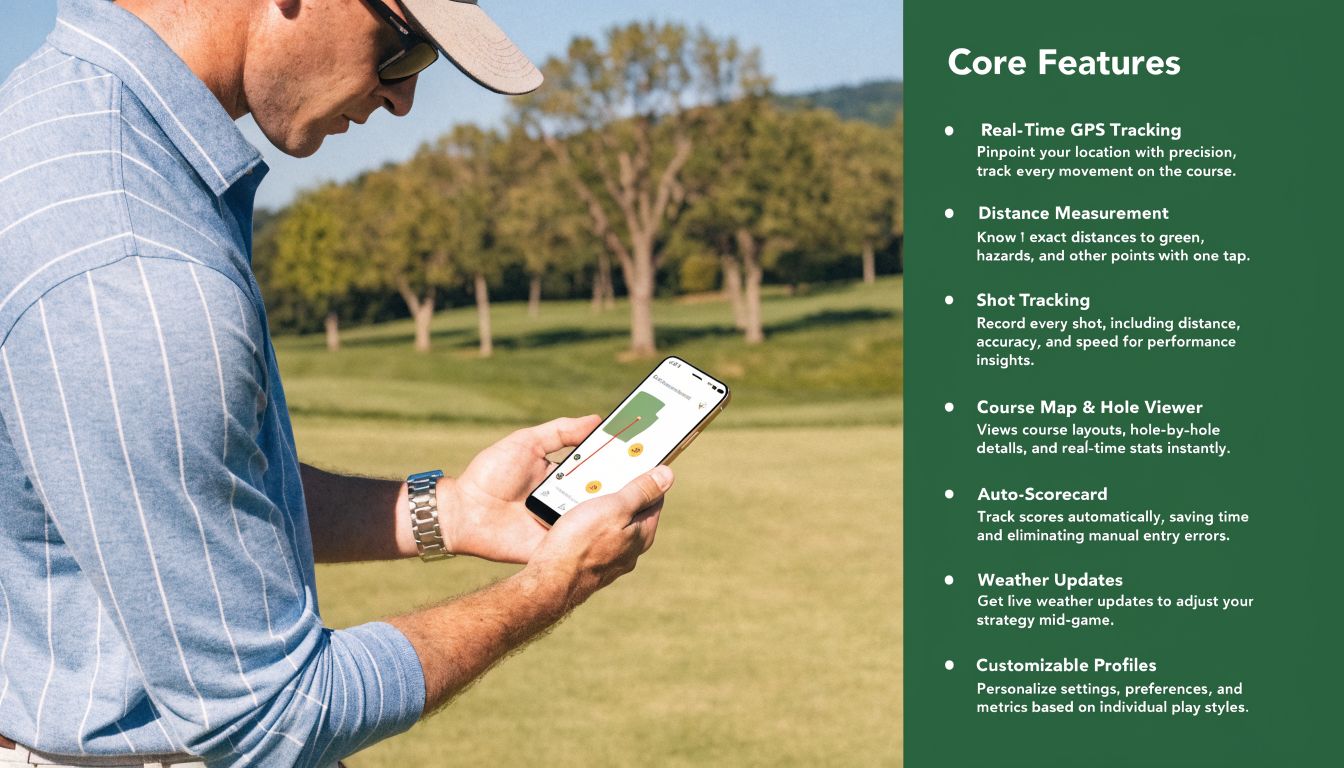
The first filter is course availability. 18Birdies offers access to over 43,000 pre-loaded courses worldwide, which shows how far course databases have expanded and why players now expect real-time yardage and hazard mapping as standard, according to Golf Monthly's review of golf GPS apps.
That level of coverage changed player expectations. It also raised the bar for tournament hosts. If a digital tool can't handle the course cleanly and present information clearly, players notice right away.
The baseline features that matter
Feature | What players care about | What operators should care about |
|---|---|---|
GPS yardages | Front, middle, back distances | Whether all groups get consistent information |
Course coverage | Their home course or travel rounds | Confidence that guest events work without surprises |
Mapping quality | Clear views of hazards and landing areas | Fewer pre-round questions and fewer scoring delays |
User interface | Personal convenience | Whether non-technical players can use it immediately |
Device compatibility | Phone or watch support | Reduced support burden for staff |
A lot of operators overvalue feature depth and undervalue usability. In tournament settings, clarity beats complexity more often than people expect.
Accuracy is only useful if people can access it
A golf yardage app can have sharp mapping and still fail operationally if the interface is cluttered or confusing. The best test is not what your assistant pro thinks after five minutes. It's what a mixed foursome does with it on hole one, with carts moving and names being called.
That's why I like using general UX standards when evaluating golf tech. A simple framework like X8 Web Design's 10-step audit is useful because it forces the same questions operators should ask any tournament tool. Is the action obvious? Is the layout readable outdoors? Can someone recover from a mistake quickly?
Clean UX isn't decoration. On a golf course, it directly affects pace, scoring accuracy, and how many questions end up back at the shop.
Mapping matters differently in events
Players often love 3D flyovers, tap-to-target views, and richer visual planning. Those features can help. But for tournament use, the best map is often the one that answers the question fastest.
That usually means:
Distance labels that are readable in sunlight
Hazards that are visible without extra taps
A screen layout that doesn't hide score entry
A hole view that loads quickly on average cell service
If you're evaluating course-side tools for events, these GPS system considerations for golf courses are worth reviewing because they shift the conversation from feature lists to operational fit.
The key is simple. A digital golf tool should make on-course decisions easier. It should not create a second training session before the shotgun starts.
The Power and Pitfalls of Player-Centric Yardage Apps
The appeal of a premium golf yardage app is easy to understand. Serious players want more than front-middle-back numbers. They want pattern recognition, trend data, and feedback that helps them practice with a purpose.
That's where player-centric apps are strongest.

Arccos Caddie and Golfshot lead in strokes gained analytics among top yardage apps, with Arccos using smart sensors and AI-powered club recommendations to help players identify where they lose strokes compared to benchmarks, as outlined in Rokform's yardage app comparison.
For individual improvement, that's valuable. It gives golfers something more actionable than “I didn't hit it well today.”
Why players love these apps
A good player app can turn a round into a usable data set.
Arccos is built around automatic shot capture with club sensors. Golfshot gives players a detailed statistical view with GPS and strategy tools. DECADE Golf and Pinpoint are also recognized for strokes gained analytics and course-management-focused tracking, and Pinpoint lets golfers collect data in about 5 minutes per round, according to Wicked Smart Golf's review of stat tracking apps.
That matters because the best stat tools don't just collect data. They collect it without becoming a chore.
Here's where these apps shine for the individual golfer:
Shot pattern awareness: Players can see where dispersion shows up, not where they think it does.
Category-specific analysis: Off the tee, approach play, short game, and putting can be separated instead of blended into one vague score.
Club planning: Recommendations become more informed once enough rounds are logged.
Practice direction: The data points players toward the weakest area instead of rewarding random range sessions.
Why they become harder to use in events
The same strengths can become limitations in tournaments.
A player-focused golf yardage app is designed around one golfer's account, one setup path, one hardware stack, and one personal routine. Tournament operations are the opposite. They involve a field of players with different phones, different preferences, and different willingness to troubleshoot.
That mismatch shows up quickly.
One player has sensors and wants every shot tracked. Another uses only GPS. A guest has never opened the app before. Someone else won't create an account on the spot. None of that means the app is bad. It means the app is solving a personal performance problem, not a group event problem.
The best player app often assumes the user is motivated, prepared, and willing to configure details. Tournament fields rarely give you that luxury.
Where they still fit
Player-centric apps still have a place in the golf ecosystem. They work well for:
Competitive players tracking development over time
Instruction programs that want deeper performance feedback
Golfers who practice with intention between rounds
Smaller informal games where official scoring isn't the central issue
They work less well when the event depends on universal participation and smooth staff oversight.
That's the trade-off. If your goal is helping one golfer understand their game, these apps can be outstanding. If your goal is getting a full field scored cleanly and quickly, their strengths don't automatically carry over.
App-Based Scoring vs App-Free Tournament Platforms
A foursome is standing on the first tee. One player is ready. One is hunting for a download link. One cannot remember an app password. One says he will keep scores on paper and sort it out later. From the tournament side, that difference matters more than another yardage feature.
The actual decision is delivery.
One system requires every player to install an app, sign in, and use that app correctly during the round. The other sends players to a browser link that opens on the phone already in their pocket. Both can record scores. Only one tends to reduce check-in friction, rules-table questions, and post-round cleanup.
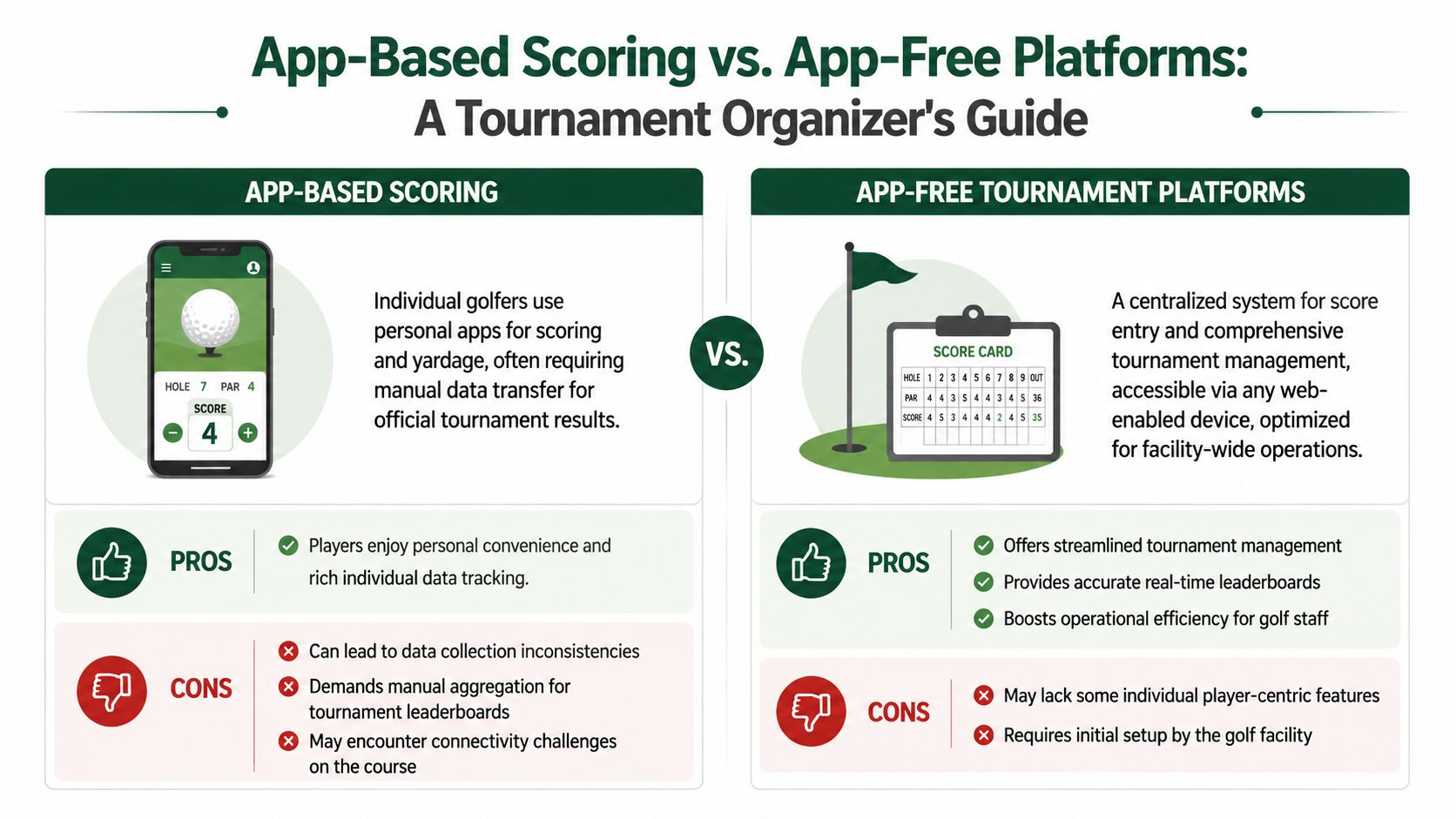
Side-by-side comparison
Category | App-based scoring | App-free tournament platform |
|---|---|---|
Access method | Download, install, sign in | Open a browser link |
Staff burden | Higher pre-round support | Lower setup friction |
Player resistance | Common with guests and casual players | Lower because it feels familiar |
Data flow | Often split across personal tools | Centralized for the event |
Best use case | Individual player routines | Organized tournaments and leagues |
What slows app-based scoring is not usually the scoring screen itself. It is the setup chain that comes before the first hole. Downloads, permissions, account creation, verification emails, password resets, and update prompts all land at the same time, usually when staff are also handling pairings, contests, announcements, and pace reminders.
That stack of small delays creates what operators feel as pre-round drag.
Where app requirements create friction
From the pro shop or tournament desk, the failure points are predictable:
Late arrivals get stuck at setup: A guest who shows up minutes before announcements does not want a multi-step install process.
Sign-in problems become staff problems: If a player cannot access an account, the event team gets pulled into troubleshooting.
Battery concerns change behavior: Players often limit GPS use or live scoring because they are trying to make the phone last all day.
Partial adoption breaks the workflow: If part of the field uses digital scoring and part stays on paper, staff still have to reconcile everything.
Support spikes at the worst moment: Questions arrive right before carts leave, not an hour earlier when there is time to help.
None of this means app-based scoring is poorly built. It means the tournament is depending on every player to complete extra steps correctly under time pressure.
Why browser-first platforms usually run cleaner
Browser-based scoring removes the biggest source of resistance. Players tap a link and start. There is no app-store detour, no storage objection, and usually no new account to set up on the spot.
For staff, that changes the day. Fewer players need help before the round. More of the field enters scores in the same system. The scoring layer stays tied to the event instead of being split across personal tools and workarounds.
The practical benefit is consistency.
If the event depends on broad participation, the fastest path matters more than the richest personal feature set. That is why many operators prefer web-based score entry, especially for member-guests, charity outings, corporate events, and mixed-skill fields. A good breakdown of that workflow appears in this guide to digital golf scorecards for tournament scoring.
If live scoring is part of the event experience, the scoring method has to be easy for the least prepared player in the field, not just the most motivated one.
Where app-based scoring still fits
There are cases where an app-based model works well:
Weekly leagues with the same returning players
Private groups that have already standardized on one app
Events where player analytics matter more than universal adoption
Small fields where staff can absorb exceptions without slowing operations
I have seen that model work when the player base is stable and expectations are set early. It breaks down faster in open events, guest-heavy fields, and one-day tournaments where convenience decides whether people participate at all.
The simplest test is still the best one.
If a first-time guest needs to post a valid score in under a minute, which system gives staff the fewest chances to intervene?
For tournament operations, that answer usually points to app-free scoring.
Integrating Scoring with Back-Office Tournament Management
A lot of golf technology looks strong until the round ends.
That is when the actual operational work begins. Scores must feed results. Results must connect to flights, skins, side games, payouts, reports, and communication back to players. A high-quality golf yardage app often fails to provide sufficient support at this stage.
Current yardage app reviews focus on player features but omit how those tools fit with workflows like roster uploads, pairings, tee sheets, and payout calculations. That operational gap is exactly what dedicated tournament systems are built to handle, as reflected in this view of player-first golf app positioning.
Where player apps stop helping
This is the common mistake. A course picks a strong consumer tool and assumes it will stretch into tournament administration.
Usually, it won't.
Player apps are built to help golfers during the round. Tournament staff need support before, during, and after the round. Those jobs are different enough that trying to force one tool into both roles usually creates duplicate work.
The missing pieces are familiar to any head pro or event coordinator:
Registrations and payments
Roster imports and pairings
Tee sheets and cart assignments
Printed materials and custom scorecards
League formats and season-long standings
Payout calculations for multiple games
Post-event reporting and communication
Why integration matters more than features
Back-office integration isn't flashy, but it's where staff hours disappear.
If scores don't flow into the rest of the event stack, someone has to move information manually. That usually means retyping names, checking handicaps, rebuilding pairings, or reconciling side games by hand. Every manual handoff becomes another chance for delay or error.
A tournament platform earns its keep when the score entered on the course becomes the same score used for standings, reports, and payouts.
That's the operational difference between “a useful app” and “a system.”
What a facility should expect from a tournament solution
A true event platform should connect the full workflow instead of isolating scoring as a separate task.
That means looking for tools that support:
Operational area | What staff need |
|---|---|
Event setup | Fast roster handling and clear pairings |
On-course scoring | Simple entry with minimal explanation |
Format support | Stroke play, match play, Ryder Cup, round robin |
Event materials | Scorecards, tee sheets, cart signs, bag tags |
Wrap-up | Leaderboards, side games, payouts, reports |
If the product only helps players view holes and track their own stats, it's not really solving the course's event problem.
Facilities comparing options should spend as much time on administration as on GPS and front-end scoring. That's where golf tournament management software becomes a separate category rather than an extension of consumer golf apps.
The simple test is this. When the event gets more complex, does the system get more helpful, or does your staff step in and start doing the work manually? The answer tells you what kind of tool you are buying.
Choosing the Right Technology for Your Golf Facility
A facility usually figures this out on a bad scoring day.
The shotgun is full, half the field is from a corporate outing, a few players have weak service on the back nine, and the golf shop is answering the same app question for the tenth time before the turn. At that point, the decision is no longer about which golf yardage app has the nicest interface. It is about which system your staff can support under event pressure.
The right fit depends on what your facility is selling.
If the core experience is instruction, practice, or individual player development, a player-first yardage app can make sense. Detailed stats, club tracking, and post-round analysis are useful when the golfer wants that depth and has time to learn the tool.
Tournament operations are different. The product is not the app experience. The product is a well-run event that starts on time, posts scores correctly, updates standings quickly, and closes out without the staff rebuilding the day by hand.
Match the tool to the job
I usually break the decision into three buckets:
Choose a player-first yardage app for coaching programs, competitive practice, and golfers who care about long-term performance tracking.
Choose an app-free tournament platform for leagues, outings, member events, association play, and charity tournaments where participation rate matters more than feature depth.
Be careful with hybrid promises when a consumer app says it can also run events. The player-facing side may look polished, but staff often end up doing pairings edits, score cleanup, and payout work outside the system.
That last trade-off gets missed in a lot of software demos. A product can look modern on a phone and still create extra work in the golf shop.
A practical decision checklist
Before you choose a scoring or yardage system, ask a few questions that show up on real event days:
Where does staff time go after play starts?
How often do players need help getting into scoring?
Will guests and occasional golfers use it without a tutorial?
Does the score entered on the course flow straight into standings, reports, and payout prep?
If a player never downloads anything, can the event still run cleanly?
As noted earlier, event operators using web-based scoring links have reported better adoption and more live scoring participation than download-first setups. That lines up with what many facilities see in practice. Every extra step between the player and the score entry screen lowers participation.
The best tournament technology disappears into the event. Players can use it quickly. Staff do not have to rescue it.
An app-based setup can still work for a small, repeat group that is comfortable with the process. For mixed fields, guest-heavy events, and facilities that want fewer support issues, lower training friction usually matters more than advanced yardage features.
If you're looking for a simpler way to run tournaments, leagues, and outings without forcing players into another download, Live Tourney is built for exactly that workflow. It gives golf facilities web-based live scoring, real-time leaderboards, and the back-office tools staff need, including pairings, scorecards, side games, payouts, and league management, all in one place.