May 13, 2026
golf tournaments in colorado, colorado golf events, amateur golf tournaments, colorado golf, pga colorado
Find the top golf tournaments in Colorado for 2026. Your guide to PGA, amateur, and state open events, with dates, entry info, and tips.

Planning your competitive golf season in Colorado usually starts the same way. You've got a few dates circled, a vague sense of which events matter most, and a growing list of questions about qualifiers, travel, altitude, and whether an event is worth the time if you're not already playing top-level tournament golf. Organizers run into a similar problem from the other side. They know players want a cleaner registration process, faster updates, and less confusion on tournament week, but the tools and workflows across the state are still scattered.
Colorado has the history to justify the effort. The state has hosted 34 PGA Tour events, including 6 major championships, and organized amateur championship play in Colorado dates back more than a century through the state's golf institutions and championship structure. That combination matters. It means golf tournaments in Colorado aren't just plentiful. They sit on top of a deep competitive culture that ranges from municipal city championships to national-pathway professional events.
If you're choosing where to compete in 2026, these are the tournaments I'd keep at the top of the list. If you run events, this is also a useful benchmark for what players now expect from scheduling, registration, scoring, and presentation.
1. The Blue Championship

If you want to watch the highest-level summer pro golf in the state, start here. The Blue Championship is the Colorado Korn Ferry Tour stop at TPC Colorado in Berthoud, with the 2026 event scheduled for July 9 to 12. It's a PGA TOUR-sanctioned week with a projected purse of $1,000,000 and a projected 156-player field, which makes it a serious spectator event and a useful study model for anyone who manages tournament operations.
For players, the trade-off is simple. This is not an amateur entry opportunity. Access is limited to tour members and exemptions, so most readers should think of it as a viewing, networking, and course-study week rather than a playable target.
Why it stands out
TPC Colorado gives this event a big-stage feel, and the midsummer placement makes it easy to plan around if you're building a summer golf calendar. For sponsors, hospitality teams, and event staff, fixed July timing is helpful because lodging, staffing, and activation plans can be built earlier than with more fluid local schedules.
Practical rule: If you're attending as a fan or sponsor guest, lock in parking and ticket plans early. Big-event logistics get tighter the closer you get to tournament week.
For organizers, this event is a reminder that presentation matters as much as setup. A polished championship doesn't feel polished by accident. Registration flow, on-site communication, leaderboard visibility, and pace around the property all need to work together. If you're building your own event operations, a solid golf tournament planning guide is a better starting point than trying to patch the week together with spreadsheets.
Best fit
Best for spectators: Strong pro field and a true championship setting.
Best for sponsors: Reliable midsummer timing helps with planning.
Not ideal for amateurs: There's no standard open entry path for local players.
The official event site is The Blue Championship at TPC Colorado.
2. Inspirato Colorado Open
A Denver player who wants one real shot at a state open usually starts here. The Inspirato Colorado Open at Green Valley Ranch Golf Club is the event that tests whether your tournament game holds up outside your home course, and whether your prep work is good enough to survive qualifying.
What sets it apart is the balance between status and access. The field is strong, but this is still a championship where elite amateurs can play their way in. That matters in Colorado, where plenty of tournaments are either spectator products or member-driven events with a narrower entry path.
For players, the qualifier structure is the practical advantage. You are not pinned to one site or one date, which gives you options if work, travel, or weather gets in the way. The trade-off is that options create their own planning burden. A late entry can leave you chasing tee times, practice access, hotel availability, and a qualifying venue that does not suit your eye.
I tell players to prepare for this event in two stages. First, get through qualifying with a plan that fits the course and the day. Then prepare for Green Valley Ranch itself. That means altitude control, disciplined wedge numbers, and patience on a layout that can tempt players into forcing birdies too early.
What players should know before entering
Green Valley Ranch tends to reward players who control spin and distance, not just players who hit it far. If you are coming from sea level or from a mountain course with very different turf conditions, build in time to recalibrate yardages. One solid practice round with a clear target map is worth more than mindlessly beating balls for two days.
The event also shows where many state opens lose players before the first competitive round. Registration, qualifying, waivers, tee time communication, and scoring updates often sit across different systems. That broader registration challenge across Colorado tournaments is not unique to this championship, but strong events handle the friction better than weak ones.
Best fit
Best for elite amateurs: A legitimate qualifying route leads to a respected state-open field.
Best for pros: The tournament carries local visibility and a serious competitive standard.
Less ideal for casual competitors: Sharp scoring and tournament pressure expose loose preparation quickly.
For organizers, this event is a useful model because the player journey starts well before tournament week. Qualifying administration, confirmation emails, pairing accuracy, and live scoring all shape whether the championship feels well run. Players remember operational mistakes just as clearly as they remember course conditions.
3. Inspirato Colorado Women's Open
You arrive in Denver on Tuesday, squeeze in nine holes that afternoon, and by the first round you realize the week will reward discipline more than urgency. That is part of the appeal of the Inspirato Colorado Women's Open. It gives professionals and top amateurs a serious early-season test at Green Valley Ranch Golf Club, with the 2026 event scheduled for June 3 to 5.
For players, the date matters. Early June usually gives you enough season under your belt to compete sharply without the travel pileup that hits later in the summer. For out-of-state entrants, that can mean better flight options, more workable lodging choices, and a little less fatigue before the opening tee shot.
The field quality is the real separator.
A good women's open exposes every loose part of a player's preparation. If your wedge numbers are inconsistent, if you have not adjusted to Front Range pace on the greens, or if you rely on recovery golf too often, this event tends to show it quickly. Players who do well usually arrive with a clear yardage plan, a practice-round strategy, and enough patience to accept that par still has value.
Entry standards are part of that filter. Exemptions, qualifying paths, and handicap-related requirements can narrow access for newer competitors, but that structure helps protect the level of play. From a tournament director's view, that trade-off is usually the right one. A stronger field creates better scoring integrity, a more credible title, and a better experience for the players who earned their spot.
Organizers should study how an event like this handles mixed expectations on site. A women's open often brings together professionals, elite amateurs, coaches, families, and local spectators in the same footprint. That puts pressure on the basics: accurate pairings, fast scoring updates, clear player notices, steady pace-of-play management, and enough staff at the right checkpoints. If any of those pieces slip, players notice immediately.
Course setup matters too. The strongest version of this event is demanding but readable. Fair pin positions, consistent green speeds, and tee placements that ask for shotmaking instead of forced defense will produce a better championship than a setup that chases difficulty for its own sake.
If you are playing, treat travel and prep as part of the tournament, not side tasks. Book Denver lodging early, build time for at least one focused practice round, and spend extra minutes reading putts from below the hole. On courses along the Front Range, subtle movement can beat players who only trust the first look.
4. Inspirato Colorado Senior Open
You get to late summer with enough competitive reps under your belt, your body feels better than it did in the spring, and you want a championship that rewards discipline more than raw speed. That is the appeal of the Inspirato Colorado Senior Open. The 2026 event is scheduled for September 2 to 4 at Green Valley Ranch Golf Club, with a 54-hole state open format for professionals age 50 and up plus qualified amateurs.
That timing matters. Early September usually gives senior players a cleaner runway than the crowded middle of the season, and it gives organizers a better chance to deliver a sharper event because staffing, pace-of-play oversight, and scoring operations are easier to manage outside the busiest tournament weeks.
Where it fits best
For senior pros, this is a practical target if you want a serious state-level start without building your whole calendar around travel. For qualified senior amateurs, the value is different. You get a look at professional tournament standards, and you learn quickly whether your game holds up over three rounds when the setup, field strength, and scoring pressure all tighten at once.
The age split inside senior golf matters too. A super-senior component gives older players a fairer competitive lane instead of forcing one broad age group to absorb every difference in distance and recovery time. That is smart event design, not a side detail.
Players should prepare for Green Valley Ranch like a championship venue, not a casual Denver round. The course can expose weak wedge distance control and rushed reads on medium-length putts. Arrive early enough to map misses, note how the ball reacts on approach, and keep your prep simple. One focused practice round and a clear yardage plan usually beats extra range time.
For tournament directors, this event is a good model for field management. Senior competitions often bring a wider mix of expectations around pace, access, and communication than open-age events. Clear notices, visible starting information, and reliable live scoring reduce friction fast. If you are building your own event workflow, this guide to golf tournament scoring systems and operations is a useful starting point.
The trade-offs are straightforward. Eligibility is limited by age, so the field is intentionally narrower. Demand can still be strong, especially for a Denver-area championship with easier airport access than mountain venues. Travel is simpler, but the smart move is still to book lodging early and keep your commute to the course short.
As noted earlier, the championship sits under the same broader Colorado Open umbrella. You do not need another link to know what matters here. This is a late-season senior event that rewards patience, sound planning, and a game built to avoid mistakes.
5. CGA Amateur Championship

You get through qualifying, arrive in the mountains, and realize by the second round that this event asks for more than a hot ball-striking week. The CGA Amateur Championship is Colorado's state amateur stroke-play title, scheduled for August 3 to 6 in 2026 at Sonnenalp Club, with qualifying held statewide in June and July. Over 72 holes, small mistakes stop feeling small.
That is what gives this championship its standing. A player can survive a rough stretch in a one-day event. In a four-round state amateur, weak course management, poor recovery decisions, and sloppy speed control usually catch up.
Why players take it seriously
This championship carries real weight because the standards are clear and the format leaves little room to hide. Rotating sites also matter. A venue change forces players to prepare from scratch instead of leaning on years of local comfort, and it gives organizers a chance to match setup to the kind of test they want.
Sonnenalp Club adds a different challenge than a front-range municipal or resort-style birdie fest. Altitude, mountain weather shifts, and uneven lies can change club selection and shot shape faster than out-of-state players expect. If you are traveling in, plan for one purposeful practice round, not a marathon session. Learn where approach shots can feed, where misses get expensive, and which holes demand restraint.
What players and planners should watch
Entry standards shape the field: This is for CGA members who meet the published handicap requirement, so the field quality stays high.
Qualifying rewards planning: Players need to treat the qualifier as its own event, with travel, warm-up, and conservative targets mapped out in advance.
Stroke play punishes mental leaks: Four rounds test routine and discipline as much as mechanics. Clean golf tournament scoring helps, and players who also understand how match play strategy differs from stroke play usually make smarter risk decisions late in rounds.
Venue rotation creates work for directors: Organizers do not get the convenience of repeating the same host setup every year, but they gain a fresher event and a broader statewide footprint.
The organizer lesson is practical. A championship like this works because the path in is defined, the competitive bar is obvious, and players know what standard they are walking into. That reduces confusion before the first tee shot and makes on-site operations easier to run.
For players, the trade-off is just as clear. This event gives you a true state-amateur test, but it asks for more preparation than a local weekend tournament. Travel, altitude adjustment, and four days of decision-making all matter.
6. CGA Match Play Championship
You survive a qualifier, book the trip, and arrive ready to play. In a standard one-and-done bracket, one flat nine can send you home before the event really starts. The CGA Match Play Championship avoids some of that waste with pod play up front, then a Final 8 at a second site. For players, that means more guaranteed competition. For organizers, it is a smarter way to justify travel, tee-time inventory, and staff effort.
For 2026, pod play is scheduled for June 8 to 10 at CommonGround Golf Course in Aurora, with the Final 8 on June 11 to 12 at Flying Horse North in Colorado Springs. Qualifiers run in May and June, so this event asks for more calendar control than a simple local entry.
Why this format deserves attention
Match play exposes a different kind of player. Shot quality still matters, but decision-making matters more than many stroke-play regulars expect. The best competitors know when to press, when to accept a half, and when an aggressive line only hands the hole away.
Pod play changes the tone early. Players get a real chance to settle in, learn the speed of the greens, and recover from one bad stretch. That makes the event better for competitors and easier to sell to players who are weighing hotel costs, time off, and statewide travel.
The split-site finish also creates a cleaner championship arc. CommonGround handles the early sorting. Flying Horse North gives the closing rounds a bigger-stage feel.
What players and organizers should plan for
Entry standards still matter: This is a serious amateur championship, not an open-signup weekend event.
Travel can shift quickly: Advancing players need flexible lodging and transportation plans because the event moves from Aurora to Colorado Springs.
Course prep should match the format: Players who only practice medal-play golf often make poor choices once holes become one-on-one contests.
Operations need clear communication: Directors have to explain pod standings, tie procedures, and site changes before confusion starts on property.
A common mistake is treating match play like short-form stroke play. It is not. If a player does not understand how concessions, order of play, and hole-by-hole pressure change decisions, the format gets expensive fast. A quick review of the rules and strategy differences in golf match play is practical prep, not homework.
There is a useful organizer lesson here too. This championship works because the format gives players more competitive value without turning the whole week into a marathon. That same principle applies to local events. If you want stronger fields, use technology and scheduling tools that make standings easy to follow, communicate advancement clearly, and reduce the usual back-and-forth once play begins.
Event details are published through the CGA tournament schedule, as noted earlier.
7. Denver City Amateur Championships
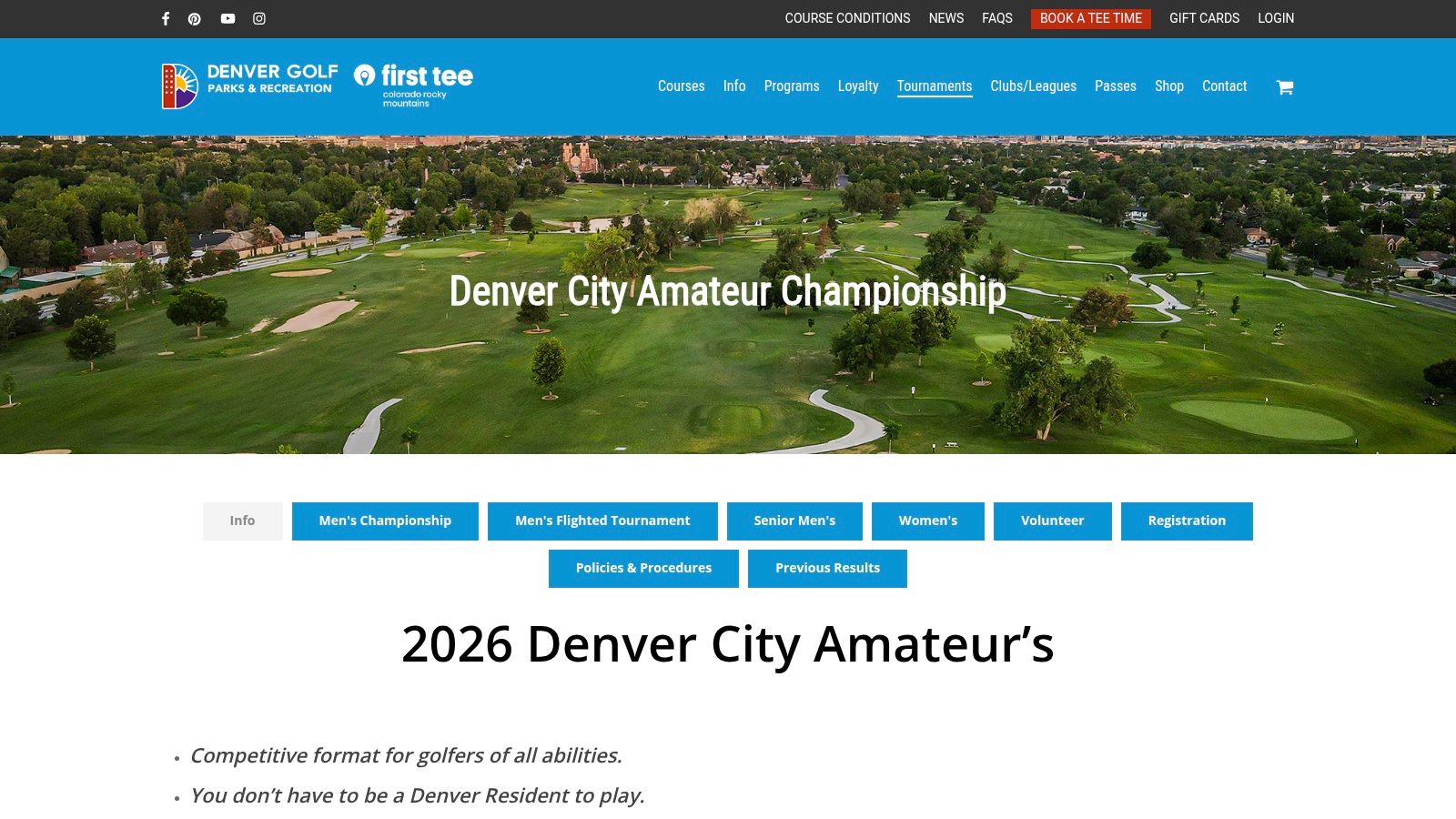
Not every worthwhile event needs statewide travel, hotel coordination, and a qualifier road trip. The Denver City Amateur Championships are a strong option for players who want a legitimate championship setting on municipal courses without turning the entire week into a logistics project.
These city-run events include men's, women's, and senior divisions, with registration windows, policies, and scheduling handled through Denver Golf. For local players, that accessibility is the whole point. You can stay competitive, play for a city title, and avoid some of the friction that comes with bigger statewide events.
Why local players should pay attention
Municipal championships often get overlooked by players who chase only the biggest names on the calendar. That's a mistake. Public-course championships can be deep, well contested, and less forgiving than expected because the field usually includes local players who know the property and the pace of the greens.
They also fit a wider range of competitive goals. Some players use them as season targets. Others use them as tournament reps before trying for bigger CGA or open events later in the summer.
Organizer lesson from the city model
Colorado's municipal golf market shows wide revenue spread, with annual median facility revenue reported at $1,346,264 and a range from $717,282 to $2,789,609 in the Colorado municipal golf analysis from HVS. For operators, that kind of variation is a reminder that event execution isn't a side issue. Tournament efficiency, repeat play, and outing quality can shape real facility performance.
For players, the downside is simpler. Fields can fill quickly, and city policies or course rotation can shift from year to year. Read the event page carefully instead of assuming this year looks like last year.
The official entry point is Denver City Amateur Championships.
Comparison of 7 Colorado Golf Tournaments
Event | 🔄 Implementation complexity | ⚡ Resource requirements | 📊 Expected outcomes | 💡 Ideal use cases | ⭐ Key advantages |
|---|---|---|---|---|---|
The Blue Championship (Korn Ferry Tour) | 🔄 High, PGA TOUR standards, large field & fan programming | ⚡ Very high, staffing, infrastructure, media, sponsor fulfillment | 📊 National exposure, strong spectator engagement, pathway to PGA TOUR | 💡 Sponsors and hospitality programs seeking national‑caliber visibility | ⭐ Top‑tier field & venue; predictable midsummer dates |
Inspirato Colorado Open | 🔄 Medium‑High, statewide qualifiers and championship logistics | ⚡ High, multiple qualifier sites, prize purse, event operations | 📊 Strong state visibility and competitive fields; sizable purse | 💡 Pros/amateurs seeking state title and qualifier pathways | ⭐ High‑profile state championship; broad entry opportunities |
Inspirato Colorado Women's Open | 🔄 Medium, qualifying plus broadcast‑quality presentation | ⚡ High, presentation, player travel, prize fund parity commitments | 📊 Nationally respected women's field and good media presentation | 💡 Organizations promoting women's golf and equal‑purse initiatives | ⭐ Respected women's state open; timing avoids peak summer conflicts |
Inspirato Colorado Senior Open | 🔄 Medium, senior eligibility, super‑senior categories | ⚡ Medium, targeted operations, senior prize administration | 📊 Strong senior competition and championship recognition | 💡 Senior professionals and competitive 50+ amateurs | ⭐ Top‑tier senior field and course setup; late‑summer scheduling |
CGA Amateur Championship | 🔄 Medium, 72‑hole format with regional qualifiers & exemptions | ⚡ Medium, qualifier administration, rotating course logistics | 📊 State amateur title with clear competitive pathway | 💡 Low‑handicap amateurs pursuing state championship recognition | ⭐ Published qualifier/exemption pathways; premier venue rotation |
CGA Match Play Championship | 🔄 Medium‑High, pod play format and split‑site finals logistics | ⚡ Medium‑High, multiple sites, compressed schedule coordination | 📊 Guaranteed multiple matches then knockout; historic prestige | 💡 Match‑play specialists and entrants seeking more matches | ⭐ Player‑friendly pod play; strong match‑play pedigree |
Denver City Amateur Championships | 🔄 Low, municipal event structure across public courses | ⚡ Low‑Medium, city staff, course scheduling, online registration | 📊 Local championship access and community participation | 💡 Local amateurs wanting accessible competition without statewide travel | ⭐ Accessible, transparent city‑run administration and timing |
From Player to Planner Your Tournament Playbook
You land in Denver, grab the rental car, and wake up on tournament morning feeling fine until the first full wedge flies long and the walk starts to feel steeper than the yardage book suggested. That same kind of surprise hits organizers who wait too long to tighten operations. In Colorado, both groups get punished for late preparation.
Tips for competing players
Travel and lodging: Front Range tournament weeks get crowded fast, especially in summer. Book flights and rooms early if you want better tee-time flexibility and less rate pressure. For metro-area events, Aurora or Centennial often make more sense than downtown Denver. The room is usually cheaper, parking is easier, and the drive to the course is often shorter.
Course prep: Altitude matters, but it is rarely the only adjustment. Tournament setups in Colorado also expose players who have not prepared for firm approaches, uneven lies, and greens that pick up speed as the day goes on. A practice round gives more useful information than a long range session. Use it to map carry numbers, test how the ball reacts into greens, and identify the misses that still leave an up-and-down.
Pacing: Players coming from lower elevation often plan for distance and forget stamina. That shows up around the turn. Walk too fast early, skip food, or wait too long to hydrate, and decision-making gets sloppy on the holes that matter most. Treat the practice round like reconnaissance. Figure out where to eat, when to drink, and which holes reward restraint.
Advice for tournament organizers
Good events usually break down at the handoff points. Registration lives in one tool, payments in another, pairings on a spreadsheet, and scoring somewhere else. Then staff spend tournament week answering basic questions, fixing data-entry mistakes, and posting updates players expected to see already.
A stronger setup puts registration, payment collection, pairings, scoring, and player communication in one web-based process. That matters for a city amateur, a charity scramble, or a state-level championship. Players get one place to check details. Staff spend less time patching together workarounds.
Colorado also exposes operational sloppiness quickly. Fields often mix local members, competitive amateurs, and out-of-state players who have seen well-run events elsewhere. Slow check-in, unclear pairings, or delayed score posting changes how they judge the tournament. Clean communication and fast scoring improve that experience immediately.
As noted earlier, Live Tourney is one example of a web-based platform that handles tournament and outing management with app-free live scoring. For operators still relying on paper cards, email chains, and manual leaderboard updates, that kind of system can cut event-week admin and reduce avoidable mistakes. For an unrelated but practical facility read, see maximizing golf cart battery life.