
Mar 20, 2026
Struggling to read a leaderboard? Our guide on golf scoreboard explained covers stroke play, match play, and live scoring to make you a pro in no time.

At its core, a golf scoreboard is just a grid that shows how players are doing against a target score, or par. The most important thing to look for is the +/- number. This one number tells you everything you need to know at a glance: if a player is under par (-), over par (+), or right on the money (E).
That’s it. The player with the lowest number is winning.
How to Read a Golf Scoreboard Instantly
Ever glance at a live leaderboard during a tournament and feel like you're trying to read a foreign language? You're not alone. That grid of names, numbers, and abbreviated terms can look intimidating, but it’s actually a really simple system designed to tell a story as it unfolds.
Think of it like the dashboard in your car—each little gauge gives you a quick, vital piece of information. Once you know what a few of those gauges mean, the whole thing clicks into place. Suddenly, a confusing jumble of data becomes a clear picture of who’s hot, who’s not, and how the tournament is shaping up.
The Core Components of Any Scoreboard
Every golf leaderboard, from a casual weekend scramble to the Masters, is built on the same handful of concepts. These are the non-negotiables that work together to show you exactly where a player stands.
For a quick reference, here’s a table breaking down the most common terms you'll see.
Key Leaderboard Terms at a Glance
Term | What It Means | Example |
|---|---|---|
Score | The player's score relative to par. A negative number is good. | -5 means five strokes under par. |
Thru | The last hole the player has officially completed. | 14 means the player just finished the 14th hole. |
Par | The expected score for the round, usually 72. | The benchmark all scores are measured against. |
E | Stands for "Even Par." | The player's score is exactly 72 on a par-72 course. |
F | Stands for "Finished." | The player has completed all 18 holes. |
Once you understand these five terms, you can instantly read and understand almost any golf leaderboard.
A Deeper Look at the Key Data Points
Score: This is the big one, usually shown with a plus (+) or a minus (-). It’s a player's total strokes relative to the course's par. A score of -5 means they're five strokes under par, while +2 means they're two strokes over. "E" just means their score is exactly par for the holes they've played. The player with the lowest number (the most negative) is leading.
Par: This is the baseline—the number of strokes a skilled golfer is expected to take to complete the course. For most 18-hole courses, this is 72. While it’s not always shown next to every player’s name, it’s the standard that all the scores are measured against. For a full breakdown of how par and handicaps work on a scorecard, check out our guide on the best golf scorecard practices.
Thru: This column tells you how far along a player is in their round. If it says "14," the player has finished the 14th hole and is moving on to the 15th. If you see an "F" or "18," it means they’ve finished their round for the day.
This simple graphic puts it all together, showing how these elements work on a real leaderboard.
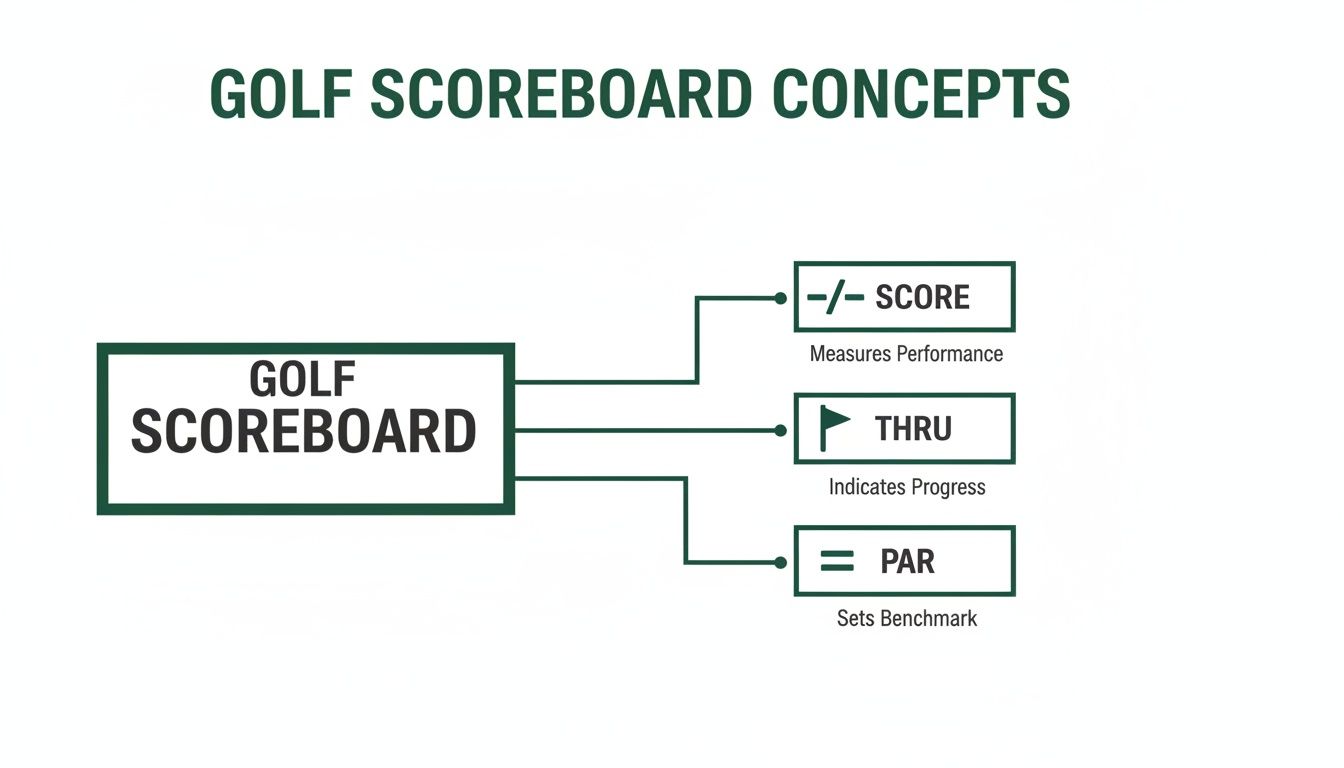
As you can see, just a few key pieces of information are all you need to get a complete picture of a player’s performance at any moment during the tournament.
From Paper Scorecards to Live Leaderboards

For decades, scoring a golf tournament was a quiet, almost ritualistic process. It involved a sharpened pencil, a folded paper scorecard, and a lot of trust. At the end of the round, organizers would collect these cards, huddle up, and painstakingly tally the scores to figure out who won.
While there’s a certain nostalgia to it, this traditional method was slow and created a huge information gap. Spectators and even the players themselves were often left completely in the dark about where things stood until long after the final putt dropped. The only real window into the action was the iconic hand-operated leaderboard, but even that relied on runners physically carrying scores from the course.
The Need for Real-Time Excitement
The modern game, however, demanded something more. The real drama of a tournament isn’t just the final score—it's the momentum shifts, the back-nine charges, and the sudden collapses. Those are the moments that get lost when scoring is delayed.
You can see just how much more competitive golf has become by looking at the pros. At the Masters, for instance, a staggering 65% of winners since 1990 have finished with a score of 278 or better. The average winning score today is a sharp 11-under par, a world away from the 5-under and 7-under par scores that won in the 1930s and 40s. You can dive deeper into the fascinating numbers behind Masters scoring to see the full picture.
This trend isn’t just golf trivia; it proves the game is faster and more exciting than ever. The technology had to evolve to capture that energy.
Digital leaderboards were the answer. They transformed the golf scoreboard from a simple historical record into a living, breathing part of the event.
Bringing the Pro Experience to Everyone
What started on the pro tours has now trickled down to every corner of the golf world. The real game-changer wasn't just putting scores on a screen; it was making that technology accessible enough for any event, from a Saturday morning league to a major charity fundraiser.
Web-based platforms have completely flipped the script for organizers and players.
For Organizers: The tedious, error-prone job of collecting and calculating scores is gone. It's now automated, with instant and accurate results ready to display on clubhouse TVs or any phone.
For Players: The experience is so much better. Golfers can see their standing in real-time right on their phones, track how their friends are doing, and feel that competitive buzz that used to be reserved for the pros.
This leap from paper to digital has made every tournament feel more engaging and professional, connecting everyone from the first tee shot to the final leaderboard update.
Understanding Common Golf Scoring Formats
Think all golf tournaments are won by the person with the lowest score? Think again. While that’s the most common way to play, known as Stroke Play, the tournament format can completely change how you read the scoreboard and approach your strategy.
Getting a handle on these different formats is crucial, whether you’re in the event or just trying to follow along. The scoring system sets the entire tone for the day, from a laid-back charity scramble to a tense club championship.
Stroke Play: The Foundation of Golf Scoring
Stroke play is as straightforward as it gets. Your goal is to get through the round using the fewest shots possible. Every single swing counts toward your final total, and the player with the lowest score at the end of the day wins. Simple as that.
The leaderboard for stroke play is what most people imagine when they think of a golf scoreboard. It shows each player's score relative to par (like -5, E, or +3), and the rankings run from the lowest score to the highest. It’s a marathon where every shot matters, from the first tee to the very last putt.
Match Play: A Hole-by-Hole Battle
Match Play flips the script entirely, turning a round of golf into 18 separate, head-to-head contests. You aren't playing against the whole field; you're just trying to beat the person you’re paired with on each hole. The goal is to win more individual holes than your opponent, not to post the lowest overall score.
Because of this, the scoreboard looks totally different. You won't see traditional scores like -5 or +2. Instead, you'll see terms like:
Up (e.g., "3 Up"): A player is leading by three holes.
Down (e.g., "2 Down"): A player is trailing by two holes.
A/S (All Square): The match is tied.
If a player goes "3 Up" with only two holes left, the match is over—they win "3 & 2." This format creates fantastic drama where one blow-up hole won’t torpedo your entire round. You can just shake it off and try to win the next one.
Stableford: Rewarding the Bold
Stableford is a points-based game that’s all about encouraging aggressive play. Instead of tallying up every stroke, players earn points based on their score for each hole. A great hole gives you a big reward, while a bad hole has a limited downside.
A common Stableford system might award 4 points for an eagle, 3 for a birdie, 2 for a par, and 1 for a bogey. A double bogey or worse? You just get zero points, which means you can pick up your ball and move on without a scorecard-wrecking 8 or 9. The winner is the player with the highest point total.
These common formats are built on rules that have been refined for over a hundred years. The Stableford system itself was a game-changer, invented by Dr. Frank Barney Gorton Stableford and first tested in the 1930s. By 1952, the R&A and USGA had unified the official rules for both stroke and match play, creating the global standards we use today. You can discover the history of golf's scoring rules to see how it all came together.
To help you see the differences at a glance, here’s a quick breakdown of how these popular formats stack up.
Comparing Common Golf Tournament Formats
Format | How You Win | Scoreboard Display |
|---|---|---|
Stroke Play | Finish the round(s) with the lowest total number of strokes. | Ranks players by score relative to par (e.g., -5, E, +3). |
Match Play | Win more individual holes than your opponent. | Shows the status of the match (e.g., 3 Up, 2 Down, A/S). |
Stableford | Accumulate the highest point total based on your score per hole. | Ranks players by total points earned (e.g., 42, 38, 35). |
Choosing the right format is one of the most important decisions for any tournament organizer. For a deeper dive into the specifics, check out our complete guide to golf tournament scoring to figure out which one is the best fit for your next event.
How Live Scoring Elevates the Tournament Experience
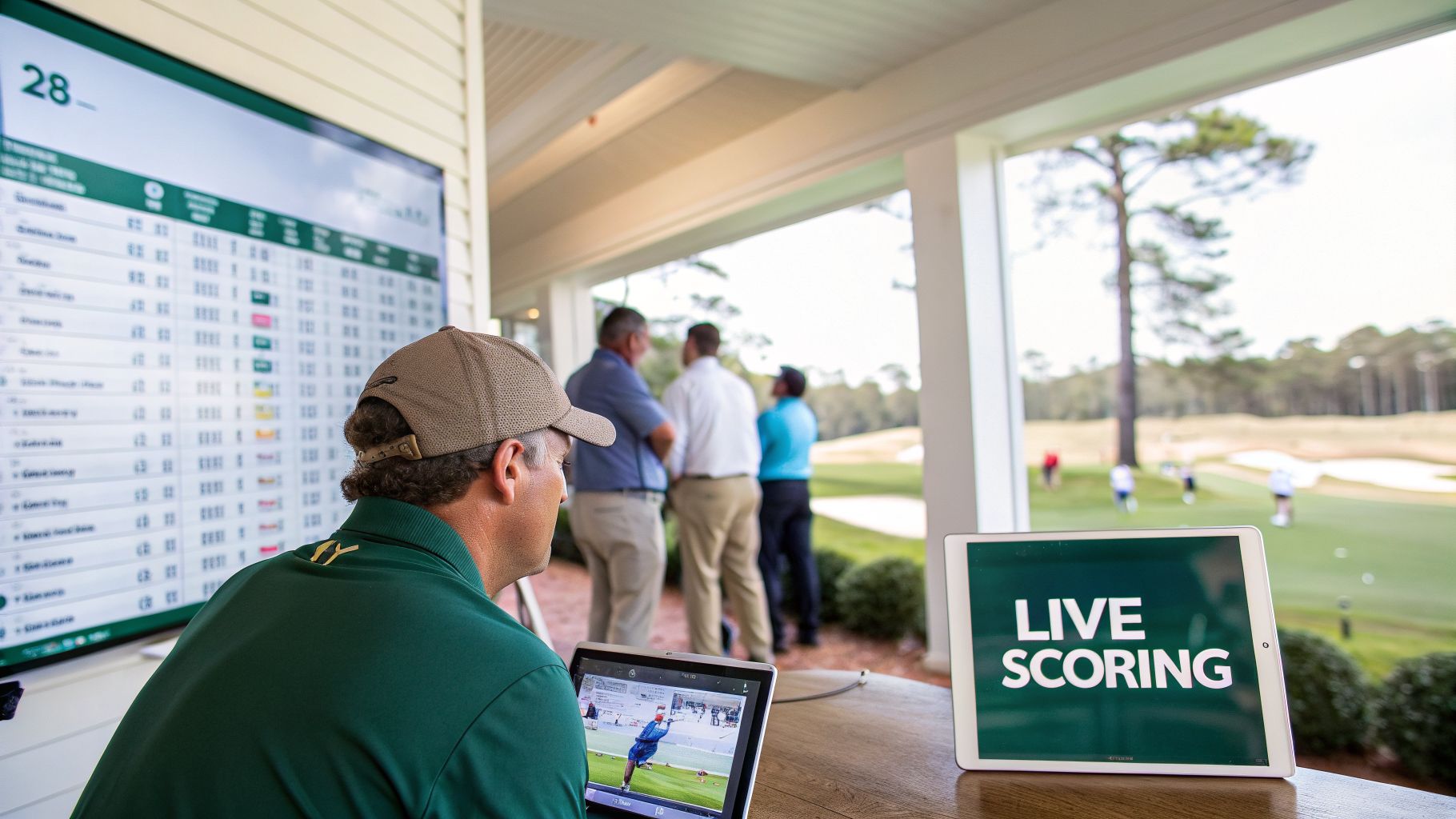
If there’s one thing that completely changes the feel of a golf event, it’s live scoring. It’s what turns a quiet round into a real competition, giving any outing the buzz of a professional tour event.
This is where the magic happens. Imagine knowing exactly where you stand against the field as you step onto the 16th tee. That real-time feedback loop builds pressure and excitement with every hole. For spectators, following along from the clubhouse or their phones keeps them glued to the action.
Efficiency Gains for Organizers
For anyone running a tournament, the benefits are huge. The days of chasing down paper scorecards, trying to read messy handwriting, and spending hours plugging numbers into a spreadsheet are over. A good live scoring system automates everything.
This shift delivers a few key advantages:
Instant Results: The moment the last group walks off 18, the leaderboard is final. You can announce prize winners, skins, and flight champions right away, killing that long, awkward wait that drains the energy from a post-round gathering.
Reduced Human Error: Manual data entry always leads to mistakes, which frustrates players and can create disputes. Digital scoring keeps things accurate and fair, building trust in your event.
Professional Presentation: Throwing a live leaderboard up on the clubhouse TVs or a projector makes any tournament feel bigger and more official. It’s a polished touch that sponsors, members, and guests will notice.
The core benefit is simple: your staff can focus on creating a great experience for players instead of getting stuck doing admin work. This is exactly why modern golf tournament scoring software has become a must-have tool for clubs.
A More Engaging Player Experience
At the end of the day, you want to run a tournament that players remember. Live scoring does this by tapping right into the competitive side of golf. Players are no longer playing in a bubble, guessing how they’re doing.
They can track their friends, see who's making a late charge, and feel the competitive energy build all day. It keeps everyone—from the scratch players to the 20-handicaps—invested in the outcome.
It’s what transforms a regular round of golf into a true tournament experience people will be talking about long after it's over.
Practical Tips for Players and Organizers
A great tournament experience isn't about luck—it's about smooth execution. Whether you're running the show or just trying to post a low number, getting the scoring right can make all the difference.
For organizers, it’s about looking professional without adding a ton of work. For players, it’s about knowing where you stand and how to play your best golf. Nail these simple things, and everyone from the head pro to the first-time participant has a better day.
A Checklist for Tournament Organizers
Running a modern golf tournament with live scoring doesn't have to be a headache. A little prep work goes a long way in making your event feel polished and professional.
Here's a simple checklist to keep things running smoothly:
Pre-Round Communication: Before the event, send players a quick, clear message explaining how scoring works. Most importantly, give them the direct link to the leaderboard—this simple step is huge for getting everyone involved.
Day-Of Briefing: At check-in or during the pre-round announcements, give a quick reminder on how to enter scores. A small instructional card on each cart is a great touch and answers questions before they're asked.
Automate Tie-Breaking: Nobody likes a post-round scramble to figure out who won. Set your tie-breaking rules in the software beforehand. A standard scorecard playoff (comparing back-nine scores, then last six, then three) can be calculated automatically, saving you a massive headache.
Display the Leaderboard: Make sure the live leaderboard is up on screens in the clubhouse, pro shop, or anywhere players gather. This creates a buzz as groups finish and turns the final hour of the tournament into an event in itself.
Mastering these small details is what separates a good event from a great one. The goal is to make the technology feel invisible, allowing the competition to take center stage.
The best systems are built to handle this stuff effortlessly. Think about it: the Masters has a 92-year history, and in all that time, only eight winners have scored 15-under or better—with six of them coming in the last 25 years. Good software manages those kinds of complex, multi-round metrics without blinking. For golf associations and outing coordinators, the right platform can run everything from stroke play to side games with instant leaderboards. This tech, already proven at top US courses, has powered over 10,000 events, cuts setup time by 3x, and boosts live scoring participation by 40% without forcing anyone to download an app. You can learn more about how modern scoring handles championship-level metrics and see how it can elevate any event.
Simple Tips for Players
As a player, your job with live scoring is simple but super important. Entering scores accurately and on time keeps the leaderboard honest and makes the day more fun for everyone.
First, designate one official scorer in your group. This avoids confusion, prevents multiple people from entering the same scores, and keeps things clean. That person should confirm the scores with each player after every hole before putting them in.
Second, learn to use the leaderboard to your advantage. If you're in the hunt down the stretch, knowing whether you need a birdie or can play it safe for par is a huge strategic advantage. It can absolutely change how you approach the final few holes.
Finally, watch out for the most common mistake: misinterpreting handicaps. Always double-check that the correct handicaps are being used for your group. This directly impacts net scores and the final standings, so a quick check before you tee off can save you from a frustrating surprise later.
Why App-Free Scoring Is the Future
Here’s a simple question: what’s the easiest way to get everyone involved in your tournament? When it comes to live scoring, the answer is often staring us right in the face, but we miss it.
The biggest hurdle for any live scoring system is the dreaded app download. Forcing players to search the app store, install something new, and create yet another account is the #1 reason they just don't bother.
This creates a domino effect. Players get frustrated and give up, which means your "live" leaderboard is mostly empty. Your staff ends up playing IT support for the few who try, instead of actually running the event. The whole point of real-time scoring is lost.
The Power of a Simple Link
The fix is surprisingly simple: ditch the app and use a link instead. With app-free, web-based scoring, players get a single link they can click. That's it. The leaderboard and scoring portal open right in their phone’s browser.
This approach is a game-changer because it removes every single barrier. It makes participation effortless for everyone, from the tech-savvy golfer to the guy who still has a flip phone. A simple link is all it takes to get 100% of your players engaged.
This makes life better for literally everyone involved:
For Players: They get instant access with zero hassle. It makes the day on the course that much more fun.
For Organizers: You'll see way more people actually using the live scoring, making the tournament more competitive and exciting from the first hole to the last.
For Staff: You get to save hours of frustration by not having to troubleshoot app downloads and login issues.
By embracing app-free scoring, you can offer a truly professional experience that players will actually enjoy. It’s the most effective way to make your event feel bigger, keep everyone locked into the action, and finally unlock the full potential of a live golf scoreboard.
Frequently Asked Questions
Golf scoreboards can be a little confusing at first, but once you know what to look for, they’re easy to read. Let's clear up a few of the most common questions we hear from players and organizers.
What Does E Mean on a Golf Scoreboard?
That "E" on the leaderboard simply stands for Even Par.
If a player is at "E", it means their score is exactly what's expected for the number of holes they've played. For example, if they're through 9 holes and the par for that stretch is 36, their score is exactly 36. It’s the baseline—not over par (+) and not under par (-).
How Are Ties Broken in a Golf Tournament?
The most common method is the scorecard playoff, sometimes called a countback. It’s a simple way to break a tie without sending players back out on the course.
If two players finish with the same total score, you look at their scores on the back nine (holes 10-18). Whoever played better on the back nine wins. If they’re still tied, you move to the last six holes, then the last three, and finally, hole-by-hole from the 18th backward until a winner emerges.
Can You Play from an Out-of-Bounds Area?
Nope, you can't. It's a fundamental rule: you are not allowed to make your next swing while any part of your body is in an out-of-bounds (OB) area.
If your ball lands OB, you take a penalty stroke and hit your next shot from either your previous spot or near where the ball crossed the out-of-bounds line.
What if your ball is in bounds, but you're right up against the OB line? In that case, players can take relief up to one meter away from the line—without penalty—to make sure they have a fair and legal stance.
If you have more technical questions about the big digital scoreboards themselves, you can find a lot of great information in these LED video wall FAQs.
Ready to run your next tournament with effortless, app-free live scoring? Join the thousands of events that trust Live Tourney to deliver a professional experience every time. Get started with our no-risk, 10-day free trial and see how easy it can be to elevate your event. Visit https://livetourney.com to learn more.





