
Mar 8, 2026
Master fair tournament play with our guide to the golf handicap differential calculator. Learn how to calculate differentials and ensure WHS compliance.

A golf handicap differential is the key to unlocking the World Handicap System. It's the one number that standardizes your performance, turning your raw score from any course into a universal value that reflects how you played against that course's specific difficulty.
The Foundation of Fair Golf Competition
At the end of the day, the score differential is what makes fair competition possible. It's the engine that levels the playing field, allowing a golfer who shot an 85 on a brutally tough course to compete fairly against someone who shot a 78 on an easier one.
This concept is the core of the modern World Handicap System (WHS), which brought over 25 million golfers under a single, unified system back in 2020. The WHS transforms a player's score into a Score Differential, giving everyone a clear and consistent way to measure performance. You can get a more detailed overview of the Score Differential and how it works globally.
Understanding the Core Formula
So, how is this all-important number calculated? The formula itself is pretty straightforward:
Score Differential = (Adjusted Gross Score – Course Rating) × 113 / Slope Rating
This calculation, rounded to one decimal place, is the final word on your performance for a given round. To really get a handle on it, you need to know what each piece of the puzzle means.
The table below breaks down each component of the formula, explaining what it is and why it matters in the calculation.
Breaking Down the Score Differential Formula
Component | Definition | Role in the Calculation |
|---|---|---|
Adjusted Gross Score (AGS) | Your raw score adjusted for handicap purposes, mainly by capping abnormally high hole scores using Net Double Bogey. | This is the starting point—your actual performance on the course, but with outliers smoothed out for fairness. |
Course Rating | An estimate of what a "scratch golfer" (0 handicap) is expected to shoot on a given set of tees. | This sets the baseline for difficulty. A rating of 72.5 means a scratch player is expected to shoot 0.5 over par. |
Slope Rating | A number (55 to 155) showing how much more difficult a course is for a "bogey golfer" versus a scratch golfer. | This adjusts the difficulty based on player skill. A high slope means the course gets exponentially harder for higher handicaps. |
113 | The number representing a course of standard, or average, difficulty. | This constant acts as a universal baseline, standardizing the calculation across all courses, regardless of their individual slope rating. |
Let's quickly walk through what each of these inputs represents in the real world.
Adjusted Gross Score (AGS): This isn't just your final score. It’s your gross score adjusted for exceptionally high scores on any one hole. The WHS uses a Net Double Bogey cap, which prevents a single disastrous hole from skewing your handicap.
Course Rating: Think of this as the benchmark score for a scratch golfer. If a course has a rating of 72.1, it means a top-tier player is expected to shoot just over par from those tees.
Slope Rating: This number shows how much harder a course plays for a "bogey golfer" compared to a scratch player. A higher slope (the max is 155) means the course punishes mistakes more severely, making it much tougher for the average golfer. The number 113 is the baseline for a course of "standard" difficulty and is the constant that ties the whole formula together.
For anyone running a tournament, understanding how a player's round becomes a differential is non-negotiable. It’s the foundation of player trust and fair play. Without it, you’re just guessing who really played the best.
How to Calculate a Score Differential Manually
Sure, a golf handicap differential calculator does all the heavy lifting for you, but what's really going on under the hood? Knowing how to run the numbers yourself gives you a much better feel for the handicap system. It’s the kind of knowledge that helps you confidently explain to a player why their 85 on a tough track was actually a better round than their 82 last week.
This simple graphic breaks down the flow. You start with the score, mix in some course data, and out comes the differential.
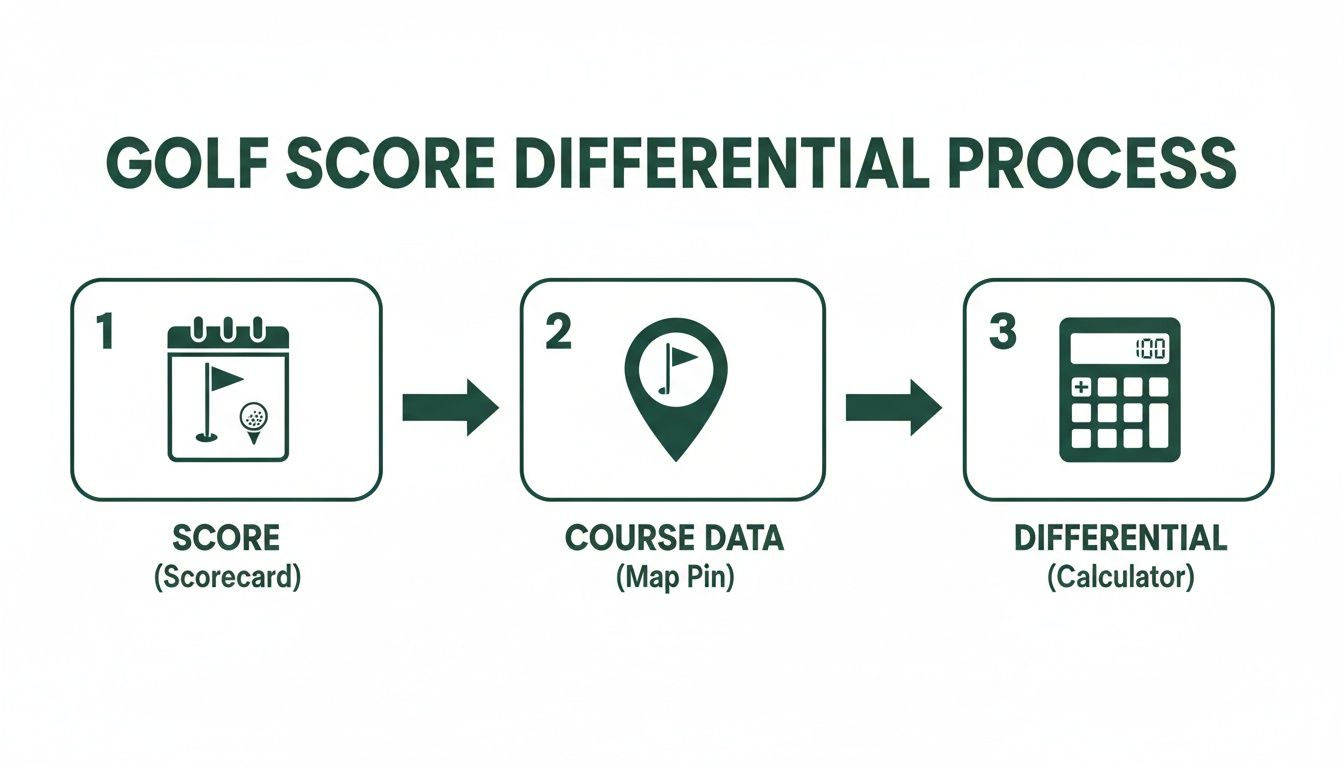
As you can see, the raw score is just one piece of the puzzle. The course itself provides the context. Let's dig into where you get these numbers and how to put them together.
Gather the Necessary Inputs
Before you can touch the formula, you need to pull three key numbers. Two are right there on the scorecard, but one requires a little bit of work.
Course Rating: This is the baseline—what a scratch golfer is expected to shoot. A 73.1 rating means the pros are expected to be just over one stroke above par.
Slope Rating: This measures how much harder the course plays for a bogey golfer versus a scratch player. A big number like 135 means the course is a beast that punishes mistakes.
Adjusted Gross Score (AGS): This is the most important—and most involved—input. You don't just use the player's final score. You have to adjust it to make sure a couple of blow-up holes don't throw the whole number out of whack.
To get the AGS, you have to apply the Net Double Bogey adjustment. This is a cap on the maximum score a player can take on any single hole for handicap purposes. The formula is: Par + 2 + any handicap strokes the player receives on that hole.
For example, let's take a player with a 10 Course Handicap playing a par-4. On a hole where they get one handicap stroke, their max score is a 7 (4 + 2 + 1). Even if they carded a snowman (8) or a disastrous 9, you'd write down a 7 for the AGS calculation.
Run the Calculation with a Practical Example
Once you’ve got your three inputs, you can plug them into the Score Differential formula. Let's run through a couple of common scenarios to see how this standardization really works.
Scenario 1: Strong Round on a Tough Course A player shoots an 85 on a difficult course. The scorecard shows a Course Rating of 74.5 and a Slope Rating of 140.
Calculation: (85 - 74.5) x 113 / 140 = 8.4
This gives them a Score Differential of 8.4.
Scenario 2: Average Round on an Easy Course That same player heads to an easier track and shoots a lower score, an 82. This course has a Course Rating of 70.2 and a Slope Rating of 115.
Calculation: (82 - 70.2) x 113 / 115 = 11.6
This round results in a Score Differential of 11.6.
Here’s the takeaway: even though the player shot three strokes better in the second round, their differential was higher. This proves the 85 on the tougher course was the superior performance.
Going through this manually really shows you how much work is involved. That’s why understanding different golf tournament scoring methods and having a system to automate this is a game-changer. It eliminates the potential for human error and frees up your staff to run a better event.
Using Differentials to Identify Scoring Outliers
A Score Differential is a great snapshot of how a player performed on a given day, but it doesn't tell you the whole story. To really protect your tournament’s integrity, you need to know how that score compares to the player's own established potential. This is where the Net Handicap Differential comes in.

Think of it as a simple but potent formula: Net Handicap Differential = Score Differential - Handicap Index. The result, whether positive or negative, gives you a clear number of strokes a player performed better or worse than their handicap. A negative number means they beat their handicap; a positive number means they had an off day.
Putting Scores into Statistical Context
It’s common for a player to shoot a stroke or two better than their handicap. But what happens when someone shoots six or seven strokes better? Was it a career round or a potential red flag? This is where probability data becomes an indispensable tool for any tournament director.
By understanding the real-world likelihood of exceptional scores, you can handle player questions with confidence and spot potential sandbagging.
For instance, an analysis of over 7.3 million scores revealed some eye-opening probabilities. The data, detailed in the Score Probability Table from Miami Valley Golf, shows that posting a Net Handicap Differential of 0 or better happens about once every 2.3 rounds. But the odds get much longer with each stroke a player sheds.
A Net Handicap Differential of -3 is a 1-in-12 round. A differential of -6 is a 1-in-258 statistical longshot. This context is what separates a great day on the course from a suspiciously good one.
Having this knowledge empowers you to maintain a fair event. When a player posts a score that’s a statistical outlier, you have the data to back up any questions. It’s not about making accusations—it’s about upholding the integrity of the competition for everyone.
Identifying Potential Sandbagging
Having the data is one thing, but using it effectively is what matters. An automated golf handicap differential calculator built into your tournament software can flag these outliers for you in real time. This lets your tournament committee be proactive instead of reactive.
Here are some statistical benchmarks to help identify rounds that might need a closer look:
-3 to -4: An excellent round, but it's still in a believable range. This happens roughly once every 12 to 28 rounds.
-5: This is a truly standout performance. The odds are about 1-in-84, making it a career-type round for most golfers.
-6 or better: A highly improbable score. A Net Handicap Differential of -6 has a probability of 1-in-258, and a -7 is a staggering 1-in-930.
When you understand these numbers, you can manage your tournament with confidence. You're no longer just looking at a low net score; you're seeing it within the context of what’s statistically possible for that player. This protects your event and ensures everyone is competing on a level playing field.
Let's be honest, golf rarely sticks to the script. A perfect, sunny, 18-hole round is the dream, but reality often involves sudden downpours, conceded putts in a tight match, or days where the course just plays brutally tough.
A truly reliable handicap system has to be built for the real world, not just the "perfect round" scenario. Mastering how the system handles these oddball situations is key to making sure every score is posted fairly and accurately.
What About 9-Hole Rounds?
Not every round is a full 18. In fact, squeezing in a quick nine is incredibly common. The World Handicap System (WHS) has specific procedures to make sure these shorter rounds count toward your handicap.
When you post a 9-hole score, it isn’t just doubled or ignored. It used to be combined with an "expected" score for the other nine to create an 18-hole equivalent. But a recent update in 2024 changed the game.
Now, 9-hole scores are converted directly into a differential using their own specific 9-hole Course and Slope Ratings. This has been a huge step forward for accuracy, especially in places like the US where nearly half of all rounds played are nines. It’s a big reason why, since the WHS was introduced, the average Handicap Index dropped 1.2 strokes for men and 1.8 strokes for women by 2023.
The Bottom Line: A 9-hole score is a valid and important part of your handicap history. The system carefully integrates it into your 18-hole scoring record using specific formulas, so don't hesitate to post those twilight nines.
The Playing Conditions Calculation (PCC) Explained
Ever had one of those days? The wind is howling, the pins are tucked on tiny shelves, and it feels like the entire course is out to get you. Suddenly, everyone's scores are ballooning.
The WHS has a brilliant, automated fix for this called the Playing Conditions Calculation (PCC).
The system crunches the numbers on all scores submitted on a course for that specific day. If scores are way higher or lower than what’s expected, it applies an adjustment to every single player's Score Differential.
A PCC of -1 means conditions were unusually easy, and the system subtracts one stroke from your differential.
A PCC of +3 means the course played exceptionally tough, and three strokes are added to your differential, which actually helps your handicap.
This automatic adjustment is a game-changer. It ensures a brutal day of weather or a tough course setup doesn't unfairly blow up your handicap. Any good differential calculator will factor this in without you even having to think about it.
Unfinished Rounds, Conceded Holes, and Other Oddities
So, what happens when you don't finish a hole? Or even a few holes? The WHS provides clear guidance so you can still post a valid score for the round.
Holes Not Played: If you have to stop a round due to darkness or bad weather, you don't just throw the score out. For any holes you didn't play, you simply record a score of Net Par.
Conceded Putts: This happens all the time in match play. When your opponent gives you that two-footer, you record your most likely score. For most of us, that means assuming you would have made the putt and finishing out the hole on your scorecard accordingly.
A quick reference can be a lifesaver when you're trying to figure out how to handle these common situations during a tournament.
Quick Guide to Common Scoring Adjustments
This table summarizes WHS procedures for frequent scoring scenarios, offering a quick-reference for maintaining compliance during your tournament.
Scenario | WHS Handling Procedure | Impact on Differential |
|---|---|---|
9-Hole Score | Posted as a 9-hole round; converted using 9-hole ratings. | Directly contributes an 18-hole equivalent to your record. |
Hole Not Played | Record a score of Net Par for that hole. | Allows the round to be posted for handicap purposes. |
Conceded Putt | Record your most likely score for the hole. | Ensures match play rounds can be accurately posted. |
Max Score | Score is capped at Net Double Bogey for any hole. | Prevents a single disaster hole from ruining your differential. |
Getting these little details right is what keeps a Handicap Index accurate and fair. You can learn more about the fundamentals by checking out our guide on the best golf scorecard practices. These rules are in place so you don't have to discard an entire round just because of a few unfinished holes, which means more of your scores count toward a true reflection of your game.
Automating Differentials for a Better Tournament
Knowing the math behind a golf handicap differential is one thing. But actually running the numbers for an entire tournament field? That's a completely different beast.
Manually calculating differentials for dozens, or even hundreds, of players is a recipe for headaches and human error. This is where modern tournament software completely changes the game.

Think about it: players enter their scores hole-by-hole right on their phones. The second a score is logged, the system instantly does the dirty work—applying adjustments and recalculating standings on the fly. It's a massive operational advantage.
This isn't just about saving a few minutes. It's about getting hours of your day back and guaranteeing flawless accuracy. Costly mistakes from a slip of the finger on a calculator or a typo in a spreadsheet simply vanish.
Elevating the Player Experience
Beyond making your life easier, automation does something incredible for the players. When golfers can watch a live, real-time leaderboard update with every score posted, it injects a whole new level of competitive energy into the day.
The real magic happens when players see live net standings. This immediate feedback shows them exactly where they stand against the field after handicap adjustments, turning a standard round into a dynamic and engaging horse race.
This kind of transparency makes the event feel more professional and boosts engagement. It brings a bit of that pro tour experience to your local club championship or corporate outing, making your participants feel like they're part of something special.
It’s a huge shift from crunching numbers to creating a real-time competitive atmosphere. To see how this all comes together, it’s worth looking into the features of modern golf tournament scoring software and how it can completely transform your events.
The Power of Real-Time Data
The benefits of an automated system ripple through the entire event, from setup to the final payout. The tech does the heavy lifting so you don't have to.
Key Automation Benefits
Instant Score Adjustments: The software automatically applies the Net Double Bogey adjustment for every player, making sure all scores are compliant with WHS rules without you lifting a finger.
Real-Time Differentials: The moment a round is finished, the Score Differential is calculated using the correct Course and Slope Ratings for the tees they played.
Live Leaderboard Updates: Both gross and net scores are updated instantly. Players and spectators can follow along as the action unfolds.
Error-Free Administration: By taking manual data entry out of the equation, you kill the risk of typos or formula errors that can destroy the integrity of your results.
Ultimately, using a platform with a built-in golf handicap differential calculator lets you and your staff stop being data-entry clerks and start being event hosts. You can spend less time buried in a spreadsheet and more time interacting with players, managing logistics, and creating a tournament people will remember.
Common Questions About Handicap Differentials
Even after you’ve got a handle on the formulas, a few common questions always seem to come up in the middle of a tournament. When you’re running an event, having quick and clear answers is the key to keeping things running smoothly and making sure your players trust the process.
Let's clear up some of the most frequent points of confusion we hear about golf handicap differentials.
What Is the Difference Between a Score Differential and a Handicap Index?
This is a big one. Think of it this way: a Score Differential is a snapshot of your performance in a single round. It’s the number that shows how well you played on a specific day, on a specific course, after accounting for that course's difficulty.
Your Handicap Index, on the other hand, is the bigger picture. It’s a rolling average of the best 8 Score Differentials from your most recent 20 rounds. In other words, differentials are the building blocks, and your Handicap Index is the result—a measure of your demonstrated potential.
Why Does the Formula Use the Number 113?
That magic number, 113, is what makes the whole system work. It represents the Slope Rating of a perfectly average, or "standard" difficulty, golf course.
By using 113 in the formula, we can neutralize the specific difficulty of the course you just played. It essentially converts your score into what it would have been on a standard course, which is why a differential from a tough mountain course can be fairly compared to one from your local muni. It creates a universal standard.
How Does an Automated Calculator Help Prevent Sandbagging?
Automated systems are a sandbagger’s worst nightmare, mostly because of transparency and speed. When you’re using live, hole-by-hole scoring, players can't conveniently "forget" to post a good round or fudge a few strokes at the end. The data is posted in real time, for everyone to see.
The real secret weapon here is the instant calculation and display of Net Handicap Differentials. These systems can immediately flag scores that are statistically way out of line with a player's history. It’s incredibly hard for someone to manipulate their handicap when a great round is automatically highlighted for the tournament committee to review.
Can a Score Differential Be a Negative Number?
Absolutely—and when it happens, it’s a great thing! A negative differential simply means you shot a score that was better than the Course Rating. For example, if you shoot a 71 on a course with a 72.5 Course Rating, you're going to end up with a negative differential.
All it means is you played an excellent round of golf. These are exactly the kind of scores that will help lower your Handicap Index, as they’re the most likely to be included in your best eight.
Stop wasting time on manual calculations and start running better tournaments. Live Tourney offers instant, automated differential calculations and live leaderboards that elevate the player experience and free up your staff. Set up your next event in minutes and see the difference for yourself. Learn more about Live Tourney.





