
Apr 15, 2026
A step-by-step guide to creating a league. Learn to plan, launch, and manage a successful golf league with tips on formats, registration, scoring, and payments.

You’re probably dealing with the same mess most golf operators run into when they start creating a league. One spreadsheet for the roster. Another for weekly points. A text thread for no-shows. Handwritten scorecards. Venmo reminders. Last-minute pairings rebuilt in the golf shop while players are standing at the counter asking who they’re with.
That system works until it doesn’t.
The breaking point usually isn’t one big failure. It’s the accumulation of small admin jobs that steal time from the part that matters: giving players a league they want to come back to next week. Good leagues feel organized, fair, social, and easy to join. Bad leagues feel like extra work for everyone.
That’s always been true in organized sports. The National League was established on February 2, 1876, with 8 teams and a 70-game schedule, and that standardized structure helped boost fan participation by 25% year-over-year through 1880 (LeagueRepublic). The lesson holds up. Structure drives engagement.
Creating a league in 2026 shouldn’t mean recreating old admin problems with newer phones. It should mean building a repeatable system that handles registration, payments, pairings, scoring, standings, and post-round reporting without forcing staff back into manual cleanup every week.
Beyond the Spreadsheet The Modern League Experience
Most league problems start before the first tee shot.
A course announces a new weekly game. Interest is good. The shop puts together a sign-up sheet, builds pairings manually, and collects money as players trickle in. That feels manageable at first. Then someone misses a week. Another player brings a guest. A regular wants to pay later. One scorecard comes in with unclear handwriting. The standings file gets edited by two different staff members. Now the league has friction.
What the old setup gets wrong
Spreadsheets aren’t the problem by themselves. The issue is that they turn a recurring customer program into a patchwork process.
Here’s what usually breaks:
Registration gets fragmented: Some players sign up in person, some by email, some through a text.
Payments stay unresolved: Staff ends up chasing balances instead of checking in golfers.
Pairings become reactive: One no-show forces a full reshuffle.
Scoring slows down: If results have to be re-entered later, errors creep in.
Communication drifts: Players don’t know where to find standings, format rules, or next week’s details.
When operators say a league is “hard to manage,” that’s usually what they mean. Not golf. Admin drag.
Practical rule: If league information lives in more than one place, staff will spend the season reconciling it.
What a modern league should feel like
A well-run league has a simple front door and a consistent weekly rhythm.
Players register online. They pay before they play. Rosters update without someone rebuilding the whole sheet. Pairings go out cleanly. Scores get entered once. Standings update fast enough that players care. The shop staff isn’t stuck doing cleanup at closing time.
That shift matters because organized play only grows when the structure is dependable. The earliest successful sports leagues proved that standardized rules and scheduling weren’t cosmetic details. They were the operating system for repeat participation, as the National League example shows in the historical record above.
The operator’s goal
The goal isn’t to add technology for its own sake.
It’s to remove avoidable work.
A modern setup should help you do four things well:
Launch clearly: Players know how to join, what it costs, and how the season works.
Run each week cleanly: Pairings, scoring, and updates happen without bottlenecks.
Keep players engaged: They can follow the competition without hunting for information.
Finish professionally: Results, payouts, and next-season planning don’t become a scramble.
That’s the difference between “we have a league” and “we run a league people count on.”
Laying the Foundation Your League's Blueprint
Before you open registration, decide what kind of league you’re building.
A lot of operators start with the wrong first question. They ask, “What night should we run it?” The better question is, “Who is this league for, and what kind of weekly experience do we want them to have?” Once you know that, format, schedule, and pricing get much easier.
Start with the player mix
League formats fail when they ignore the room.
If your field is mostly casual players, a format that exposes every bad hole can wear people out quickly. If your field is competitive and handicap-aware, an overly loose social format won’t hold attention for long. Creating a league works better when the game format fits both skill level and time tolerance.
Use this as a working filter.
Format | Best For | Pros | Cons |
|---|---|---|---|
Scramble | Beginners, social leagues, corporate groups | Faster pace, less intimidating, team energy stays high | Better players can carry weaker teams too much |
Best Ball | Mixed-skill groups with some competitive interest | Rewards individual good holes without punishing every miss | Scorekeeping needs more attention |
Match Play | Competitive regulars, rivalry-based leagues | Easy to understand weekly winner, strong head-to-head feel | Uneven attendance can complicate standings |
Stableford-style points | Players who want pace and less blow-up-hole pain | Keeps rounds moving, one bad hole hurts less | Some players need a clear explanation early |
Ryder Cup style team formats | Clubs trying to build identity and camaraderie | Creates season-long team buy-in | More moving parts for captains and setup |
Pick the format based on behavior, not preference
An operator may love match play. That doesn’t mean the Tuesday after-work crowd will.
Look at the actual conditions:
If pace is your pressure point: Favor formats that reduce long hole-by-hole stress.
If retention matters most: Avoid structures where weaker players feel buried early.
If your field changes week to week: Use a setup that can absorb substitutes and absences without wrecking fairness.
If your bar and grill benefits from post-round energy: Lean toward team competition and visible standings.
The best league format isn’t the one that sounds the most competitive. It’s the one players will still enjoy in week eight.
Build a season players can stay in
Schedule length shapes engagement more than most operators realize.
A short season can feel casual and manageable, but it may not create enough habit. A long season builds routine, though only if the standings structure stays alive. For leagues running 14 weeks or longer, best practice is to split the season into two halves and reset points at the midpoint so early leaders don’t create a gap the rest of the field stops chasing (X4Golf).
That one decision can keep the back half of the season competitive.
A few scheduling rules work in practice:
Protect consistency: The same day and time each week reduces drop-off.
Match the time slot to the player type: Early evening works for working adults. Mid-morning can fit retirees or flexible schedules better.
Leave room for makeups: Even if you don’t advertise formal makeup rounds, you need a policy before weather or travel issues hit.
Avoid complexity in year one: One division run cleanly beats multiple divisions managed loosely.
If you want a practical framework for structuring recurring programs, this guide on golf league program planning is a useful operational reference.
Decide your league identity early
A strong league has a clear identity from the first announcement.
That means answering these questions in plain language:
Who should join
What format you’re playing
How standings work
What players get for their fee
What makes this league worth returning to
If you plan to approach sponsors, local businesses, or community partners, package that clearly. A concise overview, audience description, and visibility plan are usually enough to start. If you need help presenting that cleanly, this resource on how to create a media kit effectively is useful.
Keep the rules simple enough to administer
The league that looks clever on paper often becomes a burden in the golf shop.
Use rules your staff can explain in under two minutes. If a substitute policy, point formula, or tiebreak system needs a long verbal explanation every week, simplify it before launch. Players forgive straightforward rules. They don’t forgive confusion that feels inconsistent.
Automating Setup Registration Payments and Rosters
The admin side of creating a league is where good intentions usually get exposed.
Operators often spend real time designing the format, then wing the mechanics of registration and payment. That’s backward. The player’s first experience with your league isn’t the first tee. It’s the sign-up process. If that feels messy, everything after it feels less credible.
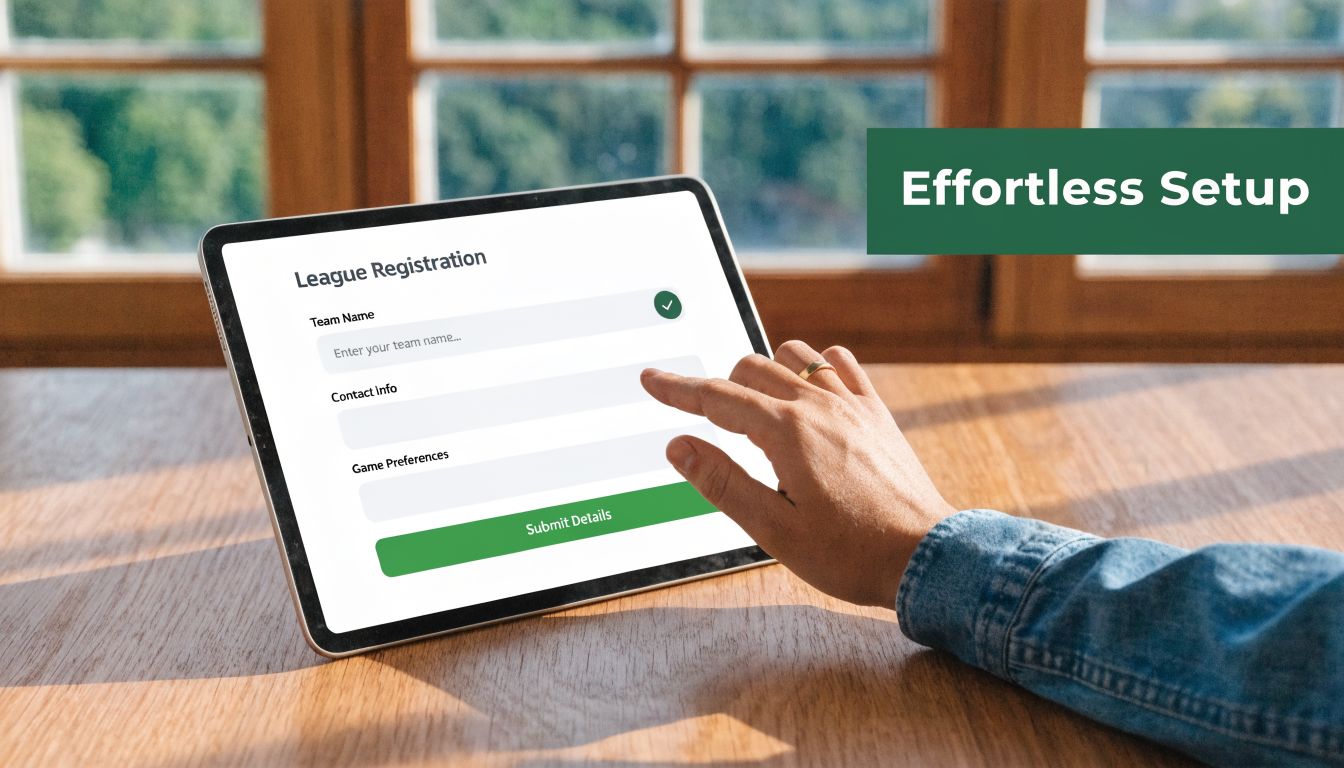
Build one clean registration path
Give players one place to join. Not a paper form plus an email option plus “call the shop if you’re interested.”
Your registration flow should collect only what you’ll use:
Basic player details: Name, email, mobile number.
League-specific needs: Preferred partner if applicable, handicap information if required, and any eligibility notes.
Operational details: Payment status, acknowledgment of rules, and whether the player is available for the full season.
If you’re evaluating systems broadly, it can help to look at how other operators think about membership management software, especially when comparing recurring sign-ups, payment handling, and roster visibility.
A clean form does two things. It reduces back-and-forth, and it prevents staff from re-keying information later.
Don’t separate registration from payment
At this stage, many leagues create unnecessary friction.
If players can register without paying, staff inherits a collection problem. If players can pay without completing league details, you end up matching money to incomplete records. Keep those actions together.
A major issue in league creation is financial sustainability, especially when hidden costs like travel and gear can push players out. Using a platform with no onboarding fees that automates registration and payments can help organizers keep league fees affordable, including models such as $50 per season, while also cutting setup time by 3x (USA Cheer underserved communities resource).
That matters most for public courses, municipal facilities, and leagues that rely on broad community participation rather than a small core of highly committed players.
Set payment rules before the first invoice
Don’t improvise payment exceptions after registration opens.
Decide these policies up front:
When payment is due: At sign-up, before week one, or before a player can appear in pairings.
Whether substitutes pay separately: This has to be defined early.
How refunds work: Especially for withdrawals before the season starts.
What happens with missed weeks: Credit, no credit, or prize-fund only adjustments.
Operators get into trouble when they’re generous but inconsistent. If one player gets a late-pay exception and another doesn’t, the league starts feeling arbitrary.
Roster management needs to be living, not static
The roster is not a finished document once registration closes.
Players miss nights. Someone refers a friend. One participant drops out for work or family reasons. Another asks to sub for a few weeks. If your system treats the roster like a fixed spreadsheet, every change becomes manual surgery.
What works better is a roster setup that supports:
Easy imports at launch
Status changes without rebuilding pairings
Round-by-round attendance tracking
Substitute notes tied to the specific week
Clear payment and communication history
For operators looking at golf-specific tools, league management software for golf events gives a practical view of what that workflow should support.
This is the one place where mentioning a purpose-built platform is useful. Live Tourney handles online registration, payments, roster uploads, and league administration in a web-based system, which is the kind of setup that helps staff avoid rebuilding records manually each week.
Shop-floor rule: If a player update requires editing multiple files, your process is too brittle for a season-long league.
Price for sustainability, not optimism
A lot of leagues are underpriced because the operator only counts visible costs.
The hidden workload is real. Staff time, payment handling, communication, score entry cleanup, and end-of-season reconciliation all count, even if they don’t show up as a separate invoice. At the same time, pricing too aggressively can choke off participation.
The practical middle ground is to build a fee structure around what the league includes, then strip out unnecessary admin overhead with automation. That gives you more room to keep player costs accessible without pushing clerical work onto the golf shop team.
Executing Gameday Pairings Scoring and Engagement
League day tells players whether your operation is sharp.
Not the flyer. Not the registration form. Not the opening-week announcement. The actual day. That’s where all the planning either looks well-executed or starts leaking.
The cleanest league days follow a steady rhythm. Staff knows who’s in. Pairings are already set. Players aren’t hovering at the counter waiting for answers. The scoreboard starts moving while groups are still on the course. By the time the last carts come in, participants already know where they stand.
The morning should feel quiet
If game day starts with panic, the system is wrong.
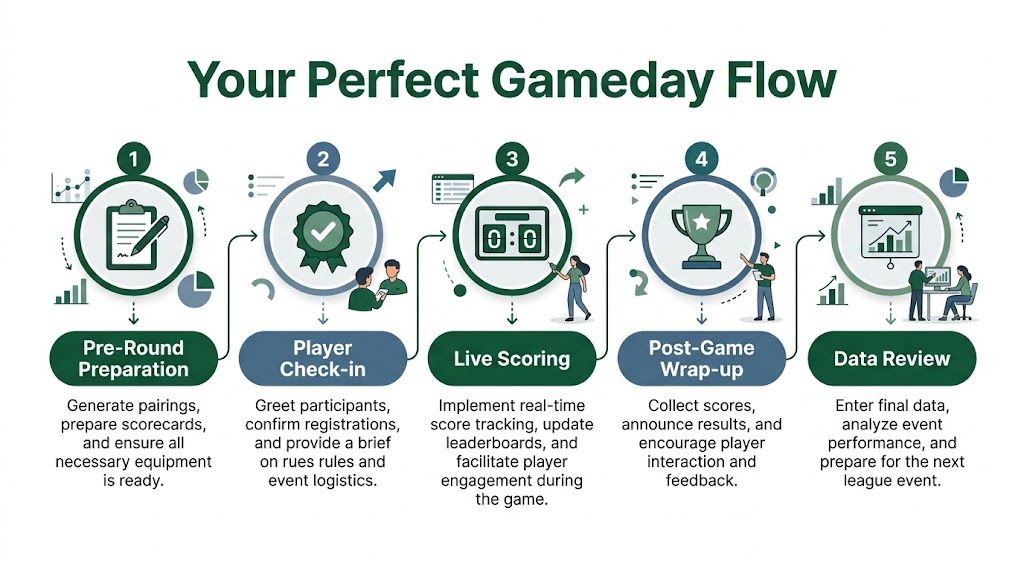
The ideal flow is simple. You review attendance changes, confirm the field, generate pairings, print or share what players need, and move into check-in. You’re not rebuilding the event from scratch every week.
This process view helps keep the sequence tight.
Pairings should serve the format
A common mistake is treating pairings like a clerical output instead of a league tool.
Good pairings do more than fill tee times. They reinforce fairness, maintain pace, and support the competitive structure you chose at launch. If you’re running head-to-head play or rotating team matchups, use a pairing method that stays balanced over time instead of relying on whoever happened to play together last week.
For leagues with recurring matchups, a proper round robin scheduling approach is usually far more reliable than ad hoc weekly grouping. It keeps the competition from feeling random.
Check-in should answer questions before they get asked
By the time players arrive, they should already know three things:
Who they’re playing with
What format applies that day
How scores will be entered
If any of those still needs explaining at the counter, check-in becomes a bottleneck.
A smooth check-in usually includes one quick confirmation, one reminder about the day’s format, and one clear instruction for scoring. That’s it. Long speeches delay tee times and confuse people who were already ready.
If you have to explain scoring differently to every group, players won’t trust the leaderboard later.
Live scoring only works when it’s easy
At this point, modern league operations pull away from legacy systems.
Players won’t consistently enter scores if the process has too many steps. App download requirements are a common problem. They sound minor to staff, but they create drop-off. Some players never install the app. Others forget their password. A few don’t want another account on their phone. Then the shop has to finish the job after the round.
Platforms with app-free live scoring see 40% higher participation in score entry because players can use a simple link instead of downloading an app and creating an account (Live Tourney).
That point isn’t about novelty. It’s about behavior. Lower-friction systems get used.
The leaderboard changes the atmosphere
A league feels bigger when players can see it moving.
When scores update during the round, the competition stops being abstract. The group finishing on 18 knows whether a putt matters. The players in the grill room keep watching. Staff doesn’t have to answer the same “where do I stand?” question over and over.
That kind of visibility is one of the simplest ways to make weekly golf feel more event-driven.
Use the leaderboard deliberately:
Display it where players gather: Clubhouse screens, check-in area, or shared links after the round.
Keep naming clear: Teams, flights, and side games should be easy to identify.
Avoid clutter: Too many mini-contests can bury the main competition.
Post updates quickly: Delay kills interest.
Side games should add energy, not admin
Closest-to-the-pin, skins, and weekly team games can help a league feel lively. They can also create another layer of reconciliation if they’re run loosely.
The rule is simple. Only offer side games you can settle cleanly.
That means you need:
Published rules before play
A clear record of who opted in
Consistent score capture
A fast method for calculating results
If the side game requires a handwritten side sheet and a separate payout spreadsheet, it’s probably too clunky for a weekly program.
End-of-round processing should be short
The round ends. Players come in. The league should not enter a second work shift.
A strong finish usually looks like this:
Final scores are confirmed
Any scoring disputes are handled immediately
Standings update
Weekly winners are visible
Next week’s reminder goes out soon after
That final step matters more than many operators think. Weekly leagues build habit through continuity. The less time players spend wondering what happens next, the more likely they are to stay engaged.
Wrapping Up Reporting Payouts and Next Season
A league doesn’t end when the last score is posted.
The post-round and post-season process shapes how professional the whole experience feels. Players remember whether results were clear, whether payouts were accurate, and whether next season felt organized or improvised.
Close each round the same way
Operators save time when every league night ends with the same checklist.
Use a repeatable process:
Confirm final scoring: Resolve missing or disputed entries before staff leaves.
Lock results: Don’t keep standings open to casual edits after players have seen them.
Publish winners clearly: Weekly results should be easy to read, not buried in a spreadsheet attachment.
Record financial outcomes: If there are payouts, credits, or prize-fund allocations, log them immediately.
The problem with delaying this work is that details get fuzzy fast. By the next morning, scorecards are gone, players remember holes differently, and staff is trying to reconstruct what should have been finished the night before.
Payouts need consistency more than complexity
Most leagues don’t struggle because payouts are hard mathematically. They struggle because the payout rules weren’t defined tightly enough.
Before the season starts, be specific about:
What gets paid weekly
What rolls into season-long prizes
How ties are handled
Whether substitutes are eligible
How no-shows affect team outcomes
If your payout logic changes based on who asks, you’ll spend more time managing perceptions than running golf. Keep it written down and visible.
This visual captures the mindset you want after the round ends.

Reporting is part of the player experience
Players don’t need a complicated season report. They do want clarity.
A useful end-of-season report usually includes:
Final standings
Weekly winners summary
Season champions
Notable side-game or team results
A simple thank-you and next-step note
You’re not producing an annual report. You’re giving players closure and a reason to return.
Clean reporting does two jobs at once. It proves the season was run properly, and it markets the next one.
Use the completed season as your template
The biggest operational win after a successful season is that you don’t need to start over.
Most of the work should carry forward:
The league settings
The communication cadence
The roster framework
The payout logic
The reporting format
That gives you a better starting point next season than the one you had this year. Small improvements are easier when the base system already works.
Ask for the right feedback
Don’t send a vague “How was the league?” message and hope for insight.
Ask narrower questions:
Was the format fun enough to repeat?
Did the time slot work?
Was scoring easy to use?
Did the standings stay interesting through the season?
What slowed down league night from the player view?
Those answers are more actionable than a generic satisfaction score.
Start next season before this one fades
The best time to prepare the next league is right after the current one ends, while players still remember the routine and momentum is intact.
Open a priority list. Note the players who want back in. Record the rule changes you already know you need. Save the communication language that worked. If your platform supports cloning or duplicating events, use it. Rebuilding from zero every season is wasted labor.
Your Golf League Questions Answered
League management always looks simple in the planning stage. The true test is how you handle the awkward situations that show up every week.
What’s the best way to handle substitutes
Use substitutes only if your policy is written before the season starts.
Define who can sub, whether the same person can sub repeatedly, and whether substitutes can win weekly prizes or only help the team result. Keep the rule short enough that players can understand it without interpretation. The more judgment calls staff has to make, the more conflict you invite.
A practical approach is to require all substitutes to be approved before pairings are finalized for that round.
What should you do with no-shows
Treat no-shows differently from planned absences.
A planned absence can fit into your substitute or adjusted-pairing policy. A no-show disrupts the whole field because staff has already built around that player. If you don’t have a written no-show rule, players will assume staff is inventing consequences after the fact.
Good policy usually includes:
A clear deadline for withdrawal
A default scoring or match outcome
Whether fees are forfeited
How repeated no-shows are handled
How do you manage rainouts without creating confusion
Pick one rainout policy and publish it before week one.
The simplest options are either rescheduling the round or treating that week as a canceled event with no points awarded. Problems start when operators try to make weather decisions ad hoc based on who can return on a makeup date.
If your schedule is long enough to allow flexibility, build one or two buffer dates into the calendar from the start. Even if you never use them, players appreciate knowing the plan exists.
How do you keep players near the bottom engaged
Don’t rely on standings alone to hold attention.
Players who fall behind still need a reason to show up. Weekly prizes, team-based elements, flighting, and second-half competition structures all help. The key is making sure the season has more than one path to relevance.
This matters even more in longer leagues. If the same few players dominate the top from early on, the rest of the room starts treating league night like optional golf instead of a real competition.
A healthy league gives middle-of-the-pack and lower-ranked players something meaningful to play for every week.
Should you run one big league or split into divisions
Start with one league unless the field size or skill spread clearly demands separation.
Divisions can improve fairness, but they also create more admin work, more payout decisions, and more communication complexity. If your staff is still refining the workflow, simplicity wins. Once the process is stable, you can add flights or divisions without creating chaos.
What’s the right way to communicate every week
Use one primary communication channel and stick to it.
Email works well for official weekly details. Text can be useful for day-of reminders if your player base expects it. What doesn’t work is scattering information across emails, texts, social posts, and verbal shop updates.
Every weekly message should answer the same basic questions:
When is the next round
Who is in
What format are you playing
How are scores being handled
Where can players see results
How detailed should your rules document be
Detailed enough to remove ambiguity, short enough for players to read.
Keep the master document concise. Then keep a shorter public-facing summary for everyday use. The common mistake is burying practical rules inside a long policy sheet no one opens once the season starts.
When should you say no to a format idea
Say no when the format creates admin work your staff can’t support consistently.
A creative structure isn’t valuable if the weekly execution becomes fragile. If pairings, score entry, and standings require too much manual intervention, the format is too expensive operationally. Players would rather have a clean, reliable league than a clever one that feels disorganized.
What usually makes a league succeed year after year
Not one feature. Not one prize. Not one kickoff event.
The leagues that last do the basics repeatedly well. Easy sign-up. Clear rules. Fair pairings. Fast scoring. Visible results. Consistent communication. If those pieces are solid, players forgive a lot. If those pieces are weak, no amount of extra polish saves the season.
If you’re creating a league and want a simpler way to handle registration, payments, pairings, scoring, and reporting in one web-based workflow, take a look at Live Tourney. It gives courses and organizers a cleaner alternative to manual league administration, and the app-free scoring model makes it easier for players to participate without extra setup.





