
Feb 18, 2026
Learn how to run a flawless Captain's Choice golf tournament. Our guide covers rules, scoring, side games, and software to create an unforgettable event.

If you’ve ever run a golf event, you know the Captain's Choice format. It's often called a scramble, and it’s the go-to for a reason: it just works. The concept is simple, which is exactly why it's so popular for charity, corporate, and member events.
In a scramble, every player on the team hits a tee shot. The team picks the best one, and everyone plays their next shot from that spot. You repeat this all the way to the hole. It’s a low-pressure, fun-first format that makes golf accessible to everyone, regardless of their skill level.
Why Captain's Choice Is a Go-To for Successful Golf Events
The scramble isn't just a trend; it's the foundation of countless successful golf outings. For tournament directors and head pros, understanding its appeal is the key to filling your tee sheet and boosting revenue. It’s a proven method for creating an inclusive, fast-paced, and genuinely fun day on the course.
The mechanics are straightforward:
Each player on the team (usually a foursome) tees off.
The team decides which drive is the best—a decision often led by the "captain."
All players place their ball within one club-length of that spot and hit their second shot.
This continues for every shot, including putts, until the ball is holed. The team records a single score for the hole.
This setup immediately takes the pressure off. A beginner doesn't have to worry about a shank ruining their day because they've got three other teammates to lean on. This team-first approach is a huge draw for golfers who might otherwise feel too intimidated to sign up.
The Power of Inclusivity and Pace of Play
One of the biggest wins of a Captain's Choice event is how it levels the playing field. You can put a scratch golfer, a mid-handicapper, a senior, and a complete novice on the same team, and they can all contribute meaningfully. This makes it perfect for corporate outings with a mix of skill levels or charity events where the focus is on fun and fundraising, not hardcore competition.
The format also naturally speeds up play. With teams always playing from the best position, you get fewer lost balls and fewer painful recovery shots—the two biggest culprits for five-hour rounds. A faster round means happier players and a smoother transition to your post-round dinner and awards.
This chart is a great way to see if a scramble fits your event's goals, whether you're aiming for pure fun or a more competitive vibe.
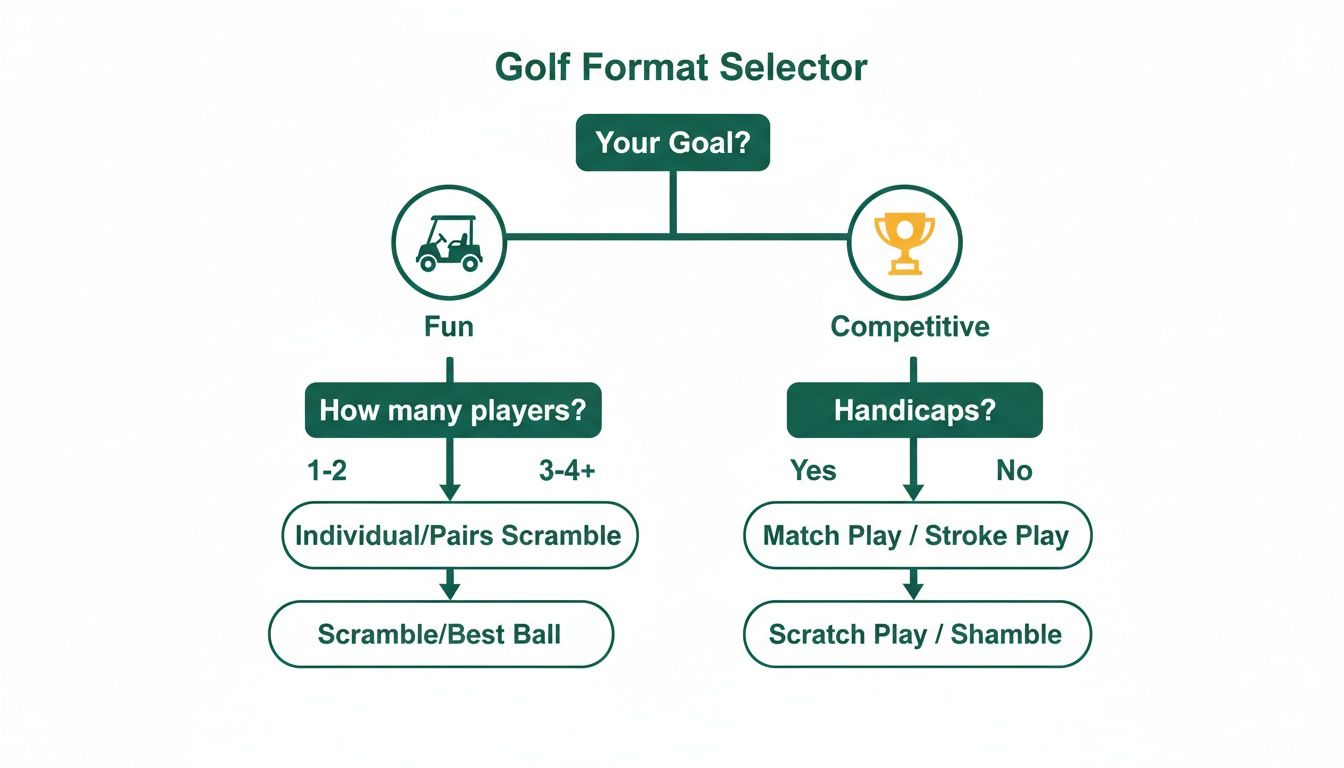
As you can see, the scramble is the clear choice when the goal is a social, low-stress atmosphere that everyone can enjoy.
Popular Variations To Add Strategy
The standard scramble is great, but adding a few twists can keep things fresh and introduce a little more strategy, especially for events with repeat players.
Texas Scramble: This is the most common variation. It’s a standard scramble, but with one rule: the team must use a minimum number of tee shots from each player (e.g., two drives from each person in a foursome). This stops one great player from hitting every drive and makes sure everyone is involved.
Shamble (or Bramble): A great hybrid format. Everyone tees off and the team selects the best drive. From there, each player plays their own ball into the hole, like regular stroke play. The team then records the best one or two individual scores for the hole.
Florida Scramble: This one is all about speed. The player whose shot is chosen sits out the next shot. The rotation continues all the way to the green, ensuring different players are contributing at each stage of the hole.
The core appeal is undeniable. A Golf Channel study found that 78% of golfers who played in a scramble reported having way more fun than during a regular round. That explains why it accounts for roughly 15% of all organized tournament rounds. You can get more details on why scramble formats are so popular in golf.
Captain's Choice Format Variations at a Glance
Choosing the right scramble variation can make a big difference. This table breaks down the most popular options to help you pick the one that best fits your event's goals and your players' expectations.
Format | How It Works | Best For | Pace of Play |
|---|---|---|---|
Standard Scramble | All four players hit, select the best shot, and everyone plays from there. | Charity events, corporate outings, mixed-skill groups. Pure fun. | Fast |
Texas Scramble | Standard scramble, but teams must use a set number of drives from each player. | Adding strategy and ensuring all players contribute. | Fast |
Shamble | Select the best drive, then each player plays their own ball in from that spot. | More competitive events where individual skill still matters. | Moderate |
Florida Scramble | The player whose shot is selected sits out the next one. | Speeding up play even more and keeping everyone involved on different shots. | Very Fast |
Ultimately, the format you choose sets the tone for the entire day. By understanding these variations, you can tailor the experience to be exactly what your players are looking for.
Laying Down the Rules and Setting Up the Teams

Okay, you've landed on the Captain's Choice format. Now comes the real work: dialing in the details that make a tournament run smoothly and fairly. The success of any captain's choice golf event lives and dies by its rules and pairings. Get these right, and you'll prevent confusion, keep the competition fair, and make sure every golfer feels like they have a real shot.
Your first job is to get specific with the gameplay rules. Think past the basic scramble concept and anticipate the questions your players will have. For instance, how many drives does each player have to contribute? This is a huge one. It adds a layer of strategy and stops one ringer from hitting every single tee shot.
A good, fair standard for a four-person team is requiring at least two drives from each player. This forces everyone to get involved and makes teams think hard about whose drive they use on each hole.
Defining Your On-Course Rules
Once the drive requirement is set, you need to nail down the other details. A pre-tournament rules sheet is your absolute best friend here. It clears up any gray areas and nips potential arguments in the bud before they start.
Make sure your rules sheet clearly spells out:
Putting Order: Can players putt in any order, or does the person whose ball was chosen have to putt last? To keep things moving, I'm a big fan of allowing continuous putting—if someone has a tap-in, let them clean it up. It really helps the pace of play.
Ball Placement: Get specific. "Within one scorecard length" is a popular and simple standard. "One club length" is another common one. The key is to just pick one and stick with it.
Tee Box Assignments: Which tees are you using? Do you have different tees for men, women, and seniors? Setting this from the get-go prevents a logjam and confusion on the first tee.
As you get into the nitty-gritty of rules and logistics, checking out a broader practical guide to event management planning can give you a better big-picture view. It helps ensure all your detailed on-course rules fit into a well-run event from start to finish.
Structuring Teams For Balanced Competition
How you build the teams has a massive impact on whether the tournament feels competitive or like a blowout. You've really got two choices: let people sign up as a team, or you build the teams yourself. Letting friends play together is fine for a casual, fun-focused outing, but it almost always leads to a few stacked teams running away with it.
If you want a truly competitive event, you need to create balanced teams. The classic A-B-C-D player assignment is a method that just works. It involves ranking every player by handicap (or an honest skill estimate) and splitting them into four groups:
A Players: The top 25% of the field (lowest handicaps).
B Players: The next 25%.
C Players: The third 25%.
D Players: The final 25% (highest handicaps).
From there, you just build your teams by picking one player from each A, B, C, and D group. This approach is fantastic for mixing up skill levels, giving every team a legitimate chance, and making the competition way more exciting for everyone.
A well-balanced field is a happy field. When players know the teams were created fairly using a system like A-B-C-D pairings, it increases their trust in the event's integrity and makes the final results more meaningful for everyone involved.
Calculating Team Handicaps Fairly
The team handicap is the secret sauce for any net-scoring captain's choice golf event. It's what levels the playing field and lets a group of 20-handicappers go toe-to-toe with a foursome of scratch players. Without a solid handicap system, you risk a big chunk of your field feeling like they have no chance before they even tee off.
There are a few different ways to calculate team handicaps, but the goal is always to find a system that doesn't give an unfair advantage to any one type of team.
Here's a common, USGA-recommended formula for a four-person scramble:
25% of the A Player's Course Handicap
20% of the B Player's Course Handicap
15% of the C Player's Course Handicap
10% of the D Player's Course Handicap
Let’s run through a quick example. Say you have a team with handicaps of 5 (Player A), 12 (Player B), 18 (Player C), and 24 (Player D).
Player | Handicap | Percentage | Calculated Value |
|---|---|---|---|
A | 5 | 25% | 1.25 |
B | 12 | 20% | 2.40 |
C | 18 | 15% | 2.70 |
D | 24 | 10% | 2.40 |
Total | 8.75 |
This team's final handicap would be 8.75. That number gets subtracted from their gross score to give them their net score. This weighted system properly reflects the A-player's skill while still making sure the whole team's contributions matter.
For more complex events like multi-day leagues where you're juggling a lot of moving parts, knowing how to create a round robin schedule can also be a massive help for keeping things organized.
Adding Excitement With Side Games And Payouts
A great Captain's Choice event is more than just the final score. What players really remember are the on-course contests, the friendly rivalries, and a prize structure that keeps everyone in the game until the very last putt drops. These side games are the secret sauce that turns a good day on the course into a fantastic one.
The classics are classics for a reason—they're simple, fun, and easy to run. You can't go wrong setting up contests like Closest to the Pin, Longest Drive, and Straightest Drive. They sprinkle in moments of individual glory within the team-focused captain's choice golf format.
Setting Up Classic On-Course Contests
For these games to run smoothly, clear instructions and a good setup are non-negotiable. Get a proximity marker and a sign explaining the contest rules out on the designated tee box before play begins.
Closest to the Pin: Pick a scenic and fair par-3. Place the marker near the green where players can easily measure their shot. The first group just writes their name and distance on the sheet. From then on, a group only updates the marker if they've stuck it closer.
Longest Drive: This one belongs on a long, wide-open par-4 or par-5. To make things more inclusive, it's a good idea to set up separate contests for men and women. The number one rule here is that the drive must be in the fairway to count. No exceptions.
Straightest Drive: Here's a contest that rewards precision over pure power. Just snap a chalk line down the center of a fairway—the ball resting closest to that line wins. It’s a great way to give the not-so-long hitters a real shot at winning something.
If you really want to elevate the experience, think about adding something unique like a golf simulator hire for a dedicated closest-to-the-pin contest. It's a fantastic focal point for pre-round warmups or post-round entertainment.
Creative Games and Fundraising Add-Ons
Beyond the standard contests, there are plenty of ways to add more layers of excitement, especially if you're running a charity event.
Selling "advantages" is a proven fundraising tactic that also adds a ton of fun. The two most popular are mulligans and string. A mulligan lets a player take a do-over on a bad shot, while buying "string" allows a team to move their ball—say, into the hole for a short putt—by cutting off a matching length of their purchased string.
Another fantastic option is a "Beat the Pro" challenge on a par-3. Players can make a small donation for a chance to hit their tee shot closer than the club pro. It's interactive, raises money, and gives players some serious bragging rights if they pull it off. For more great ideas, check out our complete guide on how to run a golf tournament.
Structuring Your Prize Payouts
How you structure your payouts says a lot about your event. Are you only rewarding the absolute top finishers, or do you want to spread the wealth to keep more teams engaged? A solid plan recognizes both gross (actual score) and net (handicapped) winners.
Rewarding both Gross and Net divisions is crucial. It gives the best golfers a chance to win based on pure skill, while the handicap system ensures that every team, regardless of ability, feels they have a fair shot at a prize.
For a field of, say, 25 teams, you might pay out the top four or five spots in both divisions. Prizes don't always have to be cash, either. Pro shop credit, new equipment, or gift certificates are often a huge hit.
To give you a clearer picture, here’s a sample payout structure you can adapt for your own event.
Sample Payout Structure for a 25-Team Scramble
Prize Category | Gross Division Payout | Net Division Payout | Prize Value/Type |
|---|---|---|---|
1st Place | Team wins | Team wins | $100 Pro Shop credit per player |
2nd Place | Team wins | Team wins | $75 Pro Shop credit per player |
3rd Place | Team wins | Team wins | $50 Pro Shop credit per player |
Side Games | Individual winner | N/A | Sleeve of premium golf balls |
Putting Contest | Individual winner | N/A | New putter or golf bag |
This kind of balanced approach ensures that more teams go home with something, making the awards ceremony an exciting and positive conclusion to a successful captain's choice golf tournament.
Using Modern Software To Run A Flawless Event
Let’s be honest: manually managing pairings, printing scorecards, and tallying scores has long been the accepted headache of running a golf tournament. That administrative grind doesn't just eat up hours of your staff's time; it also creates a chaotic post-round scene for you and your players.
Modern tournament software completely flips that script, trading tedious manual work for automated, real-time efficiency.
Imagine setting up your entire captain's choice golf event in minutes, not hours. With a platform like Live Tourney, you can build a custom registration page, upload your player list, and instantly generate pairings, tee sheets, and even customized cart signs with a few clicks. This lets your team focus on creating a memorable player experience instead of getting buried in paperwork.
The whole process becomes centralized and simple, taking the stress out of juggling dozens of moving parts.
The Game-Changer: App-Free Live Scoring
The biggest leap forward is easily app-free live scoring. This one feature transforms the entire feel of an event. Instead of forcing players to download an app (a common point of friction), they just click a simple scoring link on their phones. It’s an elegant solution that gets almost everyone participating.
As teams finish each hole, one player punches in their score. That data instantly populates a live leaderboard, which you can show on clubhouse TVs, at the turn, or on players' own phones. This creates a buzz and a dynamic atmosphere that lasts the whole round.
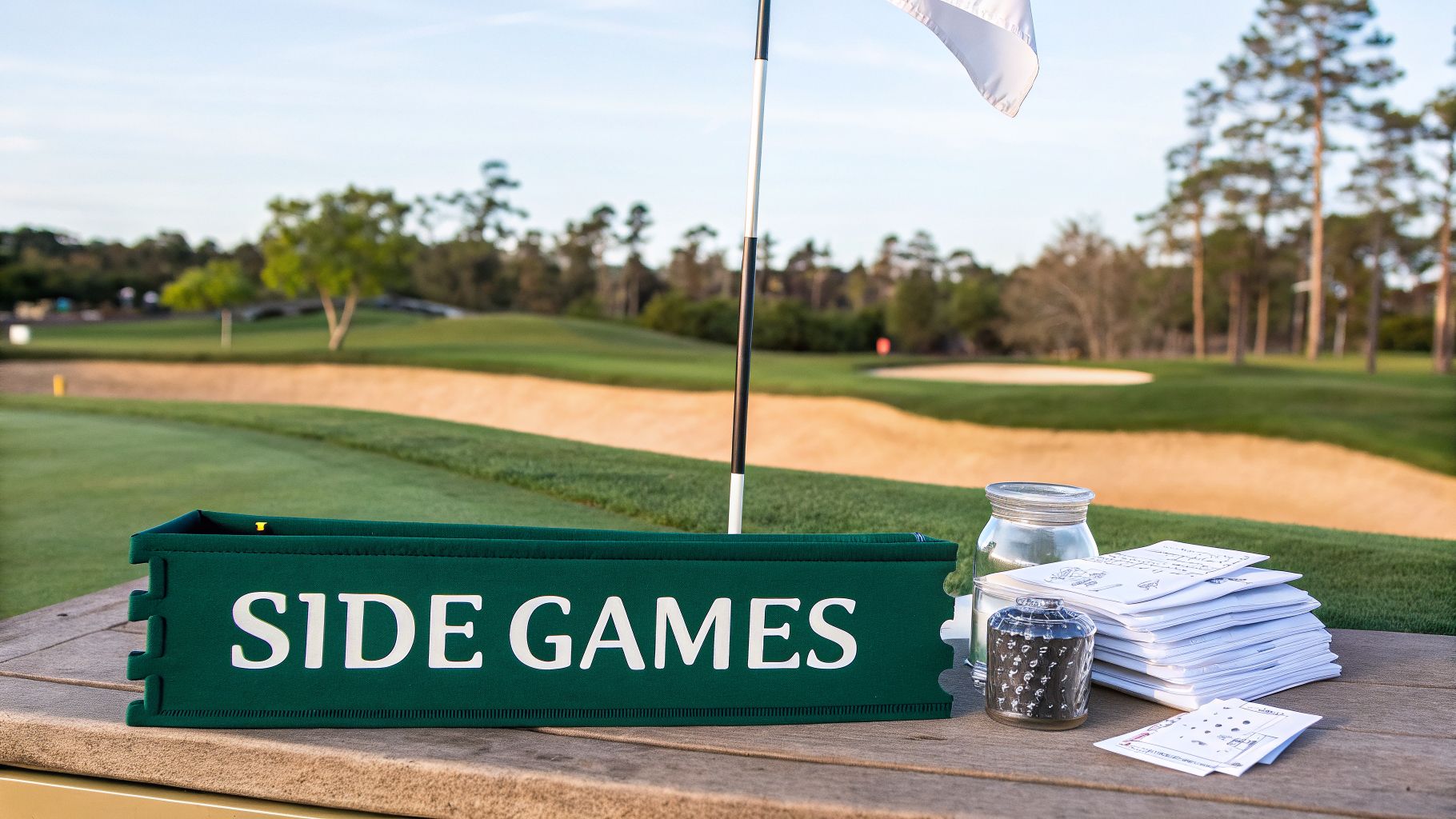
The interface is intuitive, so players can enter scores quickly without holding up play, which means higher engagement and real-time updates for everyone.
The impact is immediate. Players aren't waiting around for hours to see where they stand. They can watch the leaderboard update hole-by-hole, which builds excitement and friendly competition, turning the post-round wait into part of the fun.
From Manual Tallying To Instant Results
The end of the round is where modern software really shines. Gone is the chaotic scene of collecting, checking, and manually adding up dozens of scorecards. The second the last group enters their final score, the tournament is over, and the results are ready.
The software does all the heavy lifting in the background:
It totals up the gross scores for every team.
It applies your handicap formula to calculate each team's net score.
It sorts the leaderboard into gross and net divisions.
It even calculates payouts for side games like skins.
This automation is a huge time-saver. You can identify your winners and hand out awards just minutes after the last putt drops. Not only does this look incredibly professional, but it also shortens the gap between play and the awards ceremony, keeping the energy high. For a deeper look, our guide on golf tournament management software covers these benefits in more detail.
Ultimately, using the right technology helps you run a more professional, efficient, and enjoyable event. It kills the administrative busywork, elevates the player experience with live leaderboards, and delivers instant, accurate results. It's the key to a flawless day from start to finish.
Navigating Common Challenges And Ensuring Fair Play
No matter how well you plan your Captain's Choice event, there are always a few curveballs on tournament day. From agonizingly slow play to scores that just don't add up, being ready for these hiccups is what makes an event feel professional and well-run.
The goal is to have a simple, fair game plan in place before you even need it.
Score integrity is probably the trickiest issue. Scrambles are meant to be fun, but they're also notorious for "pencil whipping"—teams turning in scores that seem a little too perfect. You have to walk a fine line: encourage honesty without making your players feel like they're being watched over like hawks.
This is where clear communication and a little bit of tech go a long way. A simple announcement before the round, reminding teams to record their actual gross score on each hole, can make a huge difference.
Addressing Suspiciously Low Scores
The golf world is filled with wild stories about unbelievable scramble scores. There was the New England tournament where a team shot a 28-under-par (44), and another where a foursome carded a 40 with two holes-in-one—an achievement so unlikely it's practically a statistical impossibility. For anyone running an event, this is a real concern. As MyGolfSpy.com points out, cheaters have been ruining scrambles for a long time.
Using a modern tournament platform with live scoring, like Live Tourney, is one of the best ways to combat this. It provides instant score entry, automated checks, and a transparent leaderboard that makes it much harder to fudge the numbers.
When every team can see the scores updating in real-time on their phones, a crazy-low number stands out to everyone, not just the tournament director. That public accountability is a powerful deterrent.
Managing Pace of Play
A slow round can kill the vibe for the entire field, even in a faster format like a scramble. You don't want groups backed up on every tee box. The key is to be proactive.
Here are a few simple things you can do to keep everyone moving:
Set the Expectation: During your pre-round announcements, mention the expected pace of play (e.g., four and a half hours) and remind everyone to keep up with the group ahead.
Use On-Course Rangers: A friendly ranger or volunteer making the rounds is invaluable. They can spot a slow group early and give them a gentle nudge before it becomes a major problem for the whole course.
Promote "Ready Golf": Encourage teams to hit when ready, get to their balls, and be prepared for their next shot. Little things like continuous putting can save a lot of time over 18 holes.
A friendly on-course presence is far more effective than a post-round penalty. The goal is to help players enjoy their day, and a simple reminder from a ranger is usually all that's needed to get a slow group back on track.
Handling No-Shows and Rule Disputes
You can almost guarantee a few logistical bumps. A foursome suddenly becoming a threesome at check-in is a classic example. You need a rule ready for this. A common and fair solution is to let one player on the three-person team hit a second shot on every hole, rotating who gets the extra shot.
Rule disputes are another inevitability. The best way to handle them is to have a designated rules official or the head pro on call to make the final decision. Instruct players that if they're unsure of a rule, they should play two balls and bring it up with the committee after the round. A clear process keeps things professional and protects the integrity of your event.
No matter how well you plan your Captain's Choice event, you can count on a few questions popping up from the players. It just comes with the territory. Getting out ahead of these common queries makes for a much smoother day for everyone involved.
Here are the questions I hear most often, along with some straightforward answers you can use.
How Should We Set Team Handicaps?
This is probably the biggest question you'll get, and for good reason. A fair handicap system is what makes a net-division event competitive and fun.
While there's no single "right" answer, the A-B-C-D weighted method is a classic for a reason. It does a great job of balancing teams with different skill levels and stops one low-handicapper from dominating the field.
A popular formula looks like this:
35% of the A-player's handicap
15% of the B-player's handicap
10% of the C-player's handicap
5% of the D-player's handicap
If that feels a bit too complicated, you can't go wrong with a simpler method: just take 20-25% of the team's total combined handicap. The most important thing is to pick a method and stick with it. Thankfully, good tournament software calculates all of this for you, so you can ditch the calculator and avoid any manual errors.
A fair handicap system is the foundation of a competitive net-division event. It ensures that every team, from scratch golfers to high-handicappers, feels they have a legitimate chance to win, which is crucial for player enjoyment and engagement.
How Many Drives Must Each Player Use?
For a standard four-person team, the answer is almost always two drives per player. This is a fantastic rule that adds a nice layer of strategy to the day. More importantly, it ensures everyone on the team contributes and prevents the group's best driver from hitting every single tee shot.
If you’re running an event with five-person teams, one or two required drives per player is pretty standard.
Whatever you decide, make it crystal clear before the first ball is in the air. A great pro-tip is to add a small section on the scorecard where teams can track whose drives they've used. It saves a lot of confusion on the back nine.
Can We Play with Three Players on a Team?
Absolutely. Last-minute cancellations happen, and running with a three-person team is a common fix. The trick is making a small adjustment so they can compete fairly against the four-person squads.
One of the easiest solutions is to let one player on the three-person team hit an extra shot on each hole after the best ball is chosen. You can simply have them rotate who gets the extra shot. Another option is to create a slightly modified handicap formula just for them.
The key, as always, is to establish the rule beforehand and communicate it clearly to everyone.
Running a professional, seamless, and fun Captain's Choice Golf tournament is easier than ever with the right tools. Live Tourney eliminates administrative headaches with app-free live scoring, instant results, and effortless setup. Elevate your next event and give your players an unforgettable experience. Learn more and start your free trial today!





