
Apr 13, 2026
Learn the Callaway scoring system for golf. This guide explains the rules, table, and calculations with examples to run a fair tournament for all players.
You’ve probably got an outing on the calendar right now where the field is all over the map. A few players can really play. Most can get around. A handful haven’t kept any kind of official handicap in years, if ever.
That’s where the scoring headache starts. Gross scoring feels unfair. Full handicap verification is too much work for a one-day event. And if you try to patch it together by hand, the scoring table becomes the bottleneck at the exact moment everyone wants results.
The callaway scoring system for golf solves that specific problem. It gives organizers a one-round way to level the field for players without established handicaps. Better yet, it fits modern event operations far better than it did when people had to calculate everything with pencils, paper charts, and a lot of checking.
What Is the Callaway Scoring System for Golf
The Callaway Scoring System is a one-round handicap method built for golfers who don’t carry an official handicap. It was invented by golf professional Lionel F. Callaway in 1957 and was designed to let occasional golfers compete more fairly with stronger players by deducting scores from the worst holes in the first 16 holes of an 18-hole round, with a maximum deduction of 50 strokes (Florida GOLF archive).
That’s the big idea. You don’t ask players to submit past rounds. You don’t need a handicap committee to verify indexes. You take the score they shoot that day, apply the Callaway rules, and produce a net score that gives more people a realistic chance.
Why organizers keep coming back to it
The format fits the events most clubs and coordinators run all the time:
Charity outings: Players often show up with mixed experience and no current index.
Corporate events: Some guests play weekly, others play once a year.
Member-guest side divisions: You may want a simple net method for casual or mixed groups.
One-off tournaments: There isn’t time to collect and validate handicap histories.
The appeal is practical. It’s a same-day system, built for broad participation.
Practical rule: If your field includes many players who can’t provide a reliable handicap before the round, Callaway is one of the cleanest ways to preserve fairness without slowing registration.
What makes it different
Most handicap systems try to measure a player over time. Callaway doesn’t. It focuses on one round and uses a fixed method to soften the effect of the player’s worst holes.
That’s why it works so well for casual competition. A golfer who makes a few big numbers can still post a competitive net score, but the method doesn’t turn the round into a free-for-all. It’s structured, table-based, and predictable once you know the chart.
For organizers, the challenge has never been understanding the concept. The challenge has been processing it cleanly at scale. If you want a broader primer on event scoring options before settling on a format, this guide to scoring in golf tournament play is a useful companion.
How the Callaway Handicap System Actually Works
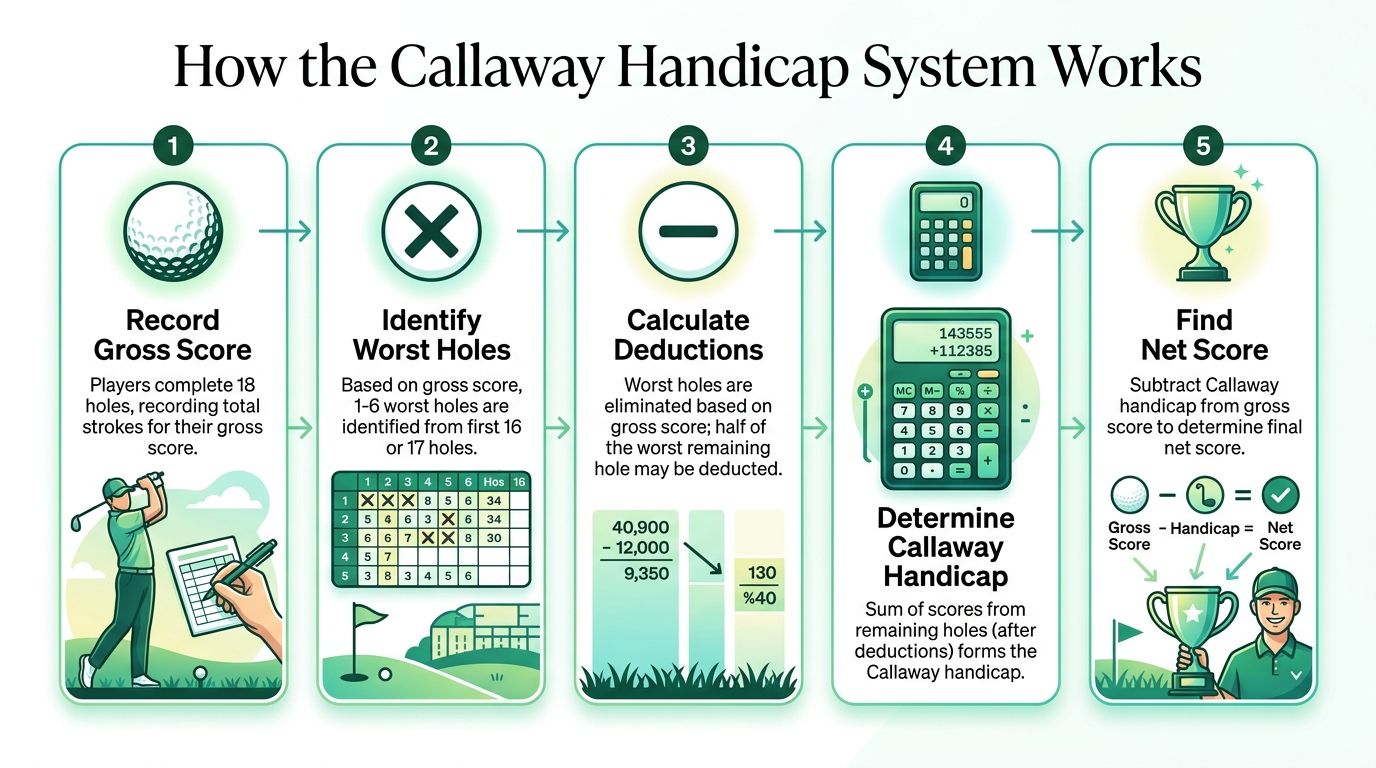
The mechanics are straightforward once you stop thinking of it as a mystery formula. It’s really a sequence. Cap the hole scores, total the adjusted gross, find the proper deduction on the chart, remove the eligible worst holes, then apply the final adjustment.
A few rules matter more than the others, and if your staff gets these right, the rest becomes routine.
Start with adjusted gross score
Before you look at the chart, each hole score is capped at double par. That means a par-3 can count no higher than 6, a par-4 no higher than 8, and a par-5 no higher than 10. This produces the adjusted gross score used by the system (Golfing Scribe explanation of the Callaway handicap system).
That cap is important because it prevents a single disaster hole from overpowering the rest of the round.
Use the official chart
Once you have the adjusted gross, you look up the deduction allowance. The official chart below is calibrated for a par-72 course.
Official Callaway Handicap Adjustment Chart Par 72
Gross Score | Handicap Deduction | Adjustment |
|---|---|---|
68-72 | Scratch | 0 |
73-75 | 1/2 worst hole | 0 |
76-77 | 1 worst hole | -1 |
78-80 | 1 worst hole | 0 |
81-82 | 1 1/2 worst holes | -1 |
83-85 | 1 1/2 worst holes | 0 |
86-87 | 2 worst holes | -1 |
88-90 | 2 worst holes | 0 |
91-92 | 2 1/2 worst holes | -1 |
93-95 | 2 1/2 worst holes | 0 |
96-97 | 3 worst holes | -1 |
98-100 | 3 worst holes | 0 |
101-102 | 3 1/2 worst holes | -1 |
103-105 | 3 1/2 worst holes | 0 |
106-107 | 4 worst holes | -1 |
108-110 | 4 worst holes | 0 |
111-112 | 4 1/2 worst holes | -1 |
113-115 | 4 1/2 worst holes | 0 |
116-117 | 5 worst holes | -1 |
118-120 | 5 worst holes | 0 |
121-122 | 5 1/2 worst holes | -1 |
123-125 | 5 1/2 worst holes | 0 |
126-127 | 6 worst holes | -2 |
128 | 6 worst holes | -1 |
129 | 6 worst holes | 0 |
130 | 6 worst holes | +1 |
Only the first 16 holes can be deducted
This catches people every time. The system excludes holes 17 and 18 from deduction eligibility. A player can make a mess late and those holes still count. That design rewards finishing the round well and keeps the end from being manipulated.
Holes 17 and 18 are never part of the worst-hole deduction. When you train volunteers, put that sentence on the scoring sheet in bold.
Half-hole deductions are literal
If the chart says 1/2 worst hole or 3 1/2 worst holes, you deduct the full worst holes first, then half of the next eligible worst hole. Half strokes round up. So if that half-hole score is 7, the half deduction is 4.
That rounding rule matters because it changes the handicap by a stroke in many real scorecards.
The cap on total handicap
The final handicap is capped at 50. That prevents the system from giving away too much in very high-score rounds and keeps the format usable in mixed fields.
Adjusting for courses that aren’t par 72
The standard chart is for par 72. On a different par, you shift the gross by the par difference before using the table. If the course is par 70, subtract 2 from the gross score before finding the row. If it’s par 71, subtract 1.
That keeps the logic consistent without changing the table itself.
Calculating a Callaway Score Step-by-Step
You are in the scoring tent after a shotgun start. A volunteer slides over a card marked 96 and asks for the net score now, not after a rules debate. This is the part organizers need to get right quickly, and it gets much easier once everyone follows the same sequence or, better yet, uses software that applies the chart logic in the same order every time.

Example one with an adjusted gross of 96
Start with a fictional player named Ryan. After the hole-by-hole caps have already been applied, his adjusted gross is 96.
For that score, the Callaway chart assigns 3 worst holes with a -2 adjustment, as noted earlier in the article. The job is to turn that chart row into a handicap and then into a net score.
Step 1 Find the chart row
Ryan’s adjusted gross is 96.
That places him in the row for 3 worst holes and -2.
Step 2 Identify the eligible worst holes
Now sort only the deductible holes. For staff training, this helps to explain it like a filter. First choose the eligible holes, then choose the highest scores within that group.
Suppose Ryan’s highest eligible hole scores are:
9
8
7
Those three holes total 24.
Step 3 Apply the adjustment
The chart gives Ryan a three-hole deduction of 24, then a -2 adjustment.
So his Callaway handicap is:
24
minus 2
equals 22
Step 4 Compute the net score
Ryan’s adjusted gross is 96.
Subtract the Callaway handicap of 22:
96 - 22 = 74
His net Callaway score is 74.
That is the full calculation. If your staff follows the same order on every card, the method stays simple even in a busy scoring room.
Where organizers get tripped up
The problems usually come from process, not arithmetic.
Using holes 17 or 18 in the deduction pool
Those holes still count in the adjusted gross, but they never count as deductible worst holes.Forgetting to cap a blow-up hole before totaling the card
The adjusted gross has to be correct first. If that input is wrong, every later step is wrong too.Handling half-hole deductions incorrectly
A half-hole deduction means half of that hole’s score, rounded up, not half a stroke.
Train scorers to check those three items before they touch the calculator. It saves more time than rechecking the whole card after a dispute starts.
Example two with an adjusted gross of 97
Now take Melissa. Her adjusted gross is 97.
For this example, use a row that calls for 3 worst holes with a -1 adjustment, following the same chart logic already established earlier. Her three worst eligible holes total 25.
Step 1 Confirm the three worst eligible holes
Melissa’s highest scores among the eligible holes are:
9
8
8
Those add up to 25.
Step 2 Apply the chart adjustment
For this row, the adjustment is -1.
So:
25
minus 1
equals 24
Melissa’s Callaway handicap is 24.
Step 3 Subtract from adjusted gross
Her adjusted gross is 97.
97 - 24 = 73
Her net score is 73.
If someone on your staff already knows how to calculate golf handicaps, this still feels different. Traditional handicap work looks backward across many rounds. Callaway works like a one-day shortcut built from today’s scorecard alone.
A quick template your staff can use
For live scoring or back-office verification, use this exact sequence on every card:
Step | What to do |
|---|---|
1 | Cap each hole at double par |
2 | Add the adjusted gross |
3 | Find the proper deduction row on the chart |
4 | Select the worst eligible holes from 1 through 16 |
5 | Add full-hole deductions and any half-hole deduction |
6 | Apply the chart adjustment |
7 | Subtract total handicap from adjusted gross |
The practical lesson
Callaway works well when the workflow is fixed and visible.
A good organizer gives scorers a standard worksheet, or better, a scoring platform configured to apply the chart, hole eligibility, rounding, and adjustment rules in the right order. One concrete habit helps immediately. Print this seven-step template on the back of every scorecard or rules sheet.
When to Use the Callaway Scoring System
Callaway works best when your event needs same-day fairness more than long-term handicap precision.
That usually means mixed fields, public-facing events, and outings where the priority is a clean competition that feels legitimate without requiring advance handicap administration.
Best-fit events
Some formats line up with Callaway almost perfectly.
Corporate outings
These fields usually include regular players, occasional golfers, and guests who don’t know their index. Callaway gives you a net competition without forcing anyone through a handicap intake process.Fundraisers and community events
You want the event to feel fair, but you also need registration and scoring to move. A one-round system fits that pace.Casual association days
If the group changes from event to event, there’s little value in building a formal handicap framework just for one round.Resort or destination events
Organizers often don’t know the players well, and players may be traveling in for a single day.
Why it fits these events so well
It removes pre-event friction. Players don’t need to email handicap numbers. Staff don’t need to decide whose index is current. The event can stay welcoming without becoming sloppy.
It also helps from a communication standpoint. Players understand “we’ll adjust today’s score using a standard worst-holes method” faster than they understand a long pre-tournament handicap policy.
The best one-day formats aren’t the most scientific. They’re the ones players trust quickly and organizers can administer cleanly.
When not to use it
Callaway isn’t the best choice for every tournament.
Avoid it when:
Your event is a serious championship and official handicaps are expected.
You’re running multiple rounds and want performance measured across more than one day.
The field already has established indexes and there’s no reason to use a substitute method.
You need maximum handicap accuracy for prizes, flights, or formal posting standards.
In those settings, an official handicap framework is the better tool. Callaway is a practical event format, not a replacement for a recognized index system.
The decision test
Ask one question before you commit: Are most players arriving with a trustworthy handicap, or are they arriving with a golf bag and a best guess?
If it’s the second group, Callaway is often the right answer. It gives structure to a field that would otherwise be difficult to score fairly.
Pros and Cons Callaway vs Other Handicap Systems
Every one-day handicap method is trying to solve the same problem. The difference is how much complexity it asks from the organizer and how believable the final result feels to the players.
Callaway sits in a useful middle ground. It’s more structured than a casual adjustment, but less demanding than a full handicap system.

Where Callaway is strong
It works without player history
That’s the biggest advantage. A golfer can show up with no official handicap and still compete in a net format that has clear rules.
It’s easy to explain at check-in
Players don’t need to memorize hidden-hole logic or a points conversion. “We deduct a set number of your worst eligible holes based on your score” is intuitive enough for most fields.
It softens blow-up holes without ignoring the round
Because the method is tied to actual hole scores and a fixed chart, it can reduce damage from bad holes while still rewarding steady play.
It’s practical for event operations
You can train staff on one chart and one repeatable workflow. If your team also manages official handicap events, this overview of how to calculate golf handicaps helps frame where Callaway sits relative to formal handicap work.
Where Callaway is weaker
It isn’t as precise as a long-term index
A one-round method can only estimate so much. It’s useful, not perfect.
The chart creates edge cases
Two players with similar rounds can land in slightly different treatment because they fall on different chart rows. That’s not a flaw unique to Callaway, but it’s something experienced organizers should expect.
Manual scoring can become tedious
The format is simple in concept, but repeated chart lookups, half-hole deductions, and score verification can bog down the scoring table if you’re doing everything by hand.
A format can be fair on paper and still fail in practice if the scoring desk can’t process cards quickly and consistently.
Callaway compared with Peoria
Peoria is another one-day handicap method. It typically relies on a selected set of holes to estimate a handicap after the round.
That can work well, but many players find it less transparent because they don’t always know how those holes affect the result until later. Callaway feels more visible. Players can understand that big numbers on certain eligible holes matter directly.
Callaway compared with System 36
System 36 uses a points-style approach based on performance relative to par. Some organizers like it because it avoids chart lookups and worst-hole subtraction.
Others prefer Callaway because it mirrors the scorecard more directly. If your players are comfortable reading hole-by-hole scores but not point systems, Callaway is often easier to defend in the scoring tent.
Callaway compared with WHS or club handicaps
Official handicap systems remain the better answer when you have established indexes and want the most credible net competition possible.
Callaway isn’t competing with that standard. It fills the gap when the field doesn’t have official numbers or when gathering them would create more hassle than value.
Implementing the Callaway System with Live Tourney
Most Callaway problems aren’t rules problems. They’re workflow problems.
The format asks your staff to capture gross scores accurately, apply the same logic to every player, and publish results without delay. When any one of those steps is manual, your event team ends up doing repetitive math when they should be managing pace, prize tables, and player questions.

Build the event around clean score capture
For Callaway, the score input matters as much as the formula. If the card is messy, the deduction will be messy too.
A solid setup includes:
Hole-by-hole entry: You need the actual hole scores, not just a total.
Clear player instructions: Tell groups to enter every hole exactly as played before any Callaway adjustment.
Single scoring method: Don’t mix paper reconstruction, text messages, and partial digital entry.
Back-office review: Someone should be able to spot a likely posting error before results lock.
If your team wants a consistent process for handling score entry after play, this guide to posting golf score details is worth keeping in your operating notes.
Use automation for the repetitive parts
Callaway is perfect for software because the logic is fixed. The system can apply the same sequence every time:
Read the hole-by-hole scores.
Enforce the double-par cap.
Compute the adjusted gross.
Check the chart row.
Identify the worst eligible holes.
Apply the final adjustment.
Output the net result.
That’s the work humans tend to do inconsistently when the event gets busy.
A setup checklist for tournament organizers
Before the event
Confirm the course par used for the table
Decide who reviews exceptions
Prepare a short player explanation
Make sure hole-by-hole scoring is enabled
Test one sample scorecard before event day
During the round
Monitor incoming scores for obvious entry issues
Keep one rules contact available for questions
Avoid manual side calculations in the field
Let the scoring platform remain the single source of truth
After the round
Review any tied or unusual cards
Verify that holes 17 and 18 were not included in deductions
Publish net leaderboard only after score integrity check
Keep the gross leaderboard visible too, so players can see both views
Players don’t mind waiting a few extra minutes for results. They do mind when the posted leaderboard has to be corrected twice.
Pre-event email template
Use language like this:
Subject: How scoring will work for Saturday’s outing
We’ll use the Callaway scoring system for golf for net results. You do not need an official handicap. Please enter your hole-by-hole gross scores as played. The event scoring process will calculate net scores after the round using the Callaway method. Record every hole carefully, especially on the closing holes, and do not try to adjust your own scorecard.
On-course instruction card
Keep it shorter than you think you need:
Enter each hole score exactly as played.
Do not apply your own handicap adjustment.
Make sure every hole is posted before the round is submitted.
If a player is unsure about a score entry, contact the tournament staff before final submission.
Why software changes the experience
The old version of Callaway depended on a printed chart and careful arithmetic. That still works for a small field, but it doesn’t scale gracefully.
With modern tournament software, the organizer keeps the fairness of the format and removes the slowest part of running it. That’s the part players notice most when they’re standing near the scoreboard waiting for winners.
A Fair and Fun Format for Any Golf Outing
The callaway scoring system for golf has lasted because it solves a real tournament problem. You can run a fair net competition for players who don’t carry official handicaps, and you can do it in a way that still feels orderly and defensible.
That makes it a strong fit for corporate days, guest events, fundraisers, and casual mixed-skill fields. If you’re planning one of those events, this guide to charity golf tournaments is a helpful resource for the broader event side of planning.
The main caution is operational. Callaway only feels simple when the scoring process is disciplined. If staff members are capping holes manually, checking charts by hand, and recalculating cards under pressure, the format can become slower than it needs to be.
That’s why modern tournament software matters so much here. It removes the repetitive math, keeps hole-by-hole data organized, and lets the event team focus on running the day instead of policing arithmetic.
Used well, Callaway gives you something every organizer wants. A field with mixed ability levels, one clean round of golf, and a leaderboard that players accept as fair.
Run your next Callaway event with less paperwork and faster results using Live Tourney. It gives organizers app-free live scoring, real-time leaderboards, and a simpler way to manage tournaments from setup through final payouts.





