
Apr 12, 2026
Your complete guide to Brookside Golf Club in Pasadena. Explore the Koiner & Nay courses, tee times, rates, amenities, and tips for hosting a tournament.

A tournament director once told me, “We booked Brookside,” and I had to ask one question before we could talk setup: Which Brookside? That confusion happens more often than people admit, because two historic clubs in two different states carry the same name and very different operating realities.
The Tale of Two Famous Brookside Clubs
When golfers say brookside golf club, they might mean the public municipal facility in Pasadena, California, or they might be thinking of the private club in Pottstown, Pennsylvania. For players, that mix-up is harmless. For event organizers, it matters immediately because the booking process, field expectations, and course access are completely different.

The Pennsylvania Brookside
The Pottstown club has real history behind the name. Brookside Country Club in Pottstown, Pennsylvania, was constructed in 1916 and opened its original 9-hole course in 1917. By the 1920s, it had 153 members and hosted an exhibition featuring Harry Vardon, Ted Ray, and Walter Hagen according to the club’s history page.
That’s the profile of an early private club that built prestige quickly. It’s tied to classic Northeastern club development, member culture, and exhibition golf as a statement of status.
The Pasadena Brookside
The Pasadena property is the one commonly meant when discussing a broad public golf destination. It’s the better subject for operators because it combines historic architecture, municipal access, heavy public use, and event flexibility in a way few facilities do.
This brookside golf club sits beside the Rose Bowl and functions as more than just a place to play a casual round. It’s a working example of how a public golf site can remain historically significant while still handling modern traffic, daily-fee expectations, practice use, food-and-beverage needs, and organized competition.
Practical rule: If a client or sponsor says “Brookside,” confirm the city before you discuss formats, pricing, or tee sheets.
Why Pasadena deserves the deeper look
Pasadena’s Brookside raises questions operators face every week:
How do you allocate players across multiple courses?
How do you preserve pace when a public facility also hosts events?
How do you make a historic site feel current without sanding off its identity?
Those are operating questions, not brochure copy. And Brookside in Pasadena offers useful answers because it has enough history to matter and enough daily activity to expose every weak point in planning.
Exploring the 36-Hole Layout The Koiner and Nay Courses
Brookside Golf Club in Pasadena is strongest when you look at it as a two-course system, not a single venue with overflow capacity. The operational value is in the contrast.
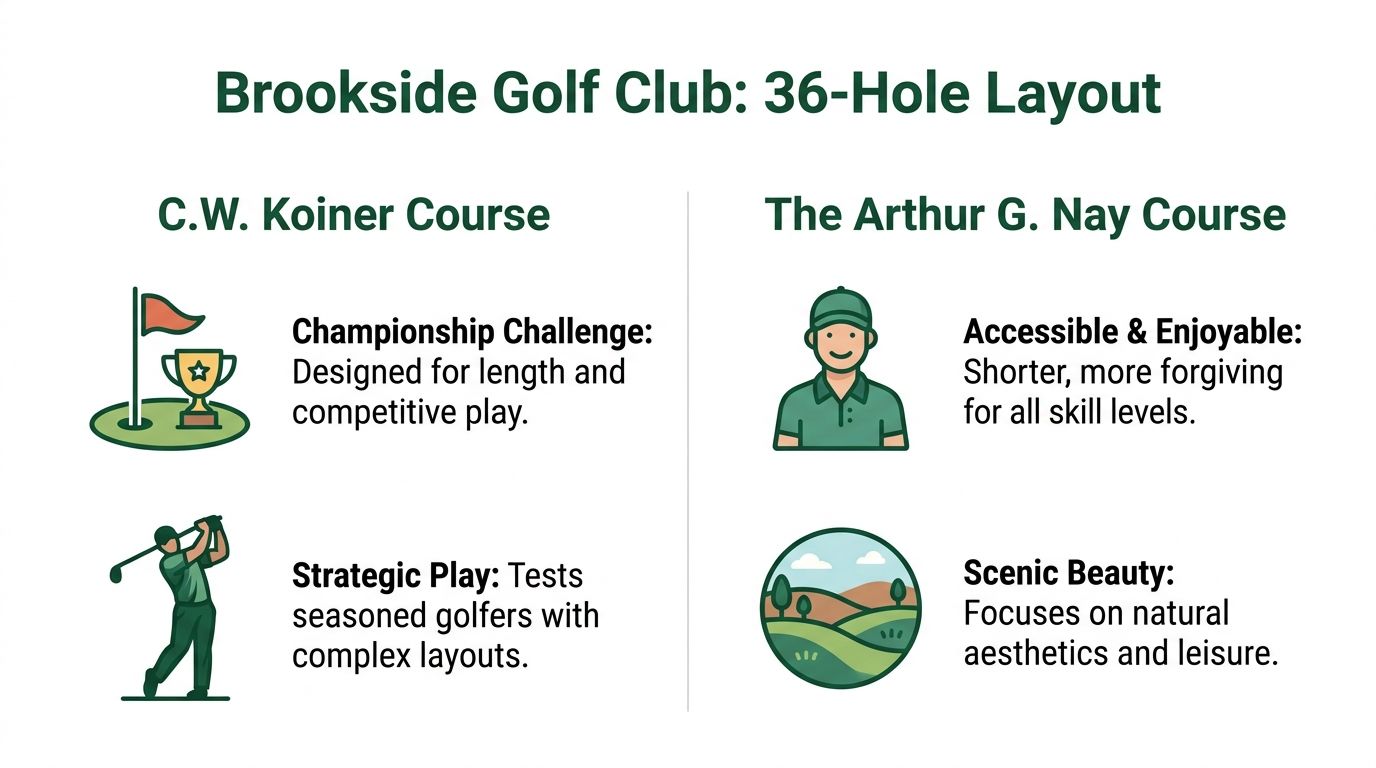
The C.W. Koiner Course is a 7,104-yard, par-72 championship layout with a 73.6 rating and 128 slope, while the E.O. Nay Course measures 6,025 yards at par 70. Both were designed by William P. Bell, with Koiner opening in 1928 and Nay following in 1938 as outlined in this Fore Magazine feature on Brookside’s history and operations.
Two courses, two jobs
Koiner is the course that carries the competitive identity. It has the scale and scorecard profile that fit championships, stronger fields, and players who want a full-length municipal test.
Nay does a different job. It’s shorter, easier to absorb for a broader player base, and far more useful than many organizers initially realize. Shorter doesn’t mean less valuable. It often means more flexible.
Here’s the cleanest way to think about the property.
Feature | Koiner Course | Nay Course |
|---|---|---|
Yardage | 7,104 yards | 6,025 yards |
Par | 72 | 70 |
Positioning | Championship course | Shorter public test |
Opening timeline | 1928 | 1938 |
Best fit | Stronger competitive fields, championship setups, marquee events | Mixed-ability groups, easier access, secondary event rotations |
What Bell’s design still does well
William P. Bell’s work tends to reward players who pick targets carefully rather than just swing aggressively. At Brookside, that matters because the site isn’t trying to imitate a modern resort spread. It’s a mature municipal layout with tree-lined corridors, classic strategic framing, and enough variation between courses to let organizers shape the day instead of forcing everyone into one setup.
The Koiner Course gives tournament staff a truer championship canvas. It’s the natural home for top flights, gross competitions, qualifiers, and events where the course itself should be part of the test.
The Nay Course is where operators can solve practical problems:
Mixed-skill fields: Better for outings where handicaps vary widely.
Split-course shotgun plans: Useful when pace and capacity matter more than pure difficulty.
League and community events: Less intimidating for newer or occasional players.
Turf and presentation matter
The property is also defined by Bermuda grass fairways, Poa annua greens, and tree-lined holes framed by eucalyptus, pine, and oak, all part of the facility profile described in the same Fore Magazine reporting. Those details shape how the course plays and how events should be staged.
Poa annua greens usually reward patience more than aggression. Bermuda fairways can produce lies that look straightforward but require cleaner contact than some public players expect. Mature trees create direction and strategy, but they also influence cart routing, marshal visibility, and recovery-shot options.
A dual-course site works best when each course serves a purpose. Problems start when organizers treat them as interchangeable.
What players and organizers should take from the layout
For players, the takeaway is simple. Choose the course based on the round you want, not the brand name alone.
For organizers, the lesson is sharper. Don’t ask only, “Can Brookside host my event?” Ask, “Which course should hold which portion of my field, and why?” That single decision affects pace, scoring spread, player satisfaction, and how much trouble your staff inherits by the turn.
Strategic Play and Course Management Tips
The most useful way to approach Brookside is to stop thinking in terms of “fairway versus rough” and start thinking in terms of preferred corridors. That’s where the architecture starts talking.
Start with the landing area, not the club
A key design principle associated with Brookside’s course architecture is “random bunkering,” with slice bunkers removed on one side and hook bunkers installed on the other, creating 3-4 landing corridors and shifting drive zones as described on the Brookside Country Club golf course design page.
That matters because the hole doesn’t ask every player the same question. A longer hitter may see one lane. A conservative player may have a different safe zone. A senior event, junior field, or mixed corporate outing won’t experience the same hole the same way.
What works
Pick a side before you pull a club. On holes with angled bunkering, indecision is more dangerous than laying back.
Use the tee that matches your carry pattern. Brookside’s style rewards players who can reach the correct corridor, not players who insist on proving something.
Miss where the next shot stays simple. On tree-lined municipal golf, the big penalty often isn’t distance loss. It’s losing a clean angle.
What doesn’t
Trying to overpower a hole without identifying the better side rarely pays off. Neither does defaulting to driver everywhere.
A lot of players also misread Poa annua greens by treating them like perfectly uniform surfaces. Late in the day, pace and texture can change enough that defensive putting becomes smarter than hunting the edge on every attempt.
If the course offers multiple landing corridors, your job isn’t to find the longest one. It’s to find the one that still gives you your preferred approach.
Green-reading discipline matters
Brookside-style greens usually reward two habits:
Read from below the hole when possible. You’ll see more of the tilt and control speed better.
Respect the final few feet. Poa annua can make short putts feel less automatic if you hit them lazily.
For competitive players, pin position changes the whole strategy. If you want a better process for that, this guide on how to read pin sheets is worth reviewing before any organized event.
Best advice for mixed-ability groups
If you’re planning a round with players of very different levels, assign success differently.
A stronger player should focus on angle and distance control. A mid-handicap player should prioritize the widest useful corridor. A newer player should treat tree trouble and greenside bunkers as red zones to avoid at almost any cost.
That approach lowers blow-up holes and makes Brookside more enjoyable. On this kind of architecture, smart restraint usually beats heroic recovery golf.
Rates Tee Times and Club Amenities
At a facility like brookside golf club, the first practical question isn’t architecture. It’s access. Can you get on, warm up properly, and support the kind of day you’re trying to have?
What the facility offers beyond the first tee
Brookside’s value as a public venue comes from being more than two golf courses. The facility includes a restaurant, banquet facilities, pro shop, driving range, putting greens, chipping area, and bunker practice space, all identified in the earlier-cited Fore Magazine reporting.
That package matters for both casual golfers and event staff. If a course has weak practice infrastructure, players show up cold and events start ragged. If food-and-beverage space is limited, post-round awards turn into a traffic problem. Brookside avoids a lot of those bottlenecks because the support pieces are already part of the property.
How to think about booking
Specific public rates and tee-time policies change, so the smart move is to verify current pricing and availability directly with the facility before making plans. From an operator’s perspective, the important point isn’t a single posted number. It’s the booking strategy.
Use this approach:
For a casual round: Look for the day and time that match your tolerance for traffic, not just the lowest rate.
For a buddy trip: Reserve enough lead time to keep the group on one tee block or one course.
For an outing: Ask early whether your field is better served by one course, both courses, or a staggered plan.
Amenities that affect operations
Some amenities sound secondary until they create or solve a problem.
Practice range and short-game space: Essential for clinics, sponsor activations, and players who need structured warm-up time.
Banquet and restaurant support: Useful for check-in, scoring wrap-up, awards, and donor recognition.
Pro shop capacity: Important for merch credits, prize distribution, and last-minute guest needs.
A practical detail many operators overlook is fleet readiness. If your event depends on carts, maintenance discipline matters. For teams that manage their own fleet or want a useful refresher, this guide on how to maintain golf cart batteries is a worthwhile operational reference.
Who gets the most value from Brookside
Brookside tends to fit three groups especially well:
Golfers who want a historic public course with real practice support.
Organizers who need space for both golf and post-round functions.
Groups that want flexibility without sacrificing a recognizable venue.
That’s the key distinction. Some public courses give you a tee time. Brookside gives you an event environment.
How to Run a Modern Tournament at Brookside
Brookside is attractive for tournaments for the same reason it can become difficult. It has room, reputation, and multiple moving parts. If you run events often, you already know those advantages can turn into friction fast if the planning system is weak.
Why the venue works for organized play
A dual-course municipal property gives organizers options that single-course facilities can’t. You can separate divisions, route different formats more intelligently, and absorb larger fields without making every player feel jammed into the same competitive lane.
That flexibility becomes even more important when the property is evolving. Brookside’s dual-course municipal setup, combined with modernization work that includes a new ADA-accessible miniature golf course, highlights the scheduling and format complexity tournament software should be able to handle, as noted by First Tee Greater Pasadena’s coverage of the project context.
Tournament trade-offs
The common mistake is assuming more holes automatically make tournament administration easier. They don’t. They create more decisions.
A modern event at Brookside usually requires someone to manage:
Course allocation: Which players belong on which course.
Format alignment: Whether the field should all play the same setup or split by ability and purpose.
Registration flow: How players, guests, and sponsors get assigned cleanly.
On-course scoring: How to avoid paper chaos and delayed leaderboards.
Accessibility and routing: How to account for participant needs without forcing staff into manual workarounds.
What good tournament planning looks like here
The strongest Brookside events usually share a few habits.
Build the field around the venue
Don’t start with a generic outing template and force Brookside into it. Start with what the property does well. If your field has competitive players and casual guests, use that distinction instead of pretending one setup fits everyone.
Keep registration tied to course logic
When organizers collect entries without mapping them to course placement, trouble starts later. Flights, sponsor spots, pace expectations, and player satisfaction all get harder to manage.
Use live scoring and centralized administration
At a property with this much activity, staff shouldn’t be chasing paper scorecards across banquet tables. A centralized platform that handles pairings, mobile-friendly scoring, live leaderboards, and final results isn’t a luxury. It’s operational protection.
For a deeper look at what that kind of system does, this breakdown of golf tournament management software is a practical benchmark.
Operator note: The bigger the venue, the less you can rely on verbal fixes. If pairings, course assignments, and scoring rules aren’t centralized, staff will spend the day correcting preventable errors.
What fails most often
Three things tend to go wrong at venues like Brookside.
First, organizers overcomplicate formats for a mixed field. Second, they underestimate communication needs across two courses. Third, they leave scoring reconciliation too late.
The best modern tournament isn’t the one with the most moving parts. It’s the one where players know where to go, staff know what’s happening, and results come in cleanly without a back-office scramble.
Directions Contact Information and Recent Reviews
Brookside Golf Club’s biggest location advantage is also the easiest way to explain where it sits. It’s adjacent to the Rose Bowl in Pasadena. If you know the stadium, you’re already close.
Getting there without overthinking it
For most visitors, GPS navigation to Brookside Golf Club in Pasadena is straightforward. The practical advice is to build in extra time on event days, major weekends, or any period when Rose Bowl traffic may affect nearby roads and parking patterns.
If you’re bringing a group, send one parking and arrival note to every player the day before. That single message prevents more late starts than almost anything else.
What to confirm before you leave home
Check the club’s official channels directly for current contact details, online tee time access, and any same-day operating notices. For organizers, confirm the basics in writing:
Arrival window
Check-in location
Course assignment
Practice access
Food-and-beverage timing
That sounds simple because it is. Problems usually come from assuming everybody already knows.
What recent player feedback usually centers on
The recurring themes around a high-profile public facility like Brookside are predictable. Players tend to focus on four things:
Conditioning: Historic layouts always invite strong opinions about turf quality and green performance.
Pace of play: Public demand can make timing a real part of the experience.
Staff interaction: A smooth check-in and clear starter communication improve the day quickly.
Overall value: Golfers usually judge Brookside as a full-site experience, not just a scorecard test.
The balanced way to read those reviews is this: Brookside isn’t a secluded private retreat. It’s a busy, historic public golf operation. If you arrive expecting polished municipal golf at a landmark setting, you’re likely evaluating it fairly. If you expect private-club tempo from a high-volume public venue, you probably won’t.
Brookside Golf Club FAQ
Is Brookside Golf Club public or private
The Pasadena Brookside Golf Club is a municipal public golf facility, which is the main reason it draws such a broad mix of daily-fee players, local regulars, and event groups.
Are there two different Brookside clubs people confuse
Yes. The name often gets confused with the private Brookside Country Club in Pottstown, Pennsylvania. If you’re booking a round or planning an event, always confirm you mean the Pasadena facility beside the Rose Bowl.
Which course is better for stronger players
The Koiner Course is the more natural fit for stronger players and competitive events because it’s the championship test on the property. If you want to better understand terms like rating and what they imply for setup difficulty, this explanation of what is a course rating is useful background.
Is the Nay Course only for beginners
No. It’s shorter, but that doesn’t make it irrelevant for good players. Shorter courses often create better pace, better mixed-field events, and more enjoyable rounds for groups that don’t need a full championship setup.
What practice amenities should players expect
Brookside offers a solid practice footprint that includes a driving range, putting greens, a chipping area, and bunker practice. That’s a meaningful advantage for players who like to warm up properly and for organizers who need pre-round activity space.
Is Brookside a good venue for tournaments
Yes, but only if the event is organized with the venue’s complexity in mind. The dual-course format creates flexibility. It also creates more moving pieces around assignments, scoring, and player communication.
Good Brookside events are built around clarity. Players should know their course, their format, and how scores will be handled before they arrive.
What kind of atmosphere should visitors expect
Expect a historic public golf environment, not a private-club bubble. The appeal is the combination of architecture, accessibility, established local identity, and the Rose Bowl setting.
Does Brookside work for casual golfers too
Absolutely. That’s one of its strengths. The facility can support a serious competitive round, a casual public tee time, a charity event, or a mixed-skill group without losing its identity.
If you’re planning an outing, league, or tournament at Brookside and want the admin side to run as cleanly as the golf side, Live Tourney gives organizers a simple way to manage registration, pairings, live scoring, and results without the usual friction. It’s a practical fit for busy facilities and event staff who need modern tournament operations without adding complexity.





