
Apr 5, 2026
Discover the best app for golf handicap in 2026. Compare official USGA systems with feature-rich trackers to find your perfect fit today.

So you're looking for a golf handicap app. The first thing you'll notice is that there are a ton of options out there, and picking the "best" one isn't as simple as it sounds.
The choice boils down to one fundamental question: Are you tracking your handicap for official, competitive tournaments, or are you more focused on game improvement and friendly matches?
Your answer points you down one of two very different paths.
Official vs. Third-Party Apps
Think of it like this: are you looking for a certified odometer to enter a classic car show, or a souped-up dashboard with a GPS for track days? Both measure performance, but they serve completely different purposes. One is for official validation, the other is for a richer, more detailed experience.
Official USGA/GHIN Apps: These are the gatekeepers. If you want to play in a club championship, a state amateur event, or any competition that requires a validated Handicap Index, you have to use a system that posts scores directly to the USGA's Golf Handicap Information Network (GHIN). The official GHIN app is the most direct way to do this.
Third-Party Apps: This is where you'll find popular apps like TheGrint, 18Birdies, and Golfshot. Honestly, they often have a much better user experience with advanced stats, on-course GPS, and social features that the official apps just don't offer. The good news? Many are licensed to post your scores to GHIN, giving you the best of both worlds.
For a lot of serious golfers, the perfect setup is a third-party app that links directly to their GHIN account. You get all the powerful features and analytics while making sure every round counts toward your official Handicap Index.
Ultimately, how you play the game will steer your decision. The die-hard competitor needs the official stamp of approval from a USGA system. But if you're a weekend player who loves digging into stats, a third-party app will probably give you way more value.
To make it even clearer, here’s a quick breakdown of how these two types of apps stack up against each other.
Official USGA Apps vs Third-Party Handicap Trackers
This table gives you a high-level look at the key differences between the official systems and the feature-rich third-party alternatives.
Feature | Official USGA/GHIN App | Third-Party Apps (e.g., TheGrint) |
|---|---|---|
Official Handicap | Yes. Posts directly to GHIN for an official Handicap Index. | Often. Many are licensed to post to GHIN, but not all. |
Core Function | Score posting and basic handicap lookup. | All-in-one: GPS, stats, social features, and score posting. |
Advanced Analytics | Very limited. Focuses on handicap calculation only. | Extensive. Deep dives into strokes gained, putting, and more. |
On-Course GPS | Basic or non-existent. | Standard Feature. Usually includes distances, flyovers, and targets. |
User Experience | Functional, but often feels dated and clunky. | Generally more modern, intuitive, and user-friendly. |
Social Features | Minimal. Limited to your club's network. | Robust "Facebook for golf" style feeds, friend groups, and leaderboards. |
Cost | Included with your golf association membership fee. | Often a freemium model; basic features are free, advanced stats require subscription. |
In short, if you just need to post scores for an official handicap, the GHIN app does the job. But if you want a tool that helps you track your game, analyze your performance, and connect with other golfers, a third-party app is almost always the better choice—just make sure it’s licensed to post to GHIN if you need an official index.
Understanding How a Golf Handicap Works
Before picking an app, you need to get what a handicap actually does. Think of it as the ultimate equalizer in golf. It’s the system that lets a weekend warrior have a fair match against a club champ.
A lot of golfers think a handicap is just their average score. It’s not. It’s a measure of your potential, based on your best rounds. This is a key difference—it means one terrible day on the course won't wreck your handicap.
The World Handicap System
This all runs on the World Handicap System (WHS), which uses two key numbers from the course itself to figure out how tough your round really was.
Course Rating: This tells you what a scratch golfer (a player with a 0 handicap) is expected to shoot. If a course has a 71.5 rating, that’s what a top-tier player should be aiming for.
Slope Rating: This measures how much harder the course is for a bogey golfer (around an 18 handicap) compared to a scratch player. The scale goes from 55 to 155—the higher the number, the tougher it is for the average player.
The system uses these ratings to turn your score into a Score Differential. Your official Handicap Index is then calculated by averaging the 8 best Score Differentials from your most recent 20 rounds.
Your Handicap Index isn’t your average score; it’s a reflection of your best golf. It’s calculated using only your top performances, which is why posting scores consistently and accurately is the only way to maintain a true number.
The flowchart below breaks down how to think about your choice. Is your main goal playing in official events, or are you more focused on tracking your own progress?
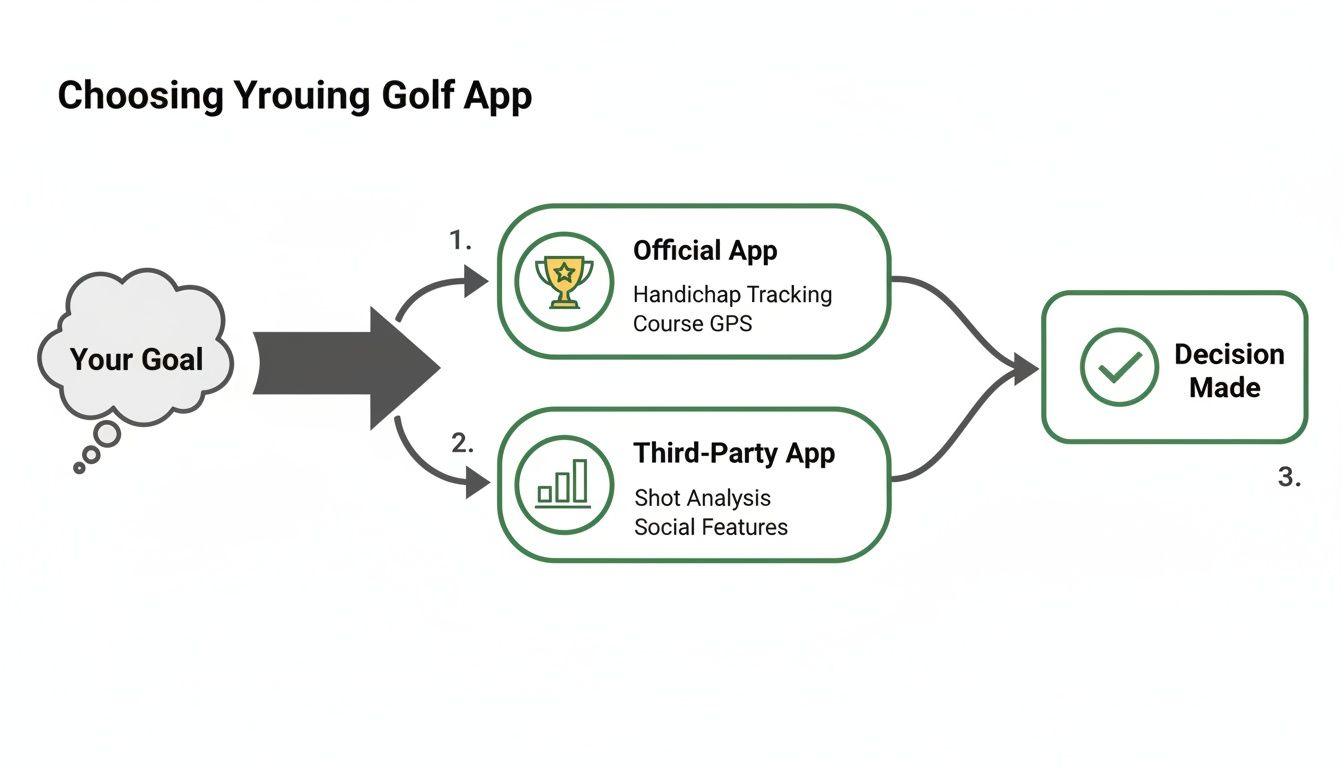
This really gets to the heart of the matter: an official GHIN app is non-negotiable for validated tournament play, but a third-party app will usually give you far better tools for game analysis.
If you want to get into the weeds on the formulas, you can check out our full guide on how to calculate golf handicaps. Getting this foundation right makes it obvious why a good app's features are so critical for tracking your game.
Essential Features of a Great Golf Handicap App
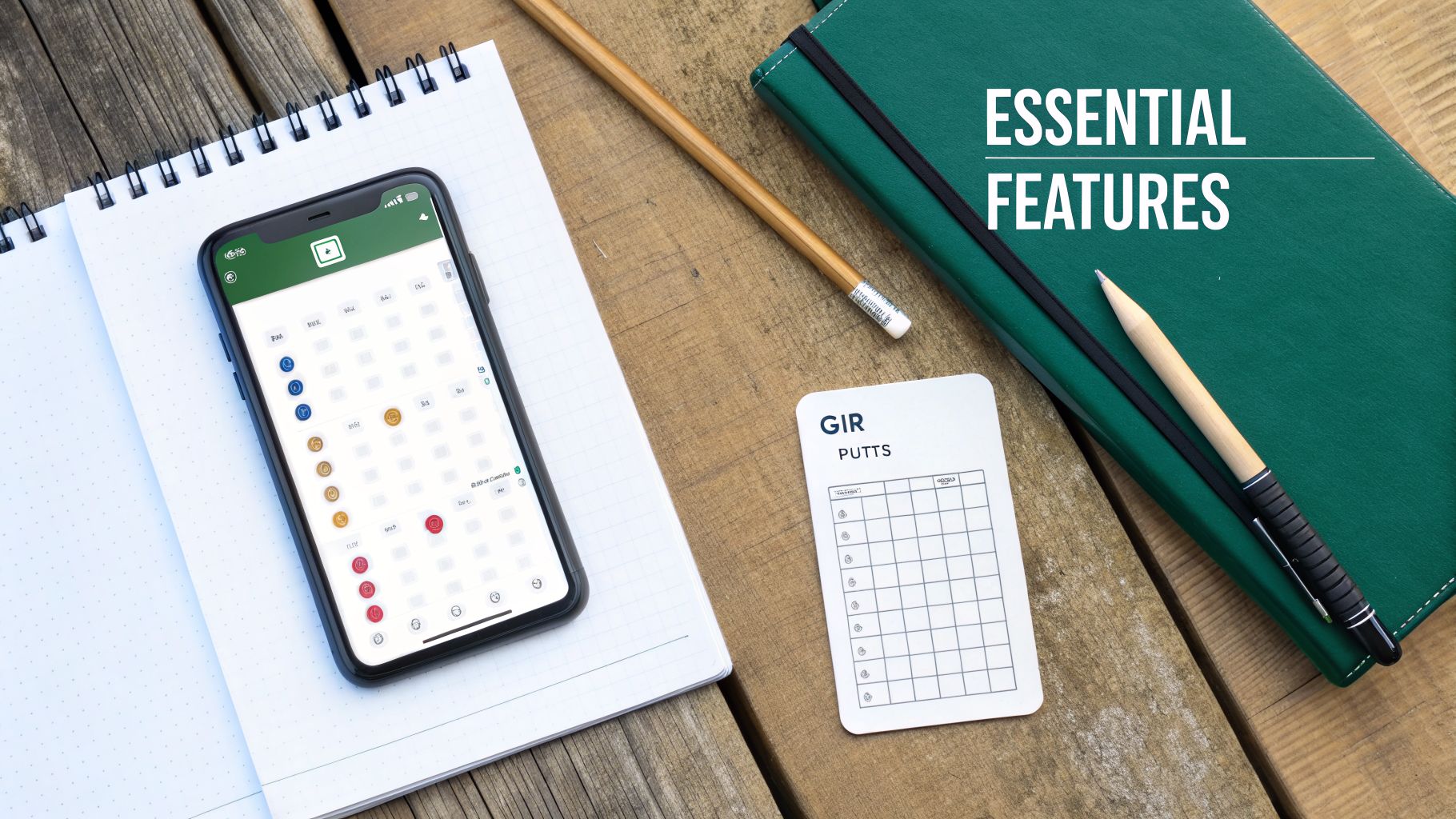
What really separates a game-changing golf app from a basic digital scorecard? When you're looking for the best app to track your golf handicap, the difference comes down to a few core features that actually help you get better.
An app that just lets you punch in your final score is fine, but a great one should actively help you manage your handicap and understand your game.
The single most important feature? Official scoring. If your goal is to carry an official Handicap Index, the app absolutely must connect directly with the USGA/GHIN system. This is a non-negotiable. It’s what ensures every round you post is legit and counts toward your index, making you eligible for tournaments.
Must-Have Functionality
Beyond just posting scores, the best apps give you a whole suite of tools to dig into your performance. You'll want to look for these essentials:
Robust Stat Tracking: Your app needs to go beyond your final score. Look for key metrics like Greens in Regulation (GIR), Fairways in Regulation (FIR), putts per round, and sand saves. This is the stuff that paints the full picture of your game's strengths and weaknesses.
On-Course GPS: A reliable GPS is a true game-changer. Getting precise distances to the front, middle, and back of the green—plus any hazards—takes the guesswork out of club selection. It helps you commit to your shot with confidence.
Intuitive Score Entry: A great golf app shouldn't feel like a chore to use. In fact, good user experience best practices are critical. Tapping in scores hole-by-hole should be fast and simple, not a distraction from your actual round.
The gold standard is an app that makes you a smarter golfer. It shouldn't just track what you did, but give you the data to understand why it happened. That’s what guides your practice and on-course strategy.
Differentiators That Set an App Apart
While the features above are the baseline, a few other things can elevate an app from good to great. These are the "nice-to-haves" that often become the reason you stick with one for the long haul.
Some platforms have really nailed this by bundling everything into one package. For instance, TheGrint has become a huge player by building its platform around a feature set that integrates directly with the USGA. Its one-tap score upload syncs right to your Handicap Index, and it tracks over 18 advanced stats, giving you the granular insights needed for real improvement.
Social features that let you compete against friends or follow their rounds can also make things more fun and keep you motivated. As you get more serious about improving, the ability to dive into strokes gained analysis can completely change how you see your game.
And if you want to get into the nitty-gritty of how to enter those scores, check out our guide on posting your golf score correctly.
Comparing Official and Alternative Handicap Apps
When you’re picking an app for your golf handicap, you’re really choosing between two different philosophies. It’s a lot like choosing between a government-issued passport and a premium travel card. One is the official key for entry, while the other is loaded with perks that make the whole experience better.
The undisputed "passport" in the golf world is the official app from the Golf Handicap Information Network (GHIN). Its job is simple and authoritative: post your scores to the USGA system and maintain your official Handicap Index. That direct line to the USGA is its superpower.
The Official Standard: GHIN
If you have any plans to play in official club championships, state amateurs, or any other sanctioned tournament, a GHIN-compliant system isn't just a good idea—it's mandatory. The GHIN app is the most direct way to get there.
The Golf Handicap Information Network (GHIN) app is the official standard for handicap management in the United States, and because it's free, it makes tracking an official USGA handicap accessible to everyone. It sticks to the basics: posting scores, looking up handicaps, and pulling up course data. You can check it out on the App Store for more details.
While some golfers find its features a bit bare-bones, its official status and no-cost download make it an essential tool. But let's be honest, many of us want more than just compliance. We want tools that actually help us get better. That’s where the alternatives come in.
The Feature-Rich Alternatives
Apps like TheGrint, Golfshot, and Arccos have built their reputations by delivering what the official apps often don't: deep analytics, incredible on-course tools, and social features that make the game more fun. They’re the premium travel cards of the golf world.
These apps are usually packed with features that serious golfers love:
Advanced Shot Tracking: Using your phone or a watch, they can automatically track every shot, giving you real data on how far you actually hit each club.
Strokes Gained Analysis: This is the metric the pros use. These apps crunch the numbers to show you exactly where you're losing strokes against a benchmark, whether it’s off the tee or on the green.
GPS with Green Contours: Forget just getting the distance to the pin. The best apps give you detailed heat maps of the greens, showing you the slopes and breaks before you even step up to your putt.
Practice and Swing Analysis: Some apps even help you on the range, using your watch's sensors to give you feedback on your swing tempo without needing a pricey launch monitor.
The trade-off is pretty clear. With an official app, you get no-frills compliance. With an alternative, you get a powerful game-improvement partner that can still keep your handicap official.
This is the best part: many of these top-tier apps, including TheGrint, are licensed by the USGA to post scores directly to your GHIN account. You get the best of both worlds—all the advanced features and a legitimate, official handicap.
While some systems like Arccos require you to buy sensors and pay a subscription, others like TheGrint and Golfshot offer a ton of value for a low annual fee. Your choice really comes down to what you value more: simple, official scorekeeping or a richer platform that helps you analyze and improve your game.
The Tournament Organizer’s Management Challenge
While the best app for a golf handicap is fantastic for an individual player, it creates a massive headache for anyone trying to run a tournament.
The entire focus of a player app is personal performance, not group coordination. This creates a huge gap between what a player tracks on their own and what an organizer actually needs to manage an entire field of golfers.
Imagine you're running a charity outing with 120 players. Each one shows up using a different app—TheGrint, Golfshot, GHIN, or a dozen others. Your pre-event and on-course workflow immediately becomes a logistical nightmare.
The Problem With Player-Centric Apps
When you rely on individual apps, you’re forced into a manual, error-prone process. The challenge isn't just getting a final score; it's about managing the entire event from the moment players arrive until the last prize is handed out.
This patchwork approach creates several serious bottlenecks:
Handicap Verification: How do you reliably collect and verify handicaps from dozens of different sources? Manually typing this data into a spreadsheet is a recipe for mistakes and wastes a ton of time.
Score Collection: Are you really going to ask players to text you screenshots of their scorecards? It’s chaotic, unprofessional, and makes real-time updates impossible.
Live Leaderboards: A dynamic live leaderboard is what makes a modern tournament exciting. You can't have one if all the scores are locked away in 120 separate apps on 120 different phones.
Pairings and Flights: Building flights and creating fair pairings based on verified handicaps turns into a painful spreadsheet exercise instead of a simple, automated task.
The core issue is that personal handicap apps are built for the player's world, which is all about their own history and stats. A tournament organizer lives in a world of event logistics and needs a central command center to manage the entire field.
Simply put, these apps solve the player's problem, not the organizer's.
Trying to run a tournament by piecing together data from individual player apps is like trying to direct an orchestra where every musician is playing from different sheet music. It's completely unsustainable for creating a smooth, professional event. This is where a dedicated management solution becomes a necessity, not just a nice-to-have.
Running Your Tournament With Dedicated Software

While a personal handicap app is great for tracking your own game, it creates headaches when you’re trying to run an event for a group. This is where dedicated tournament software comes in. It flips the script entirely, focusing on solving the organizer's problems instead of creating new ones.
Think of it as the command center for your event. Instead of chasing down players to download apps or dealing with a dozen different interfaces, a good platform brings everything into one place. Solutions like Live Tourney are built from the organizer's point of view, making setup and scoring simple without forcing players to download anything. They just use a link on their phone.
Shifting Focus from Player to Organizer
The real goal of tournament software is to get you out of the back office and away from the spreadsheets. It automates the tedious, time-consuming tasks that can either make or break an event, freeing you up to focus on creating a great experience for your players.
It turns painful manual jobs into instant, automated actions:
Online Registration: Players sign up through a simple link, and their info goes right into the system. No more messy lists.
Easy Pairings & Flights: The software builds tee sheets and flights automatically based on handicap data.
Automated Scorecards: Generate professional, custom scorecards and other materials in minutes, not hours.
Live Leaderboards: As scores are entered, the leaderboard updates in real-time, bringing that pro-tour excitement to everyone.
Tournament software doesn't replace the apps players already love. It works with them, acting as the bridge that connects every player to a single, professionally managed event. It guarantees a smooth, consistent experience for everyone.
The App-Free Advantage
Let's be honest—the biggest point of friction at any event is forcing people to download an app. Asking dozens or even hundreds of players to install, sign up for, and learn a new app before they can play is a recipe for frustration.
An app-free, web-based system removes that barrier entirely, ensuring 100% participation from anyone with a smartphone.
This approach immediately makes your event feel more professional. By letting the software handle the logistics of handicaps, pairings, and scoring, your staff can focus on providing great service. Players get the thrill of a live leaderboard, and you get the peace of mind that comes with a smooth, well-run tournament. To see how it all works, check out our guide on modern golf tournament management software.
Common Questions About Handicap Apps, Answered
When you start digging into golf handicaps and the apps that track them, a lot of questions pop up. Here are some of the most common ones we hear, whether you're a player just trying to get an index or an organizer setting up your next event.
Do I really need an official USGA handicap for tournaments?
It depends on the event. For most club championships, state amateur events, or other serious competitions, the answer is yes. You’ll need an official Handicap Index® from a USGA-authorized golf club, which is usually tracked in a system like GHIN.
But for casual outings or charity scrambles? Organizers often just use unofficial handicaps or fun scoring formats where a strict index isn't necessary. The best advice is simple: always check with the tournament organizer beforehand.
Can an app like TheGrint get me an official handicap?
Yes, it can, but it’s good to know what’s happening behind the scenes.
Apps like TheGrint are able to provide an official Handicap Index because they're licensed by the USGA to connect you with an authorized golf club. When you sign up for their handicap service, you’re essentially joining what's known as a "Type 3" club—a club without a specific real estate location—that is authorized to issue you a GHIN number. The app just provides a slick, user-friendly way to post your scores into that official system.
Why can't organizers just use the same apps players do?
Because player-focused apps and tournament software solve completely different problems. Apps for individual golfers are great for tracking personal stats and scores, but they just aren't built for managing a whole field of players.
Tournament software is designed for logistics. Organizers need a central hub to manage registrations, build tee sheets, apply different handicap allowances, run side games, calculate results instantly, and show off a live leaderboard for everyone to follow.
Trying to juggle all of that using individual player apps is a recipe for headaches and mistakes. It's slow, messy, and exactly why dedicated tournament platforms are a must-have for anyone running an event. You can learn more about how specialized apps target different golfers in this insightful market breakdown.
Managing a tournament shouldn't be a logistical nightmare. Live Tourney offers an app-free, web-based solution that makes everything easier—from registration and pairings to live scoring and payouts. See how you can run a smoother, more professional event at https://livetourney.com.





