
Mar 26, 2026
Explore the Augusta National layout with a hole-by-hole analysis, strategic insights, and a look at the design philosophy that makes it a masterpiece.

The Augusta National layout isn't just another golf course; it's a strategic masterpiece. Co-designed by the legendary Bobby Jones and Alister MacKenzie, it was built to test a golfer's mind, nerve, and precision far more than their raw power.
It’s defined by its massive elevation changes, deceptively wide fairways that demand perfect positioning, and of course, its notoriously fast and contoured greens.
Exploring Golf's Most Famous Masterpiece
Think of Augusta National as a living, breathing character in golf's greatest annual drama—not just a collection of perfectly manicured holes. From the very beginning, the course was never meant to be a brutal, penal track that punishes every slight mistake. It was designed to be a strategic playground.
The core idea from Jones and MacKenzie was to create a course that rewards thinking. They wanted to give players options and encourage them to plot their way around the 18 holes rather than just blasting away with the driver. That philosophy is still the soul of Augusta National today.
More Than Meets the Eye
What you don't fully appreciate on TV are the dramatic elevation changes. The drop from the 10th tee down to the fairway is a staggering 100 feet—that's like hitting off the top of a 10-story building. Because of these constant slopes, players almost never get a perfectly flat lie, adding another layer of difficulty to every single shot.
The course was designed to be a true second-shot golf course. Jones and MacKenzie believed the real test should come on the approach, where precision and creativity are everything.
And then there are the greens. Famous for their insane contours and glass-like speeds, they are probably the course’s greatest defense. An approach shot that lands just a few feet from the target can easily trundle off the green or leave a putt that’s nearly impossible to make.
The Journey from Vision to Play
The creation of the course followed a clear path, from a simple idea to the world-renowned stage we see today. It all started with Jones's vision, which MacKenzie then brought to life in his design, ultimately creating a course built for the player.
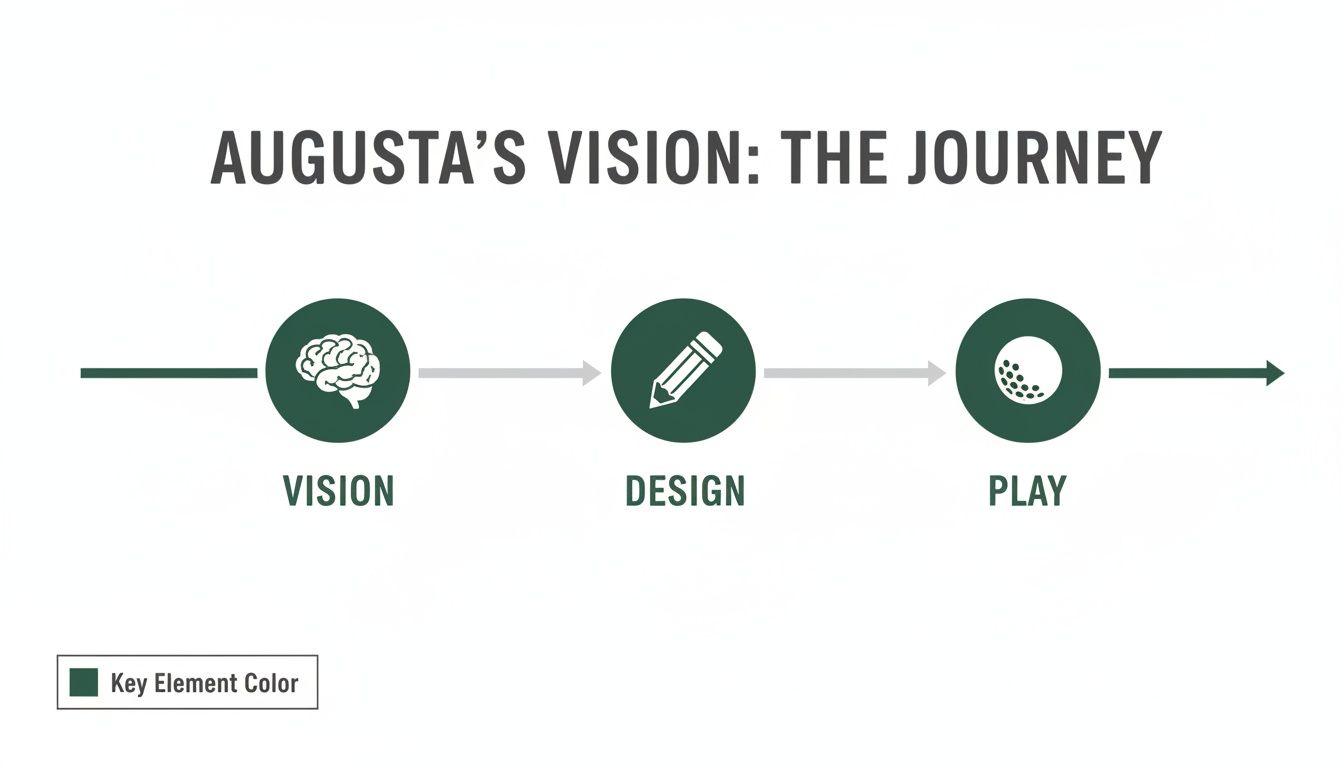
This simple progression shows that the Augusta National layout was built on a player-first philosophy from day one. As we get ready for a hole-by-hole journey, keeping this foundation in mind is key. You'll quickly see how it all comes together to create the ultimate test of a golfer's power, precision, and courage.
The Evolution of Augusta National's Layout
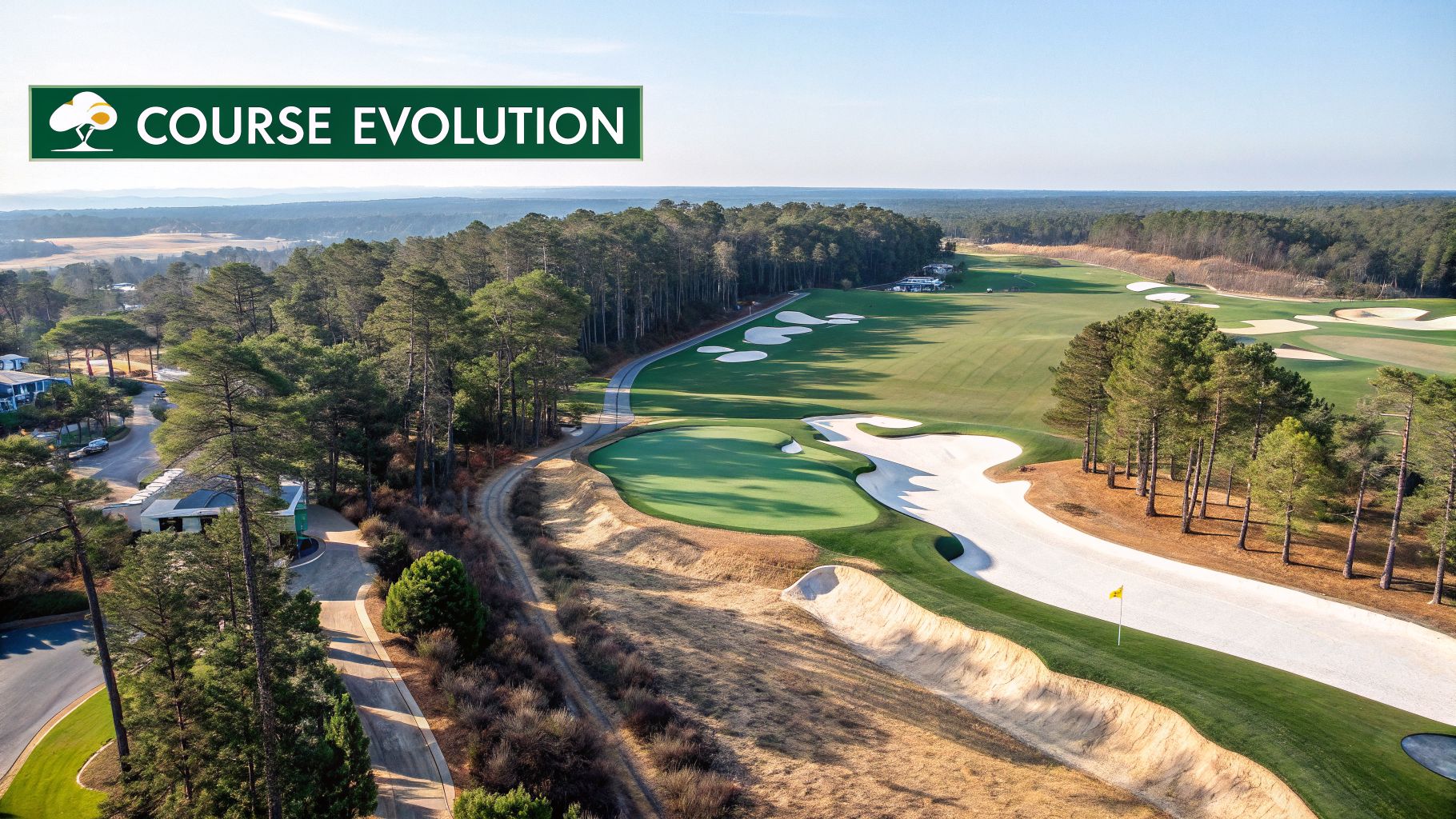
Augusta National isn't a course frozen in time, preserved under glass like a museum piece. Far from it. It’s a living, breathing layout that is constantly adapting to stay one step ahead of the best players in the world.
From the very beginning, Bobby Jones and Alister MacKenzie’s design has been tweaked and refined. The club has always believed in continuous improvement, making sure their masterpiece never gets outmatched by the modern game. This process, often called "future-proofing," is a direct answer to massive gains in player skill and equipment technology. Without these thoughtful changes, the course that crowned champions in the 1930s would be defenseless today.
A Response to Modern Power
The biggest reason for this evolution? Simple. The incredible power of today's players. To keep the course a proper test, Augusta National has systematically lengthened holes and tweaked its defenses, all to bring back the strategic questions Jones and MacKenzie wanted to ask. The point isn’t just to make the course longer, but to make it smarter.
The real wake-up call came after Tiger Woods ran away with the 1997 Masters. He completely dismantled what was then a 6,925-yard course, and the club knew it had to make some serious adjustments. That victory kicked off a series of renovations that quickly became known as "Tiger-proofing."
The club’s answer was to push back tees on key holes, plant new trees, and shift bunkers into landing zones. This put a premium back on precision, preventing players from just bombing it over the Augusta National layout’s strategic features.
These changes were all about making sure a well-placed shot still meant more than a mindlessly powerful one, preserving the soul of the course.
Lengthening the Legend
The numbers tell the whole story. When Augusta National Golf Club first opened in 1933, it played at around 6,800 yards—a monster for that time. By 1990, it had barely grown, measuring just 6,905 yards.
But after Tiger’s win, things changed fast.
In 2002, nine new back tees added a whopping 285 yards.
By 2006, further changes pushed the total length to 7,435 yards.
Today, it plays well over 7,500 yards from the tournament tees.
That’s a total increase of more than 700 yards from its original design. You can explore more about these architectural shifts and see just how much they’ve altered the challenge over the years.
This constant state of change shows a deep respect for the course’s original intent. Every adjustment is carefully weighed to protect the strategic genius that makes Augusta so special, ensuring The Masters remains the ultimate examination in golf.
A Strategic Walk Through the Front Nine

Everyone talks about the back nine at Augusta, and for good reason—that’s where the high drama of Amen Corner unfolds. But the truth is, the Masters is often won or lost on the outward nine. This is where the Augusta National layout begins to test every part of a player's game.
These holes are a puzzle, demanding careful shot-making and smart course management from the very first swing. A bad start here puts you on your back foot, and a few early bogeys can derail a round before it ever really begins.
Before we dive into the strategy, here's a quick look at the holes that make up Augusta's challenging front nine.
Augusta National Front Nine Overview
Hole | Name | Par | Yardage |
|---|---|---|---|
1 | Tea Olive | 4 | 445 |
2 | Pink Dogwood | 5 | 585 |
3 | Flowering Peach | 4 | 350 |
4 | Flowering Crab Apple | 3 | 240 |
5 | Magnolia | 4 | 495 |
6 | Juniper | 3 | 180 |
7 | Pampas | 4 | 450 |
8 | Yellow Jasmine | 5 | 570 |
9 | Carolina Cherry | 4 | 460 |
As you can see, the course presents a mix of lengths and challenges right from the start. Now, let's break down what it takes to navigate them.
No 1 Tea Olive Par 4 445 Yards
Forget a gentle handshake to start the round. ‘Tea Olive’ is a wake-up call. It's an uphill, slight dogleg right where the fairway immediately wants to kick your ball into a deep bunker on the right. If you find that sand, you’re scrambling for bogey right away.
The smart play is a draw that hugs the left side, opening up the approach. But the green is the real beast, sloping severely from back to front. Anything long of the pin leaves a putt that feels like it’s on a marble countertop.
No 2 Pink Dogwood Par 5 585 Yards
This is the first real green light of the day. ‘Pink Dogwood’ is a downhill par-5 that dares you to go for it in two, but it’s a classic risk-reward shot. The tee shot has to steer clear of a massive bunker on the right, which is about a 340-yard poke.
Find the fairway, and you've got a decision. The bold play is a long iron or wood into a green flanked by two deep bunkers. Laying up is safer, but you still need precision to leave yourself a full wedge into a green that tilts from left to right.
No 3 Flowering Peach Par 4 350 Yards
At just 350 yards, ‘Flowering Peach’ is a masterclass from Alister MacKenzie, proving a hole doesn’t need length to have teeth. It’s all about the tiny, pear-shaped green with its false front and wicked contours. This hole is a pure test of wedge play.
Big hitters might be tempted to drive the green, but a collection of four bunkers guards the left side, ready to swallow any miss. Most players will opt for an iron off the tee, leaving a short pitch where spin control is everything.
No 4 Flowering Crab Apple Par 3 240 Yards
Right after the shortest par-4 comes this monster par-3. ‘Flowering Crab Apple’ plays long and downhill, usually into a swirling wind that makes club selection a total guessing game. Two huge bunkers protect the front, demanding a perfect high-iron shot.
Even if you hit the green, you’re not safe. It’s divided into separate sections, so finding the putting surface is no guarantee of a two-putt. Miss long, and your up-and-down is next to impossible. Par here feels like a birdie.
No 5 Magnolia Par 4 495 Yards
‘Magnolia’ is a brute. This sweeping dogleg-left par-4 requires a long, accurate drive to avoid two cavernous fairway bunkers on the left. To carry them, you need to fly it over 315 yards.
The approach is to a massive, undulating green with a false front that will send any short shot rolling back into the fairway. A large mound on the back-right makes for tricky putts and chips. Walking off with a 4 on the scorecard is a job well done.
The Front Nine is not about survival; it's about positioning. Every hole is designed to give you a chance if you play the right shot, but it will punish you quickly if you get out of position.
This is exactly why players have to be so deliberate. It's a constant calculation of risk versus reward, and one bad decision can easily lead to a crooked number. This strategic element is also vital for tournament staff, who know that hole locations can dramatically change how a hole is played. For anyone curious about that side of the game, it's worth learning how to read pin sheets.
No 6 Juniper Par 3 180 Yards
Here, you're hitting from one of the highest points on the property down to one of its wildest greens. The tee on ‘Juniper’ sits about 40 feet above the green, making this 180-yard hole play much, much shorter.
The pin position dictates everything. A back-right pin brings a giant slope into play, forcing players to use the contour to feed the ball toward the hole. A front-left pin is a completely different challenge, demanding a shot that just carries the front edge. End up on the wrong tier, and it’s an almost guaranteed three-putt.
No 7 Pampas Par 4 450 Yards
‘Pampas’ has been toughened up over the years to keep up with the modern game. Once a straightforward hole, it’s now a tight, tree-lined corridor that demands a perfectly straight drive. The approach is just as intimidating, with five bunkers guarding a shallow, elevated green. Distance control is non-negotiable.
This transformation tells a story about the course itself. A defining feature of the original Augusta National layout was its sparse bunkering—just 22 in total when it opened in 1933. As noted by sources like Golf Club Atlas, the 7th hole originally had no bunkers at all. Today, with more than double that number, the course demands far more precision.
No 8 Yellow Jasmine Par 5 570 Yards
This uphill par-5 plays every bit of its 570 yards, and then some. Off the tee, the goal is simple: avoid the huge fairway bunker on the right. From there, it’s a three-shot hole for almost everyone.
The second shot is a blind layup over a crest, setting up the crucial third. The approach is played into a long, narrow green that’s protected by mounds on the left. The putting surface is severely contoured, making any long putt a real adventure. Birdies are gettable, but eagles are almost unheard of.
No 9 Carolina Cherry Par 4 460 Yards
The front nine wraps up with ‘Carolina Cherry,’ a hole famous for one thing: its treacherous green. The tee shot is downhill, but the approach is steeply uphill to a putting surface with three distinct tiers. The golden rule here is simple: leave the ball below the hole.
Any approach shot that flies past the pin leaves one of the scariest putts in golf—a downhill slider that seems impossible to stop. You'll often see players land their second shot well short, hoping it releases perfectly onto the front of the green. It’s a delicate shot that perfectly sums up the precision required to score on Augusta’s front nine.
Conquering Amen Corner and the Back Nine

If the front nine at Augusta sets the stage, the back nine is where the drama unfolds. This is where the Masters is truly won or lost. It’s a stretch of the Augusta National layout that has become golf legend, responsible for more moments of pure elation and crushing heartbreak than anywhere else in the sport.
The journey builds to a crescendo at one of golf’s most sacred places: Amen Corner.
This three-hole gauntlet, which includes the approach on 11, the entirety of 12, and the tee shot on 13, is where the pressure of the tournament becomes almost unbearable. Legendary writer Herbert Warren Wind coined the name back in 1958, and it stuck because it perfectly captures the spirit of this place. Here, players aren't just fighting the course; they're fighting history, their own nerves, and the notoriously fickle winds swirling through Rae’s Creek.
No. 10 Camellia: Par 4, 495 Yards
Before a player can even think about Amen Corner, they have to survive 'Camellia.' This is one of the toughest holes on the course, thanks to the most dramatic elevation change at Augusta. It drops more than 100 feet from tee to green.
The ideal tee shot is a big, sweeping draw that works its way from right to left, a shot that needs to be perfectly executed to open up a look at the green. From there, it's a long iron into a putting surface that slopes severely from right to left. A par here feels like stealing a shot from the course and provides a crucial dose of confidence before heading into the crucible ahead.
No. 11 White Dogwood: Par 4, 520 Yards
The official gateway to Amen Corner. 'White Dogwood' is a beast of a par-4 that has only gotten tougher over the years as it's been lengthened. Trees loom down the right side, pushing players toward the left on this dogleg-right layout. It demands a powerful and accurate drive.
But it’s the approach shot that defines the hole. This is one of the most terrifying shots in major championship golf. A pond guards the left side of the green while a bunker waits on the right, leaving absolutely no margin for error. Most players will bail out to the right, taking their chances with a tough up-and-down rather than risking a watery grave.
Amen Corner is not just about the difficulty of the shots; it's about the psychological weight they carry. A player's entire tournament can change in the span of these three holes.
This is the pressure cooker of the Masters. One bad swing here, and a green jacket can vanish in an instant.
No. 12 Golden Bell: Par 3, 155 Yards
This is the heart of the Augusta National layout and Amen Corner. 'Golden Bell' is arguably the most famous par-3 on the planet. On the scorecard, 155 yards looks simple enough. It’s anything but.
Rae’s Creek runs in front, azaleas bloom behind, and three bunkers surround a green that is shockingly narrow from front to back. The real monster, though, is the wind. It swirls and gusts unpredictably through the tall pines, making club selection an absolute nightmare. A player can feel a breeze in their face on the tee while the flag on the green is blowing in a completely different direction. It’s a hole that preys on indecision.
No. 13 Azalea: Par 5, 545 Yards
'Azalea' is the ultimate risk-reward hole, a masterpiece of strategic design. It's a sharp dogleg left where the tee shot absolutely must hug the corner to give a player any hope of reaching the green in two. A tributary of Rae's Creek guards the entire left side of the hole before cutting across in front of the green.
After a good drive, the player faces a monumental decision: go for it over the creek, or lay up safely? The club recently lengthened the hole to 545 yards, making that choice even more agonizing and restoring the classic dilemma that modern equipment had started to neutralize. An eagle is on the table, but so is a complete disaster.
No. 14 Chinese Fir: Par 4, 440 Yards
After the sheer intensity of Amen Corner, 'Chinese Fir' feels like a bit of a breather, mainly because it’s the only hole at Augusta with no bunkers. Don't be fooled. The hole's primary defense is one of the most wild, contoured greens on the course.
The fairway cants hard from left to right, so the tee shot has to favor the left side. From there, the approach has to find the right level on a massive, undulating green. Land on the wrong tier, and a three-putt becomes almost inevitable.
No. 15 Firethorn: Par 5, 550 Yards
This is another legendary risk-reward par-5, the scene of so many late-round heroics. A good drive down the fairway sets up a classic "go or no-go" decision. The green is reachable in two for most of the field, but the shot must carry a pond that protects the front.
Any shot that comes up short is wet, period. A bunker also guards the back, and anything long leaves a treacherous downhill chip shot that runs straight back toward the water. This hole was built for Sunday drama.
No. 16 Redbud: Par 3, 170 Yards
A stunning par-3 played entirely over water. At 170 yards, club selection is everything. The green slopes hard from right to left and is protected by three bunkers.
On Sunday, the pin is famously placed in the back-left portion, which allows players to use the slope as a backboard. A well-struck tee shot can catch the ridge and feed down toward the hole, setting up some of the most memorable moments in Masters history.
No. 17 Nandina: Par 4, 440 Yards
'Nandina' is a tough, uphill par-4 that used to be home to the famous Eisenhower Tree before an ice storm took it down in 2014. Even without the iconic landmark, the hole demands a precise drive to set up an approach to an elevated, tricky green. Par is always a good score here as players head for the finish.
No. 18 Holly: Par 4, 465 Yards
One of the most iconic finishing holes in all of golf. 'Holly' is a tight, uphill, dogleg-right par-4 that demands two brilliant shots. The drive has to be threaded through a narrow chute of trees, avoiding the two fairway bunkers on the left elbow of the dogleg.
The approach is played steeply uphill to a two-tiered green guarded by a pair of bunkers. Walking up the 18th fairway with the lead on Sunday is one of the most nerve-racking experiences in sports. Making par here to win the green jacket is a fitting end to the ultimate test in golf.
Of course, the stunning beauty of the Augusta National layout isn’t just about the routing or the thousands of azaleas. A massive part of its mystique comes down to the turf itself—those perfectly manicured playing surfaces are a show all on their own.
Those legendary conditions aren't an accident. They’re the product of decades of obsessive work and a drive for perfection that’s almost hard to believe.
Nowhere is this more obvious than on the putting greens, which are famous for their terrifying speed. But it wasn’t always that way. The real turning point came in 1981 when the club switched its greens to bentgrass. This new grass could be cut tighter and roll truer, completely changing the course's character and turning the greens into the slick, treacherous surfaces we see today.
The Secret Weapon: The Sub-Air System
To get that level of consistency day in and day out, the grounds crew needs total control over the turf’s moisture and firmness. That’s where Augusta’s famous sub-air system comes in. Think of it as a network of pipes and vacuums built right under the greens.
This system lets the staff literally suck moisture out of the ground. After a heavy rain, they can dry the greens to tournament speed with shocking efficiency. On the flip side, they can also pump air into the root zone to keep the grass healthy. It gives them an incredible advantage to manage conditions, no matter what the weather does.
The sub-air system is the secret behind Augusta's famous firmness. It allows the club to present a fast, firm test every single day, ensuring the course plays exactly as intended.
With this kind of control, the strategic demands of the Augusta National layout are never watered down by soft, receptive conditions.
More Than Just Fast Greens
The club's obsession with pristine surfaces goes well beyond the greens. While the putting surfaces were getting faster, the course itself was getting longer. Believe it or not, Augusta’s greens used to run at just 7 feet 9 inches on the Stimpmeter. After the switch to bentgrass, they now push 13-14 feet.
At the same time, the course has stretched from 6,985 yards in 2000 to over 7,500 yards today. It shows how turf technology and course length have evolved together to keep testing the world's best. You can discover more insights about these changes on GolfPass.com.
The "Second Cut"
One of the first things you’ll notice at Augusta is the lack of traditional rough. Instead, the fairways are lined with a "second cut," which is mown only slightly higher than the fairway. We're talking 1.375 inches for the second cut versus 0.375 inches for the fairway.
This subtle difference creates a unique visual and strategic challenge:
Fairway: Mown toward the green, encouraging extra roll on tee shots.
Second Cut: Mown against the direction of play to slow down errant shots before they run out into the pine straw.
It’s a brilliant, understated way the Augusta National layout shapes play without harshly punishing a slightly missed fairway. Understanding these details can even help organizers appreciate the complexities of setting up their own events; for those interested, check out our guide on what a course rating is and how it's determined.
Common Questions About Augusta's Layout
The mystique surrounding Augusta National always seems to spark a ton of questions. Let's clear up a few of the most common ones and dig a little deeper into what makes this course a living legend.
What Makes the Augusta National Layout So Difficult?
It’s not one single thing—it’s the relentless combination of challenges that makes Augusta so tough.
First, TV just doesn't do the elevation changes justice. What look like gentle slopes are actually severe hills. The drop from the 10th tee down to the fairway is more than 100 feet. Players almost never have a perfectly flat lie, forcing them to constantly adjust on the fly.
Second, the bentgrass greens are the course’s main line of defense. They’re lightning-fast and wildly contoured. Landing your approach on the wrong tier of a green can make a two-putt feel like a miracle. Precision isn’t just a nice-to-have; it's mandatory.
The real test isn't just hitting the green. It's hitting the right spot on the green. A shot just a few feet off can lead to a bogey or worse, even if you're on the putting surface.
Then there’s the "rough"—or lack thereof. While the fairways are wide, the course design demands you be on the correct side of them. The wrong angle into a green can completely shut down your chance of getting close to the pin.
Finally, the swirling winds, especially around Amen Corner, are completely unpredictable. A breeze can switch directions in a heartbeat, testing a player’s nerve and their trust in the club they've chosen.
Who Designed Augusta National and What Was Their Philosophy?
Augusta was the masterpiece of the legendary amateur Bobby Jones and famed course architect Dr. Alister MacKenzie. Their vision was heavily influenced by the Old Course at St. Andrews, with a focus on strategic options over purely penal design.
They wanted a course that an average member could enjoy but that would push the world's best under tournament pressure. This philosophy came to life through a few key principles:
Wide Fairways: Giving players plenty of room off the tee but demanding smart placement for the approach shot.
Minimal Bunkering (Originally): The course opened with just 22 bunkers. The natural slopes and tricky greens were meant to be the primary hazards.
Complex Green Structures: The greens were designed with severe slopes and multiple tiers, making putting the ultimate test of skill.
The whole idea was to reward thinking your way around the course. Jones and MacKenzie wanted a layout where strategy and execution mattered more than just raw power.
Have the Holes at Augusta National Always Been in the Same Order?
Nope. The routing we see today isn't the original one. For the first Masters back in 1934, the nines were actually flipped. What we now know as the iconic back nine was played as the front nine, and the current front was the back.
The club switched to the current routing in 1935 for a surprisingly practical reason: comfort. The original back nine (today's front) is on higher, more exposed ground. By starting players on the lower, more sheltered holes, they could ease into their rounds on cool mornings.
This change also created the incredible drama we've come to expect on Masters Sunday. The round now builds toward a climax on the most famous risk-reward holes in golf. If you're interested in how course design impacts scoring, understanding the meaning of slope rating offers some great context.
What Is the Most Significant Recent Change to the Augusta Layout?
One of the biggest recent tweaks to the Augusta National layout was the lengthening of the par-5 13th hole, 'Azalea,' ahead of the 2023 Masters. The club acquired land from the neighboring Augusta Country Club to push the tee back 35 yards, stretching the hole to 545 yards.
This was a direct answer to modern club and ball technology. For years, players had been turning the hole into a simple driver and short iron, which took away from its original strategic dilemma.
The added length has brought the classic risk-reward decision roaring back to life.
The Decision: The choice to go for the green in two is now a much more difficult one.
The Second Shot: It now demands a perfectly struck long iron or fairway wood over Rae’s Creek, not a mid-iron.
The Layup: More players are now opting to lay up, which brings par—and even bogey—back into the equation.
By making this change, the club has ensured that 'Azalea' will remain one of golf's great turning points, where a heroic shot can lead to eagle, but a small mistake can lead to disaster.
Running a golf tournament with the same level of professionalism and engagement seen at major events is easier than you think. Live Tourney provides modern, app-free live scoring and intuitive management tools that simplify everything from setup to final payouts. Elevate your next event and give players an unforgettable experience. Explore how Live Tourney can transform your tournaments.





