

Jan 19, 2026
Learn what is Stableford scoring in golf and how it makes the game more enjoyable. Our guide explains the points system, handicap use, and tournament tips.
If you've ever had one disastrous hole blow up your entire scorecard, you know how frustrating traditional stroke play can be. A triple bogey here, a lost ball there, and suddenly your round feels like it's over. That’s the exact problem Stableford scoring was designed to solve.
Instead of counting every single stroke, the Stableford system awards you points for your score on each hole relative to par. The goal is simple: get the highest score possible. It completely flips the script on how you approach the game.
Shifting from Penalties to Rewards in Golf
Think of it this way: in stroke play, every shot is a potential penalty added to your total. It's a game of avoidance. Stableford, on the other hand, is a game of accumulation. You're out there collecting rewards, not dodging bullets.
The best part? Once you’ve had enough shots on a hole that you can no longer earn a point (usually after a net double bogey), you can just pick up your ball and head to the next tee. No more grinding out a 9 or 10 just to write it on the card. This one simple rule keeps the pace of play moving and, just as importantly, keeps your head in the game.
The Standard Points System
The real beauty of Stableford is its simple and universal points structure. While some tournaments might tweak the numbers, the standard system is what you'll see most often. It’s a huge reason why it’s become a go-to for all kinds of golf tournament scoring.
This quick-reference table breaks down how the points are usually awarded.
Score Relative to Net Par | Points Awarded |
|---|---|
Double Eagle (or better) | 5 points |
Eagle | 4 points |
Birdie | 3 points |
Par | 2 points |
Bogey | 1 point |
Double Bogey (or worse) | 0 points |
As you can see, the system heavily rewards you for going low. A couple of birdies can instantly wipe out the damage from a hole where you scored nothing, keeping every player in the hunt right until the very end. Your new mission on the course is to rack up as many points as you can over 18 holes.
The Story Behind Stableford: A Solution to Golf Frustration
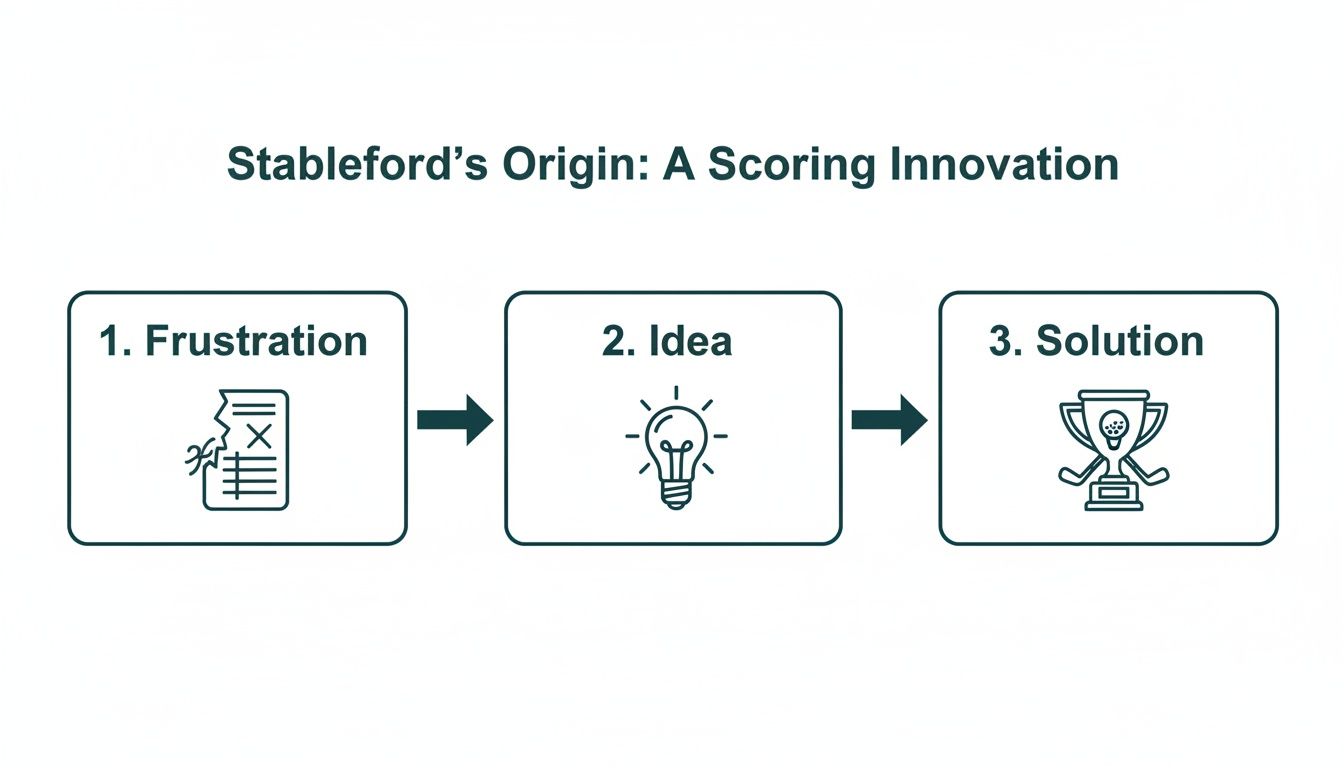
To really get why Stableford scoring is so popular, you have to understand the problem it was designed to fix. We’ve all been there—one disastrous hole completely derails an otherwise solid round. A bad swing, a lost ball, and suddenly the thought of ripping up your scorecard feels very, very real.
That exact feeling of frustration is what sparked one of golf’s most player-friendly inventions.
The system came from the mind of Dr. Frank Barney Gorton Stableford, a member of Wallasey Golf Club near Liverpool, England. He was tired of watching fellow golfers, battered by the course's punishing coastal winds, give up mid-round after a few bad holes. The "aha!" moment came in late 1931 as he tried to figure out a way to keep players in the game for all 18 holes, no matter what. You can get the full rundown on the Stableford scoring system's history over at bunkered.co.uk.
From a Bad Round to a New Format
Dr. Stableford’s idea was brilliantly simple: stop counting every single stroke and start collecting points instead. This new format rewarded good play but didn't brutally punish the unavoidable bad hole. The goal was to make the game more resilient and, frankly, more fun.
The first official Stableford competition took place at his home club in 1932, and it was an instant hit. Players quickly realized they could take more risks, knowing the worst they could do on any given hole was score zero points—not a round-killing 8 or 9.
By capping the damage from a single bad hole, the Stableford system fundamentally changed the psychology of the game. It encourages perseverance and aggressive play, making it a beloved format for club events and casual rounds worldwide.
This simple shift kept the competitive fire alive while boosting morale and speeding up play. It turned golf from a grind into a hunt for positive achievements, and that’s a legacy that continues to make the sport more enjoyable for everyone.
How Handicaps Make Stableford Fair for Everyone
The real magic of Stableford scoring is how it levels the playing field, creating a genuinely competitive match between golfers of completely different abilities. It does this by weaving the handicap system right into its DNA, making sure every golfer is playing against the course—and their own potential—not just the low-handicappers.
In regular stroke play, a higher handicap gives you strokes, but you still have to write down every single shot. A disaster hole can kill your round. In Stableford, those handicap strokes are applied before points are awarded, giving you a “net par” on certain holes. This is where the game completely changes.
Applying Your Handicap Strokes
Your Course Handicap tells you how many extra shots you get during a round. These shots aren't random; they're given out on the toughest holes, which are ranked by the Stroke Index (SI) on your scorecard. The SI 1 hole is the hardest, while SI 18 is the easiest.
A player with a 14-handicap gets one extra stroke on each of the holes with a Stroke Index from 1 to 14.
A player with a 20-handicap gets one extra stroke on all 18 holes, plus a second extra stroke on the two hardest holes (SI 1 and SI 2).
This whole concept was born out of the frustration of having one bad hole ruin a scorecard. It evolved into a much fairer solution.
Let’s see how this works in practice.
Imagine a 20-handicap player on a par-4 hole with a Stroke Index of 2. Because their handicap is over 18, they get two handicap strokes here. If they shoot a gross score of 6 (a double bogey), their net score is 4 (par).
That means they earn 2 points for a net par—the same as a scratch golfer making a gross par.
The system rewards you for beating your own handicap, one hole at a time. This keeps every golfer in the game, knowing they have a real shot at winning based on how they play against their personal skill level.
To really see the difference, let’s compare how a single blow-up hole impacts a player's round in both formats.
Stroke Play vs. Stableford: The Impact of One Bad Hole
The table below shows a player's score over three holes. Notice how the triple bogey on Hole 2 devastates the stroke play score but has a much smaller impact in Stableford.
Hole | Par | Player's Score | Stroke Play Score | Stableford Points |
|---|---|---|---|---|
Hole 1 | 4 | 4 (Par) | 4 | 2 |
Hole 2 | 4 | 7 (Triple Bogey) | 7 | 0 |
Hole 3 | 4 | 4 (Par) | 4 | 2 |
Total | 12 | 15 | +3 | 4 |
In stroke play, the player is 3-over par. In Stableford, they've picked up 4 points and are still very much in the game. That one bad hole didn't sink their entire round.
This elegant, player-friendly design is why Stableford is so popular in club events and golf trips around the world. It mathematically caps the damage of a bad hole while still rewarding great shots. If you want to dig deeper, you can explore more about how the Stableford golf scoring system works and see its full impact.
Twists on the Classic: Modified Stableford and Other Variations
The standard Stableford system is a brilliant starting point, but its real beauty lies in how flexible it is. Tournament organizers love to get creative with the points structure, tweaking it to encourage a certain style of play or just to spice things up. This adaptability is exactly why understanding Stableford opens up a whole new world of tournament possibilities.
The most famous twist is easily the Modified Stableford. It's a high-risk, high-reward format designed to create drama by incentivizing aggressive, go-for-broke golf. Instead of only awarding points for good scores, this version also dings you for the bad ones.
Real-World Action: The Barracuda Championship
For a perfect example, look no further than the PGA Tour's Barracuda Championship. They switched to a Modified Stableford format to generate more excitement for fans and players alike. Their system doesn't just reward birdies—it heavily rewards eagles and double eagles while taking points away for bogeys or worse.
Here’s how their high-octane points table breaks down:
Albatross (Double Eagle): +8 points
Eagle: +5 points
Birdie: +2 points
Par: 0 points
Bogey: -1 point
Double Bogey or worse: -3 points
This structure basically forces players to attack pins and go for par-5s in two. Playing it safe with pars won't get you very far. The PGA Tour made this change for the Barracuda back in 2012 for that exact reason, and it paid off—the 2023 champion racked up 125 points with an incredible 25 birdies.
Other Common Tweaks
Beyond the high-stakes world of Modified Stableford, you'll see other adjustments, especially in team events. For instance, in a four-ball (2v2) competition, it's common to apply a handicap allowance. A popular choice is giving each player 85% of their course handicap.
This simple change keeps the competition balanced. It prevents one player with a very high handicap from single-handedly carrying their team, ensuring the event stays fair and fun for everyone.
These variations show just how versatile the format can be. By making small changes to the points or handicaps, you can completely change the strategy of the tournament. That's a powerful tool to have when you're learning how to run a golf tournament that people will be talking about long after the final putt drops.
How Technology Simplifies Running Stableford Events
Running a flawless Stableford tournament used to be a real headache. I’m talking hours spent with calculators and stacks of scorecards, manually applying handicap strokes, and triple-checking every point total. It was a tedious, error-prone process.
Thankfully, modern tournament software has completely changed the game.
Instead of hunting down physical cards, players can just punch in their gross scores on their phones using a simple web link—no app download needed. The software instantly does all the heavy lifting in the background, automatically applying handicap strokes to the right holes and converting scores into Stableford points. This one change alone eliminates human error and saves a ton of time.

Elevating the Player Experience
But the real magic is the live leaderboard. As soon as a score is entered, the standings update in real-time on everyone’s phones and on TVs back in the clubhouse. This is what turns a regular Saturday event into something that feels like a professional competition.
Players know exactly where they stand at all times, which keeps the energy high and everyone engaged. It makes for a far more interactive and memorable day on the course.
Pro Tip: With modern software, setting up a custom Modified Stableford format takes just a few clicks. You can easily adjust the point values to encourage aggressive play, showing just how easy it is to create unique event experiences without the administrative headache.
By automating everything from setup to the final payouts, you get to focus on what actually matters: giving every golfer a fantastic experience. The right golf tournament scoring software lets you run smoother, more professional Stableford events that people will be talking about long after the final putt drops. It’s a simple shift that makes the entire event better for everyone involved.
Common Questions About Stableford Scoring
Once you get the hang of the basics, a few practical questions almost always come up. Stableford is a super flexible format, but knowing how to handle things like ties, team games, and what a "good" score actually looks like is the key to running a smooth event.
Let's clear up some of the most common questions so you feel completely confident using this system.
What Is a Good Stableford Score?
This is probably the first thing everyone asks. The simple answer? 36 points is the magic number.
If you finish a round with 36 points, it means you’ve played exactly to your handicap—averaging two points on every hole. Anything higher than that, and you've had a great day on the course. Anything lower, and you played a bit worse than your average.
In most club competitions, the winning scores usually land somewhere in the high 30s or low 40s.
How Do You Handle Tiebreakers in Stableford?
Ties happen all the time in Stableford, so having a clear tie-breaking rule from the start is non-negotiable. The universal method is a scorecard countback.
It's a straightforward process where you compare scores over smaller and smaller segments of the round until someone comes out on top. Here’s how it usually works:
Best Back 9: The player with more points on the back nine wins.
Best Last 6: Still tied? Look at the points from the last six holes (13-18).
Best Last 3: If it's still a deadlock, compare scores on the final three holes (16-18).
Final Hole: And if all else fails, the score on the 18th hole decides the winner.
This system is fair, easy to explain, and avoids the hassle of a playoff.
Can Stableford Be Used for Team Games?
Absolutely. In fact, Stableford is a fantastic format for team competitions. It brings a whole new layer of strategy and fun to the day.
The most popular team game is a Four-Ball Better Ball (2v2). In this setup, all four players play their own ball and track their individual Stableford points on each hole. The team then takes only the single best score between the two partners for their official team score on that hole. It keeps everyone in the game, because either player can be the one to deliver the points the team needs.
Ready to run a flawless Stableford event without the manual math? Live Tourney offers app-free live scoring that automates everything, from handicap application to live leaderboards. Set up your next tournament in minutes and give your players an unforgettable experience. Explore all the features and start your free trial.





