
Jan 26, 2026
Ever wonder what is net score in golf? This guide explains how handicaps create fair competition, how to calculate scores, and how to run better tournaments.

At its core, a net score in golf is your final score after your handicap strokes have been subtracted. It answers a simple but crucial question: "How did you play today compared to your potential?"
The final number comes from taking your gross score (the actual number of shots you hit) and subtracting your handicap strokes.
Understanding Net Score in Golf and Why It Matters

Think of a net score like getting a head start in a race. It's the great equalizer in golf, allowing players with vastly different skill levels to compete on fair terms. Without it, the player with the lowest raw score—the gross score—would always win, making most amateur tournaments pretty predictable and not much fun for the average golfer.
Net scoring completely changes the game. It levels the playing field and shifts the focus from who has the most raw talent to who played the best against their own ability on that particular day. This concept is the backbone of nearly every amateur golf tournament you'll ever play in, from a casual Saturday club event to a major charity fundraiser.
For anyone running a tournament, understanding what a net score is and how it works isn't just helpful—it's essential for putting on a fair and successful event.
Here’s what it really accomplishes:
Keeps Competition Fair: It’s how a 20-handicap can go head-to-head with a 5-handicap and have a real shot at winning.
Boosts Engagement: Every single player has a legitimate chance to win their flight or even the whole thing, which keeps everyone invested until the last putt drops.
Measures True Performance: The leaderboard shows who really "beat their handicap"—not just who shot the lowest absolute score.
In the end, net scoring is the magic that transforms a simple skills contest into a dynamic, equitable, and much more interesting competition. It's what makes handicapped golf tournaments work for everyone involved.
The Golf Handicap System: The Engine Behind Fair Play
Before we can even talk about a net score, we have to talk about the system that makes it all possible: the golf handicap. A handicap is more than just a number—it’s the secret sauce that levels the playing field in a notoriously difficult game. Think of it as a portable skill rating that travels with you, adjusting to the unique challenge of any course you play.
It wasn't always this simple, though. For decades, handicapping was a bit of a mess. Different clubs had their own rules, making it nearly impossible to have a fair match when players from different courses got together. It was apples and oranges.
Everything changed in 1983 when the USGA rolled out the Course Rating System and Slope System. This was a huge deal because, for the first time, handicaps became truly portable. Suddenly, your handicap from your home course could be accurately applied anywhere, bringing a new level of integrity to competitions. If you're curious about the deep history, you can learn more about the evolution of golf's handicap system on Wikipedia).
How Course and Slope Ratings Work
These two numbers are the foundation of the modern handicap. They're what make your handicap mean something from one course to the next, and they’re essential for calculating a fair net score.
Course Rating is what a scratch golfer (someone with a zero handicap) is expected to shoot on a given set of tees. So, a rating of 71.5 means the pros are expected to shoot just a little over par.
Slope Rating measures how much harder the course gets for a "bogey golfer" (around an 18 handicap) compared to that scratch player. A high slope, like 135, means the course is a beast for the average player, with trouble lurking everywhere.
Together, these ratings make sure you get the right number of strokes for the course you're actually playing. You’ll get more help on a tough track (high slope and course rating) and fewer on an easier one.
This system creates a reliable, standardized measure of a player's ability. For anyone running a tournament, this is gold. It builds trust and ensures that the final net leaderboard is a true reflection of how everyone played, making the entire event more credible and fun.
Applying Handicap Strokes to Get Your Net Score
Knowing a player has a handicap is one thing, but knowing how to apply it correctly is where the real magic of net scoring happens. It’s not as simple as subtracting one number from the final score. Instead, handicap strokes are strategically handed out across the scorecard based on how tough each hole is.
This system is designed to give players a little help exactly where they need it most, which makes for a much fairer and more interesting competition, hole by hole. If you're running a tournament, getting this concept down is key to explaining the scoring to your players.
The journey from a player's general Handicap Index to their final net score is a pretty straightforward process. This graphic breaks down how a player's overall ability is adjusted for a specific course to create a fair handicap for the day.
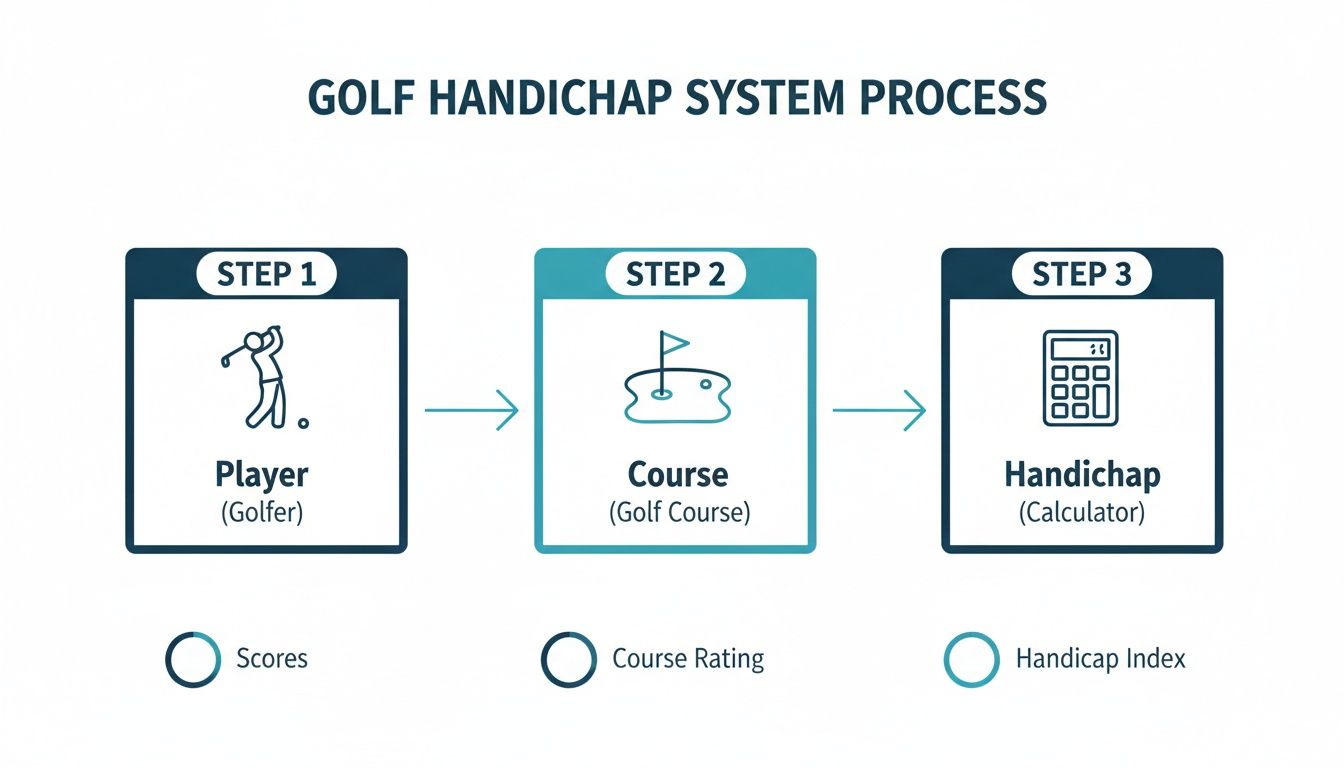
This flow—from the player's history to the course's difficulty to the final calculation—is the core of the World Handicap System. It's what keeps scoring equitable and consistent, no matter where you play.
From Handicap Index to Course Handicap
First things first, a player’s Handicap Index (a number representing their general skill) gets converted into a Course Handicap. This is the actual number of strokes they'll receive on that specific course, from that specific set of tees.
The calculation uses the course's Slope Rating to tailor the handicap to the day's challenge. For instance, a golfer with a 14.2 Handicap Index might get a Course Handicap of 15 on a really tough track but only 13 on an easier one. This adjustment is the crucial first step.
How to Distribute Strokes Using the Stroke Index
Once you have the Course Handicap, you use the Stroke Index on the scorecard to hand out the strokes. You'll see every hole is ranked from 1 (the hardest) to 18 (the easiest).
If a player has a 14 Course Handicap, they get one stroke on the 14 most difficult holes—that is, the holes with a Stroke Index of 1 through 14. If they have a 20 Handicap, they'd get one stroke on every hole, plus a second stroke on the two hardest holes (Stroke Index 1 and 2).
Let’s walk through a quick example:
Player A has a 14 handicap. He gets one stroke on each of the holes with a Stroke Index from 1 to 14.
On the #1 hardest hole (a par 4), he makes a 5. His gross score is 5, but after subtracting his handicap stroke, his net score is a 4 (a net par).
On the #17 easiest hole, he also makes a 5. Since his handicap of 14 doesn't give him a stroke on this hole, his gross and net scores are both 5.
Here’s a table showing how those 14 strokes would be allocated across the scorecard.
Hole Number | Par | Stroke Index (Difficulty) | Strokes Received |
|---|---|---|---|
1 | 4 | 5 | 1 |
2 | 5 | 11 | 1 |
3 | 3 | 15 | 0 |
4 | 4 | 1 | 1 |
5 | 4 | 13 | 1 |
6 | 3 | 17 | 0 |
7 | 5 | 3 | 1 |
8 | 4 | 9 | 1 |
9 | 4 | 7 | 1 |
10 | 4 | 8 | 1 |
11 | 5 | 2 | 1 |
12 | 4 | 14 | 1 |
13 | 3 | 18 | 0 |
14 | 4 | 4 | 1 |
15 | 4 | 12 | 1 |
16 | 3 | 16 | 0 |
17 | 5 | 6 | 1 |
18 | 4 | 10 | 1 |
As you can see, strokes are applied only to the holes ranked 1 through 14 on the Stroke Index column. This hole-by-hole method gives a far more accurate picture of a player's performance against their potential.
To see how net scores fuel different types of competitions, check out our complete guide to golf tournament scoring.
Running Your Tournament with Net Scoring
Knowing what a net score is and actually using it to run a great tournament are two different things. Think of net scoring as the engine that makes a golf event truly competitive and fun, giving every single player a legitimate shot at winning, no matter their skill level.
From a classic Stroke Play event to a team Scramble, the net score is what really matters. It’s the ultimate equalizer and an essential tool for any organizer who wants everyone to stay engaged from the first tee to the final putt.
Choosing the Right Net Format
The most common setup for individual players is Net Stroke Play. It’s as straightforward as it gets: the player with the lowest total net score after 18 holes wins. This format is simple, pure, and rewards the player who beats their handicap most consistently.
Another fantastic option, especially for more social events, is Stableford. Here, players earn points on each hole based on their net score relative to par. A net birdie might be worth three points, for example. The beauty of Stableford is that one blow-up hole won’t completely derail someone's round, which keeps the energy up and more players in the game until the very end.
For team events, the same core ideas apply, just with a little twist:
Fourball (Best Ball): Each partner plays their own ball through the hole. The team's score is simply the lower of the two partners' net scores. It's a classic format that lets partners pick each other up.
Scramble: Everyone tees off, the team picks the best shot, and everyone plays their next shot from that spot. To make it fair, team handicaps are created using a specific formula (like 35% of the A-player's handicap plus 15% of the B-player's).
You might wonder how fair this all really is. The handicap system has been put to the test. A landmark 1980 USGA study crunched the numbers on over 100,000 scores and found that the system predicts low-net-scores with an average error of just 1.4 strokes. It really works. You can dive into the details from the research on handicap reliability.
Ultimately, the format you pick sets the tone for the entire day. Whether it's a serious club championship or a laid-back company outing, the right net scoring format ensures the competition is balanced, exciting, and fair for everyone involved. For a deeper dive, check out our guide on how to run a golf tournament.
How Tournament Software Automates Net Scoring
Let's be honest: calculating net scores for a full tournament field by hand is a nightmare. It’s a surefire way to get bogged down in spreadsheets, chasing down handicaps and trying to apply strokes hole-by-hole. That’s a massive headache that pulls you away from actually running a great event.
This is where modern tournament management software steps in. Platforms like Live Tourney are built to crunch all these numbers instantly and automatically. The system takes each player's Handicap Index, converts it to their correct Course Handicap for the day, and applies those strokes exactly where they should go on the scorecard.
From Manual Work to Live Leaderboards
The real game-changer here is the ability to generate live, accurate leaderboards. As players punch in their scores on the course, the software calculates their net score in real time, keeping everyone in the loop and completely engaged.
A live net leaderboard, for example, shows players, organizers, and even spectators exactly where everyone stands from one moment to the next.

This kind of immediate feedback totally transforms the tournament experience. It adds a layer of excitement and professionalism that you just can't get with paper and pencil.
The core value of automating net scoring is simple: it eliminates the risk of human error while saving organizers countless hours. Instead of wrestling with numbers in the pro shop, you can focus on creating a memorable event for your players.
By letting the software handle the math, you ensure the integrity of the competition and deliver a polished experience from start to finish. If you want to see how this works in more detail, you can find more info about golf tournament scoring software and how it can elevate any event you run.
A Few Lingering Questions About Net Scoring
Even after you get the hang of net scoring, a few specific situations can throw a wrench in the works for tournament organizers. Let's tackle some of the most common questions to make sure you can run your events with total confidence.
What’s the Difference Between a Net Score and an Adjusted Gross Score?
This is a big one, and it's a critical distinction every golfer and organizer needs to get right.
A Net Score is purely for competition. It’s your gross score minus your handicap strokes, and it’s the number used to decide who wins and where everyone lands on the leaderboard. Simple as that.
An Adjusted Gross Score, on the other hand, is only for handicap purposes. This is where you cap your score on any given hole to a maximum number (a concept called Net Double Bogey). It’s the score you post to maintain your handicap index, making sure one disastrous hole doesn't unfairly blow it up.
The whole idea behind Net Double Bogey is to protect your handicap from that one meltdown hole we all have. It's calculated as par + two strokes + any handicap strokes you get on that hole. This effectively puts a ceiling on your score for handicap purposes, keeping things fair. Want a deeper dive? Check out this great explainer on golf handicap calculation on burlingameccwnc.com.
How Does Net Scoring Work in a Stableford Competition?
In a Stableford event, you don't just subtract your handicap strokes at the end of the round. Instead, the magic happens on each individual hole.
First, you apply your handicap strokes where they fall to figure out your net score for each hole. Then, you award points based on that hole-by-hole net score. A net par might be worth two points, a net birdie gets you three, and so on. The winner is the player with the most points, not the lowest score. It's a popular format because it rewards good shots without letting one bad hole ruin your day.
Can a Player's Net Score Be Higher Than Their Gross Score?
For 99.9% of the amateur golfers you'll see in a tournament, the answer is a firm no. A handicap is there to reduce your score, so your net score will always be lower than your gross.
The only time this isn't true is for "plus-handicap" players—golfers who are actually better than scratch. These elite players have to add strokes to their score, which means their net score will be higher than their gross. But let's be honest, you're not likely to see many of them at your average club or charity scramble.
Running a modern, professional-feeling tournament means leaving the manual math behind. Live Tourney handles every format instantly, from Net Stroke Play to Stableford, so you can deliver accurate live leaderboards and focus on your players. It completely elevates the event experience. Start your free trial today at livetourney.com.





