
Jan 3, 2026
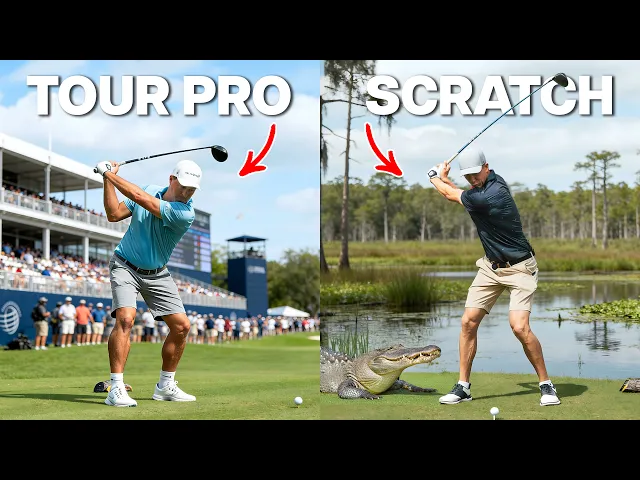
Ever wonder what is a scratch golfer? Our guide breaks down the 0.0 handicap, what it really means on the course, and how it impacts tournament play.
In the world of golf, you hear the term "scratch golfer" thrown around a lot. It's the gold standard for amateur players, the benchmark everyone quietly aims for. So, what does it actually mean?
Simply put, a scratch golfer is a player with a 0.0 Handicap Index. They're expected to shoot even par on a course of average difficulty. Reaching that level of play is a massive achievement, signaling a rare blend of skill, consistency, and a serious dedication to the game.
What a Scratch Golfer Actually Is
Think of a scratch golfer as the universal yardstick in amateur golf. They are the fixed point from which all other handicaps—higher or lower—are measured. While shooting par sounds straightforward, getting there is a monumental task that takes way more than just a pretty swing. It demands a deep understanding of your own game, smart course management, and a rock-solid mental game.
A huge part of playing at this level is mastering the mental side of the game. Applying principles from golf sport psychology is key to staying focused, minimizing mistakes, and capitalizing on every opportunity. It all shows up on the scorecard. This is why tracking performance is so critical; knowing how to read the details on the best golf scorecard formats can reveal the patterns you need to fix to shave off those last few strokes.
The real hallmark of a scratch golfer is their ability to show up to almost any rated course in the world and play to a Course Handicap of zero. Their game is so consistent that it can be reliably benchmarked against par, no matter where they tee it up.
Ultimately, a scratch golfer is the embodiment of consistency. It's not about playing perfectly every round. It's about having a game so solid that you can step onto any course—from your local muni to a U.S. Open venue—and be expected to play to par. The USGA defines this as the ability to achieve a Course Handicap of zero on any rated course, a true testament to predictable, high-level performance.
How Handicaps Really Work for Elite Players
It’s one of the biggest myths in golf: that a scratch player shows up to every course and shoots even par. While their 0.0 Handicap Index is the official benchmark, what they're actually expected to shoot on any given day is a lot more fluid.
The secret is understanding the difference between a player's raw potential and the unique challenge a specific course presents.
A player's Handicap Index is their portable golfing résumé—a standardized measure of their demonstrated ability. But that number doesn't tell the whole story. To figure out their target score for the day, you have to calculate their Course Handicap, which adjusts their index for the difficulty of the tees they're playing.
This simple breakdown gets to the heart of what makes a scratch golfer.
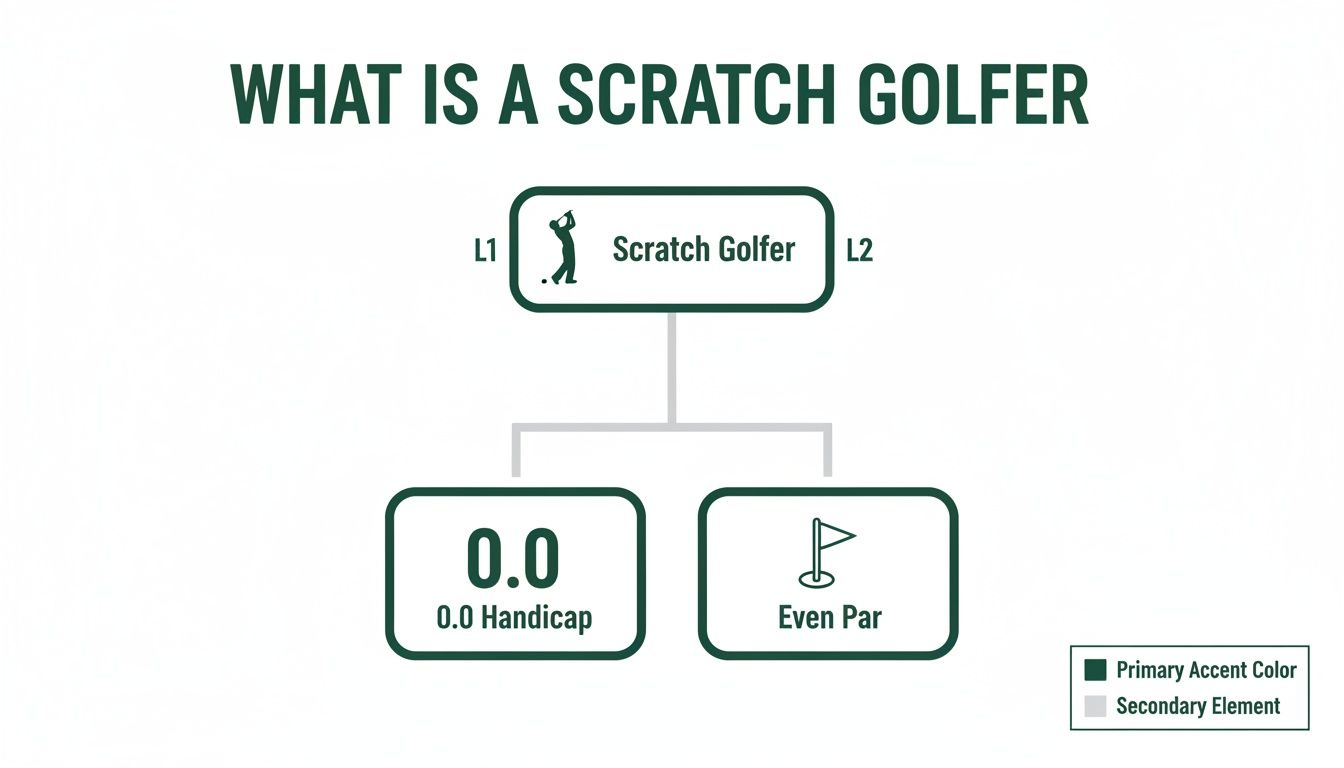
As the chart shows, it all starts with that 0.0 Handicap Index, which translates to an expectation of playing to even par on a course of standard difficulty. But how many courses are truly "standard"?
Course Rating vs. Slope Rating
Every set of tees on a rated golf course has two critical numbers that tell you just how tough it is: the Course Rating and the Slope Rating. These are the keys to figuring out what a scratch golfer should actually be shooting.
Course Rating: This is what a scratch golfer is expected to shoot on that course. If a par-72 course has a Course Rating of 73.1, a scratch player is expected to shoot about one over par—not 72.
Slope Rating: This measures how much harder the course is for a "bogey golfer" compared to a scratch player. A higher slope (up to 155) means the course gets exponentially tougher for the average amateur.
For a scratch golfer, their real target score for the day is the Course Rating. If they're playing a beast of a par-72 track with a rating of 73.5, their personal "par" is effectively 73.5. A final score of 74 would actually be a great round relative to expectations.
This is why understanding the numbers is so important for fair competition and is a fundamental part of most golf tournament scoring systems. It makes sure a player's performance is judged against the true difficulty of the course, not just the par on the scorecard.
The Real Statistics Behind Scratch Golf
Let’s get one thing straight: scratch golfers are not flawless, shot-making robots. The reality is far more human—and honestly, way more impressive. Their superpower isn't perfection; it's consistency and brilliant damage control, all backed by some surprisingly relatable stats.

When you really dig into the data, you find a game built on minimizing disasters, not chasing perfection. A scratch player’s round is defined by how well they manage their misses, turning a potential double bogey into a routine par or, at worst, a manageable bogey.
Key Performance Metrics for a Scratch Golfer
So, what does top-tier amateur golf actually look like by the numbers? While every player is different, these stats paint a clear picture of what it takes to maintain a 0.0 Handicap Index.
Fairways Hit: They find the fairway only about 55-60% of the time. Yep, that means they’re playing from the rough on nearly half their tee shots. The difference is they have the skill to recover.
Putting Prowess: This is a big one. A scratch golfer averages less than one three-putt per round. Their distance control on the greens is what separates them from the pack.
Scrambling: When they miss a green in regulation, they still manage to get up-and-down for par roughly 50% of the time. It’s this ability to salvage par from tough spots that truly defines elite play.
The most revealing stat, though? Greens in Regulation (GIR). Scratch golfers aren’t just peppering every flagstick. They are masters of proximity, playing to smart targets and limiting the damage when they miss.
Becoming a scratch golfer isn’t about hitting every shot perfectly—it's about managing the misses across 18 holes. The stats tell the whole story. They hit around 10 greens in regulation per round, which means they miss almost half of them.
Their iron play isn't automatic, either. The GIR percentage jumps to a solid 61% from 130-150 yards out, but it drops to just 41% from the 170-190 yard range. If you want to dive deeper into the numbers, National Club Golfer has a great piece on what scratch golf really looks like.
For tournament directors, understanding these numbers is huge. It sets realistic scoring expectations and makes it clear that even the best amateurs are grinding hard for every shot—they aren't just coasting on raw talent.
The Skill Gap Between a Scratch Player and a Tour Pro
If a scratch golfer is the peak of amateur play, you might think they're not too far off from the pros you see on TV. But the gap between a scratch player and a PGA Tour professional is massive.
It’s like comparing a great college quarterback to an NFL MVP. Both are incredibly talented, but they aren't playing the same game. That distinction is key to understanding the real tiers of elite golf.
The difference isn't just one or two clutch shots a round. It's a consistent, measurable advantage that shows up in every part of the game—from raw power off the tee and surgical precision with scoring clubs to unshakable nerves on the greens.
Quantifying the Professional Advantage
When you look at the numbers, the separation becomes undeniable. A scratch player’s goal is to shoot par on a tough course. A Tour pro is expected to go deep under par, even on a much harder course set up for a championship.
This isn’t just a gut feeling. The data shows that a PGA Tour player's scoring average is effectively 5.5 strokes better than a scratch player's once you adjust for course difficulty. Tour pros average 2.25 strokes under par on courses rated 3.2 strokes harder than what a scratch golfer is measured against. You can dive into the full breakdown to learn more about the statistical gap between pros and scratch golfers.
The key takeaway is that pros don't just score lower; they do it on championship-caliber courses that are longer, have faster greens, and feature punishing rough.
This immense skill gap is built on a few core strengths:
Driving Distance: Pros are consistently longer, leaving them with shorter, more manageable approach shots into greens.
Iron Proximity: They simply hit their irons closer to the hole, creating way more legitimate birdie opportunities.
Scrambling: Their ability to get up-and-down to save par from tough spots is on another level.
Putting: When the pressure is on, pros make the putts that matter far more often.
Why Understanding Scratch Golfers Elevates Your Tournament
Knowing what a "scratch golfer" really is isn't just about golf trivia; it's a huge strategic advantage for anyone running a tournament. This knowledge is the bedrock of fair competition. It ensures every decision you make—from pairings and flights to payouts—is grounded in the official language of the sport.
Frankly, it's the key to turning a good event into a great one.
When you really get that a scratch player represents the 0.0 Handicap Index anchor, you can build a tournament structure that feels credible and equitable. This isn't just about the elite players. It’s about creating a level playing field for everyone, from the +2 handicap player to the 25-handicapper.
This understanding directly impacts the most critical parts of your event management, giving you the confidence to handle the logistics that define a professional and well-run tournament.
Building Fair and Competitive Fields
A solid knowledge of the scratch benchmark directly boosts the integrity of your tournament. It empowers you to create balanced flights and accurate seedings that players will trust.
Fair Flighting: By understanding how all handicaps relate back to the scratch standard, you can group players of similar abilities together. This creates much more engaging head-to-head competition within each flight, making the event more fun for everyone involved.
Accurate Seeding: For any match play bracket, knowing a player's true ability relative to scratch is absolutely crucial. It ensures the top seeds are genuinely the strongest players in the field, which helps prevent lopsided, uninteresting matches in the early rounds.
Gross vs. Net Payouts: The scratch concept is also fundamental to structuring your prize money. It clarifies why gross score competitions reward the best raw golfers while net competitions celebrate the players who simply outperform their own established potential on that given day.
When players see that the flights are logical and the payouts are fair, their confidence in your event grows. That kind of professionalism is what builds a loyal following and keeps participants coming back year after year, knowing the competition is managed with real expertise.
Ultimately, a firm grasp of what a scratch golfer represents is about more than just numbers. It’s about running an event that is respected for its fairness and professionalism. Using the right tournament manager golf software can automate these complexities, but your own foundational knowledge is what lets you make the smart, strategic decisions that elevate the entire player experience.
Common Questions About Scratch Golfers
Even with a clear definition, the whole idea of a "scratch golfer" can still feel a bit fuzzy. Let's tackle some of the most common questions to clear up any confusion and give you a real-world feel for what this level of play actually means.
Can a Golfer Be Better Than Scratch?
Yes, absolutely. Once you get to scratch, you can keep going. A golfer with a "plus" handicap, like a +2.0 Handicap Index, is considered better than scratch.
What that really means is they're expected to shoot two strokes under par on a course of standard difficulty. In tournaments, these players actually have to add strokes back to their gross score to get their net score. So, a +2 player who shoots a 71 would have a net score of 73 (71 + 2), leveling the playing field against higher handicap golfers.
Does a Scratch Golfer Always Shoot Par?
Nope, and this is probably the biggest misconception out there. A 0.0 Handicap Index is a reflection of a player's potential to play great golf, not their average score every single round.
The handicap system works by taking the best eight of your last 20 rounds. So on any given day, a scratch player’s score will bounce around based on weather, course setup, or just having an off day. Like everyone else, their average score is usually a few shots higher than their handicap index.
A scratch golfer's 0.0 index is a measure of what they're capable of on a good day. It's the benchmark of their best golf, not a guarantee they'll shoot par every time they tee it up.
How Rare Is It to Be a Scratch Golfer?
Getting to scratch is an incredible achievement, and the numbers show just how rare it is. Only a tiny fraction of golfers who keep a handicap ever reach this level.
Men: Less than 2% of male golfers with a handicap have an index of 0.0 or better.
Women: It's even more exclusive for female golfers, with well under 1% reaching scratch status.
These stats really put it in perspective. They show just how much skill, practice, and mental toughness it takes to consistently perform at that level. It's a truly elite group.
How Can Software Simplify Handicap Management?
Trying to manage all these calculations by hand is a massive headache. Modern tournament software is built to handle all the complex handicap math for you, instantly and accurately.
A good platform can take a player's Handicap Index, calculate their correct Course Handicap for the specific tees they're playing, and manage scoring for both gross and net competitions. This gets rid of human error, keeps the competition fair for everyone, and saves organizers a ton of time—whether the field is full of scratch players or 30-handicappers.
Running a professional-grade tournament means making sure the details are handled effortlessly. Live Tourney automates handicap calculations, pairings, and live scoring, so you can deliver a seamless experience for every player. Learn more about how Live Tourney can elevate your next event.





