
Jan 29, 2026
What is a Plus Handicap in Golf? Learn how this adjustment works and its impact on competition (what is a plus handicap in golf).
When you hear the term "plus handicap" in golf, it means you're talking about a seriously skilled player. These golfers are better than scratch—so good, in fact, that instead of getting strokes taken off their score, they have to add them back on.
It’s a sign of an elite amateur, the kind of player who consistently shoots under par.
Understanding the Plus Handicap in Golf
Think of it like a pro bowler giving a few pins to their opponent to make the game fair. A standard handicap levels the playing field by giving strokes to higher-scoring players. A plus handicap does the exact opposite: it gives strokes back to the course to keep things competitive.
This system ensures that even the best players face a real challenge. For example, a player with a +2 handicap who shoots a fantastic gross score of 70 on a par-72 course has to add two strokes. Their final net score for the competition becomes 72. This simple adjustment puts them on even ground with a scratch golfer who shoots par.
A plus handicap isn't just a number; it's a mark of distinction. A +3 player who shoots a 68 has to add three strokes, posting a net 71. In match play, this means they're effectively giving strokes away to their opponents. To really appreciate this, it helps to understand the history of handicap systems in golf and how they’ve evolved to create fair competition at every level.
Key Takeaway: A plus handicap isn't a penalty. It's a badge of honor that adjusts a top player's score upward, ensuring they compete fairly against the entire field.
To make this crystal clear, let's look at a simple comparison.
Plus Handicap vs Standard Handicap at a Glance
This table breaks down the fundamental difference in how a plus and a standard handicap affect a golfer's final score.
Golfer Type | Handicap | Gross Score | Calculation | Net Score |
|---|---|---|---|---|
Elite Player | +2 | 70 | 70 + 2 | 72 |
Average Player | 14 | 86 | 86 - 14 | 72 |
As you can see, both golfers end up with the same net score, but they get there in completely different ways. The plus handicap adds strokes to an under-par score, while the standard handicap subtracts them from an over-par score, bringing both players to a level playing field.
How a Plus Handicap Is Actually Calculated
Earning a plus handicap isn't just a pat on the back—it's the direct result of consistently incredible golf, all tracked by the World Handicap System (WHS). It’s mathematical proof that you can regularly shoot scores that are better than what a scratch golfer is expected to shoot on any given course.
The entire system is built on two key numbers that every course has:
Course Rating: Think of this as the baseline. It’s what a scratch golfer is expected to shoot on a specific course. A 71.5 rating means the pros expect a scratch player to shoot around 71.5.
Slope Rating: This measures how much harder a course gets for a bogey golfer compared to a scratch player. A higher slope (the max is 155) means the course is way tougher for the average Joe than it is for the elite player.
Every time you post a score, the system crunches it against that day's course and slope ratings to produce a Score Differential. This single number is the key—it captures how well you actually played, regardless of the course's difficulty.
From Score Differentials to Handicap Index
Now, your Handicap Index isn't a simple average. The WHS takes your most recent 20 rounds, finds the best 8 Score Differentials among them, and then averages those out.
A plus handicap is officially born when that average number drops below zero. If you have a +2.0 Handicap Index, it means your best rounds are, on average, two full strokes better than the Course Rating. That's some seriously good golf.
This simple visual breaks down how a plus handicap flips the script on your score.
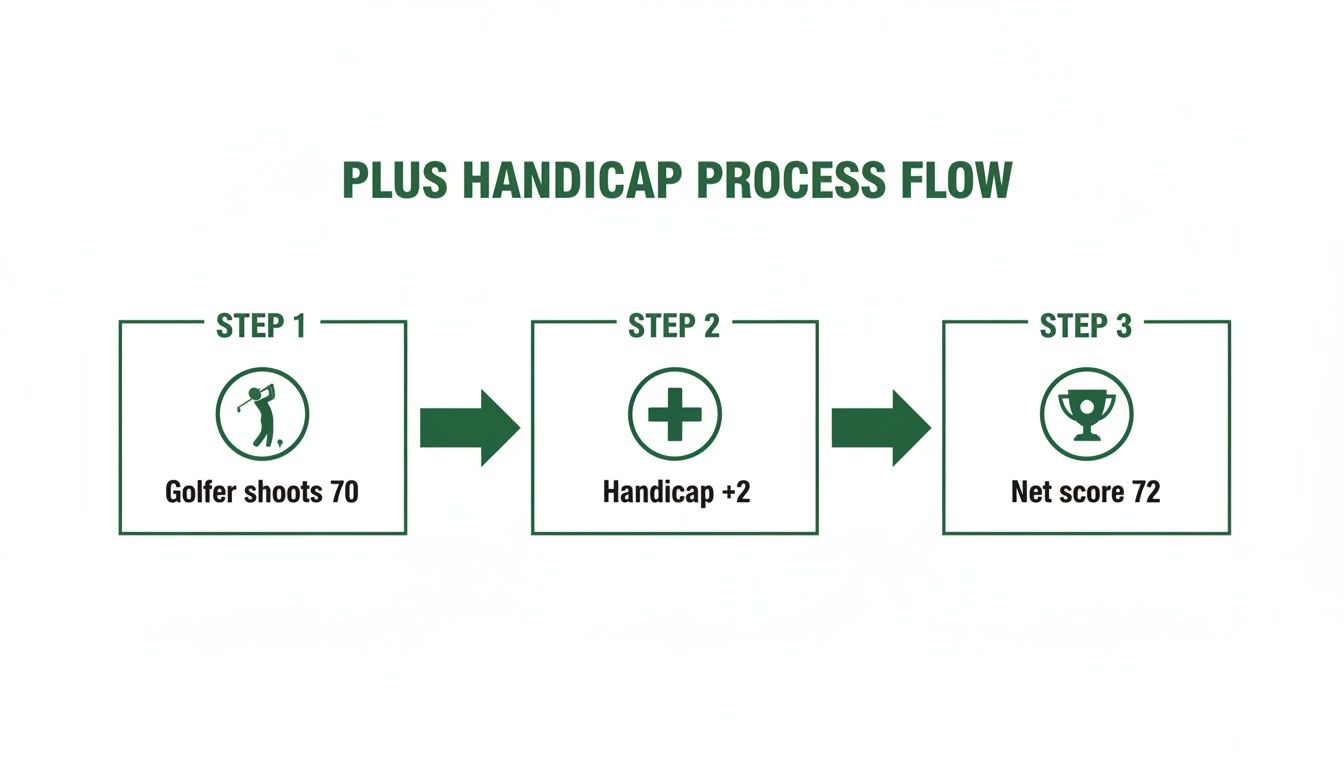
As you can see, a player with a +2 handicap who shoots a raw 70 actually has to add those two strokes back. Their net score for the tournament becomes a 72. This is how the system keeps things fair when elite players compete against the rest of the field.
Getting this right is absolutely essential for accurate golf tournament scoring, as it’s the only way to make sure everyone is competing on a truly level playing field.
Putting the Plus Handicap Formula into Practice
So, how does this all play out on the actual course? It's one thing to talk about a player's Handicap Index as a general measure of skill, but the real magic happens when we calculate their Course Handicap for a specific round.
Let's imagine an elite golfer—someone who consistently shoots under par—stepping up to the first tee with a +2.0 Handicap Index.
They’re playing a tough track, one with a Slope Rating of 130. A quick refresher: Slope Rating tells you how much harder a course is for a bogey golfer compared to a scratch player. 113 is the baseline for an average course, so 130 means this place has some teeth.
Calculating the Course Handicap
To figure out this player's handicap for the day, we'll use the standard formula:
Course Handicap = (Handicap Index x Slope Rating / 113)
Now, let's plug in our golfer's numbers:
(2.0 x 130) / 113 = 2.3
The system rounds this to the nearest whole number, which gives our player a Course Handicap of +2. This is the key part: they actually have to add two strokes to their final score.
Let's see how this looks on the scorecard. Our player goes out and has a fantastic day, firing a three-under-par gross score of 69. To get their official tournament score, we have to account for their plus handicap.
Gross Score: 69
Course Handicap: +2
Net Score: 71
That’s right. Even though they shot a stellar 69, their net score for the competition is 71. This little adjustment is what levels the playing field against the rest of the golfers. It's a critical detail for creating one of the best golf scorecards for tournaments, because it ensures the results are transparent, fair, and accurately reflect every player's true performance. When everyone understands the math, there’s no confusion—just good, clean competition.
How Plus Handicaps Change Tournament Dynamics
When a plus handicap golfer enters the field, it completely changes the tournament's competitive feel. It’s not just about bragging rights; their presence fundamentally alters how scores are calculated and how strategy unfolds. Whether it’s stroke play or match play, the goal is always the same: keep things fair for everyone.
In a standard stroke play event, the adjustment is pretty straightforward. A plus handicap is simply added to the player’s gross score. So, if a golfer with a +2 Course Handicap goes out and shoots a stellar 70, their official net score for the day becomes a 72. It's a clean, simple way to level the playing field against the rest of the competition.
The Impact on Match Play
Match play is where things get really interesting. In this format, a plus handicap player doesn't just adjust their own score—they actually have to give strokes back to their opponent on certain holes. This creates a whole new layer of strategy right from the first tee.
Let's walk through a common scenario:
Player A: An elite golfer with a +3 Course Handicap.
Player B: A solid mid-handicap player with a 10 Course Handicap.
The total difference between their handicaps is a whopping 13 strokes (10 - (-3) = 13). This means Player B, the higher handicap golfer, gets to take 13 strokes off their score throughout the match, courtesy of Player A.
These aren't just random strokes, though. They're applied to the 13 toughest holes on the course, as ranked by the "Handicap" or "Stroke Index" row on the scorecard, starting with the #1 handicap hole.
This system gives Player B an advantage exactly where they’re most likely to need it, making for a much tighter and more exciting head-to-head battle.
Below is a quick breakdown of how a +2 handicap player would stack up against different opponents in various formats.
Plus Handicap Impact on Tournament Formats
Format | Opponent Handicap | Stroke Difference | How Strokes Are Given/Received |
|---|---|---|---|
Match Play | Scratch (0) | 2 strokes | The +2 player gives 2 strokes on the #1 and #2 handicap holes. |
Match Play | 10 Handicap | 12 strokes | The +2 player gives 12 strokes on the 12 most difficult holes. |
Match Play | +4 Handicap | 2 strokes | The +2 player receives 2 strokes from the +4 player. |
Four-Ball (90%) | Paired with a 12 | Team plays off lower Hcp | The +2 becomes +2 (rounded) and the 12 becomes 11 (rounded). |
This table really highlights how the plus handicap shifts the dynamic, ensuring that no matter the format, the competition remains balanced.
Applying Percentage Allowances in Team Events
In team games like four-ball or scrambles, tournament organizers add another layer of fairness by applying handicap allowances. A common rule, for instance, is to use 90% of each player's Course Handicap.
This adjustment is applied to everyone across the board. Our +3 golfer's handicap would become +2.7 (which rounds to +3), while the 10-handicap player's would adjust down to 9. The system scales everyone's handicap proportionally, which keeps the relative skill gap intact and stops any single team from having an unfair advantage.
Managing Plus Handicaps in Your Tournament Software
When you've got elite players in your tournament, the last thing you want is a logistical headache. Running a professional-feeling event means your software needs to handle every detail flawlessly, especially when it comes to something like a plus handicap. Good tournament software takes the guesswork out of it, so you can focus on the event itself.
The whole process starts with one simple but critical step: data entry. To make sure every calculation is spot-on, a plus handicap has to be entered as a negative number. So, if a player has a +2 Course Handicap, you’ll enter it into the system as -2. This tells the software to add strokes to their gross score instead of subtracting them. It's a small detail that makes all the difference.
Real-Time Leaderboard Accuracy
Once the handicaps are in correctly, the software does the heavy lifting. Live leaderboards automatically adjust for plus handicaps, showing accurate net scores for everyone—players, spectators, and staff—in real time. This means no more confusion or manual double-checking. The standings are just… right.
Here’s a look at how a clean, live leaderboard in Live Tourney provides that clarity for everyone watching.

This kind of seamless integration lets you project standings on screens around the clubhouse with total confidence.
And it’s not just for basic stroke play. The best platforms handle complex formats without breaking a sweat. For team games like a four-ball or scramble that use percentage-based handicap allowances (like 90%), the system applies those rules automatically to every player, even those with plus handicaps.
Key Advantage: Automation gets rid of the need for messy spreadsheets and manual calculations. The software ensures every single score—from individual net results to team allowances—is calculated fairly and consistently for the entire field.
This is a game-changer for tournament organizers. If you want to see how this works in practice, check out our guide to the best golf tournament scoring software to see how it can elevate your next event. When you can rely on the right tools, you can stop worrying about the math and focus on creating an experience your players won't forget.
Common Questions About Plus Handicaps
Even when you get the hang of the math, a few questions about plus handicaps always seem to pop up for golfers and tournament organizers. Let's tackle these common points of confusion so you can manage your elite players with total confidence.
How Rare Is a Plus Handicap in Golf?
Getting to a plus handicap is incredibly rare. It puts a golfer in the absolute top tier of amateur players. According to the USGA, fewer than 1% of all golfers with an official Handicap Index ever reach that level.
To give you some perspective, the average handicap for a male golfer in the U.S. is around 14. That massive gap is exactly why you see plus-handicap players consistently dominating club championships and other high-level amateur tournaments.
Do Handicap Allowances Favor Plus Players?
Not at all. The World Handicap System’s allowances are specifically designed to keep things equitable. When a percentage-based allowance is used, like 85% in a team game, it scales everyone's handicap down proportionally.
For example:
A +2 player’s handicap adjusts to +1.7 (which rounds to +2).
A 20-handicap player’s becomes 17.
The whole point is to preserve the relative skill gap between players, not to hand anyone an unfair advantage. Modern tournament software handles all these calculations automatically, so fairness is locked in across the entire field.
Can a Player's Handicap Change Mid-Tournament?
Nope. A player's official Handicap Index is locked in the moment a competition starts. This is a hard-and-fast rule that guarantees a consistent playing field for every round of that specific event.
Now, any exceptional scores they shoot during the tournament will absolutely factor into their future handicap revisions. A great performance could easily push their index even further into plus territory for the next event they play.
The Bottom Line: The handicap used for a tournament is set before the first tee shot and doesn’t change until the event is over. This gives every competitor stability and predictability.
How Should Leaderboards Display Plus Handicap Scores?
Clarity is king here. A well-designed leaderboard needs to show three key things to avoid any confusion for players and spectators:
Gross Score: The actual number of strokes taken.
Course Handicap: Clearly marked with a plus sign (e.g., +2).
Net Score: The final score after the handicap is applied.
Good tournament software displays this automatically, correctly adding the strokes back to the gross score. This prevents the all-too-common mistake of subtracting the handicap and ensures the standings are accurate and easy to understand at a glance.
Running a professional-level tournament means nailing these details every single time. With Live Tourney, you can manage plus handicaps, apply allowances, and display crystal-clear live leaderboards without any of the manual work. Elevate your next event by visiting https://livetourney.com to start your free trial.





