
Jan 28, 2026
What is a handicap in golf? This guide explains how handicaps level the playing field, how they're calculated, and why they matter for every golfer.
Ever wondered how a casual weekend golfer can tee it up in a competitive match against a club champion and actually have a chance? The secret sauce is the handicap system, arguably one of the most brilliant and essential concepts in the game.
What Is a Golf Handicap? The Great Equalizer of the Game

At its core, a golf handicap is a numerical measure of a player's potential ability, designed to level the playing field. It’s the magic number that makes the game fair and fun for everyone, regardless of skill.
Think of it like a 100-meter dash where a slower runner gets a 20-meter head start. That's exactly what a handicap does in golf. It gives less experienced players a certain number of "free" strokes, which are subtracted from their gross score at the end of the round.
This simple adjustment creates a "net score," which is what allows for a fair comparison. It’s no longer about who shot the lowest raw score, but who played best relative to their own ability.
Understanding the Basics
The idea is pretty straightforward: the lower your handicap, the better you are at golf. A "scratch golfer" has a handicap of 0, meaning they’re expected to shoot right around the course's par. On the flip side, a player with a 20 handicap is expected to shoot, on average, 20 strokes over par.
Here’s why it’s so fundamental to the sport:
It Promotes Fair Competition: This is the big one. It lets golfers of all skill levels compete against each other in leagues, scrambles, and tournaments.
It Tracks Your Progress: A handicap gives you a clear, objective benchmark to measure your improvement over time. Watching that number drop is one of the most satisfying parts of the game.
It’s a Universal Language: Thanks to the World Handicap System (WHS), your handicap is portable. You can take it to almost any course in the world and know it will be applied fairly.
A common myth is that your handicap is your average score. It’s not. It actually reflects your potential ability, calculated from the best of your most recent rounds. Think of it as a measure of how well you can play on a good day.
Ultimately, the handicap system is what makes golf so inclusive. Without it, tournaments would only be for the elite few. It’s the mechanism that brings the entire golfing community together, ensuring every single player has a real shot at winning.
From Clubhouse Rules to a Global Standard
The modern handicap system we know today didn't just appear out of thin air. For a long time, golf was a wild west of informal agreements and "clubhouse rules" that changed completely from one course to the next.
Imagine trying to play a match where your opponent's handicap was calculated using a system you’d never even heard of. It was confusing, messy, and made fair competition almost impossible once you left your home turf.
A player’s handicap might be respected at their own club, but it meant very little somewhere else. The sport desperately needed a common language for skill—a way to make a player's ability understandable and comparable, no matter where they teed it up.
The Pioneers of Standardization
The first real steps toward a unified system came from a few forward-thinking groups. Back in the 1890s, the Ladies Golf Union (LGU) introduced one of the first standardized systems, shifting the focus from subjective club opinions to official, union-assigned course ratings. This was a huge step, laying the foundation for a more objective way to measure a player's ability.
Meanwhile, in the United States, the USGA officially adopted its first system in 1911, which was based on a player’s three best scores of the season. These early systems were simple by today's standards, but they were critical in establishing the idea of a standardized, data-driven handicap. You can dive deeper into these early efforts in the history of golf handicapping).
These early movements tackled two core problems head-on:
Portability: Making sure a handicap was actually valid when a golfer played away from their home course.
Objectivity: Getting rid of the inconsistent, club-by-club rules and replacing them with a fair, mathematical formula.
The Breakthrough: Course and Slope Rating
The real game-changer was the creation of Course Rating and Slope Rating. These two numbers transformed handicapping from a simple scoring average into a sophisticated system that finally accounted for a course's difficulty.
A Course Rating tells a scratch golfer what they should shoot on a given course. The Slope Rating, on the other hand, measures how much more difficult that same course is for a bogey golfer compared to a scratch player.
This was the missing piece of the puzzle. It allowed a golfer's single Handicap Index to be converted into a Course Handicap that was specific to the tees they were playing that day. For the first time, a player's handicap could adjust on the fly based on the challenge in front of them, creating true, equitable competition.
This entire evolution, from loose club rules to a refined global system, eventually led to the World Handicap System (WHS). Today, the WHS brings the best of all previous systems together, giving golfers a single, consistent standard across the globe. It’s a journey that shows a deep commitment to fairness, making golf the uniquely competitive and inclusive sport it is.
How Your Handicap Index Is Calculated
Let’s pull back the curtain on the math behind your handicap. It’s a smart system designed to measure your potential, not just your average day on the course. It all starts the moment you finish a round, but it cleverly protects you from that one disastrous hole we've all experienced.
That protection comes from something called the Adjusted Gross Score (AGS). Think of it as a "maximum score" allowed on any single hole for handicap purposes. It ensures that one blow-up hole doesn't unfairly torpedo your Handicap Index. The system basically says, "That triple-bogey meltdown on the 7th isn't a true reflection of your skill," and caps the damage.
This adjustment is the first step in figuring out your Score Differential, which is the ultimate measure of how well you played that day, relative to the course's difficulty.
Turning Your Score into a Differential
The Score Differential isn't just about the number you write on the scorecard. It’s calculated using a specific formula that levels the playing field, accounting for how tough the course was.
The formula looks like this:
(113 / Slope Rating) x (Adjusted Gross Score - Course Rating - Playing Conditions Calculation adjustment)
This calculation turns your raw score into a standardized number. It’s the foundational block that lets you compare a round at your local muni to a round at Pebble Beach.
Finding Your Best Self: The 8 of 20 Rule
Once you have at least 20 scores logged, the system gets to work. It looks at your most recent 20 rounds and their corresponding Score Differentials, then identifies the eight best (meaning, lowest) ones from that list.
It completely ignores the other 12 rounds, including your worst blow-ups.
Your official Handicap Index is simply the average of those eight best Score Differentials. This "best 8 of 20" approach is exactly why your handicap reflects your potential ability, not your average. It’s a measure of how good you can be when you're playing well.
Here’s a quick example: Let's say a golfer shoots an 85 on a course with a Slope Rating of 130 and a Course Rating of 71.5. After the math, their Score Differential for that round would be 11.7. The system does this for every round, finds the eight lowest differentials out of the last 20, and averages them to produce the final Handicap Index.
The handicap system has come a long way to reach this level of fairness, as this chart on the history of golf handicaps shows.
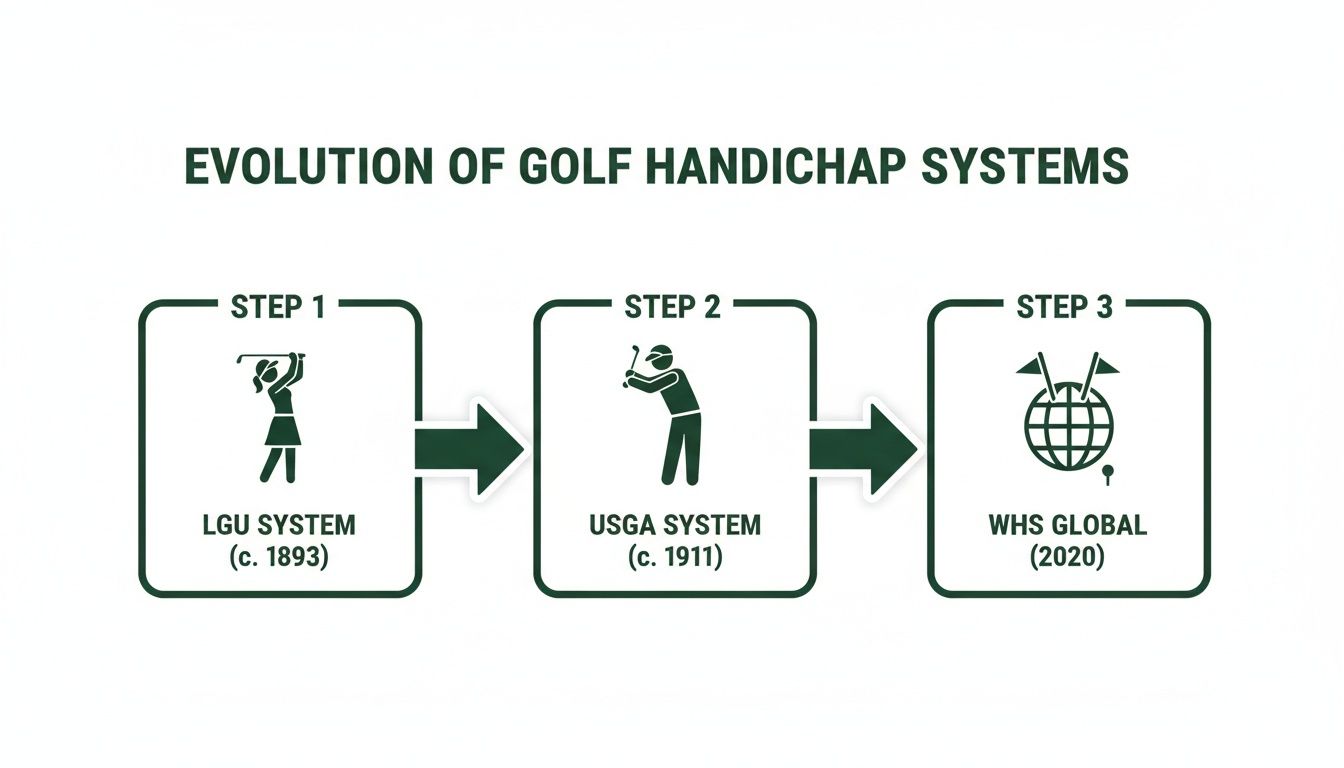
You can see the progression from early, regional systems like those from the LGU and USGA to today's unified World Handicap System. The whole point of that evolution was to create a single, equitable standard for every golfer on the planet.
Understanding Your Handicap Index vs Course Handicap
This is probably one of the biggest points of confusion for golfers. What’s the difference between a Handicap Index and a Course Handicap? It's simpler than you think.
Think of your Handicap Index as your portable, baseline skill level. It’s the single number that travels with you from course to course, giving a general snapshot of your potential ability.
Your Course Handicap, on the other hand, is the actual number of strokes you get on a specific course, from a specific set of tees, on a given day. It's the practical, adjusted number you’ll actually use to play.
This conversion from your general Index to a specific Course Handicap is what makes the whole system fair. After all, a round at a beast of a course like Bethpage Black isn't the same as a casual loop at your local muni. The handicap system has to account for that.
The Role of Course and Slope Rating
To make that crucial adjustment, the system uses two numbers every rated set of tees has: the Course Rating and the Slope Rating.
These two ratings are the secret sauce. They're what allow your handicap to adapt to the challenge in front of you.
Here's a quick look at the key terms that make the whole handicap system work.
Key Handicap Terminology Explained
Term | Definition | Purpose |
|---|---|---|
Handicap Index | A measure of a player's potential ability, calculated from their best recent scores. | Provides a portable, standardized skill level that can be used on any course. |
Course Rating | The expected score of a scratch golfer (0 handicap) from a specific set of tees. | Sets the baseline difficulty of the course for an expert player. |
Slope Rating | Measures the relative difficulty of a course for a bogey golfer compared to a scratch golfer. | Adjusts the handicap to account for how much harder a course is for an average player. |
Course Handicap | The number of strokes a player receives on a specific course from a specific set of tees. | Converts the Handicap Index into a practical, playable number for the day's round. |
Understanding these four terms is the foundation for seeing how your handicap truly functions on the course. They work together to ensure fairness no matter where you play.
The Conversion Formula in Action
So, how do you get from your Index to your Course Handicap? There’s a straightforward formula that does the work. It takes your potential ability (Index) and adjusts it based on the course’s difficulty (Slope).
Course Handicap = (Handicap Index x Slope Rating / 113) + (Course Rating - Par)
Note: The (Course Rating - Par) adjustment is a newer part of the World Handicap System formula, ensuring your target score aligns with the par of the course.
This calculation answers the all-important question: "How many strokes do I actually get today, on this course, from these tees?" It’s why a 15.0 Index might get you 17 strokes on a tough course but only 14 on an easier one. Keeping track of these details on one of the best golf scorecards is key.
This ability to adjust handicaps was a massive breakthrough for the game. The "Slope System" was first tested by the Colorado Golf Association in 1982 and officially adopted by the USGA in 1987. It finally solved a century-old problem, making a golfer's handicap truly fair and portable for the first time.
How to Use Your Handicap in Tournaments
So, you’ve got your handicap. Now what? This is where that number goes from being a personal benchmark to a powerful tool on the course. In a tournament, your handicap is what levels the playing field, giving every single golfer a real shot at winning based on how they play against their own potential.
Without it, most amateur events would just be a contest to see which scratch golfer shows up.
The magic happens when your Course Handicap is used to calculate a net score. This is the great equalizer. Instead of just adding up your total shots (your gross score), the tournament subtracts your handicap strokes. Suddenly, your performance is measured against what you’re capable of.
For example, if you go out and shoot a 90 and your Course Handicap is 18, your net score for the day is a very solid 72. You’re right in the mix.
Common Net Scoring Formats
This net scoring idea is the foundation for all kinds of fun and competitive tournament formats. The format just dictates how your handicap strokes are applied, which can add a whole new layer of strategy to the game.
Here are three of the most popular formats you’ll run into:
Net Stroke Play: This is as straightforward as it gets. At the end of the round, you subtract your Course Handicap from your gross score. The player with the lowest net score wins. It’s a pure test of who outplayed their handicap on that given day.
Net Match Play: Forget the rest of the field—here, you’re going head-to-head against one opponent. The system uses the difference between your two Course Handicaps. The player with the higher handicap gets strokes on the toughest holes (as ranked on the scorecard), evening things out hole by hole.
Stableford: Instead of counting strokes, you’re chasing points based on your net score for each hole. A net birdie might be worth three points, a net par one point, and so on. This format is great because it rewards you for playing well but prevents one blow-up hole from wrecking your entire round. To see how these calculations work, check out our guide on different methods for golf tournament scoring.
You might also hear the term Playing Handicap. For certain formats, especially team games like a Four-Ball or Scramble, the rules might require you to use only a percentage of your Course Handicap (like 85% or 90%). This extra tweak helps balance the teams and stops one high-handicap player from having an unfair advantage.
This might sound like a lot of math, but modern tournament software like Live Tourney handles it all automatically. An organizer just needs to plug in the handicaps, pick a format, and the platform does the rest—from figuring out which holes you get strokes on to updating live leaderboards with real-time net scores. It makes running a fair, fun, and professional-feeling event simple for everyone involved.
How to Get and Maintain Your Official Handicap
Ready to make your golf game official? Getting a Handicap Index is simpler than you might think. It’s the first step to truly tracking your progress, competing fairly, and connecting with the global golf community.
Your journey starts by joining an authorized golf club or association. This doesn't mean you have to join a pricey country club. Plenty of public courses, local golf associations, and even some online groups are licensed to issue an official Handicap Index. Once you're a member, you'll get a unique ID number—most likely a GHIN (Golfer Handicap Information Network) number if you're in the United States.
Posting Your Scores Correctly
With your membership set up, it's time to play some golf and post your scores. To get your initial Handicap Index, you need to submit scores from at least 54 holes. This can be any mix of 9-hole or 18-hole rounds. Most golfers post scores right from their phone using an app like the USGA GHIN app, but you can also use a computer kiosk at the club or your association's website.
It’s really important to post every acceptable score, whether it’s a great round or a terrible one. Your handicap is designed to reflect your potential ability, so it needs all the data it can get. Under the World Handicap System, almost every round you play by the Rules of Golf counts as an "acceptable score." Regular posting is key—your Handicap Index updates daily, so the more current your scores, the more accurate your handicap will be. To sharpen your skills and get your scores where you want them, spending time at facilities like the Vila Sol Golf Academy & Driving Range can make a real difference.
The system is built to reflect what you're capable of on the course. By consistently posting your scores, you're feeding it the data it needs for that "best 8 of 20" calculation to work its magic. The result is a number you can actually trust.
From there, maintaining your handicap is just a matter of habit. Get in the rhythm of posting your score right after each round. It opens the door to fair tournament play and gives you a real, tangible way to see if you're getting better. And as you get more into competitive events, using a tool like golf league management software can make it much easier to organize tournaments where everyone's official handicap comes into play.
Common Questions About Golf Handicaps
Once you start digging into the world of handicaps, a few questions always seem to pop up. Getting these cleared up is the key to understanding how this powerful system really levels the playing field.
Can I Have a Handicap Without Joining a Club?
Yes and no. You don't have to join a fancy private country club, but you do need to be a member of an authorized golf club or association. These are the groups licensed to issue an official Handicap Index.
The good news is, plenty of public courses and regional golf associations offer affordable memberships for exactly this purpose.
What Is a Good Handicap for an Average Golfer?
This is probably the most common question out there. While "good" is all relative, we can look at the numbers. The average Handicap Index for men in the United States is around 14.0. For women, it's about 28.0.
If you've got a handicap in the single digits, you're playing some seriously good golf.
Does My Handicap Expire?
Your Handicap Index doesn't technically "expire," but it does need to be kept current. To stay active and accurate, you have to post scores regularly. If you take a long break from posting, your index might become inactive until you start entering scores again.
The whole system is designed to be a fluid, up-to-date reflection of your current potential. Consistency is key, as your Handicap Index updates daily based on the scores you post.
Why Did My Handicap Go Up After a Good Round?
This one can feel a bit backward, but there’s a simple explanation. Your handicap is calculated using your 8 best scores from your last 20 rounds.
When you post a new, solid score, it might push an even better older score out of that 20-round window. It's a rolling average, so sometimes a great new round can actually cause a slight bump up.
Keeping track of all these details is a headache for tournament organizers. That's where Live Tourney comes in. It automates every handicap calculation—from Course Handicap adjustments to applying strokes in different formats—making sure your tournament is fair, professional, and dead simple to run. Learn more at livetourney.com.





