

Jan 6, 2026
Understand what does scramble mean in golf with our guide to rules, formats, and winning strategies. Perfect for players and tournament organizers.
A golf scramble is a team-based format where everyone hits a tee shot, the team chooses the best one, and every player hits their next shot from that spot. Think of it as building the perfect golf hole as a team, using only the best take for each shot until the ball is in the cup. This collaborative approach takes the pressure off any single player, making it a favorite for charity events and corporate outings.
What a Golf Scramble Really Means

If you've ever felt intimidated by the idea of playing in a golf tournament, the scramble format is your new best friend. It’s designed to be social, fast-paced, and fun for players of all skill levels, from seasoned golfers to complete beginners.
The core idea is refreshingly simple: teamwork over individual skill.
Instead of the usual stress of playing your own ball from tee to green, your team works together. After every player hits, the group walks up, finds the shot that landed in the best position, and marks it. Then, everyone on the team plays their next shot from that exact spot.
The Collaborative Spirit of the Game
This "best-ball" process continues for every single shot—drives, fairway shots, chips, and even putts—until the ball is in the hole. Only one score is recorded for the team, which is the result of everyone's collective effort.
This setup offers some huge advantages:
It Reduces Pressure: A terrible shot doesn't ruin your hole. Your teammates are right there to pick you up.
It Encourages Teamwork: You’ll find yourself strategizing and communicating with your group to figure out which shot gives you the best chance to score.
It Levels the Playing Field: A new golfer's lucky drive or a great putt can be just as valuable as a scratch player's consistent iron play.
A scramble is all about leveraging strengths. One player might be a long-ball hitter, while another is a wizard with their wedges. By combining those skills, the team can shoot a score that’s far better than what any single player could achieve alone.
The scramble first popped up in the 1950s and completely changed the game for charity and corporate events by making golf accessible to everyone. The teamwork and fun are a huge reason why it has absolutely exploded in popularity. You can learn more about its history and impact on River Hills Country Club's website.
Understanding Core Scramble Rules and Scoring
So, how does a scramble actually work on the course? It’s a simple, collaborative rhythm that repeats on every hole, designed to take the pressure off any one player and just let the team have fun.
It all starts on the tee box. In a typical four-person scramble, everyone hits a drive. From there, the whole team heads out to see where the shots landed and decides together which ball is in the best spot. This isn't always about who hit it the furthest—a shorter drive in the perfect fairway position is often a much better choice than a long one buried in the rough.
The Shot Selection Process
Once the team picks the best drive, that spot is marked. The other three players grab their balls, bring them over to that spot, and everyone hits their next shot from there (usually within one club-length, no closer to the hole).
This "play the best ball" process continues for every single stroke—from fairway shots and chips right down to the final putt. The team keeps picking the best shot until someone finally holes out. Because of this, you only write down one score for the entire team on each hole.
The whole idea behind a scramble is simple: play the best shot, every time. If one player hits a fantastic approach to just five feet from the pin, the entire team gets to try their putt from that same spot. Your chances of making a birdie just went way up.
Scoring and Handicaps in a Scramble
Scoring is as straightforward as it gets: one team score per hole. The team with the lowest total score at the end of the day wins. Simple.
But to keep things competitive between teams of different skill levels, most scrambles use a team handicap. There isn't one universal formula, but a common method for a 4-person team is to combine a percentage of each player’s handicap.
A popular calculation looks something like this:
25% of the A-Player's (lowest) handicap
20% of the B-Player's handicap
15% of the C-Player's handicap
10% of the D-Player's (highest) handicap
You add those numbers up to get the team handicap, which is then subtracted from the team's gross score for a final net score. Getting this right is key to a fair event, and you can dive deeper into the different methods in our guide to golf tournament scoring formats. This system helps level the playing field and gives every team a legitimate shot at winning.
Popular Scramble Variations You Will Encounter
While the standard format is a blast, one of the best things about a scramble is how flexible it is. Tournament organizers love to add little twists to keep their events feeling fresh year after year. Knowing the most popular variations means you’ll show up to the course ready for whatever they throw at you.
At its core, though, every scramble follows the same simple, collaborative process.
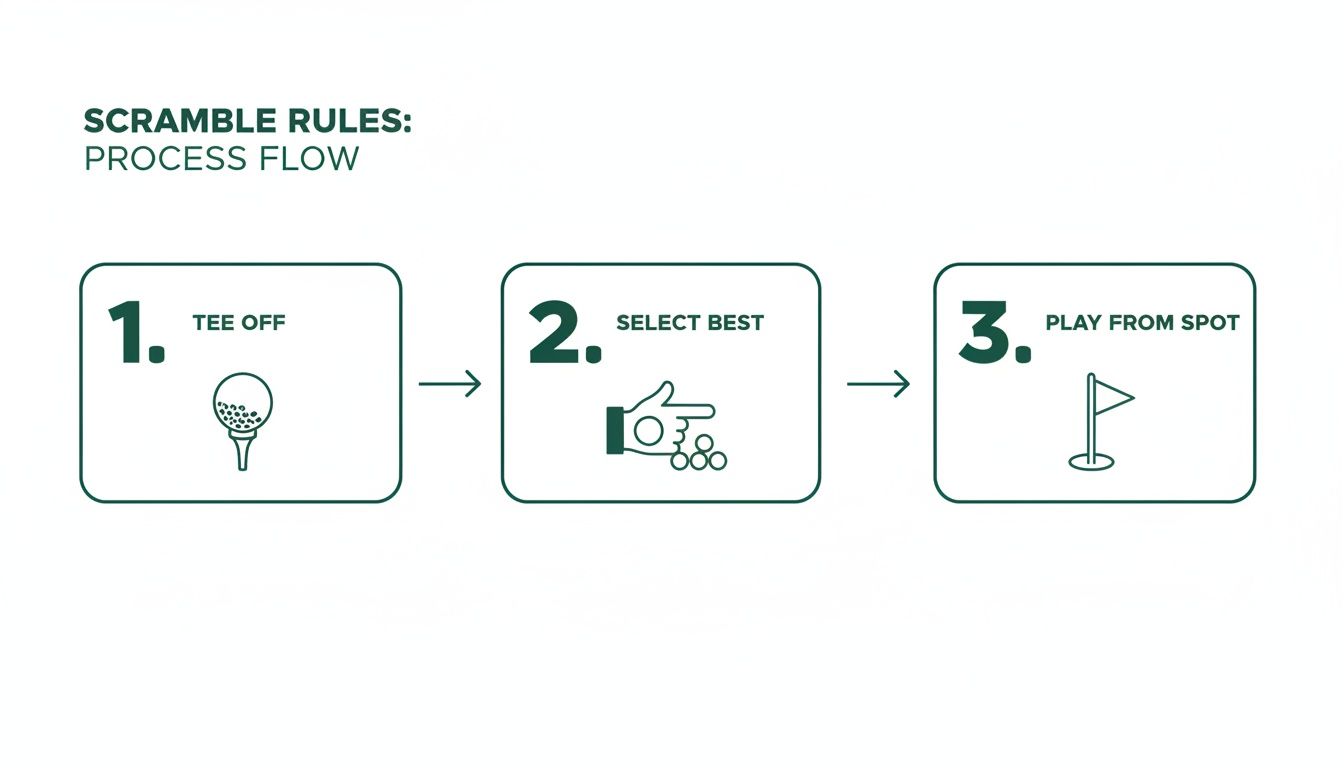
This flow is all about teamwork and making a collective decision on every single shot.
Texas Scramble
One of the most common twists you'll see is the Texas Scramble. The basic gameplay is identical to a standard scramble, but with one key rule designed to get everyone involved: the team has to use a minimum number of each player's tee shots during the round.
For a four-person team, this usually means selecting at least four drives from each player. This is a great rule because it prevents a team from just leaning on their one bomber all day. It forces you to think strategically and makes sure everyone contributes off the tee.
Shamble (or Bramble)
Another popular format is the Shamble, which you might also hear called a Bramble. Think of it as a hybrid that mixes the best part of a scramble with a bit of individual stroke play.
Here’s how it works:
Just like a scramble, everyone tees off, and the team chooses the best drive to play from.
But here's the twist: from that spot, every player plays their own ball for the rest of the hole, just like in a normal round.
The team then takes the lowest individual score on that hole as the official team score.
The Shamble is a fantastic format because everyone gets the benefit of a great drive, but you still get the satisfaction and challenge of playing your own ball into the green.
Scramble vs Best-Ball: What Is the Difference?
It’s really easy to get these two formats mixed up, but they are fundamentally different. A Best-Ball (or Fourball) isn't a scramble at all. Knowing the difference is key, so you don't find yourself playing the wrong format.
Here's a simple breakdown:
Feature | Scramble | Best-Ball (Fourball) |
|---|---|---|
Team Play | Everyone plays from the "best shot" location after each stroke. | Every player plays their own ball from tee to green on every hole. |
Scoring | One team score is recorded per hole. | The lowest individual score on the hole becomes the team's score. |
Pace of Play | Generally faster, as bad shots are picked up. | Can be slower, as up to four balls are in play for the entire hole. |
Strategy | Collaborative decision-making on every shot. | More individual, with players trying to make their own low score. |
In short, a scramble is a true team effort where every shot is a group decision. A Best-Ball feels more like playing your own round, but you have teammates to back you up if you have a bad hole.
Developing a Winning Scramble Strategy

It’s one thing to just play in a scramble, but it's another thing entirely to compete. If you want to move from just having fun to actually winning, you need a game plan. It all comes down to understanding how to use every player’s unique skills to give your team the best chance to go low.
A winning strategy actually starts before you even step on the first tee. You don't want a team of four bombers who can't chip or putt to save their lives. That’s a recipe for a long, frustrating day.
Instead, think like a general manager and assemble a balanced squad. A great scramble team usually has these key roles covered:
The Power Hitter: This is your big gun, the player who consistently sends it deep and sets the team up with short, manageable approach shots.
The Iron Specialist: You need someone who is deadly accurate with their irons and fairway woods. This is the player who sticks it close to the pin time and time again.
The Short Game Guru: Every team needs that player with magic hands around the green—someone you trust with tricky chips and bunker shots to clean up mistakes and set up easy birdie putts.
The Putting Ace: A confident putter is worth their weight in gold. This is the person who can read greens and drain the clutch putts when the pressure is on.
Optimizing Your Shot Order
Once you've got your crew, you need to decide on a batting order. And no, it’s not just about letting your best player go last every single time. It’s about putting everyone in a position to play to their strengths.
A simple but highly effective order for tee shots is to let your more aggressive (or less consistent) players go first. This gives them the green light to swing freely without any real penalty. If they pure one, great. If they don't, your most reliable and straightest driver should hit last, acting as the anchor to make sure you always have a ball in the fairway.
On the green, the strategy completely flips. Let one of your better putters go first to give the team a read on the line and speed. The final putter—often your best—now has all the information they need to knock it in.
This kind of deliberate approach to team building and shot selection is what separates the contenders from the pretenders. It transforms a casual round into a calculated attack, giving your team a huge advantage over groups that are just out there winging it.
Why Scrambles Are Perfect for Charity and Corporate Golf

There’s a good reason the scramble format is the go-to choice for charity fundraisers and corporate outings: it’s incredibly inclusive. While a traditional round of stroke play can be intimidating for new golfers, a scramble invites everyone to the party, no matter their skill level.
This team-first approach means even a total beginner can hit one great shot that helps the team, making them feel like a valuable contributor. That collaborative vibe is a game-changer for boosting participation and creating a fun, low-pressure day for everyone.
Fostering Networking and Team Building
Scrambles aren't just fun; they're practically designed for building relationships. The constant chatter about which shot to take and where to play from naturally gets people talking and working together.
It creates the perfect relaxed atmosphere for:
Corporate Team Building: Colleagues collaborate toward a shared goal in a setting far from the office.
Client Entertainment: You get hours of quality time to strengthen business connections.
Charity Networking: Donors, sponsors, and participants can connect in a casual, engaging way.
For event organizers, a thoughtful giveaway can make the day even more memorable. Something like an Augusta Golf Buddy Keychain leaves every player with a great impression long after the final putt drops.
A huge, often overlooked benefit is the pace of play. By picking up bad shots and always playing from the best spot, scramble rounds move way faster than individual formats. No more long, frustrating waits on the tee box.
That quicker pace leaves more time for what often matters most: the post-round awards dinner, auction, or networking reception. If you're planning an event, our guide on how to organize a golf tournament breaks down everything you need to know.
How to Effortlessly Manage Your Scramble Tournament
Knowing the rules of a scramble is one thing. Actually running a flawless tournament that feels professional and exciting for every single player? That's a completely different challenge.
If you’re an organizer, you already know the headaches: managing registrations, chasing down payments, creating pairings, and manually scoring everything. It can quickly turn into a logistical nightmare.
Thankfully, modern tools are built to take that entire administrative burden off your plate. Instead of getting buried in spreadsheets, you can automate everything from sign-ups to final scorecards. This frees you up to focus on what really matters—creating a memorable day for your players and sponsors.
Elevate the Player Experience
Want to know the single biggest game-changer for a scramble? Live, real-time leaderboards.
This one feature injects a massive dose of energy and competition into the day. Players can see exactly where their team stands from the first tee to the final putt. No more waiting around after the round for someone to tally up paper scorecards.
By providing an app-free live leaderboard that works on any phone, you keep players and sponsors constantly engaged. This simple addition transforms a standard outing into a dynamic, competitive event that leaves a lasting positive impression.
Modern platforms like Live Tourney offer a full suite of management tools built specifically for scrambles and other tournament formats. You can find robust golf tournament management software designed to handle all the heavy lifting for you, saving countless hours of manual work.
These systems give you everything you need to run a smooth operation from start to finish:
Effortless Registration: Set up custom online registration pages in minutes to handle sign-ups and securely collect payments.
Automated Pairings: Easily create balanced teams and generate tee sheets with just a few clicks.
Custom Print Materials: Instantly generate professional-looking cart signs, scorecards, and bag tags, all customized for your event.
Live Scoring and Leaderboards: Players enter scores right from their phones, and the results update in real-time for everyone to see.
By using these tools, you can run a seamless, professional-looking scramble that not only impresses your participants but also dramatically simplifies your workload. You end up delivering a superior experience that makes players want to come back year after year, ensuring your events are a long-term success.
Frequently Asked Questions About Golf Scrambles
Even after you get the hang of a scramble, a few questions always seem to pop up. Here are some quick answers to the ones we hear most often.
What Is a Good Score for a 4-Person Scramble?
This really depends on the course and the skill of the players, but a "good" score in a competitive scramble is usually deep into red numbers.
Winning scores at major charity or club events often land somewhere between -15 and -20. For a more laid-back outing, any score under par is a great day on the course.
How Do You Calculate Handicaps for a Scramble?
There's no single, official rule for this, but most tournaments use a formula that takes a percentage of each player's handicap to create a team handicap.
A popular method for a four-person team looks like this:
25% of the A-player's (lowest) handicap
20% of the B-player's handicap
15% of the C-player's handicap
10% of the D-player's (highest) handicap
Every tournament is different, though, so always double-check the rules sheet before you tee off.
What Is the Difference Between a Scramble and a Shamble?
The main difference happens right after the tee shot. In a scramble, the team picks the best drive, and everyone hits their next shot from that spot.
In a shamble, you also pick the best drive, but after that, each player plays their own ball all the way to the hole.
Think of it this way: a scramble is a team effort on every single shot. A shamble is a team effort on the drive, followed by individual play for the rest of the hole.
Can You Improve Your Lie in a Scramble?
Yes! This is one of the best parts of playing in a scramble. The rules usually let you place your ball within one club-length of the chosen shot, no closer to the hole.
This means you can take a ball sitting in a divot and place it on a perfect patch of grass, or fluff up your lie in the rough. Just make sure you aren't moving it from the fairway into the fringe or anything like that.
Ready to run a flawless scramble without all the usual headaches? With Live Tourney, you can automate registration, handle scoring, and print materials in minutes. Best of all, you can keep players hooked with a real-time leaderboard. Start your free 10-day trial today at Live Tourney and see just how easy your next event can be.





