

Jan 15, 2026
Unlock what does course rating mean in golf and see how it impacts your events. This guide breaks down course and slope ratings for tournament directors.
So, what does Course Rating actually mean?
It’s one of the most important numbers in golf, but it's often misunderstood. Simply put, a course rating is the expected score of a scratch golfer (a player with a 0 handicap) on a specific set of tees under normal playing conditions.
It's the purest measure of a course's difficulty for the best players out there.
Decoding Golf's Most Important Number

Let’s say you’re looking at a par-72 course, and you see the Course Rating is 73.5. That number is telling a scratch golfer, "Hey, on a good day, you're probably going to shoot about 1.5 strokes over par from these tees." It’s not just about par; it’s about the actual difficulty the course presents.
This single number is the bedrock of the entire USGA Handicap System. For anyone running a tournament, understanding this value isn't just helpful—it's essential. It’s the baseline that makes fair net scoring possible and ensures every player, no matter their skill level, can compete on a level playing field.
Course Rating vs. Slope Rating
While Course Rating tells a scratch player what to expect, its partner, Slope Rating, is all about the bogey golfer.
Think of it this way: Course Rating sets the baseline difficulty. Slope Rating tells you how much more difficult the course gets as a player's skill level decreases. A high Slope Rating means the course is exponentially tougher for a mid-handicapper than it is for a scratch player.
To make this crystal clear, here’s a quick guide to the two numbers you'll find on the best golf scorecards.
Course Rating vs Slope Rating Quick Guide
This quick reference table breaks down the two key metrics that define a golf course's difficulty for every type of player.
Metric | What It Measures | Who It's For |
|---|---|---|
Course Rating | The expected score for a scratch golfer. It's a precise number, like 71.8. | Scratch Golfers (0 Handicap) |
Slope Rating | The relative difficulty for a bogey golfer compared to a scratch golfer. It's a whole number between 55 and 155. | Bogey Golfers (~18 Handicap) |
These two numbers are designed to work together to give every golfer a fair shake.
A great way to think about it is like a mountain hike. The Course Rating is the total distance of the trail. The Slope Rating is how steep and rocky that trail is. One tells you the length of the journey, while the other tells you how much that journey punishes mistakes.
Both numbers are plugged into the World Handicap System to calculate a player's Course Handicap for a specific set of tees. That final number is the magic behind every fair and competitive tournament.
Understanding Course Rating Versus Slope Rating
To really get what a Course Rating means, you have to bring its partner into the conversation: the Slope Rating. These two numbers are a team, and together, they give you the full story of a golf course's difficulty.
Think of it this way: the Course Rating is the baseline. It tells a scratch golfer—someone who consistently shoots par—what they can expect to score on a good day. A rating of 72.5 means that’s the target for the best players. But let's be honest, how many people in your tournament field are scratch golfers?
That’s where Slope Rating comes in.

Slope Rating measures how much tougher a course gets for a bogey golfer compared to that scratch player. It’s the great equalizer in golf, recognizing that certain holes or features are way more punishing for the average player.
A Mountain Climbing Analogy
I’ve always found this analogy helps make it click.
Imagine you're climbing two different mountains. The Course Rating is the total elevation you have to climb to get to the top. The Slope Rating is how steep and nasty the path is—littered with loose rocks, narrow ledges, and all sorts of trouble.
Both mountains could have the same elevation (Course Rating), but the one with the treacherous path (higher Slope Rating) is going to be a much tougher climb for the average person. For a tournament director, that difference is everything. The Course Rating sets the standard, but the Slope Rating is what allows you to adjust handicaps fairly for the whole field, making the competition fun and equitable for everyone.
What Slope Rating Actually Does
The modern Slope Rating system we use today came out of research started by the USGA's Handicap Research Team way back in 1979. They landed on a scale from 55 (easiest) to 155 (most difficult), with 113 being the benchmark for an "average" course. This two-number system is now the foundation of the game for millions of golfers. If you're curious about the deep dive, you can learn more about how the Slope Rating was developed.
A higher Slope Rating simply means there's a bigger gap between what a scratch player and a bogey player will likely score. These are the courses with features that really trip up the average amateur, like:
Forced Carries: Long shots you have to hit over water or a ravine.
Narrow Fairways: Where a slightly offline tee shot is severely punished.
Thick Rough: The kind that makes recovery shots a guessing game.
Wicked Greens: Sloped and contoured to turn easy pars into frustrating three-putts.
In the end, it’s simple. Course Rating tells you how hard a course is for a great player. Slope Rating tells you how much harder it gets for everyone else—and that’s the key to running a fair and competitive tournament.
How the USGA Determines a Course Rating
A Course Rating isn’t a number pulled out of thin air by the head pro. It’s the result of a meticulous, on-the-ground evaluation by trained teams from authorized golf associations, all following a strict process set by the USGA. This is what ensures a 72.5 rating in California means the exact same thing as a 72.5 in Florida.
These teams don’t just show up, play a round, and make a gut call. They conduct a rigorous, on-course analysis, looking at dozens of specific factors from the perspective of both a scratch golfer and a bogey golfer. This detailed process is what makes the final numbers a trusted, unbiased standard for every course out there.
The whole evaluation is built around two core components that define a hole's true difficulty.
The Two Pillars of Course Evaluation
When it comes down to it, the rating process boils down to analyzing two major categories for every single hole, from every single set of tees.
Effective Playing Length: This is so much more than the yardage on the scorecard. Raters adjust the measured distance based on factors that make a hole play longer or shorter than its number suggests.
Obstacles: This is a complete audit of everything that can blow up a golfer's score, from the obvious hazards to the subtle challenges that just get in your head.
By systematically breaking down these two areas, the rating system makes sure every unique feature of a golf course is accounted for, creating a truly accurate picture of its difficulty.
Calculating Effective Playing Length
First, the rating team gets the precise, measured yardage of each hole. Then the real work begins. They start making critical adjustments based on a handful of variables. A 400-yard hole might actually play like a 430-yard hole if it’s consistently uphill and into the wind.
Some of the key factors that adjust a hole's length include:
Roll: Does the fairway give you a generous kick forward, or is it soft and damp, stopping the ball on a dime? Firm, fast fairways can effectively shorten a hole by 20 yards or more.
Elevation: It's simple physics. Uphill shots play longer, and downhill shots play shorter. A big change in elevation can alter a hole’s effective length in a huge way.
Doglegs and Forced Layups: Holes that take the driver out of your hand or force you to play to a specific spot completely change how the hole is played, which impacts its functional length.
Prevailing Wind: If a course is known for a stiff afternoon breeze, that gets factored in. The rating is based on consistent playing conditions, not a perfect, calm day.
A course rating team doesn't just look at the course on a perfect, calm day. They consider the typical conditions a golfer will face, ensuring the rating reflects the course's true character year-round.
Assessing Obstacles and Challenges
Once the effective playing length is locked in, the team shifts its focus to the trouble. They evaluate ten distinct obstacle factors on a scale of 0 to 10, measuring how much a particular feature will impact the score of both scratch and bogey golfers.
This detailed analysis covers everything you can imagine on a golf course:
Topography: Are you going to be dealing with awkward stances in the fairway or around the greens?
Fairway Width: How generous is that landing area where most drives end up?
Green Target: How tough is the green to hit, considering its size and the common angle of approach?
Recoverability and Rough: If you miss the fairway or green, how hard is it to salvage your score?
Bunkers: The team looks at the number, depth, and strategic placement of every single bunker.
Out of Bounds/Extreme Rough: How badly are you punished for a truly wild shot?
Water Hazards: Raters assess how close the water is to the line of play and how much it comes into play.
Trees: This factor considers the density, size, and location of trees that can block shots or force a punch-out.
Green Surface: How much break is in the greens? How fast do they typically run?
Psychology: This is for the subtle stuff—the visual tricks and intimidating shots that can challenge a player's nerve.
After all this data is gathered on-site, the numbers are plugged into the official USGA formula. Out the other end comes the final Course Rating and Slope Rating for each and every set of tees.
Applying Course Ratings to Your Tournaments
This is where the numbers on a scorecard stop being just numbers and start being the bedrock of a fair, competitive tournament. For tournament directors, knowing what a course rating means is one thing; using it correctly is what makes or breaks the event for your players. Its main job? To help you calculate a player’s Course Handicap.
Think of it as an equalizer. A Course Handicap adjusts each player's personal handicap to the specific set of tees they're playing that day. This ensures a 15-handicap from a cakewalk course can compete fairly against a 15-handicap from a beast of a track. It’s all about leveling the playing field.
Calculating a Player's Course Handicap
Thankfully, the World Handicap System gives us a straightforward formula for this. It takes the player's Handicap Index and mixes it with the Course Rating and Slope Rating of the tees they're playing from.
Here's the formula: Course Handicap = Handicap Index x (Slope Rating / 113) + (Course Rating - Par)
Let’s walk through how this works with a real-world example:
Player's Handicap Index: 14.5
Tees Being Played: White Tees
Slope Rating (White Tees): 128
Course Rating (White Tees): 71.8
Par for the Course: 72
Now, we just plug those numbers in: Course Handicap = 14.5 x (128 / 113) + (71.8 - 72) Course Handicap = 14.5 x 1.1327 + (-0.2) Course Handicap = 16.42 - 0.2 = 16.22
After rounding, this player’s Course Handicap for the tournament is 16. That means they get 16 strokes for the round. Nailing this calculation is crucial for accurate golf tournament scoring and keeping your event's credibility intact.
Practical Applications for Tournament Directors
Beyond the basic math, Course Ratings should guide how you set up and run your entire tournament. These numbers help you make smart decisions that directly affect player experience and fairness.
If you’re running a multi-day or multi-course event, these ratings are absolutely essential. A course with a 73.1 rating on day one is a whole different animal than a course with a 69.8 rating on day two. If you don't adjust handicaps for each specific course, you're not running a fair competition. It’s that simple.
This flowchart breaks down what goes into a USGA Course Rating, from the initial analysis to the final obstacle evaluation.
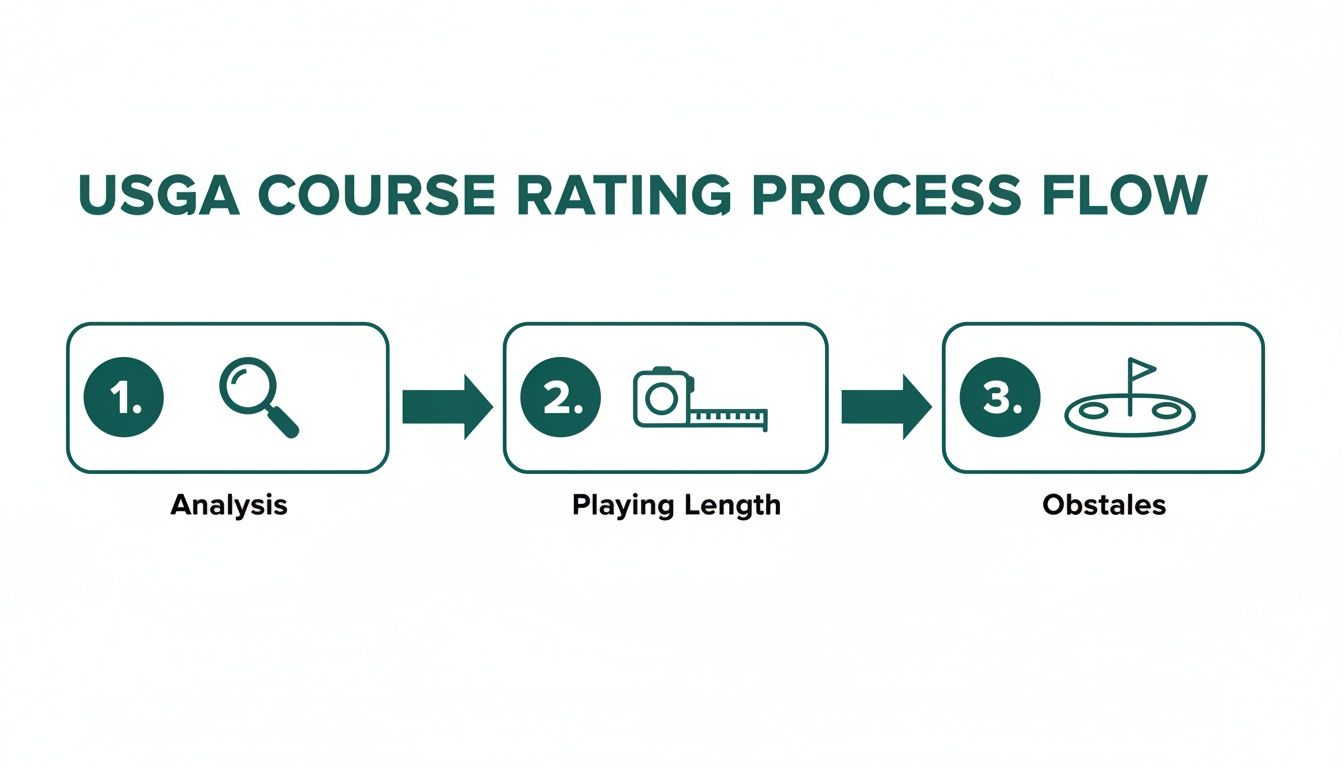
As you can see, the process is a methodical breakdown of a course's true difficulty, which is how we get such a reliable final number.
While the concept is pretty easy to grasp, automating these calculations is what saves you time and prevents headaches. The USGA has been refining its system since 1911, adding decimals in 1967 for even more precision. Today, modern tournament platforms like Live Tourney use these ratings to calculate handicaps instantly and accurately, saving you from manual errors and hours of spreadsheet work.
How Accurate Ratings Make or Break a Player’s Day
Those numbers on the scorecard? They have a direct line to the smiles on your players' faces. When you get the Course Rating right, you’re not just crunching numbers—you’re shaping how much fun people have and, more importantly, whether they feel the game was fair.
A fair fight doesn't happen by accident. It's built on a foundation of trust, and that trust starts with accurate handicapping. When players feel their handicap is applied correctly, they believe they have a real shot to compete. That’s the difference between a fun, competitive round and a frustrating day filled with doubt.
It’s All About Trust
Nailing the details with handicaps sends a powerful message. It tells your players you respect their time and are committed to running a top-notch event. That credibility is priceless. Golfers who trust the system are the ones who come back year after year—and they bring their friends.
On the flip side, even one little miscalculation can cause a ripple effect. An unfair handicap, even if it was an honest mistake, can tarnish your tournament's reputation overnight. Word travels fast in the golf world, and a reputation for being sloppy or unfair is tough to shake.
You’re not just running a tournament; you’re delivering an experience. Getting the handicaps right is a non-negotiable part of that, making players feel valued and ready to sign up again next year.
Common Mistakes That Ruin the Fun
Even with the best intentions, simple mistakes can completely undermine a competition. Knowing what to watch out for is the first step to making sure every player gets a fair shake.
Here are a few critical errors to avoid:
Using an Outdated Rating: Courses evolve. Trees get bigger, greens get redesigned, and new bunkers pop up. A rating from five or ten years ago might as well be for a different course. Always make sure you have the most current USGA rating on file.
Grabbing the Wrong Tee Rating: Every set of tees has its own unique Course and Slope Rating. If you apply the rating from the blue tees to players hitting from the whites, you'll get skewed Course Handicaps and an unbalanced game. Double-check you’re using the right data for each flight.
Ignoring Rating Differences in Multi-Course Events: If your tournament hops between two or more courses, you can't just use a single handicap for every round. A player’s Course Handicap must be recalculated for each specific course to keep things fair across the different venues.
At the end of the day, knowing what a course rating is is only half the battle. Applying it with precision is what turns a good tournament into a great one that players will be talking about for all the right reasons.
Streamline Your Tournaments and Ditch the Errors
Let's be honest. Manually calculating Course Handicaps for every single player, especially when they're playing from different tees, is a massive headache just waiting to happen. It's tedious, time-consuming, and one wrong number in a spreadsheet can throw the integrity of your whole event into question.
This is exactly why modern tournament tools were created—to take that burden off your plate and protect your tournament's reputation.
A platform like Live Tourney is built specifically to handle the messy parts of handicapping and scoring for you. Imagine importing official GHIN or WHS handicaps for your entire field in seconds. With just a few clicks, the system instantly and accurately calculates each player's Course Handicap based on the specific tees they're playing that day.
Automate Everything from Setup to Payouts
And it doesn't stop there. The automation runs through the entire event. The software handles net scoring for any format you can think of, whether it's a simple individual stroke play or a complex multi-round, multi-format championship.
The benefits are pretty clear right away:
Save a Ton of Time: No more manual data entry or double-checking calculations. Your staff can finally focus on making the event a great experience for the players.
Eliminate Costly Errors: Automation removes the risk of human error, guaranteeing every handicap is correct and the competition is fair.
Run a More Professional Event: A smooth, tech-forward experience builds trust and makes players genuinely excited to come back for the next one.
When you automate handicap management, you get to shift your focus from being an administrator to being a host. You spend less time buried in spreadsheets and more time engaging with your golfers, which makes for a better event for everyone.
For a deeper look at how software can upgrade your tournaments, check out our guide on golf tournament management software.
Ultimately, using a dedicated platform means running a perfectly handicapped tournament that feels effortless on your end and looks incredibly professional to your players. It’s the new standard for any organizer who cares about accuracy, efficiency, and giving everyone a first-class experience.
Wrapping Up: Common Questions About Course Ratings
To tie everything together, let's tackle a few common questions that pop up when tournament directors start digging into course ratings. Getting these concepts straight will make managing your next event that much easier.
What's the Difference Between Course Rating and Par?
Think of it this way: Par is the target score on a hole based on its length, while Course Rating is the expected score for a scratch golfer over 18 holes. It accounts for everything—not just distance, but also hazards, terrain, and all the little things that make a course tricky.
A course can be a par 72 but have a Course Rating of 73.5. That number tells you the course plays a stroke and a half tougher than its par for an elite player. Par is a simple target; the rating is the true measure of difficulty.
Can a Course Rating Change Over Time?
Absolutely. A rating isn't set in stone. Golf associations recommend re-evaluating a course every 10 years or so.
More importantly, a rating needs an update anytime significant changes are made. If a course adds new tees, completely redesigns a few greens, or even removes a large cluster of trees, the original rating is no longer accurate. Always make sure you're working with the most current numbers.
Where Can I Find the Official Course Rating?
You can usually find the official Course and Slope Ratings right on the course’s scorecard. If it's not there, check your authorized state or regional golf association's website. The USGA also maintains a national database where you can look up any rated course.
Run your best events with less effort. Live Tourney automates everything from handicap calculations to live scoring, saving you time and eliminating errors. See how it works at https://livetourney.com.





