

Jan 14, 2026
Master the USGA Course Handicap Calculator with our guide. Learn the WHS formula, see real-world examples, and run flawless, fair golf events.
A truly successful golf tournament is a fair one. At the heart of that fairness is the USGA Course Handicap Calculator, the essential tool for leveling the playing field. It’s what turns a player's portable Handicap Index into a specific number of strokes for the course and tees you're playing that day. This is how a scratch golfer and a 20-handicapper can actually have a legitimate match.
Why the USGA Calculator Is Key to Fair Tournaments

For anyone running a tournament, getting the course handicap calculation right isn't just a good idea—it's everything. It’s the foundation of a credible event where every single player feels like they have a real shot. Get it wrong, and you're just guessing, which quickly leads to frustration and arguments at the scoring table.
The system is designed to mathematically account for two massive variables: the skill of the golfer and the difficulty of the golf course.
This isn't some new-fangled idea. The modern system really took shape with the introduction of the Slope Rating back in 1987, which fixed a huge flaw in how handicaps worked. Before that, a player’s handicap didn't properly adjust from an easy course to a tough one, creating obviously unfair matchups. The Slope System changed all of that, making handicaps genuinely portable for the first time.
The Core Components of Fairness
So, how does the calculator work its magic? It boils down to three key pieces of data that, when combined, give you the precise number you need for your event. If you want to run a smooth tournament, you have to know what these mean.
Here’s a quick breakdown of the terms you'll be working with every time you set up a handicapped event.
Key Terms in the Course Handicap Formula
Term | What It Represents | Where to Find It |
|---|---|---|
Handicap Index | A player's demonstrated potential ability on a course of standard difficulty. It's their "golfing GPA." | Player's GHIN profile or handicap record. |
Course Rating | The expected score for a scratch golfer (0 handicap) from a specific set of tees. Higher means harder. | The club's scorecard or tee markers. |
Slope Rating | The relative difficulty for a bogey golfer compared to a scratch golfer. Higher means it's much tougher for the average player. | The club's scorecard or tee markers. |
These three numbers are the ingredients. When you plug them into the formula, you get a Course Handicap that is fair and specific to the challenge of the day.
The core purpose of the Course Handicap is to translate a player's general ability (Handicap Index) into a specific number of strokes needed for a particular course and tee combination, ensuring an equitable competition for everyone involved.
By applying these elements correctly, you create an environment where skill and strategy—not just raw scoring power—decide the winner. This is a fundamental part of learning how to run a golf tournament that people will want to come back to year after year.
Unpacking the World Handicap System Formula
Alright, let's pull back the curtain on the math that powers the World Handicap System (WHS). While most of us are happy to let an app do the heavy lifting, knowing how the sausage is made gives you a huge advantage. You can spot-check for accuracy, confidently answer player questions, and build trust in your tournament’s results.
Here’s the full formula in all its glory:
Course Handicap = (Handicap Index x (Slope Rating / 113)) + (Course Rating - Par)
It might look a little intimidating, but each piece has a specific job to do, all aimed at creating a truly level playing field. Let’s break it down into its two main parts.
The Slope Adjustment
The first chunk of the formula, (Handicap Index x (Slope Rating / 113)), is all about adjusting for how difficult a course plays for a bogey golfer versus a scratch golfer.
That number, 113, isn't just pulled out of thin air. It’s the baseline—the official Slope Rating of a course with standard difficulty. By dividing the Slope of the tees you're playing by 113, the formula figures out whether to give a player more or fewer strokes.
Slope above 113? The course is tougher for the average player, so they’ll get more handicap strokes.
Slope below 113? It’s an easier track, so they’ll get fewer strokes.
This is what makes a handicap portable, ensuring it scales correctly to the specific challenge of any set of tees.
The USGA provides great resources to help organizers and golfers get a handle on these core ideas.
It's all part of their push to create a single, unified system that works for everyone, everywhere.
The Course Rating vs. Par Adjustment
Now for the second part: + (Course Rating - Par). This is the secret sauce that many older, simpler formulas missed. This small but mighty adjustment accounts for the raw difficulty of the course itself, regardless of who is playing it.
This is what ensures a player is ultimately competing against par, not just the Course Rating. It's the key to fairness when you have players teeing it up from different sets of tees with different pars.
Think about it. If the men's tees are a Par 72 and the women's tees from a different yardage are a Par 73, this adjustment automatically accounts for that one-stroke difference before the round even starts.
Once the math is done, the final number is rounded to the nearest whole number (a .5 always rounds up). That final figure is the player's official Course Handicap for the day. Getting comfortable with this formula means you'll never have to second-guess the numbers again.
Putting The Handicap Formula Into Practice
Knowing the formula is one thing, but seeing it work in the real world is where it all clicks. As a tournament organizer, you're constantly juggling different player abilities and course setups. Let's walk through a few common scenarios to see how the numbers adapt to keep the competition fair.
This entire process, from a player's established skill to their specific handicap for the day, follows a clear and logical path.
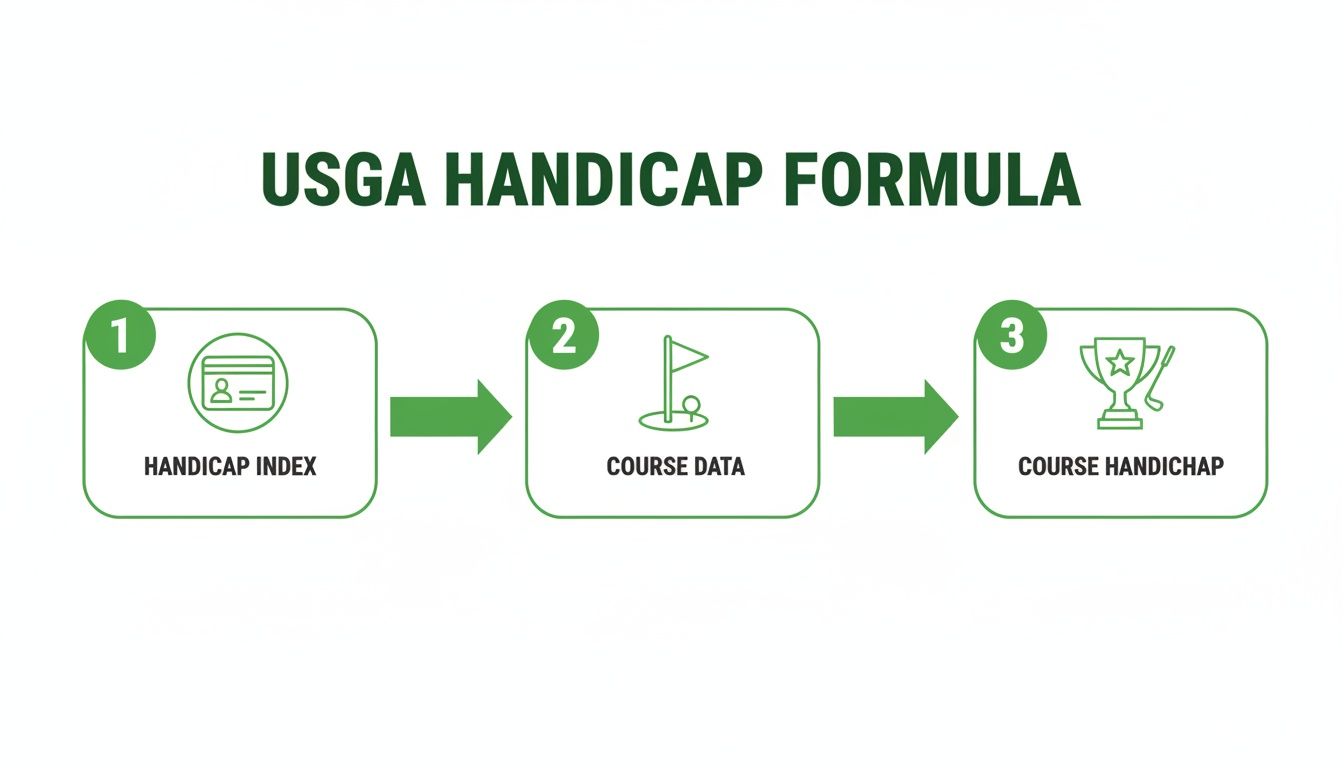
The formula is designed to take a player's portable Handicap Index and combine it with course-specific data—the ratings for the exact tees they're playing—to produce the final Course Handicap. It’s a simple flow that guarantees fairness across the board.
Example 1: The Skilled Player From The Tips
Imagine you have a low-handicapper, Sarah, playing in your club championship. She's a strong player with a 10.2 Handicap Index and decides to take on the course from the challenging back tees.
Here are the numbers for those tees:
Slope Rating: 135
Course Rating: 74.1
Par: 72
Let’s plug these into the formula:
(10.2 x (135 / 113)) + (74.1 - 72)
(10.2 x 1.1947) + 2.1
12.186 + 2.1 = 14.286
After rounding, Sarah’s Course Handicap for the day is 14. Even as a 10-index player, the sheer difficulty of the tees gives her four extra strokes to work with. That's the system working perfectly.
Example 2: The Higher-Handicapper From The Forward Tees
Now let's look at another player in the same event, Mark, who carries a 21.8 Handicap Index. He's playing from the more manageable forward tees.
Those tees have a completely different set of ratings:
Slope Rating: 120
Course Rating: 69.5
Par: 72
Running his numbers through the formula gives us:
(21.8 x (120 / 113)) + (69.5 - 72)
(21.8 x 1.0619) + (-2.5)
23.15 - 2.5 = 20.65
Mark’s Course Handicap rounds to 21. You'll notice his handicap is actually lower than his Index. This is because the tees he's playing are rated as easier than a standard-difficulty course, so the formula correctly reduces his strokes. Getting these calculations right is absolutely fundamental to proper golf tournament scoring and ensuring your net leaderboards are accurate.
The formula's brilliance is in its ability to adapt. A player's handicap isn't a fixed number; it's a dynamic value that responds to the specific challenge of the course and tees they face on any given day.
Example 3: The Executive Course Anomaly
Finally, let's look at a situation that often trips people up: an executive course with a Par of 68. A player with a 15.0 Index is playing from tees with a Course Rating of 69.0 and a Slope of 115.
Here's the math:
(15.0 x (115 / 113)) + (69.0 - 68)
(15.0 x 1.0177) + 1.0
15.26 + 1.0 = 16.26
This player gets a Course Handicap of 16. Why? Without that (Course Rating - Par) adjustment, their handicap would have been just 15. This extra stroke is crucial because it acknowledges that a scratch golfer is expected to shoot one over par (69.0) from these tees. To keep things fair against par, everyone gets that additional stroke.
Common Handicap Calculation Mistakes to Avoid
Even a tiny math mistake can create huge headaches on tournament day. I've seen it happen time and again. The good news is that most of these errors are incredibly easy to prevent if you know what to look for.
The most common slip-up? Simply grabbing the wrong data. It’s surprisingly easy to use the Slope Rating for the white tees when your players are actually on the blues. Always, always double-check that the Course Rating and Slope Rating on your tee sheet match the exact set of tees being used for that flight.
Another classic mistake is using an outdated Handicap Index. A player’s Index can update daily, so pulling a number from a registration form they filled out three weeks ago is a recipe for disaster. For a fair competition, you have to use the most current Index available on the day of the event.
Confusing Course Handicap with Playing Handicap
This is probably the most critical distinction to get right. The formula we’ve been working with gives you the Course Handicap—that’s a player’s full, unadjusted handicap for the tees they’re playing. But that’s not always the number they use to compete.
The Playing Handicap is what you get after applying a handicap allowance based on the game's format. Different formats use different allowances to keep things equitable.
Four-Ball Stroke Play: Players typically get 85% of their Course Handicap.
Individual Stroke Play: Players usually receive 95% of their Course Handicap.
Scrambles: Allowances can vary a lot, but they’re essential for balancing teams.
Forgetting this step throws the entire competition out of whack. For example, a player with a Course Handicap of 20 would have a Playing Handicap of 17 in a typical four-ball event (20 x 0.85 = 17). Using the wrong number gives them a three-stroke advantage nobody wants to argue about later.
Think of it this way: The Course Handicap is your starting point. Applying the format's allowance is the final, crucial step that tailors that number to the specific game being played, ensuring a truly balanced and fair competition.
Other Common Oversights
A few other gremlins can pop up if you’re not paying close attention.
One is incorrect rounding. The rule is simple: .5 always rounds up. It sounds minor, but that single stroke can be the difference between winning and losing a match.
Finally, don’t forget the (Course Rating - Par) adjustment. Some organizers still fall back on older, simplified formulas that skip this piece. This creates real inaccuracies, especially when you have mixed-tee events or a course where the Course Rating and Par are miles apart. To make the World Handicap System work as intended, you have to use the full, official formula every time.
How to Automate Calculations and Run Better Events
Let's be honest: calculating handicaps for a full tournament field by hand is a nightmare. It’s tedious, takes forever, and one typo can throw off the entire leaderboard. Those are hours you could be spending on literally anything else to improve the player experience.
This is exactly why modern tournament software exists. It completely eliminates the headache.
Instead of chasing down player info and punching numbers into a calculator, you just upload a roster with everyone's GHIN number. The system instantly pulls the latest Handicap Index for every golfer, straight from the official database. That simple step gets rid of the number one cause of scoring disputes—using an outdated index.
From there, you just click a button. The software grabs the correct Slope Rating, Course Rating, and Par for the tees you've selected and runs the World Handicap System calculation for every single player. In seconds, you have a perfectly accurate Course Handicap for the entire field.
Seamless Integration for Any Format
This kind of automation goes way beyond simple stroke play, too. A good platform like Live Tourney can handle anything you throw at it, from multi-day invitationals to the most complex team games.
The system automatically calculates and applies the correct Playing Handicap allowances, whether you're running a scramble, a four-ball, or a Ryder Cup-style event. This means your net scores are always right, the leaderboards update instantly, and the payouts are based on data you can actually trust.
A lot of this was made possible by the World Handicap System rollout, which got rid of many of the old, clunky rules from before 2020. That change helped fuel a 30% surge in Handicap Index holders to 3.35 million. It's that clean, standardized system that allows platforms like Live Tourney to improve live participation by 40% and let organizers generate tee sheets and payouts in a snap.
Think of the right software as your digital tournament director. It handles all the math behind the scenes, so you can focus on running a great event. For a closer look at the tools that can help, check out our guide on golf tournament scoring software.
Working Smarter, Not Harder
Automating your calculations isn't just a small improvement; it's a fundamental shift from manual busywork to truly efficient event management. You're using technology to deliver a professional, seamless experience from the moment players register to the final awards ceremony.
This dashboard shows how a clean, modern interface can bring all your key tournament info—from player lists to live scoring—into one easy-to-manage place. Managing a big event doesn't have to feel complicated.
If you're interested in the nuts and bolts of automation, looking into concepts around developing a custom calculation tool can offer some interesting parallels for building efficient systems.
By embracing automation, you replace the risk of human error with the reliability of a proven system. This builds trust with your players and frees you and your staff to handle the personal touches that make a tournament memorable.
At the end of the day, using a USGA course handicap calculator inside a larger software platform lets you run better, more credible, and more enjoyable events with a fraction of the effort.
Your Top Questions About Course Handicaps, Answered
Once you get a handle on the basic formula, you start running into all the real-world situations that pop up during a tournament. As an organizer, being ready with a clear answer is the key to keeping things running smoothly.
Let's walk through some of the most common questions I hear when it comes to putting the USGA's course handicap calculator to work.
What's the Difference Between a Course Handicap and a Playing Handicap?
This is probably the most important distinction to get right. Honestly, it trips people up all the time.
Think of it like this: your Course Handicap is the raw, baseline number of strokes a player gets for a specific set of tees. It’s calculated using the full World Handicap System formula we’ve already covered and represents their full potential handicap for that course.
The Playing Handicap is what they actually use in the competition. It’s the Course Handicap adjusted by an allowance based on the tournament's format. For example, in a standard four-ball (better ball) event, the USGA recommends an 85% allowance. So, a player with a Course Handicap of 15 would have a Playing Handicap of 13 for that event (15 x 0.85 = 12.75, which rounds up to 13).
Your Course Handicap is the starting point. The Playing Handicap is the competition-ready number you get after applying the format allowance. Always make this adjustment the final step to keep the competition fair.
How Do I Calculate a Handicap for a 9-Hole Round?
The good news is the process is exactly the same, you just need to use the nine-hole data. You'll take the player's nine-hole Handicap Index—which is usually just their 18-hole Index split in two.
From there, you just plug the nine-hole numbers from the scorecard into the formula:
Nine-hole Slope Rating
Nine-hole Course Rating
Nine-hole Par
This is super common for league play or those shorter evening events. Modern tournament software handles this switch automatically, which is a lifesaver. You don't have to worry about doing separate math for different round lengths.
What if a Player Doesn't Have an Official Handicap Index?
This one comes up a lot, especially in charity scrambles and corporate outings where you have a mix of serious golfers and weekend warriors. When someone shows up without an official Handicap Index, you've got a few options to keep things fair.
The most common solution is to create a one-day handicap. Systems like Callaway or Peoria use a player's score from that day's round to calculate a handicap after the fact. A simpler, more casual approach is just to ask for their average score ("I usually shoot around 95") and use that to estimate a handicap. It’s not as precise as the WHS, but it's way better than just guessing.
Does Bad Weather or Course Condition Change the Handicap?
Nope. The Course Handicap you calculate before the round is locked in for your event. Players will use that number whether it's perfectly calm or blowing a gale.
However, the World Handicap System has a clever feature called the Playing Conditions Calculation (PCC). This system can automatically adjust players' score differentials after the round if scores across the board were significantly higher or lower than expected. This adjustment affects their future Handicap Index, but it does not retroactively change the handicap they used in your tournament that day.
Ready to stop crunching numbers by hand and start running better events? Live Tourney automates the entire process, from roster uploads to live scoring, so you can deliver a professional experience without the headache. Learn more and start your free trial today.





