
Nov 2, 2026
turkey creek golf scorecard, course rating, tee yardages, golf handicap, tournament scorecard
Turkey Creek golf scorecard totals for Lincoln, Merrillville, Hennessey, and Alachua: pars, yardages, ratings, slopes, and event notes.

Does your Turkey Creek golf scorecard identify the course you're playing, or does it just have the right name across the top? That's the gap a quick scorecard search can miss. Several courses use Turkey Creek, and a plausible yardage total isn't enough to identify the right one.
For a tournament director, the mistake starts before anyone enters a score. Import the wrong city, tee, or rating record, and the printed cards can look professional while the scoring setup is wrong. Match the city first, then the tee, then the rating record. Check the hole sheet before publishing pairings, especially when the published arithmetic doesn't agree.
Which Turkey Creek Scorecard You Need
Which Turkey Creek scorecard matches your event's city and tee? The name alone is not enough. Use the city and the published tee record together, and keep competing listings separate until the course confirms which one applies.
Turkey Creek cards by city and tee
Location | Tee | Par | Yards | Rating / Slope | What is known |
|---|---|---|---|---|---|
Lincoln, California | Black | 72 | 6,929 | 73.2 / 137 | Front 3,482, back 3,447 |
Lincoln, California | White, men | 72 | 5,858 | 68.5 / 122 | Women's rating and slope: 74.1 / 134 |
Lincoln, California | White, alternate listing | 72 | 5,853 | 69.1 / 122 men | Women's rating and slope: 74.2 / 132 |
Merrillville, Indiana | White | 70 listed | 6,202 | 69.3 / 118 | Front 3,161, back 3,041; published hole pars total 72 |
Hennessey, Oklahoma | Confirm with course | 70 | 5,725 | 67.9 / 122 | Confirm tee color and obtain the hole sheet |
Alachua, Florida | Historical | About 6,700 in 1978 | Confirm current par and yardage | Confirm current rating and slope | Closed in 2011, reopened in January 2021 |
The Golfcore Turkey Creek Golf Club listing gives Hennessey's total as 5,725 yards, par 70, rating 67.9, and slope 122. It also lists Lincoln's alternate white record as 5,853 yards, par 72, men's rating and slope 69.1/122, and women's 74.2/132. Treat these as distinct course records, not interchangeable rows.
Choose a city before choosing a number
Match the city on the booking confirmation. For Lincoln, use the corresponding Lincoln tee record. For Merrillville, check the listed totals against the hole sheet before importing the card: the published par 70 conflicts with the listed four par 3s, ten par 4s, and four par 5s, which add to 72. For Alachua, request the current card for the restored course rather than relying on its historical dimensions.
Hennessey's listing helps identify a course record, but it does not specify a tee color or provide hole-by-hole information. Ask the course for its current tee and hole sheet before building the tournament card.
Identity check: Confirm the city, tee, and rating record before using a scorecard for event setup.
Keep competing listings separate
Lincoln's alternate white record differs from the other white listing in both total yardage and ratings. Do not take yardage from one and a women's rating from the other just because both say "white." Ask the pro shop which record matches the current setup, then save that version separately from the alternative.
Keep the publisher and the person who confirmed the setup with the saved card. That gives staff a clear record to follow if the file is handed to someone else.
Label each saved card with city, state, tee, gender rating, and verification date. “Turkey Creek scorecard” alone is not enough to identify the right record.
Lincoln Hole Pars Yardages and Nines
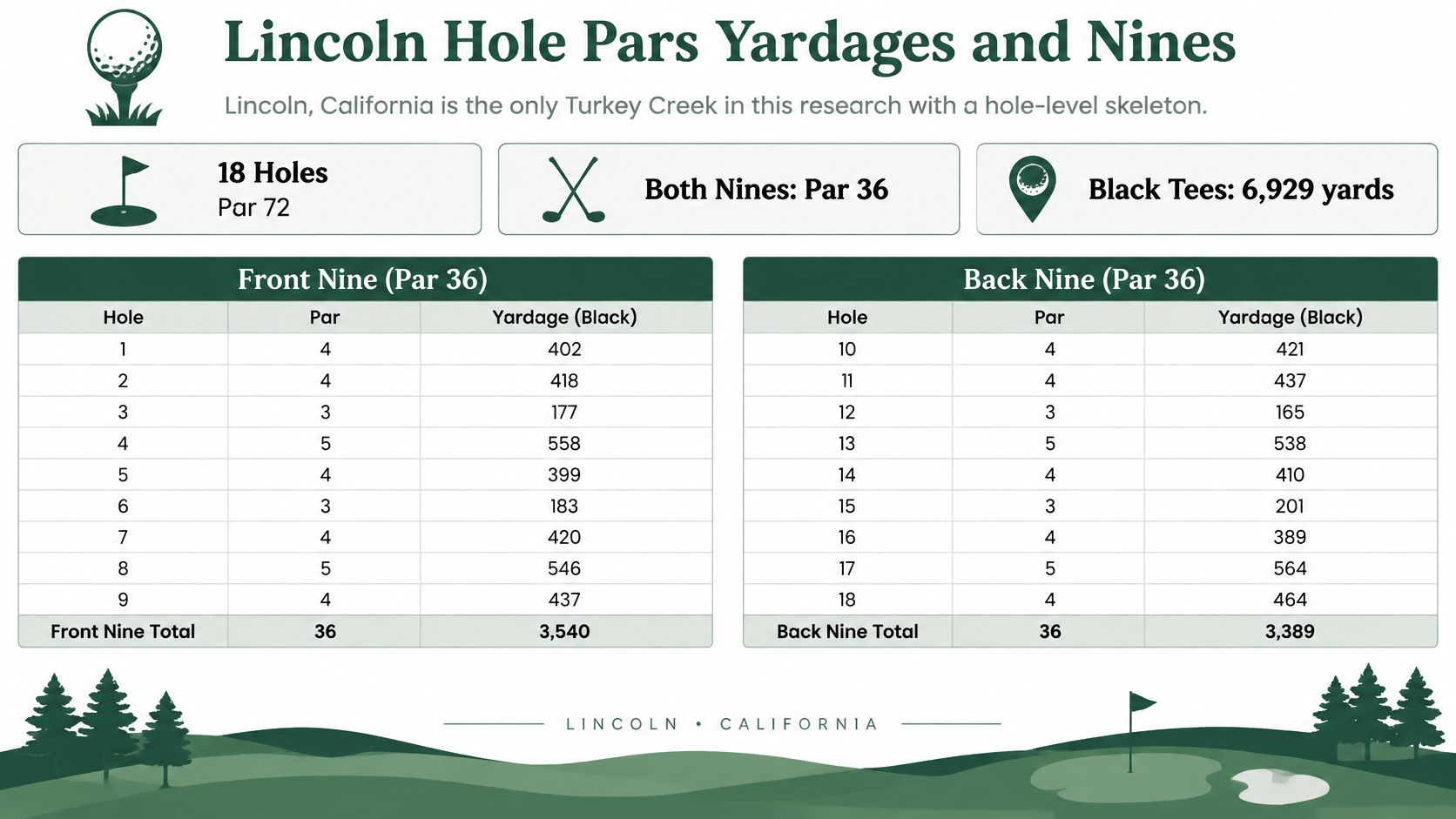
Which hole numbers and tee yardages should match a Lincoln scorecard before staff use it for pairings? The official Turkey Creek scorecard lists 18 holes, par 72, with black tees measuring 6,929 yards. The front nine is 3,482 yards, par 36, and the back nine is 3,447 yards, par 36. The published mix of four par-3s, ten par-4s, and four par-5s adds to par 72.
Check the figures together. A hole-by-hole card should agree with the stated par and the total for each nine, not just the overall yardage.
Recognize the card from its published holes
Lincoln holes with published tee yardages
Hole | Par | Black | White or White/Gold |
|---|---|---|---|
4 | 5 | 562 | |
12 | 5 | 576 | 509 white and 509 white/gold |
3 | 3 | 186 | |
14 | 3 | 167 | 114 white and 91 white/gold |
Front nine | 36 | 3,482 | |
Back nine | 36 | 3,447 |
Use the hole numbers, pars, and black-tee yardages as a practical match check. Holes 4 and 12 are par-5s at 562 and 576 yards from black; holes 3 and 14 are par-3s at 186 and 167 yards. The table includes only published figures, so blank cells do not supply an alternative tee yardage.
The GolfPass Lincoln scorecard and layout lists tee totals of 6,929 black, 6,498 blue, 6,095 blue/white, 5,858 white, and 5,490 white/gold. Its 12th-hole figures are 576, 541, 509, 509, and 509 yards, respectively. For the 14th, it lists 167 yards from black, 114 from white, and 91 from white/gold.
A shorter tee total does not mean every hole has a shorter yardage. The 12th, for example, is listed at the same 509 yards for white and white/gold, while the 14th differs between those tees. Check each hole's printed figure rather than inferring it from the overall total.
For a player, matching those hole details helps confirm that the booking is for the Lincoln course and the intended tee setup. Before issuing cards, compare the current shop sheet with the hole numbers, pars, and tee labels, and use its published figures for any cells not shown here. Obtain the complete current card, including stroke indexes, before preparing player scorecards. A useful match check identifies the course; tournament cards still need the full hole-by-hole information.
Lincoln Tee Ratings and Combination Yardages
Lincoln isn't one difficulty number. Each tee configuration needs its own record, and a combination tee isn't an average of the colors in its name.
The TeeOff Lincoln course details publish black at 6,929 yards and 73.2/137, blue at 6,498 and 71.4/130, blue/white at 6,095 and 69.7/124, white at 5,858 with men's 68.5/122 and women's 74.1/134, and gold at 4,897 with men's 63.9/112 and women's 68.5/123. The black-to-gold difference calculated from those totals is 2,032 yards.
Lincoln tee totals, ratings, and slopes
Tee | Yards | Men rating / slope | Women rating / slope |
|---|---|---|---|
Black | 6,929 | 73.2 / 137 | Not published |
Blue | 6,498 | 71.4 / 130 | Not published |
Blue/White | 6,095 | 69.7 / 124 | Not published |
White | 5,858 | 68.5 / 122 | 74.1 / 134 |
White/Gold | 5,490 | ||
Gold | 4,897 | 63.9 / 112 | 68.5 / 123 |
The white/gold yardage is published in the Lincoln hole listing, but its rating and slope aren't established by these records. Those rating cells are deliberately blank. A known distance doesn't authorize an estimated rating.
Assign divisions to complete tee records
For a mixed-tee outing, choose the tee record for each division before posting pairings. The assignment should specify the named configuration and the applicable gender rating, not just a color in a spreadsheet.
Say a division is assigned blue/white. Staff need the course's prescribed combination-hole sequence, not permission for players to choose either marker on each hole. Otherwise, players can follow the same tee label while playing different courses.
The trade-off is straightforward: combination tees can offer a better length fit, but they require more careful setup than a single-color assignment. If staff can't confirm the combination's routing and rating, choose a fully confirmed option rather than improvising.
Don't reconcile disagreement by averaging
The alternate white listing is a separate published record. This tee table uses the coherent tee-color set above; it doesn't average the competing totals or mix their rating components.
For staff who need the distinction between par and rated difficulty, the explanation of what a course rating means provides useful background. A tee's color is a label, while its rating record is part of the handicap setup.
Before releasing the field, check:
Division assignment. Each player is attached to the intended tee configuration.
Gender rating. The applicable record exists and hasn't defaulted to another one.
Combination routing. Printed instructions match the hole sequence confirmed by the course.
Stroke allocation then needs its own check. Keeping par unchanged doesn't mean a tee move leaves net scoring unchanged.
Merrillville Pars Yardages and Tee Gaps
Which Turkey Creek scorecard belongs on a Merrillville event sheet? Use the Merrillville figures, not Lincoln's par. The Golfcore Merrillville scorecard lists the white tees at 6,202 yards, rating 69.3, slope 118, and par 70. Yellow is 5,620 yards with a 66.7 rating and 111 slope; red is 4,751 yards with a 66.7 rating and 107 slope.
Merrillville tee yardages, ratings, and slopes
Tee | Yards | Rating | Slope | Stated par |
|---|---|---|---|---|
White | 6,202 | 69.3 | 118 | 70 |
Yellow | 5,620 | 66.7 | 111 | 70 |
Red | 4,751 | 66.7 | 107 | 70 |
The listing gives the white front nine as 3,161 yards and the back nine as 3,041, each labeled par 35. It also lists four par-3s, ten par-4s, and four par-5s. Those hole pars add up to 72, not 70. The hole mix and the stated total therefore cannot both be used as written.
Keep the arithmetic conflict visible
Keep the published par 70 as the working white-tee record, alongside its yardage, rating, and slope. Do not change the total or assign different pars to individual holes without the course's confirmed card. A summary can identify a course and support preliminary tee selection, but it cannot resolve the par discrepancy for a tournament.
The GolfPass Merrillville listing updated in 2026 also gives white as par 70, 6,202 yards, rating 69.3, and slope 118. Before competitive play, ask the Merrillville shop to confirm the hole-by-hole pars and the front- and back-nine totals. That confirmation is needed before players are scored against par.
Separate length selection from scoring approval
The three tee totals help players and organizers compare expected playing length. White to red is a 1,451-yard difference, while the listed par stays the same across all three tees. That is a substantial change in setup, so keep the selected tee's rating and slope attached to each player's record for net scoring.
Before pairings go out:
Confirm the hole pars. Ask the shop to verify the hole-by-hole card and resolve the mismatch with the listed total.
Keep tee details together. Record the selected tee, yardage, rating, and slope as one setup.
Hold incomplete cards. Summary totals are not enough to produce a confirmed hole-by-hole scorecard.
Players can use the table to plan around the listed lengths. Organizers should use it as a starting point, then confirm the hole-level details with the Merrillville shop before accepting scores against par.
Alachua and Thin Listings That Need a City

Could an old scorecard still describe Alachua's restored course? The WUFT account of Turkey Creek Golf Club's reopening describes the Alachua, Florida course as an 18-hole facility of approximately 6,700 yards when it opened in 1978, with water affecting six holes and bunkers near many greens.
The club closed in 2011, was purchased by the Turkey Creek Master Owners Association in 2015, and reopened in January 2021 after work on the greens, sand traps, and irrigation system. The property had been unused and overgrown for nearly a decade.
That history makes an original-era card a reference, not proof of the restored course's current dimensions. It does not establish that the holes were rerouted, either. Treat old yardages as unconfirmed until the club provides a current card.
Use the club's restored-course card
For Alachua, request a card issued by the club and confirm that it applies to the event. A post-reopening date helps identify a relevant record, but staff should still check whether the tees or ratings have changed since it was issued.
Hennessey presents a different problem: a course total alone does not identify the tee or provide the hole-by-hole information needed for a player card.
The 18Birdies Turkey Creek listing updated in 2026 gives 7,012 yards, rating 73.2, and slope 137, but does not name a city. The rating and slope match Lincoln black, while the listed total is 83 yards longer than Lincoln's published black total. That listing therefore cannot be assumed to describe Lincoln's black tee. Confirm the city and tee before using any of its figures.
Resolve a thin listing before using it
Confirm the city and state. Ask the starter, booking contact, or event organizer. Do not infer a location from the course name.
Identify the tee and rating category. Check whether the applicable men's and women's records differ.
Match the full record. Compare the total and course identity, not just a familiar rating.
Hold disputed yardage. If rating and slope match but the distance does not, get the shop's confirmation before entering a total.
Keep each hole with its course. Never fill missing rows from another Turkey Creek card.
A total without a city is a lead, not a usable card. Confirm the location and tee before publishing pairings or assigning players a course record.
Stroke Index Gender Ratings and Mixed Tees
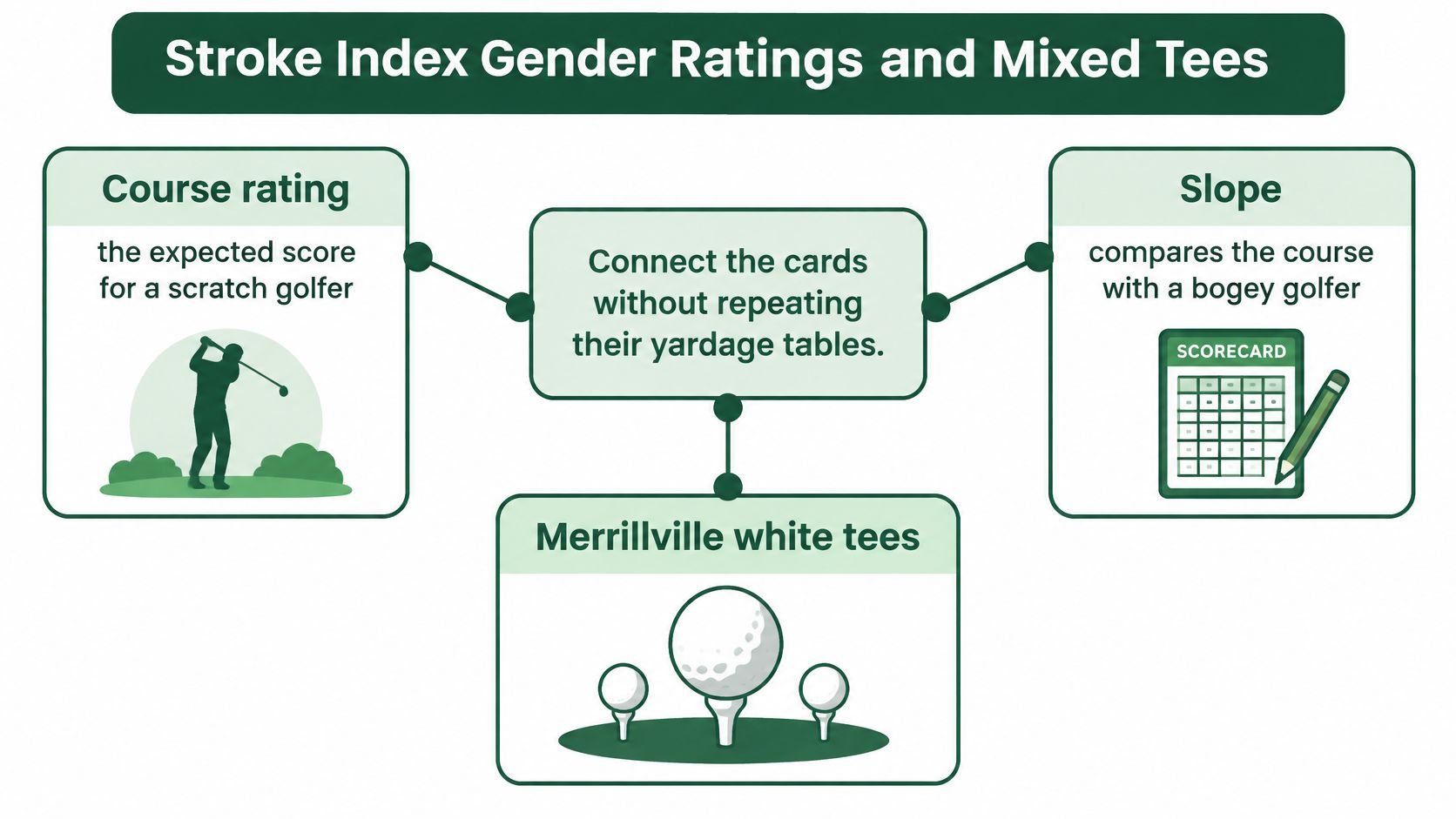
How should staff handle stroke indexes when players use different tees? Keep each allocation tied to the course and tee record it was published for. Course rating represents expected scoring for a scratch golfer, slope describes relative difficulty for a bogey golfer compared with a scratch golfer, and stroke index sets the order for allocating handicap strokes to holes.
A low stroke-index number is not a hole number or a universal ranking of difficulty for every player. Use the values printed on the selected course's scorecard, and allocate handicap strokes in index order, starting with the lowest number. For a quick guide to finding these fields, see how to read a scorecard.
Read allocation in stroke order
Before preparing a card, confirm that its stroke-index entries match the selected city and tee. Do not fill missing entries from another Turkey Creek course, or infer hole priorities from a summary that does not show the full hole-by-hole allocation.
Use the published index. Allocate strokes in numerical order, beginning with the lowest stroke-index number.
Apply the event allowance. Determine the strokes each player receives under the competition format before marking the card.
Keep the record complete. Use the selected tee's published values for each hole; hold the card if those entries are missing.
The allocation order determines where handicap strokes are applied. It does not establish a hole's par, so confirm par from the same course and tee record rather than inferring it from the index.
Treat a tee move as a record change
If a league player moves from Merrillville white to red, select the red tee record as a whole. Changing only the tee label and yardage while retaining the old rating or slope can leave the player with a mismatched card.
Apply the same check to women's ratings on Lincoln's published tees. A mixed field may require different applicable rating records, even when players use the same physical markers. Confirm the record for each player's tee and rating category before pairings go out.
Combination tees also need a confirmed configuration. A parent tee's rating cannot be assumed to apply just because its yardage seems close.
Scoring-file rule: Keep city, tee, gender, rating, slope, par, hole yardage, and stroke index linked. A tee assignment change should prompt a review of every connected field.
With those fields tied together, staff can compare the paper card with the digital event record without guessing which version players are using.
Fields a Printable Scorecard Must Carry
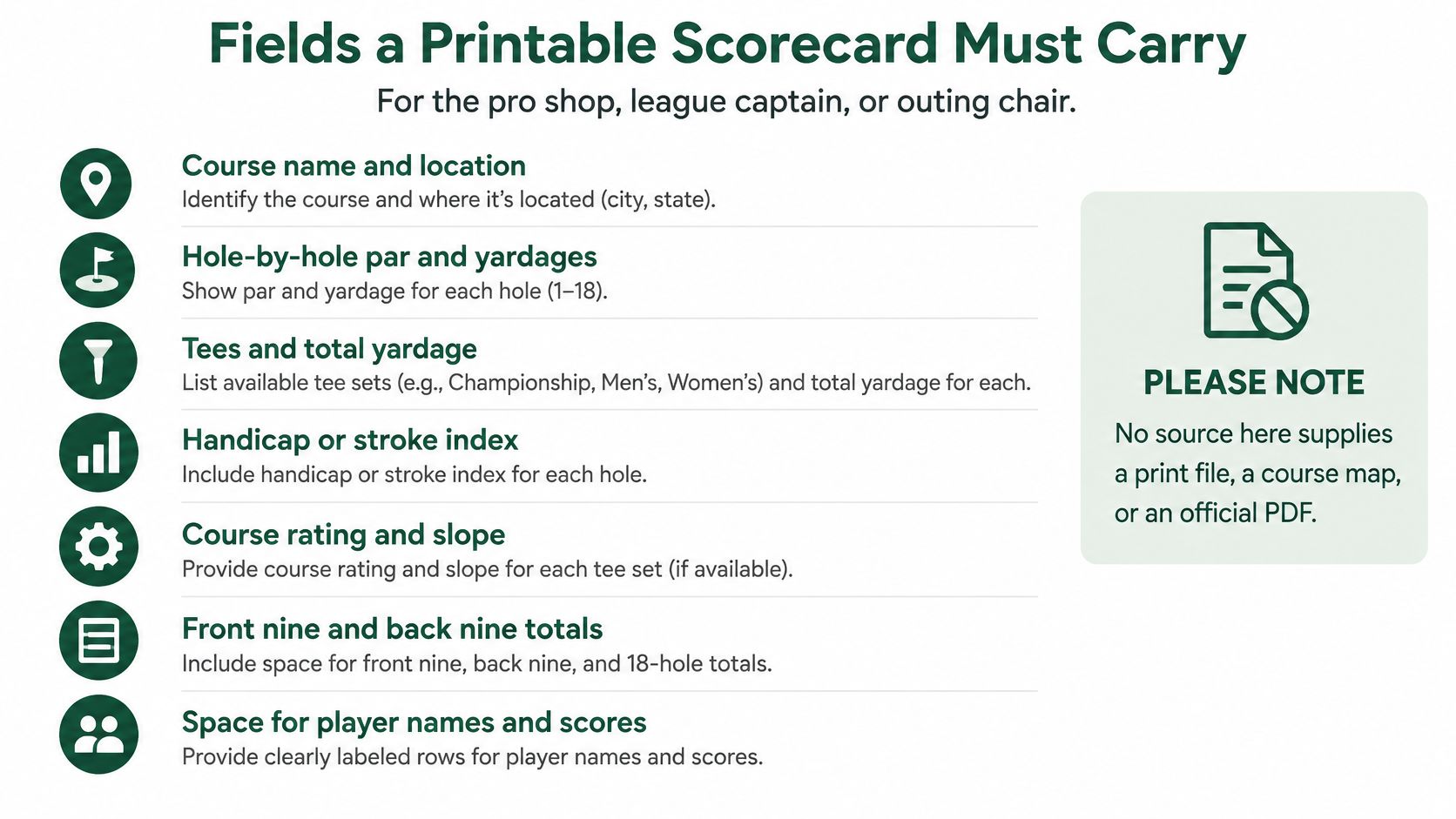
A printable Turkey Creek golf scorecard starts as a controlled template built from confirmed course data, not numbers copied from search results. Keep each city and tee configuration distinct. Merrillville's listed par 70 conflicts with its published four par 3s, ten par 4s, and four par 5s, which total 72. Resolve that mismatch with the course before printing. Leave unresolved cells blank until the shop supplies the missing details.
Put identity above the scoring grid
Course name and location. Print the full course name, city, and state so the card cannot be mistaken for another Turkey Creek.
Tee configuration. Use the course's exact color or combination name.
Rating and slope. Show the applicable men's and women's records when both are used.
Par and total yards. Match the approved course setup, and check that the hole pars add up to the printed total.
Verification date. Record when staff checked the numbers and retain the confirming document.
Use this guide to golf course scorecards for layout ideas, then check every field against the selected course record. Readability helps players use the card, but it cannot correct an unverified tee or an inconsistent total.
Make the hole rows auditable
Each hole needs par, stroke index, tee-specific yardage, and space for scores. Include front-nine, back-nine, and overall totals, plus player identification and a scorer or signature line appropriate to the medal-play procedure.
For Merrillville, use the selected tee row and resolve the par conflict before release. For Lincoln, print combination tees as named configurations, not informal instructions to alternate colors. Alachua needs the restored course's current club-issued card. Hennessey and an unidentified listing are not ready for a full hole sheet until staff confirm the location, tee, and hole details. Leave any unconfirmed cell blank rather than filling it with a value borrowed from another city or tee.
Distribute one approved version
A QR code can direct players to the approved PDF instead of circulating multiple attachments. Apply these QR code tips for menus and brochures after the card has been verified.
Test the code on the printed proof and confirm it opens the intended file. Remove superseded versions from the player-facing location so players do not choose between similarly named cards. Keep the confirmation record with the approved file, and leave incomplete fields blank until the shop provides the details.
Lock the Card Before You Publish Pairings
Approve the course record before approving the pairings. The release record should identify the city, tee, applicable gender rating, slope, par, and shop-confirmed hole sheet. Give responsibility for that approval to a named staff member rather than leaving it between the league captain and the scoring desk.
When web listings disagree, use the shop's current confirmed card. Archive the unused listing with its date and a short note explaining why it wasn't selected, so nobody reintroduces it during a later roster edit.
Keep scoring and reports on the same setup
At Live Tourney, we provide live scoring, real-time leaderboards, and instant score updates without app downloads. We can generate scorecards, tee sheets, cart signs, bag tags, and other reports, and support Single Round, Multi Round, Match Play Bracket, Ryder Cup, Round Robin, Leagues, and Outings formats. Check our current website feature list before committing to a particular report layout.
Software still needs the correct course setup. An organizer should enter the confirmed record, compare the digital hole fields with the approved paper card, and make sure player-facing outputs use the same configuration.
Use a release check staff can repeat
Approve the input. Confirm that the event uses the intended city and tee record.
Compare a hole. Check its par, yardage, and stroke index against the paper card, then complete the full-card review.
Inspect the output. Review a printed proof and the player scoring view before distribution.
Control later changes. If the course changes the setup, update the event and reissue affected materials together.
The practical next step isn't another search for a more convenient total. It's entering only the confirmed Turkey Creek record and checking it against the shop's card. Publish pairings only after that check passes.
Live Tourney offers live scoring, app-free leaderboards, and scorecard reporting for courses, leagues, and outings. Bring your shop-confirmed Turkey Creek tee record to Live Tourney, then keep player scoring and event reports aligned with the card you've approved.





