
Jun 16, 2026
tournament winner, golf tournament scoring, live leaderboards, event management, golf tie-breakers
Learn how to define and declare a tournament winner in any golf event. Our guide covers scoring formats, tie-breakers, and modern software for flawless results.
The round is over. Players are walking off the course. Someone asks the question every staff table hears at the same time.
Who won?
If your answer depends on collecting paper cards, checking arithmetic by hand, sorting out net scores, and then arguing through a tie-break nobody explained that morning, the end of the event can unravel fast. The problem usually isn't the competition itself. It's the operational gap between the last shot and the official result.
That gap is where trust is either earned or lost. A clean finish feels professional. Players see the standings, understand the rules, and hear the result quickly. A messy finish creates doubt, even if the eventual answer is technically correct. Most complaints about a tournament winner don't start with bad sportsmanship. They start with slow scoring, unclear format rules, or a tie that catches everyone off guard.
The Moment of Truth or The Moment of Chaos
The final groups come in, and your staff table turns into a bottleneck. One volunteer is trying to read a wet scorecard. Another is asking whether the side game uses gross or net. Two players are standing nearby because they think they tied for first. Meanwhile, the rest of the field is waiting for prizes, food, and some sign that the event is still under control.
That ending is more common than most organizers want to admit.
A tournament doesn't feel finished when the last ball drops. It feels finished when the winner is clear, accepted, and announced. Until then, players are in limbo. They don't know whether to celebrate, stick around, or question the board.
Where events usually break down
The chaos almost always comes from the same places:
Unclear winner definition: Staff know the event is “a scramble” or “an outing,” but nobody wrote down exactly how first place is determined.
Manual score handling: Cards come in late, math has to be checked, and one transcription mistake changes the board.
Tie confusion: A tie happens, then the committee starts discussing what seems fair in the moment.
Communication lag: Even when the scores are correct, players wait too long to hear the official result.
Practical rule: If you can't explain the winner determination process in one minute before the round, you probably won't defend it well after the round.
I've seen organizers run a smooth day for registration, pace, food, and contests, then stumble at the only moment everyone remembers. Players forgive a delayed shotgun start more easily than they forgive a confusing finish. The winner announcement is the emotional peak of the event. That's where your procedures become visible.
What a professional finish looks like
The best events all share the same traits. Scores enter cleanly. Leaderboards update without drama. Tie-breaks are already baked into the setup. Staff aren't inventing rulings at the scorer's table. They're verifying, confirming, and announcing.
That's the standard worth aiming for. Not because every club event needs big-production polish, but because every field deserves a result they trust.
What a Tournament Winner Really Means
Before you can produce a trusted tournament winner, you have to answer a basic question that many organizers skip.
What does “winner” mean in this event?
A lot of people assume the answer is obvious. Lowest score wins. Final match winner wins. Done. But tournament logic changes with the format. Even in golf, that assumption falls apart quickly. The World Wide Technology Championship uses a two-day match-play format, which is a good reminder that winner determination is format-dependent, not universal, as noted in this overview of the World Wide Technology Championship format.
Start with the event objective
Most winner disputes aren't really scoring disputes. They're design disputes discovered too late.
If you're running a club championship, players expect the format to identify the strongest competitor under a strict rules structure. If you're running a charity scramble, the priority may be pace, participation, and a social finish. Those are different events, and they need different winner logic.
Here's the clean way to consider it:
Event structure | What determines the winner | What staff must define early |
|---|---|---|
Stroke play | Lowest total score | Gross or net, round count, tie method |
Match play | Head-to-head result | Bracket, concessions, playoff procedure |
Points race or season standings | Most accumulated points | Points table, eligible rounds, tie-breaks |
Team event | Team total or best-ball outcome | How team scores are combined |
Novelty or mixed event | Specific event objective | Whether prizes are competitive or experiential |
A winner is a rule set, not just a name
That sounds dry, but it matters. The winner isn't merely “the person with the best day.” The winner is the competitor who satisfies the event's published victory conditions.
That distinction keeps staff out of trouble.
In stroke play, the winner usually comes from total scoring across the round or rounds.
In match play, the winner comes from hole-by-hole outcomes, not aggregate strokes.
In season-long or cup formats, the winner may be the player or team with the highest point accumulation, even if they didn't dominate every individual contest.
If the format changes, the meaning of “best” changes with it.
Don't overlook secondary winners
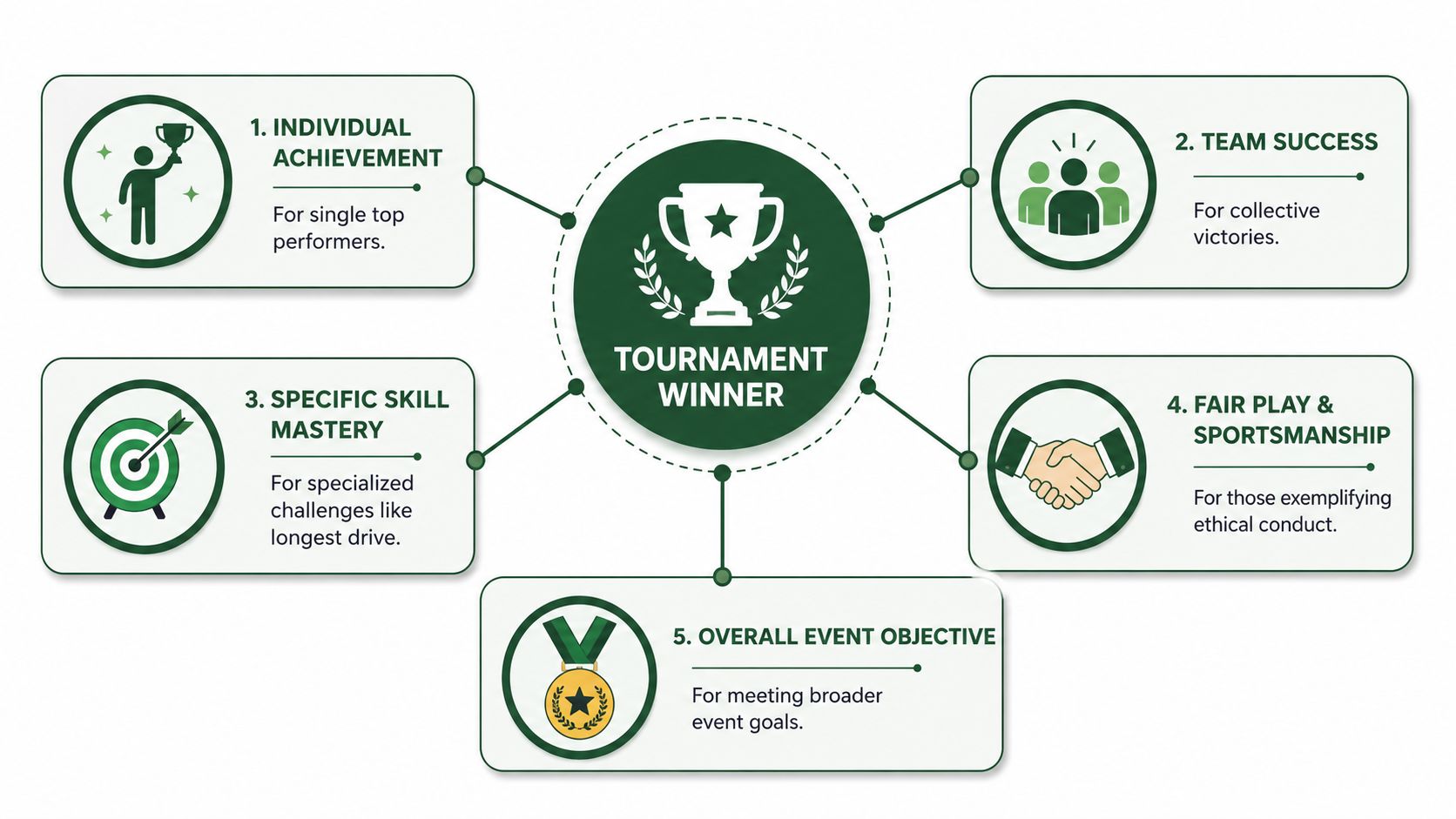
A lot of events also create multiple valid versions of a tournament winner. You may have an overall champion, a net winner, a team winner, and skills-contest winners. That's fine, but only if you separate them clearly.
Problems start when those categories blur together. If your staff says “winner” without specifying which leaderboard they mean, players will fill in the blanks themselves.
The simple fix is to name every prize bucket in advance. Overall gross. Overall net. Team division. On-course contests. Sportsmanship or participation awards if your event includes them. Once those categories are explicit, scoring setup gets easier and the final announcement gets cleaner.
Mastering Scoring Formats and Their Impact
Once the winner definition is set, scoring becomes the engine that produces it. Here, organizers either simplify the day or create preventable friction.
The biggest mistake is choosing a format because it's familiar, not because it fits the event. A member-guest, a charity outing, and a league final shouldn't automatically use the same scoring model just because staff know how to run it.
How common formats change the winner calculation
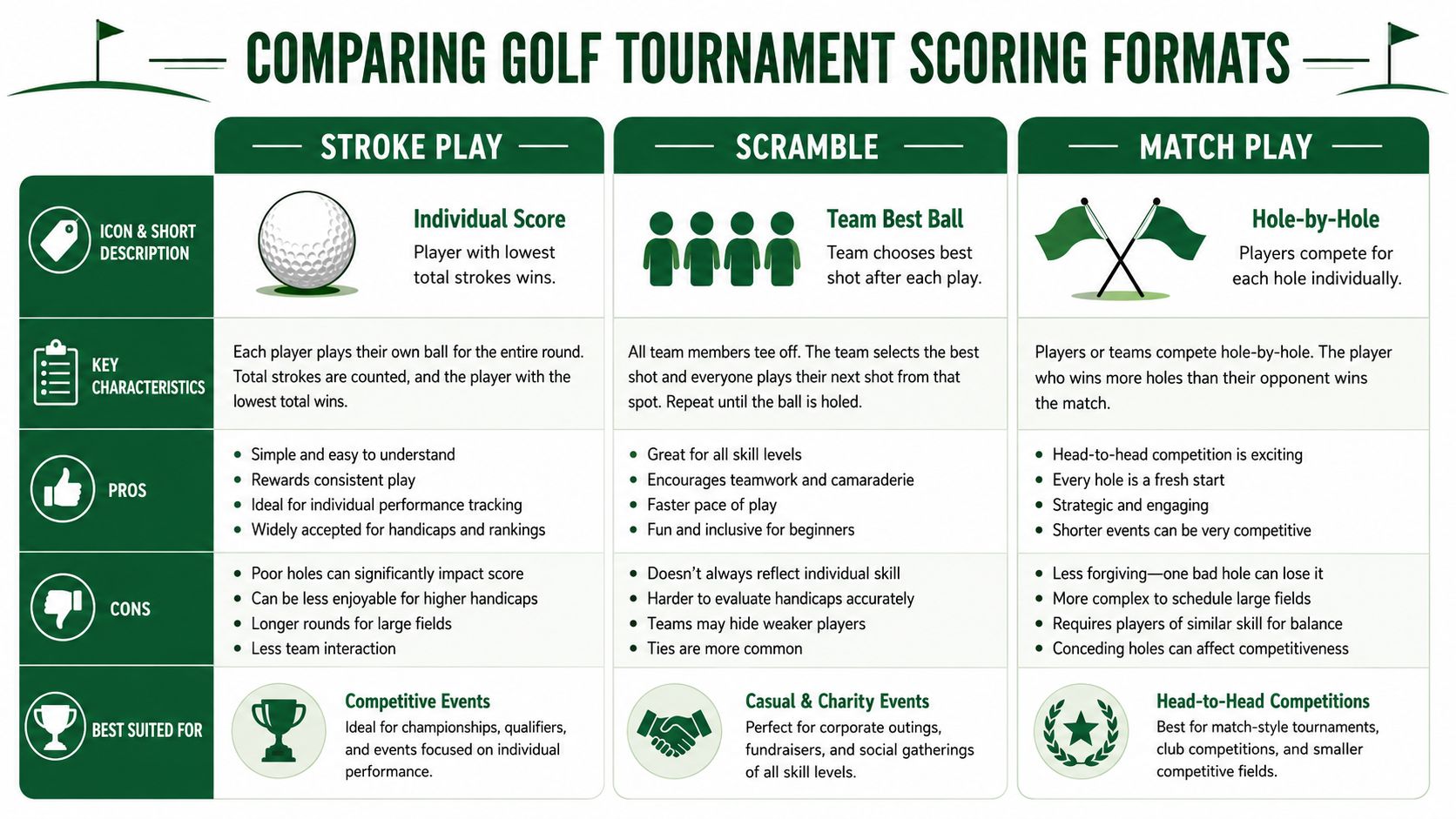
Here's the practical side-by-side view:
Format | Winner logic | Works well for | Watch-outs |
|---|---|---|---|
Stroke play | Lowest total strokes or net score | Championships, serious club events | Slow score verification if done manually |
Scramble | Team posts one selected score per shot | Charity outings, mixed-skill groups | Needs clear rules on drives, handicaps, and team composition |
Best ball or four-ball | Team score uses best individual ball on each hole | Member events, partner formats | Easy for players to misreport if instructions aren't clear |
Match play | Most holes won, or bracket advancement | Head-to-head events | Requires clear handling for ties, concessions, and playoff holes |
Multi-round points format | Highest total points across events | Leagues, season-long competitions | Must define points table and countback rules up front |
What works for different event goals
Stroke play is the cleanest competitive test. Add up the scores and rank the field. It's straightforward on paper, but the admin load rises quickly if you're also handling handicaps, flights, and tie-breaks.
Scramble is operationally friendlier for social events because it keeps groups moving and compresses scoring into a team result. But it only stays friendly if you define the team rules well. If players are unsure how many drives must be used or how handicaps apply, your “fun” format becomes a scoring dispute machine.
Match play creates strong drama and easy spectator understanding. One side wins the hole, then the match. But it demands discipline from the organizer because every round advancement, tied match, and playoff scenario has to be documented before play starts.
The points-based lesson from outside golf
Some organizers run leagues, cups, or multi-event series where first place in one round shouldn't decide the whole thing. That's where points-based logic matters.
Formula 1 handles this cleanly. The Constructors' Championship is decided on aggregate points, with 25 points for a win, descending points through 10th place, and a tie broken by countback based on wins, then second places, then third places, as explained in Formula 1's Constructors' Championship rules guide. That model matters because it shows how a winner can emerge from consistency, not just headline victories.
Golf leagues often need the same discipline. If your series rewards attendance, finishes, or points by flight, build the scoring table first. Don't patch it together midseason.
For a useful breakdown of format mechanics inside golf events, this guide to scoring in a golf tournament is worth reviewing before you publish your event setup.
Choose the format that produces the kind of winner your event is supposed to honor. Don't choose the format that creates the most work after the round.
The Art and Science of the Tie-Breaker
A tie isn't a problem. An undefined tie is.
Organizers sometimes treat tie-breakers like a footnote, something they'll sort out if needed. That approach works right up until two teams post the same number and both think they've won. Then a small omission becomes the most important rule in the event.
Single-elimination and knockout settings make this easier to see. Formal tournament analysis shows that stronger players still win more often over time, but tournament structure changes outcomes materially, and in some analyzed models a player's chance of winning ranged from 0.01 to 0.39, as discussed in this study on knockout tournament behavior. The lesson for golf is simple. Competition already carries enough variance. Don't add administrative randomness on top of it.
Decide before the first tee time
This is not optional.
If your tie-break rule is decided after scores come in, players won't view it as a rule. They'll view it as a reaction. Even if your staff chooses a perfectly reasonable method, the timing makes it feel improvised.
Use a written procedure and publish it in the player sheet, rules email, or starter notes. Keep the language short.
For example:
Scorecard playoff: State whether ties are broken by back nine, last six, last three, then final hole.
On-course playoff: State who participates, where it starts, and when it begins.
Split awards: State whether merchandise, cash, or team prizes are divided evenly.
Matching cards for net events: State exactly how handicaps are applied within the tie-break process.
Match the tie-break to the event
Not every event needs a playoff hole. Not every event should split the prize.
A competitive championship usually benefits from a visible, athletic resolution. A packed charity outing usually benefits from a pre-published scorecard method that gets everyone to dinner on time. The right answer depends on the event's purpose, pace, and player expectations.
Here's a practical view:
Situation | Better tie-break approach | Why |
|---|---|---|
Club championship | On-course playoff if feasible | Players expect a decisive competitive finish |
One-day net event | Scorecard playoff | Fast, familiar, easy to administer |
Charity scramble | Published matching-cards method | Keeps the event moving and avoids delays |
League standings tie | Season-long countback rule | Rewards consistency over time |
Field note: The most respected tie-breaker isn't always the most dramatic one. It's the one players knew about before they signed their card.
If you're working through handicap implications, this resource on handicap scoring in golf helps clarify where net calculations can complicate an otherwise simple tie.
What doesn't work
Some practices create trouble almost every time:
Committee debate at the scorer's table: It signals that the event wasn't fully prepared.
Player vote or informal consensus: Friendly groups may accept it, but it weakens the legitimacy of the final result.
Changing methods by prize category without notice: Players interpret that as selective fairness.
Overcomplicated tie systems: If staff can't execute the rule quickly, the field won't trust it.
A tie-breaker should be boring to administer. That's a compliment.
Announcing and Awarding Your Winners
The round is over, dinner is waiting, and three players are standing by the scoring table asking the same question: "Who won?" That moment decides how your event feels in people's memory. If staff are still sorting cards and debating a result out of sight, confidence drops fast. If the board is updated, the final check is clear, and the announcement comes on time, the event feels well run.
This part is operational, not ceremonial.
The job is to move from pending to official without creating doubt. Players do not need to see every back-office step, but they do need to see that scores were collected, checked, and finalized in an orderly way. That is why many organizers have shifted to mobile-first scoring. Live Tourney reports 10,000+ events, a 40% increase in live scoring participation, and 3x faster setup. The point is simple. Faster score collection shortens the gap between the last putt and a trusted winner announcement.

Handle the finish where players can follow it
Good events do not disappear into a scoring huddle at the exact moment everyone wants clarity. They show progress. A visible leaderboard, a clear "pending" status, and a defined point when results become official prevent half the arguments I used to deal with after tournaments.
Use a simple finish protocol:
Collect final scores immediately from mobile entry or scorecard return.
Review obvious exceptions fast such as missing holes, wrong player totals, or category mismatches.
Post standings as pending while staff complete the final verification.
Mark results official once the review window closes.
Start the awards presentation on schedule instead of making the room wait.
That sequence sounds basic. It is also where a lot of events fail. The common mistake is treating winner confirmation as a private admin task instead of a public trust moment.
Make the ceremony short, clear, and documented
Players want a confident result, not a long speech.
Keep the awards flow tight and predictable:
Confirm every prize category before you speak: Overall, flights, net, team, skins, closest-to-the-pin.
Announce smaller awards first: Save the overall winner for the end.
State the result cleanly: Name, score, and tie-break method if one was used.
Record what was awarded: Shop credit, cash, merchandise, or team pool payout.
Close out prize distribution that day whenever possible: Delayed payouts create more follow-up work than most organizers expect.
If you are still refining the prize side of your event, this guide on payout structures for golf tournaments helps prevent confusion once winners are official.
Communication after the ceremony matters too. Sponsors, host venues, and local media often want a polished recap within hours, not days. These golf tournament press release templates are useful when you need to turn final results into a clean, usable summary without rewriting everything from scratch.
What players remember
They remember whether the result was posted quickly. They remember whether the winner announcement sounded certain. They remember whether prize categories matched what they were told at registration.
That is the true finish line. A tournament winner is not fully established when the last score is entered. The winner is established when the field sees a result that is accurate, explained, and communicated without confusion.
Your Winner Determination Checklist
The last group walks in. Two cards do not match. One player says the posted total is wrong, and the awards table is already set.
That is when winner determination stops being a scoring task and becomes an operations test.
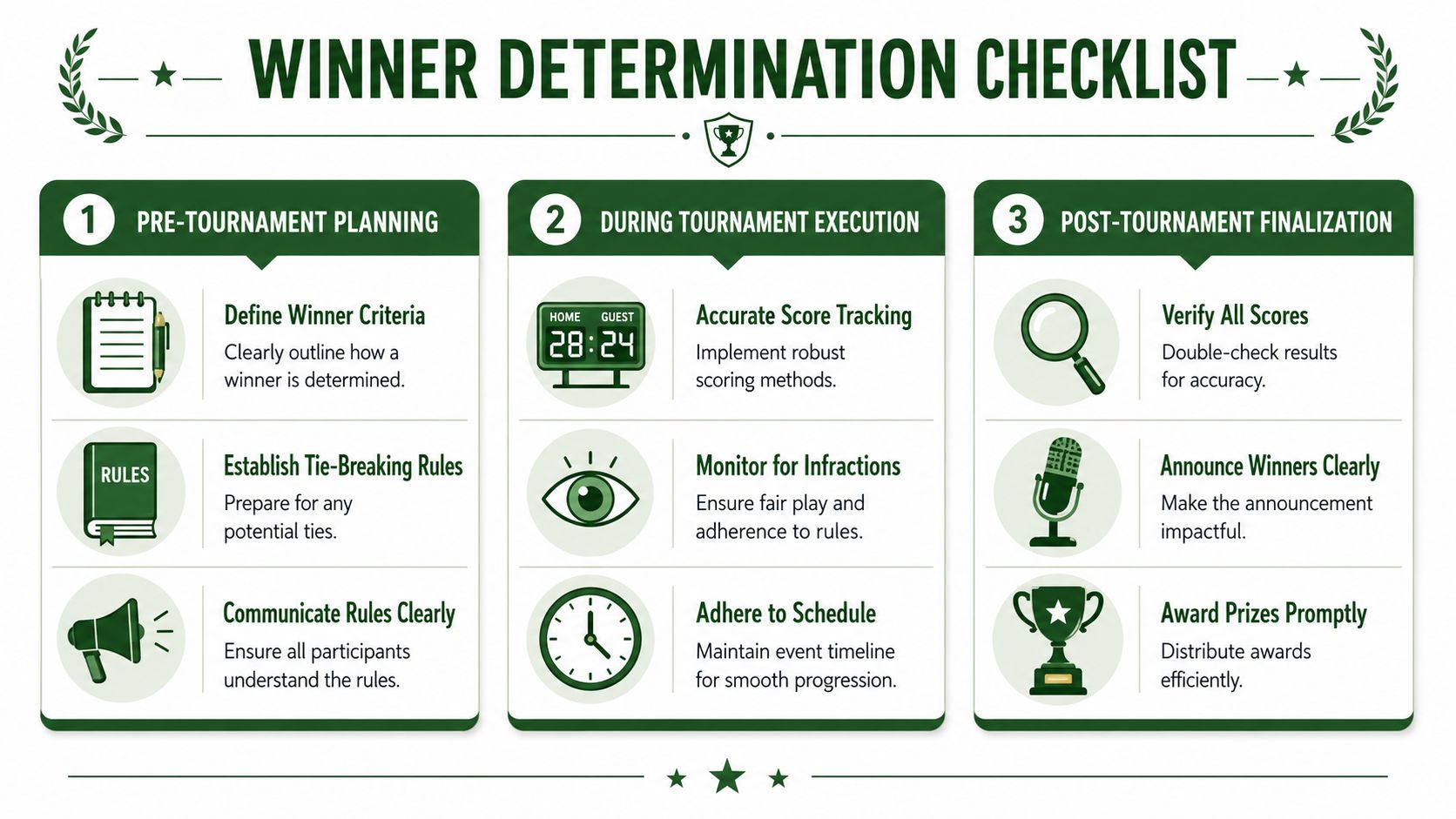
A trusted tournament winner comes from a repeatable process that staff can run under pressure. In practice, problems usually show up in three places: setup before the round, score handling during play, and final verification after the last card is in. Large professional events solve this with layers of systems and staff. A club event does not need that level of infrastructure, but it does need the same discipline. Clear rules, clean inputs, and one controlled path to the official result.
Before the event
Set the rules before anyone tees off. If staff are interpreting the format on the day, the event is already harder to control than it should be.
Define the winner clearly: Gross, net, team total, match result, or points accumulation.
Lock the tie-break rule: Put it in writing and make sure staff can explain it in plain language.
Match prizes to categories: Do not promise award buckets your scoring setup cannot support.
Prepare player communication: Use registration notes, starter sheets, printed rules, or the event page so players hear the same explanation every time.
Coordinate the broader event plan: If the tournament is part of a sponsor day or company outing, a general corporate event planning guide can help keep hospitality, timing, and golf operations aligned.
During play
Winner problems are easier to fix on hole 6 than in front of the trophy table.
Task | What good execution looks like |
|---|---|
Score collection | Scores are entered hole by hole or immediately after play |
Rules monitoring | Staff know who handles format questions and exceptions |
Leaderboard visibility | Players can follow standings without crowding the shop |
Exception handling | Corrections are logged and resolved by a designated person |
The trade-off here is simple. Live scoring takes more attention during the round, but it removes a pile of manual cleanup at the end. Paper-only events can still work well, though they need tighter card collection, faster review, and one person with final authority over corrections.
After the final group
Keep the room informed while you verify. Silence makes players assume the result is shaky.
Check obvious anomalies: Missing holes, impossible totals, duplicate entries, or cards that do not match the posted score.
Apply tie-breaks exactly as published: Staff should follow the written method, not improvise a cleaner answer.
Freeze results before awards: Post one official board and work from that version only.
Pay out or distribute prizes promptly: Delays create disputes, follow-up calls, and accounting messes.
Send a short recap: A same-day email or posted summary gives players, sponsors, and staff one clean record of the result.
Modern tournament software earns its keep here. When score entry, standings, and final winner logic live in one system, staff spend less time reconciling spreadsheets and more time handling rulings, player questions, and award flow.
That is the standard players trust. Professional clarity, delivered fast.
If you want a simpler way to produce a trusted tournament winner, Live Tourney gives organizers one web-based system for setup, live scoring, leaderboards, and final result communication. It's built for golf tournaments, leagues, and outings, and it helps staff move from “we'll sort it out after the round” to a cleaner finish players can follow.





