
Jul 31, 2026
lost springs golf course, rogers arkansas golf, golf course guide, arkansas private golf, lost springs scorecard
Your complete local guide to Lost Springs Golf Course in Rogers, Arkansas. Explore layout, scorecard, tips, rates, and how to plan your visit.

If you're trying to figure out whether Lost Springs is worth the drive, whether you can get on, and which tees won't turn your group day into a slog, you're asking the right questions. The course has enough published variation in access, yardage, and scorecard structure that a quick glance rarely tells the full story, especially if you're coordinating a tee time, a member guest round, or a tournament field that includes mixed handicaps.
Lost Springs Golf & Athletic Club sits in Rogers, Arkansas, and the first thing to understand is that it isn't built like a typical daily-fee stop. The property's history, layout, and access rules matter just as much as the yardage. If you know what kind of round you're walking into, you can choose the right tee, set the right expectations, and avoid the kind of last-minute confusion that ruins an outing before the first tee shot.
What Lost Springs Golf Course Is and Where It Sits
A lot of golfers start with the same problem. They see “Lost Springs Golf Course,” check one directory, and get one answer, then check another and get something slightly different. The cleanest way to think about it is this, Lost Springs Golf & Athletic Club is a private 18-hole club in Rogers, Arkansas, and it was built to play like a real test, not a short filler round.
The course opened in 1992 and was designed by Lyndy Lindsey. One source notes that the club was established in June 1992 on about 165 acres that had previously been a family farm, which helps explain why the routing feels like a purpose-built golf property rather than a retrofitted piece of land. The setting matters because it gives the club room for a full-length championship layout, practice areas, and multiple teeing options rather than one fixed way to play it. Lost Springs course background and opening details

Why the setting matters for planning
The practical takeaway is simple, Lost Springs is a substantial golf property with enough land to support serious play and event setup. Its listed address, 3024 N 22nd St, Rogers, AR 72756-2177, and phone number, (479) 631-9988, are repeated across independent listings, which is useful when you're verifying the venue before you book. Course location and contact details
That consistency matters because the club's public identity is less clear than its physical location. Some listings frame it as private, others imply broader access, and the club itself uses private-club language. If you're organizing a round, the location tells you where to go, but the access question determines whether you can get on.
Course Layout, Scorecard, and Tee Options
A round at Lost Springs starts with a card that does not read like a standard par-72 setup. Different listings show different ways to present the course, including a longer back-tee yardage near 6,979 yards and another scorecard that lays out a par-104 configuration with 5 par 3s, 8 par 4s, and 5 par 5s from the Blue tees at about 6,890 yards. That kind of split is exactly why players and event planners need to check the actual tee data before they assume what the course is asking for. Lost Springs scorecard and tee data
What the tee spread means in practice
One published setup shows five sets of tee boxes, ranging from about 4,740 yards at the forward end to roughly 6,979 yards at the back. That is a wide enough spread to fit very different games without making the round feel forced, and it gives organizers room to match teeing grounds to the group instead of pushing everyone into one setting. The club's setup information also points to Bermuda grass conditioning and tee-specific ratings, so the tee you choose changes the round in a real way, not just on paper. Lost Springs tee options and setup details
Lost Springs Tee Yardage and Rating Reference | |||
|---|---|---|---|
Tees | Yardage | Rating / Slope | Notes |
Back tees | about 6,979 | 73.0 / 136 | Demanding full-length option from published scorecard data |
Longest tees, another listing | 6,849 | 72.5 / 131 | Championship-length profile on Bermuda grass |
Blue tees | about 6,890 | 74 / 139 | Listed with the nonstandard par structure |
White tees | 6,303 | 70.5 / 131 for men, 77.4 / 144 for women | Clear example of how tee choice changes difficulty |
Red tees | 4,744 | 68.6 / 125 for women | Much shorter option for higher-handicap or shorter-hitting players |
The rating and slope spread says more than a yardage total ever will. If you have ever booked a course and treated par as a simple label, this is the kind of layout that exposes that mistake quickly. For a plain explanation of how those numbers work, the course rating guide is the right place to start.
Practical rule: at Lost Springs, tee choice is a scoring choice, not just a comfort choice.
How to read the scorecard honestly
For a normal foursome, the safest approach is to set tees by the player with the least speed off the ball, not by the strongest ball-striker in the group. The longer options are built to test carry distance, dispersion, and patience, while the shorter options protect pace and keep the round playable for more of the group. That matters even more when low and high handicaps are in the same outing, because the difference between a round that flows and one that stalls often comes down to moving up or back one tee box.
Smart Playing Tips for Each Part of the Course
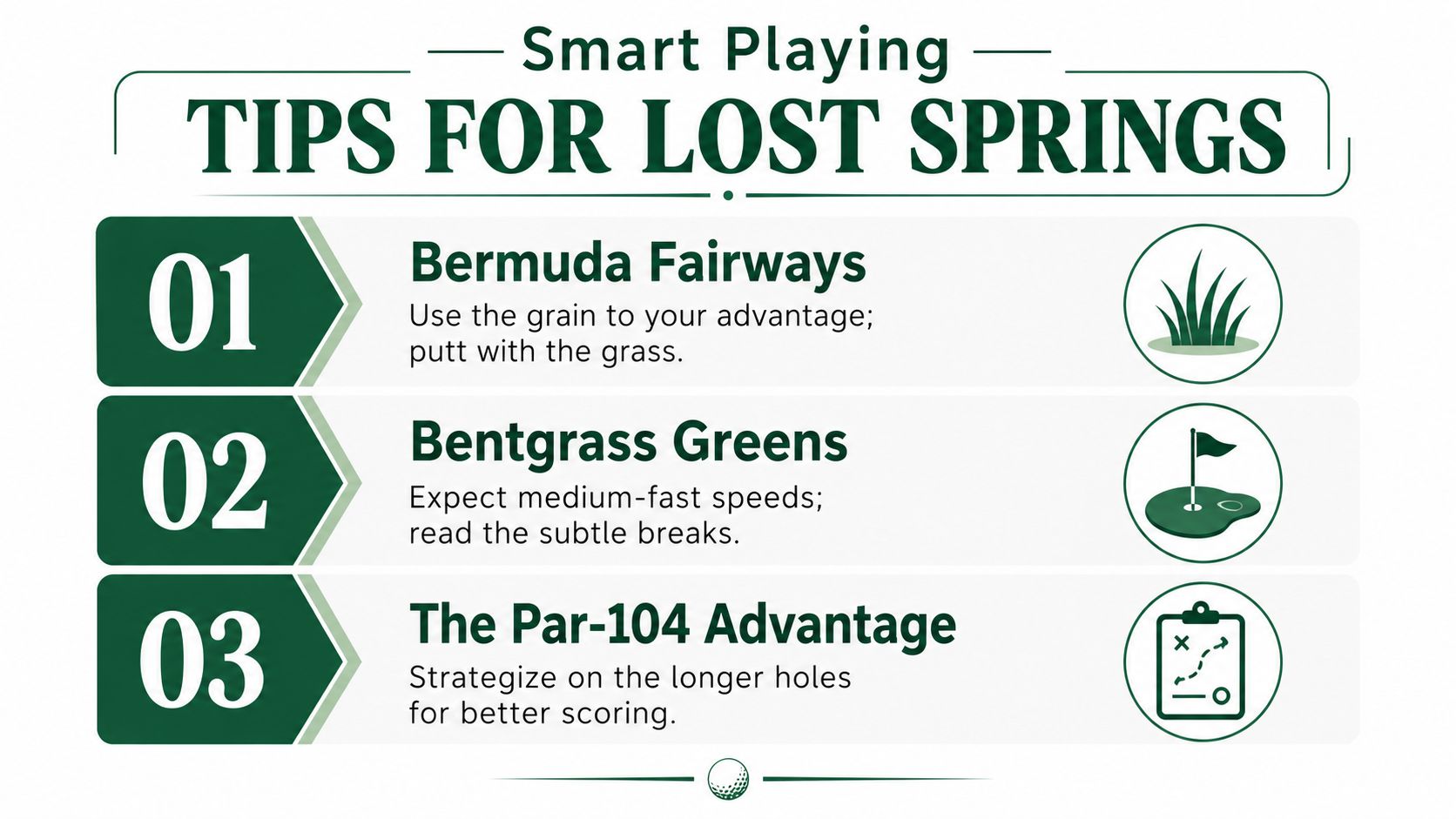
The turf split is part of what shapes the round. Lost Springs uses Bermuda fairways, tees, and roughs with Bentgrass greens, which means your game has to adjust twice, once from the tee and again on the putting surfaces. That combination is common enough to work well, but it rewards players who pay attention to lie and grain rather than trying to force every shot the same way. Course turf and conditioning details
Off the tee
The holes that stretch toward the longer tee sets are where loose swings get exposed. On a course that can play close to 6,979 yards, a driver that leaks into trouble costs more than it would on a shorter parkland layout, because you're often left with a longer second shot and a worse angle into the green. A better play for most mid-handicaps is to pick the club that keeps the ball in the fairway and lets the approach come from a manageable number rather than chasing a heroic tee shot.
Into the greens
Bentgrass greens change the scoring picture. They're usually the surfaces where pace control matters most, and they tend to reward players who hit the middle of the green and trust the putter instead of chasing every flag. If the wind's up, the smarter move is often to aim for the fat side of the putting surface and accept a longer birdie putt rather than short-siding yourself on a tucked hole location.
Playing note: when the fairway is firm enough to release, plan the bounce before you swing. That matters more than raw carry on a lot of Arkansas courses.
Around the greens and on long par holes
The extra par-3 and par-5 load in the nonstandard scorecard makes club selection more important than brute force. A player who stays disciplined on the longer scoring holes can usually keep the round moving, even if a few mid-irons don't finish exactly where they want. For a mixed field, that usually means one simple rule, play to the center on long approaches, then be aggressive only when the line is clear and the lie is clean.
Amenities, Practice Facilities, and Clubhouse Experience
Lost Springs isn't just about the round itself. GolfLink lists an onsite driving range with 4 practice tees, which is the kind of detail that tells you this is a place where a warm-up makes sense instead of being a courtesy you skip. If you're hosting guests or bringing players who like to loosen up before a competitive round, that's a meaningful advantage. Practice facilities and site details
The club also sits in the athletic club category, so the experience is broader than golf alone. That usually means the property is organized for members who expect more than a tee sheet, even if public-facing information is thin in some directories. What's published clearly confirms golf and practice infrastructure, but it doesn't always spell out clubhouse service style, dining hours, or dress code specifics, so those are the things I'd verify by phone before showing up with a group.
What to confirm before you arrive
Warm-up access: Ask whether the range is open on the day of play and whether the 4 practice tees are available.
Arrival timing: Give yourself enough time to hit balls, check in, and sort tee assignments before your slot.
Clubhouse details: Confirm dining, locker access, and guest policies directly, because the online listings stay general.
Athletic-club access: If you're bringing non-golf guests, check whether the rest of the facility is available to them.
The biggest practical win here is simple. The range and practice tees make the site better for event prep, but they also make the round more enjoyable for players who don't want to start cold. The club feels set up for people who value structure, not just a quick nine.
Access, Membership, and How to Get on the Course
Lost Springs is where the planning gets tricky. One directory lists it as private, another says tee times are available to the public, and the club's Facebook presence labels it a private championship course. That mix does not make the information worthless, it means you should confirm the access path before you leave home, because the public-facing details do not all point the same direction. Conflicting access descriptions and directory notes
The safest way to approach booking
Start with two direct questions if you are traveling in, whether non-members can play, and whether your round has to be arranged through a hosted guest or an event booking. If you are a member bringing guests, ask how guest play is handled and whether there are limits on tee times, dress, or dining. If you are organizing an outing, get the event contact right away and do not assume a normal tee sheet slot will cover a group.
A modern 2026 online booking system guide is useful context for clubs like this, because the hard part is not just opening a calendar. The work is keeping public booking, member access, and event reservations aligned with what the staff can handle on site.
Best practice: do not rely on one directory. Call the club, confirm whether your category of play is allowed, then ask who handles guest, league, or outing scheduling.
What organizers should ask
Hosted event access: Can the club host corporate, charity, or league play?
Tee sheet control: How much of the day can be blocked for your field?
Member overlap: Will your group share the course with regular play?
Scoring setup: Can the club support live scoring or digital pairings?
If you are booking a competitive group, it helps to sort out handicaps before you lock the field. A practical USGA handicap guide gives organizers a clean reference point, and that matters here because the access decision and the tee decision are tied together. At Lost Springs, the right grouping depends on knowing your players' actual index or playing ability, not just their name on a sign-up sheet.
Rates, Tee Times, and Booking Information
Published pricing for Lost Springs is limited, so this is not a course where I'd assume a standard public green-fee model. The safer read is that rates depend on access category, membership status, and whether you're booking a straight round or a hosted event. If you're calling in, the club's phone number, (479) 631-9988, is the first thing to use, because it's the only reliable way to avoid pricing guesses. Contact and location listing
What to budget for
A golfer planning a normal visit should budget time, not just money. Because access rules are inconsistent across public directories, the cost question is whether you're booking as a member, as a guest, or through an event host. If you're organizing a larger outing, you should also expect staff to ask about field size, timing, and payment structure before anything is held on the calendar.
For operators, revenue planning meets reality, and the cleanest framework I've seen on the business side is the approach in manage golf course income smarter. It's a useful reminder that tee inventory, event blocks, and member access all affect what a club can accommodate on a given day.
Booking questions that save headaches
Tee time window: Ask how far ahead you can reserve.
Cancellation policy: Confirm deadlines before you pay anything.
Payment method: Verify whether cards, member billing, or deposits are used.
Weather policy: Ask what happens if Arkansas weather turns the day sideways.
Lost Springs is a venue where advance planning matters more than at an average public track. If you show up expecting a casual walk-up model, you may waste a trip. If you call ahead and confirm the access path, the round is much easier to lock in.
Hosting Tournaments, Outings, and Leagues at Lost Springs
Lost Springs has the ingredients a tournament coordinator wants, but it also has a setup that needs care. The multiple tee sets help with mixed-handicap groups, and the unusual par structure gives event staff a chance to design formats that feel fair instead of forcing a generic stroke-play template onto every field. That matters because a course with more scoring variety can support more creative pairings, net divisions, and side games without making the day feel random.
Why the layout helps event design
A nonstandard scorecard changes the way teams think about format. Stableford, skins, and net competitions can all work well when the field is spread across different abilities, because the structure gives players more chances to contribute on specific holes instead of only chasing gross score. Organizers should think about hole-by-hole expectations before they print cards, especially when the field includes beginners, strong players, and guests who don't know the course.
For the admin side, modern tournament tools reduce a lot of friction. One practical option is How to run a golf tournament, which aligns well with a course like this because it supports live scoring, pairings, and leaderboard updates without making staff chase paper cards all day.

What works on the ground
Live scoring works especially well when the venue needs clean coordination between starters, players, and event staff. Lost Springs already demands careful tee management because of the access confusion and tee variety, so a digital scoring flow helps remove one more paper-based bottleneck. For organizers, the important point isn't novelty, it's that the course's structure benefits from a system that can handle pairings and updates in real time without requiring everyone to carry old-school scorecards.
Directions, Contact, and Planning Your Visit
The club's verified address is 3024 N 22nd St, Rogers, AR 72756-2177, and the main phone number is (479) 631-9988. If you are driving in from Rogers or nearby, use the address directly instead of relying on casual directions from a directory. Access rules and course status are the items that need confirmation, not the location itself. Verified contact listing
Plan to arrive early if you want time to warm up on the range, check in, and sort out guest or event details before your tee time. Bring a current handicap number if you are entering a competitive round, because tee selection matters here more than it does at many standard par-72 tracks. If you are organizing the day, confirm parking, arrival timing, and the person who will meet the group when you call. For booking and event coordination, use the club's phone line and verify the current setup before anyone leaves home.
Live Tourney gives golf operators a clean way to manage pairings, scoring, and leaderboards when an event needs to run smoothly from the first tee to the last putt. If you are planning a Lost Springs outing, league day, or competitive round, take a look at Live Tourney and see how a modern scoring workflow can simplify the day for both staff and players.





